

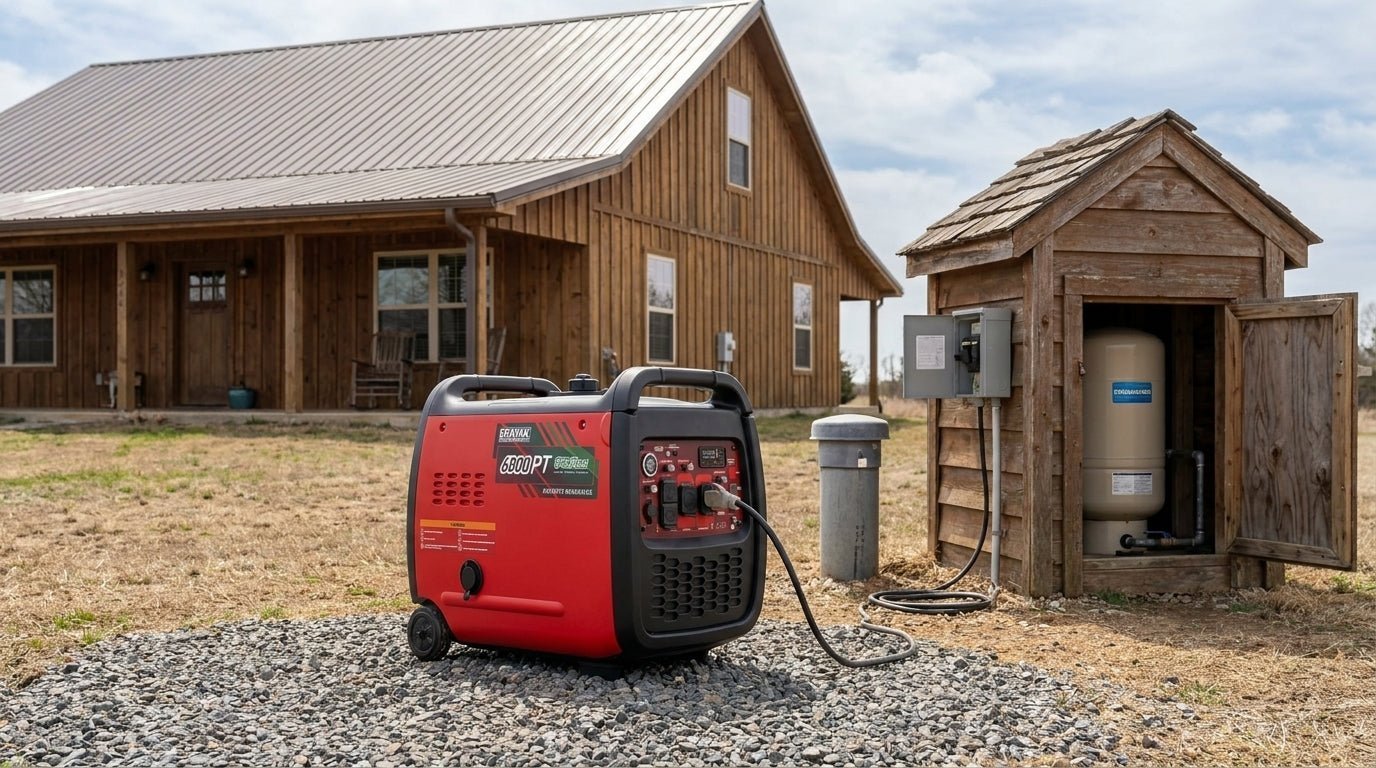
Sump Pump Generator Guide
What Size Generator Do I Need to Run a Sump Pump?
For many 1/4 HP and 1/3 HP sump pumps, a generator in the 2,000W-3,500W peak class may work after you verify the pump's startup demand. Many 1/2 HP pumps need more surge capacity, making the 3,500W-4,500W class a safer comparison range.
Size from the pump's nameplate or manual, not horsepower alone. The generator must cover both continuous running watts and the brief motor startup event.
Quick Answer: Generator Size for a Sump Pump
A 2,000W generator may run a 1/4 HP sump pump and some efficient 1/3 HP pumps, but it is not a universal answer. If the pump's total startup demand exceeds the generator's peak rating, the pump may not start. For many 1/2 HP pumps, compare generators around 3,500W-4,500W peak.
For a sump pump plus refrigerator, lights, router, and chargers, a 4,500W-class inverter generator is a practical starting point. Use a larger 120V/240V platform when the sump pump is one part of a selected-circuit home backup plan.
Sump Pump Wattage Chart by Horsepower
Sump pump watts vary by motor design, pump age, lift height, discharge restriction, voltage, and operating conditions. Use this table for planning, then verify the exact model. The startup column means total power during startup, not only the extra watts above the running load.
| Pump Size | Typical Running Watts | Possible Total Startup Demand | Generator Direction |
|---|---|---|---|
| 1/4 HP sump pump | About 400-600W | About 1,000-2,000W | 2,000W+ peak after checking the model |
| 1/3 HP sump pump | About 600-900W | About 1,300-3,000W | 2,000W-3,500W peak, model dependent |
| 1/2 HP sump pump | About 800-1,100W | About 2,500-4,100W | 3,500W-4,500W peak is the safer comparison class |
| 3/4 HP sump pump | About 1,000-1,500W | About 3,000-5,000W+ | 4,500W-6,800W+ after exact sizing |
| Two sump pumps | Add both running loads | Allow for one pump starting while the other runs | Calculate both pumps; do not assume they will never overlap |
Important terminology: Some generator worksheets list additional starting watts. If a pump uses 1,050 running watts and lists 2,150 additional starting watts, the startup event is about 3,200W, not 2,150W. Other manuals list total starting watts directly. Check the column label before calculating.
How Many Watts Does a Sump Pump Use?
A sump pump does not consume the same wattage every second. When the float switch activates, the motor needs a short startup surge. After it reaches operating speed, power demand drops to the normal running level.
Running Watts
The continuous power used while the pump is moving water. Your generator's rated output must cover this load plus every other device running at the same time.
Starting Watts
The brief motor demand at startup. The generator's peak output must handle this event without tripping overload protection.
Nameplate or Manual
Horsepower is only a category. Check volts, running amps, locked-rotor amps when available, and manufacturer generator guidance.
If the pump lists volts and running amps but not watts, multiply them for a conservative running-input estimate:
Volts × Amps = Approximate Running Watts
This calculation does not reveal the exact startup event. For that, use manufacturer data, locked-rotor amps, or a meter that can capture motor inrush.
How to Calculate the Generator Size You Need
- Find the pump voltage, running amps, and startup data. Check the label, manual, or manufacturer specification sheet.
- List the other outage loads. Include the refrigerator, freezer, router, lights, furnace blower, or second pump.
- Add all simultaneous running watts. Keep this total below the generator's rated continuous output.
- Add the largest additional startup demand. A pump may start while the refrigerator is already running.
- Leave practical margin. Output can change with fuel, altitude, heat, maintenance, cord length, and generator condition.
Portable Generator Peak Formula
If the pump manual provides total starting watts instead of additional watts, use that total starting number plus the running watts of the other connected loads. Do not count the pump's running watts twice.
Can a 2,000 Watt Generator Run a Sump Pump?
Sometimes. A 2,000W generator can be a match for many 1/4 HP sump pumps and some 1/3 HP models when the pump's total startup demand fits inside the generator's peak rating. It may be too small for a higher-surge 1/3 HP pump, many 1/2 HP pumps, or a pump running alongside a refrigerator.
| Generator Class | Possible Sump Pump Fit | Main Limitation |
|---|---|---|
| 1,500W | Measured low-surge small pump only | Very little startup margin |
| 2,000W-2,400W | Many 1/4 HP and some 1/3 HP pumps | May not support a refrigerator or high-surge model at the same time |
| 3,500W | Many 1/3 HP and some 1/2 HP pumps | Still verify startup demand and other loads |
| 4,500W | Many 1/2 HP pumps plus managed essentials | Large pumps, two pumps, or more circuits may need additional capacity |
| 5,000W-6,800W+ | Broader critical-load plan | Connection, voltage, and simultaneous motor starts still matter |
What Size Generator for a Sump Pump and Refrigerator?
A sump pump and refrigerator both use motors. The generator must handle the running load of both appliances and the largest startup event. For many homes, a 3,500W-4,500W inverter generator is a practical comparison range for a sump pump and refrigerator, but the exact result depends on pump horsepower and startup demand.
| Outage Plan | Generator Direction | Load-Management Note |
|---|---|---|
| Sump pump only | 2,000W-4,500W depending on the exact pump | Size to the total startup event |
| Sump pump + refrigerator | 3,500W-4,500W is a practical comparison range | Allow one motor to start while the other runs |
| Sump pump + refrigerator + freezer + lights + router | 4,500W class or larger after calculation | Avoid adding heaters, microwaves, or AC without recalculating |
| Two pumps or selected home circuits | 5,000W-6,800W+ and voltage matched | Use professionally installed transfer equipment |
Best Backup Power for a Sump Pump: Generator, Battery, or Power Station?
Fuel Generator
Can support the main AC sump pump and other essentials for extended outages when safe outdoor operation and refueling are possible. It requires manual deployment unless part of a professionally designed system.
Battery Backup Pump
A separate DC backup pump can start automatically when power fails or the main pump cannot keep up. Runtime and pumping capacity depend on the pump and battery system.
Portable Power Station
May power a compatible plug-in sump pump indoors if its output handles startup and its watt-hour capacity covers the required runtime. Verify both ratings before relying on it.
For unattended protection, redundancy matters. A battery backup pump can bridge the time before a portable generator is safely deployed. A fuel generator can then support longer outages and additional household loads.
Sump Pump vs Well Pump: Do Not Use the Same Generator Chart
A sump pump removes groundwater from a basement sump basin and is commonly a 115V/120V plug-in load. A well pump supplies household water from a well; many deep-well systems are hardwired 240V loads with different startup and connection requirements.
If your backup plan includes both, calculate them separately. A generator that starts a 120V sump pump may not provide the native 240V output required by a deep-well pump. Read the dedicated ERAYAK well pump wattage and generator sizing guide.
Video: Running a Well Pump on Generator Power
This video covers well pumps, not sump pumps. Watch it when your outage plan also includes household water supply, 120V/240V generator selection, or a hardwired well-pump circuit. Open the ERAYAK well pump video on YouTube.
Best ERAYAK Generator Match for Sump Pump Backup
The best match depends on the measured startup demand and the other loads you want during a storm. For most commercially relevant sump-pump-plus-refrigerator plans, start with the 4,500W class. Move to the 6800 series when the pump is one part of a broader selected-load setup.

ERAYAK 4500PD: Sump Pump + Refrigerator Backup
The ERAYAK 4500PD dual-fuel inverter generator provides up to 4,500W peak output on gasoline and gasoline/propane flexibility for storm preparation.
- Best fit for many measured sump-pump-plus-refrigerator plans
- Gasoline or propane operation
- Choose 4500PDM manual recoil start or 4500PDE electric start with recoil backup
- Confirm output by fuel and the pump's exact startup demand

ERAYAK 6800PD / 6800PT: Selected Critical Loads
Choose the ERAYAK 6800PD / 6800PT series when you need 120V/240V capability, more startup margin, or professionally connected selected home circuits.
- 6,800W peak and 5,000W rated output on gasoline
- 30A 120V L5-30R and 30A 120V/240V L14-30R
- 6800PD is dual fuel; 6800PT is tri-fuel
- No claim of whole-house capacity; calculate the complete critical-load list
For a gas-only 4,500W alternative, compare the ERAYAK 4500P gas inverter generator. To review the full range, browse the ERAYAK inverter generator collection.
How to Connect and Use a Generator for a Sump Pump Safely
If the sump pump uses a standard plug, follow both manuals and use a properly rated outdoor extension cord appropriate for the load and distance. If the pump is powered through a home circuit, use listed transfer equipment installed by a qualified electrician.
- Operate the generator outside only. Keep it at least 20 feet from the home, with exhaust directed away from windows, doors, vents, and nearby buildings.
- Keep electrical equipment dry. Do not operate a portable generator in standing water. Follow the manufacturer's wet-weather instructions.
- Use working CO alarms. Install battery-operated or battery-backup alarms on every level and outside sleeping areas.
- Start loads one at a time. Let the generator stabilize, then connect the sump pump before adding noncritical devices.
- Never backfeed a wall outlet. Use a transfer switch or compatible interlock for home circuits.
- Inspect flooded electrical systems. Equipment, wiring, outlets, breakers, and appliances exposed to water require professional evaluation before use.
Generator Safety Notice
Portable generators can produce deadly carbon monoxide. Follow current U.S. Consumer Product Safety Commission guidance: never use a fuel generator indoors or in a garage, even with doors open; operate it outside at least 20 feet from the home with exhaust facing away.
FAQ: Generator for Sump Pump Backup
What size generator do I need to run a sump pump?
Many 1/4 HP and 1/3 HP sump pumps fit a 2,000W-3,500W peak generator class after exact startup verification. Many 1/2 HP pumps need more surge capacity, making 3,500W-4,500W a safer comparison range.
How many watts does a sump pump use?
A small sump pump may use about 400-900 running watts, while many 1/2 HP models use about 800-1,100W. Total startup demand can be much higher. Check the pump label or manual because horsepower alone does not determine the exact watts.
Can a 2,000 watt generator run a sump pump?
It can run many 1/4 HP pumps and some efficient 1/3 HP models when their total startup demand fits the generator's peak rating. It may be insufficient for higher-surge 1/3 HP pumps, many 1/2 HP pumps, or a pump plus refrigerator.
Will a 3,500 watt generator run a sump pump?
It can run many residential sump pumps, including many 1/3 HP and some 1/2 HP models, but the exact answer depends on total startup watts and the other connected loads.
What size generator runs a sump pump and refrigerator?
A 3,500W-4,500W inverter generator is a practical comparison range for many sump-pump-plus-refrigerator setups. Calculate the pump startup event, refrigerator running load, and any other essentials before choosing.
What is the best indoor generator for a sump pump?
Use a battery power station with enough peak output for pump startup and enough watt-hour capacity for the required runtime, or a dedicated battery backup sump-pump system. Fuel-powered generators must never run indoors or in a garage.
Can a portable power station run a sump pump?
Yes, when the power station's inverter output handles the pump's total startup demand and its usable watt-hour capacity covers the expected operating time. Verify both output watts and battery capacity.
Is a sump pump the same as a well pump?
No. A sump pump removes groundwater from a basement basin and is commonly a 115V/120V plug-in appliance. A well pump supplies household water, and many deep-well systems are hardwired 240V loads requiring different generator and connection planning.
Storm Backup Planning
Choose a Generator From the Pump's Startup Demand
Check the sump pump label, calculate refrigerator and essential loads, then choose an ERAYAK inverter generator with enough continuous and peak output for the complete plan.
