

Safe Home Backup Generator Setup: Transfer Switch, Extension Cords, Placement, and CO Safety
A portable generator can keep your refrigerator cold, phones charged, lights on, WiFi running, fans moving, and essential devices powered during an outage. But safe setup matters as much as generator size. The right transfer switch plan, outdoor placement, extension cords, carbon monoxide alarms, and load rotation can help your family use backup power more confidently when the grid goes down.
Quick Answer
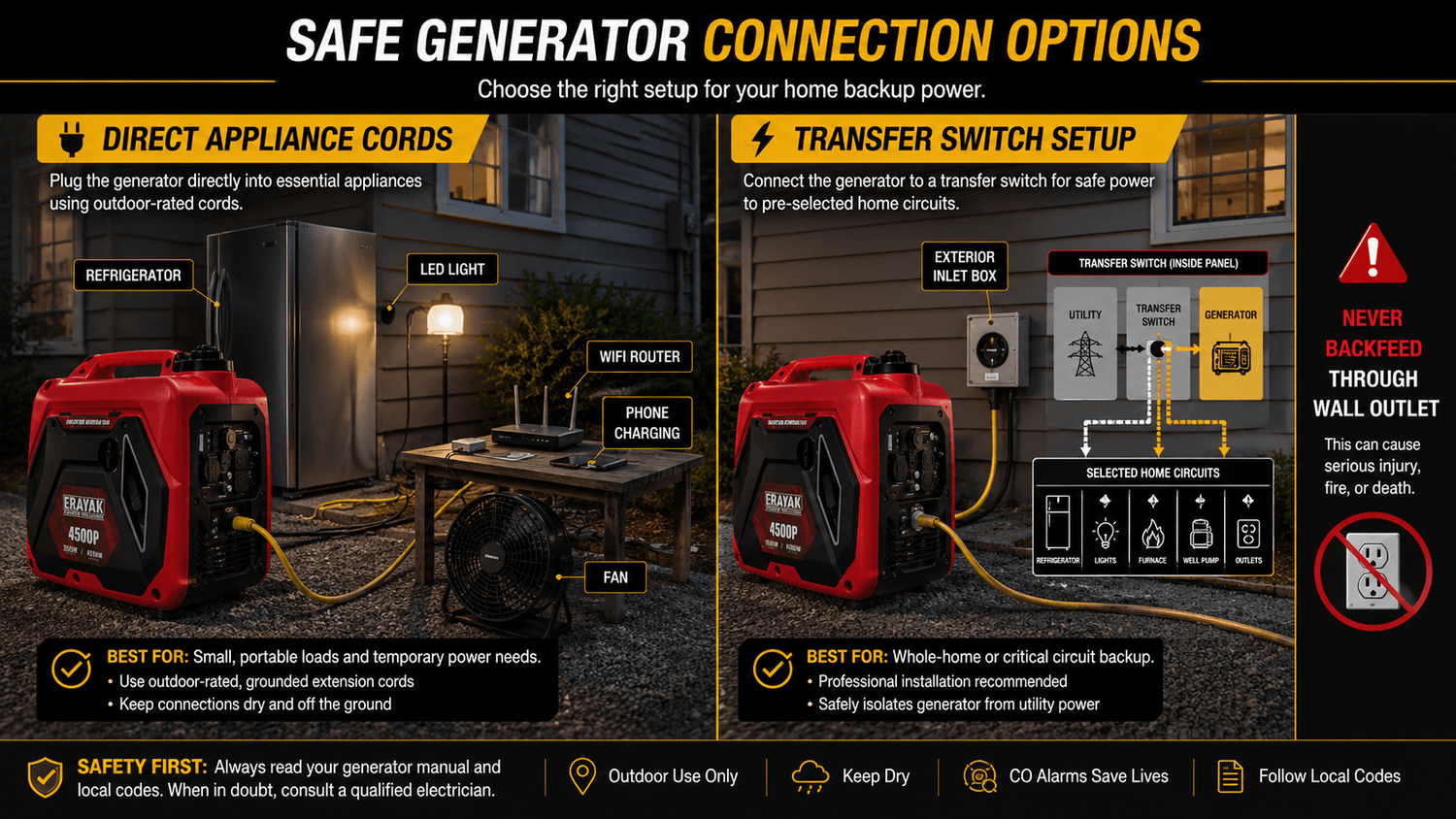
A safe home backup generator setup starts with four rules: run the generator outdoors only, place it away from doors, windows, vents, garages, and enclosed spaces, connect loads with properly rated cords or a professionally installed transfer switch, and use working carbon monoxide alarms inside the home. Never plug a generator into a wall outlet to power your house. That unsafe practice is known as backfeeding and can endanger utility workers, neighbors, your home wiring, and your appliances.
For most homeowners, the safest setup is either direct appliance connection with grounded outdoor-rated cords or selected-circuit backup through a properly installed manual transfer switch or inlet system. During an outage, prioritize refrigerator, freezer, phones, WiFi, LED lights, fans, medical chargers, and pumps before convenience appliances.
Why Safe Generator Setup Matters
In a power outage, it is easy to focus only on what the generator can run. But the connection method, cord condition, generator placement, and exhaust direction are just as important. A generator that is large enough for your loads can still be unsafe if it is operated in the wrong location or connected incorrectly.
Avoid Backfeeding
Plugging a generator into a wall outlet is dangerous. Use direct cords for selected appliances or a properly installed transfer switch.
Keep Exhaust Outdoors
Generator exhaust contains carbon monoxide. The generator must stay outdoors and away from openings into the home.
Power Essentials First
Refrigerator, phones, WiFi, lights, fans, medical chargers, and pumps should come before high-watt convenience appliances.
Transfer Switch Basics
A transfer switch is a safer way to connect a portable generator to selected home circuits. It helps isolate generator power from utility lines and lets you power chosen circuits such as refrigerator, freezer, lights, furnace controls, sump pump, router, or outlets depending on your system design.
| Connection Method | Best Use | Safety Notes |
|---|---|---|
| Direct appliance cords | Simple setup for refrigerator, freezer, lights, router, fans, and chargers | Use properly rated outdoor cords; keep connections dry and elevated |
| Manual transfer switch | Selected home circuits during outages | Should be installed by a qualified electrician according to local code |
| Power inlet box | Cleaner exterior connection point for generator cord | Must match transfer switch, cord rating, generator outlet, and circuit plan |
| Interlock kit | Panel-based generator connection where allowed | Must be compatible, code-compliant, and professionally installed |
| Wall outlet backfeeding | Do not use | Dangerous and should be avoided |
Extension Cord Setup for Portable Generators
Many homeowners use extension cords for a basic home outage setup. This can work for selected appliances, but only when the cords are outdoor-rated, grounded, intact, and properly sized for the load and distance.
| Cord Planning Item | What to Check | Why It Matters |
|---|---|---|
| Outdoor rating | Use cords designed for outdoor generator use | Indoor cords may not handle outdoor moisture, wear, or load demands |
| Grounded plug | Use three-prong grounded cords where required | Supports safer connection for grounded appliances |
| Proper amperage and wattage | Match cord rating to appliance load and generator outlet | Undersized cords can overheat or cause voltage drop |
| Cord length | Use the shortest practical length that keeps the generator safely placed | Longer cords can increase voltage drop if undersized |
| Condition | Inspect for cuts, fraying, crushed insulation, heat damage, and loose plugs | Damaged cords increase shock, fire, and failure risk |
| Dry connections | Keep plugs elevated and away from puddles, wet grass, snow, and rain runoff | Moisture around plugs increases electrical risk |
Safe Generator Placement Outside the Home
Generator placement should be planned before a storm, hurricane, winter outage, or emergency blackout. Do not decide where to place the generator while rain, darkness, wind, or stress is already making setup harder.
| Placement Choice | Safe or Unsafe? | Reason |
|---|---|---|
| Outdoors, away from doors/windows/vents | Safer choice | Helps keep exhaust away from living spaces and air intakes |
| Garage with door open | Unsafe | Carbon monoxide can still build up and enter the home |
| Covered porch or enclosed patio | Unsafe | Exhaust can collect near openings and occupied areas |
| Near open window or window AC | Unsafe | Exhaust can be pulled indoors |
| Near basement or crawlspace vent | Unsafe | CO can enter low openings and spread inside the home |
| Dry, stable outdoor surface with exhaust pointed away | Safer choice | Supports airflow, stable operation, and safer exhaust direction |
Carbon Monoxide Safety
Carbon monoxide is invisible and odorless. A running generator can produce dangerous exhaust even when the engine sounds normal. Because CO cannot be seen or smelled, placement and working CO alarms are essential parts of any home backup generator setup.
Never Indoors
Do not run a portable generator inside the home, garage, basement, crawlspace, shed, enclosed porch, or any enclosed space.
Keep It Away From Openings
Keep the generator outdoors and away from doors, windows, vents, garage openings, and air intakes.
Use CO Alarms
Install working carbon monoxide alarms inside the home, especially near sleeping areas and living spaces.
Load Management During an Outage
A safe setup also means using generator power wisely. Most portable generators are best for selected essential loads, not powering every appliance at once. Build a load plan before the outage begins.
| Priority Level | Loads | Setup Tip |
|---|---|---|
| Critical | Medical chargers, phones, emergency radio, communication devices | Keep these above convenience loads |
| Food protection | Refrigerator, freezer, deep freezer | Plan for compressor startup and avoid starting multiple compressors together |
| Basic comfort | LED lights, fans, CPAP, small air purifier where needed | Use lower-watt devices to preserve generator headroom |
| Water protection | Sump pump, selected well pump, septic pump where applicable | Check starting watts and run pump loads separately when possible |
| Kitchen timing | Coffee maker, microwave, kettle, toaster, griddle | Run one high-watt kitchen appliance at a time |
| Optional loads | TV, entertainment, extra chargers, nonessential appliances | Add only after essentials are stable |
Common Home Backup Generator Mistakes
Many unsafe generator problems come from a few repeat mistakes. Avoid these before your next outage, hurricane, winter storm, or emergency blackout.
| Mistake | Why It Is Risky | Safer Alternative |
|---|---|---|
| Running generator in garage | CO can build up and enter the home | Run outdoors only, away from openings |
| Backfeeding through wall outlet | Can energize utility lines and damage wiring | Use direct cords or a proper transfer switch |
| Using thin indoor extension cords | Cords can overheat or fail under load | Use grounded outdoor-rated cords sized for the load |
| Letting plugs sit in water | Moisture increases shock and failure risk | Keep connections dry, elevated, and protected |
| Running all appliances at once | Can overload generator and trip protection | Prioritize essentials and rotate high-watt loads |
| Refueling while hot | Gasoline can ignite near hot engine parts | Turn generator off and let it cool before refueling |
Recommended Erayak Setup by Backup Need
Erayak 2400P: Compact Essential Backup
Choose the Erayak 2400P when your safe backup setup focuses on phones, power banks, LED lights, WiFi router, laptop, fans, radio, and small electronics.
- Good fit for compact home outage essentials
- Useful for lights, phones, router, fans, laptop, and small electronics
- Pair with outdoor-rated cords, CO alarms, fuel plan, and a printed load checklist
Erayak 4500P: Safe Managed Home Backup Starting Point
Choose the Erayak 4500P when your backup plan includes managed household loads such as refrigerator, freezer planning, lights, phones, WiFi, fans, laptop, coffee maker timing, portable cooler, and selected kitchen appliances.
- Gas-only portable inverter generator
- Manual recoil start
- 55 lb lightweight design
- 2.25 gal fuel tank
- Up to 8 hours runtime
- THD < 1.2% for sensitive electronics
- 60.5 dB noise level
Erayak 4500PD: Fuel Flexibility for Longer Outages
Choose the Erayak 4500PD when gasoline and propane flexibility matters for storm season, longer outages, RV overlap, camping backup, and mixed home/outdoor emergency use.
- Gasoline and propane flexibility
- Useful for longer outage planning and flexible fuel storage
- Good fit for refrigerator, lights, fans, charging, WiFi, coffee timing, and managed emergency loads
Erayak 6800PD / 6800PT: Larger Backup, 30A, and 120V/240V Planning
Choose the Erayak 6800 series when your home backup setup needs more headroom, 30A outlets, selected 120V/240V planning, RV adapter support, pump planning, multiple power zones, and broader home backup overlap.
- 6800W peak power
- 5000W rated power on gasoline at 100% output
- 30A L5-30R outlet
- 30A 120V/240V L14-30R outlet
- Dual 120V household outlets
- TT-30R RV adapter accessory included
Home Backup Generator Safety Checklist
Use this checklist before every outage season and before every generator startup.
- Run the generator outdoors only, away from doors, windows, vents, garages, crawlspaces, basements, sheds, and enclosed spaces.
- Never run a generator indoors or in a garage, even with doors or windows open.
- Never run a generator under an enclosed porch, enclosed patio, carport with poor airflow, shed, basement, crawlspace, or any enclosed space.
- Keep the generator away from people, pets, children, windows, vents, doors, and sleeping areas.
- Point exhaust away from the home, neighboring homes, occupied areas, and air intakes.
- Use working carbon monoxide alarms inside the home, especially near sleeping areas and living spaces.
- Use grounded, properly rated, outdoor extension cords.
- Inspect cords for fraying, cuts, crushed insulation, exposed wire, loose plugs, heat damage, or missing ground pins.
- Do not use frayed, damaged, wet, crushed, or loose cords.
- Keep plug connections dry, elevated, and away from puddles, rain runoff, wet grass, snow, mud, and storm debris.
- Do not plug a generator into a wall outlet to power a home.
- Use a properly installed transfer switch if powering selected home circuits.
- Disconnect loads before starting the generator.
- Add loads gradually after the generator stabilizes.
- Rotate high-demand appliances such as coffee makers, microwaves, kettles, pumps, freezers, heaters, griddles, toasters, and cooking appliances.
- Turn the generator off and let it cool before refueling or maintenance.
- Store fuel in approved containers away from flame, heat, stoves, grills, living areas, children, and ignition sources.
- Keep a printed load plan, fuel log, maintenance checklist, and emergency contacts with the generator kit.
Build a Safer Home Backup Generator Setup
Start with safe placement, dry rated cords, working CO alarms, and a clear connection plan. Use a transfer switch for selected home circuits, or power essential appliances directly with properly rated cords. Then choose the Erayak generator that fits your real outage loads, from compact essentials to larger 30A and 120V/240V backup planning.
FAQ: Safe Home Backup Generator Setup
What is the safest way to connect a portable generator to a home?
The safest connection depends on your setup. For simple use, power selected appliances directly with properly rated outdoor extension cords. To power selected home circuits, use a properly installed manual transfer switch, inlet box, or approved interlock system installed by a qualified electrician.
Do I need a transfer switch for a portable generator?
You need a transfer switch or approved transfer equipment if you want to power selected home circuits through your electrical panel. If you are only powering appliances directly with cords, a transfer switch may not be required, but cords must still be properly rated and safely routed.
Can I plug a generator into a wall outlet?
No. Do not plug a generator into a wall outlet to power a home. This is dangerous backfeeding and can harm utility workers, damage equipment, and create serious electrical hazards.
What extension cord should I use with a generator?
Use grounded, outdoor-rated extension cords that are properly rated for the appliance load and distance. Inspect cords before use and never use frayed, cut, crushed, wet, loose, or damaged cords.
Where should I place a generator during a home outage?
Place the generator outdoors on a dry stable surface, away from doors, windows, vents, garages, crawlspaces, basements, sheds, enclosed spaces, and sleeping areas. Point exhaust away from the home and occupied areas.
Are carbon monoxide alarms necessary when using a generator?
Yes. A generator must run outdoors only, but working carbon monoxide alarms inside the home add an important layer of safety because CO cannot be seen or smelled.
What Erayak generator is best for safe home backup?
Choose the Erayak 2400P for compact essentials, the Erayak 4500P for managed home backup, the Erayak 4500PD for fuel flexibility, and the Erayak 6800 series for larger home backup, 30A, RV, and selected 120V/240V planning.
