

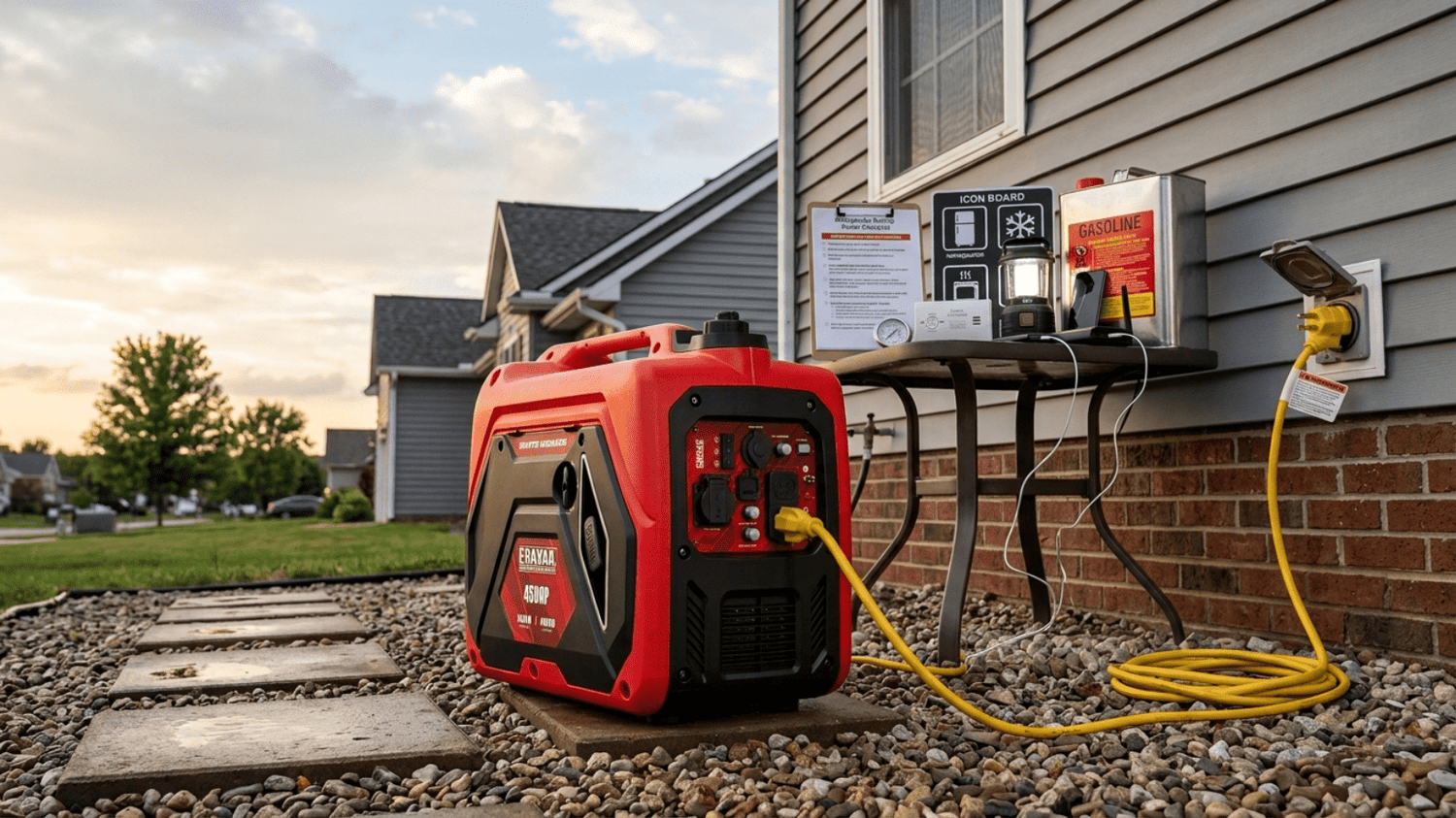
Refrigerator Backup Power: What Size Generator Keeps Food Safe During an Outage?
When the power goes out, your refrigerator becomes one of the most important appliances in the house. A few hours without cooling can put meat, dairy, eggs, leftovers, baby food, and frozen groceries at risk. The right portable generator can help keep your refrigerator running, protect your food budget, and make a storm, blackout, or emergency outage easier to manage.
Quick Answer
For basic refrigerator backup power, many homes can start with a portable inverter generator in the 2000W to 4500W class, depending on the refrigerator’s starting watts, running watts, age, compressor behavior, and what else you want to power. Always check the appliance label or manual instead of guessing.
If you only need to run one refrigerator plus phones, LED lights, WiFi router, and small electronics, the Erayak 2400P may fit compact backup needs. If you want more headroom for a refrigerator, freezer, lights, fans, router, laptop, and coffee maker timing, the Erayak 4500P is a stronger home-backup starting point. For fuel flexibility during longer outages, choose the Erayak 4500PD. For larger home backup planning with 30A outputs and selected 120V/240V planning, consider the Erayak 6800 series.
Why Refrigerator Backup Power Matters for Food Safety
During a blackout, food safety depends on time, temperature, and how often you open the refrigerator door. A closed refrigerator can keep food cold for a limited time, but once the outage stretches longer, perishable food can enter the unsafe temperature zone.
Keep the Door Closed
The refrigerator stays cold longer when the door remains closed. Open it only when necessary.
Use Backup Power or Ice
If the outage continues, a generator can help restore cooling before food safety becomes a larger problem.
Do Not Taste Test
Do not taste food to decide whether it is safe. Use temperature, time, and food type to make decisions.
Running Watts vs Starting Watts for Refrigerators
Refrigerators use a compressor. That means the appliance may require more power for a short moment when the compressor starts than it uses while running. This is why generator sizing should include both running watts and starting watts.
| Power Term | What It Means | Why It Matters for Generator Sizing |
|---|---|---|
| Running watts | The power the refrigerator uses while operating normally | Determines ongoing load after the compressor is running |
| Starting watts | The short surge needed when the compressor starts | The generator must have enough headroom to start the fridge |
| Compressor cycling | The refrigerator turns on and off to maintain temperature | Startup surge may happen repeatedly during the outage |
| Older refrigerator | May use more power or start less efficiently | Add extra headroom when sizing backup power |
| Modern efficient refrigerator | May use less running power | Still check starting behavior before choosing a generator |
What Size Generator Do You Need for a Refrigerator?
For one household refrigerator, the right generator size depends on the specific refrigerator and your backup plan. A compact setup may only need refrigerator support plus lights and charging. A larger setup may include a refrigerator, freezer, router, fans, sump pump timing, coffee maker timing, and multiple household devices.
| Backup Goal | Typical Loads | Generator Planning Direction |
|---|---|---|
| Refrigerator only | One fridge, minimal extras | Choose enough starting-watt headroom for the compressor |
| Fridge + essentials | Fridge, phones, LED lights, WiFi router, small fan | Compact inverter generator may work if starting watts are covered |
| Fridge + freezer | Refrigerator, chest freezer, router, lights, chargers | Use more headroom and avoid starting both compressors at once |
| Kitchen comfort backup | Fridge, freezer, coffee maker timing, microwave timing, lights | Use a larger generator and rotate high-watt appliances |
| Storm-ready home backup | Fridge, freezer, fans, router, lights, sump pump timing, small devices | Choose a generator with enough surge capacity and a written load plan |
Generator Size for Refrigerator and Freezer Together
A refrigerator and freezer can be a practical generator backup setup, but both may have compressor startup demand. The key is to avoid starting both at the same time and to keep the rest of the load plan simple.
| Load Pairing | Main Concern | Best Practice |
|---|---|---|
| Refrigerator + chest freezer | Two compressor loads | Start one appliance first, let it stabilize, then connect the second |
| Fridge + upright freezer | Startup surge and cycling overlap | Use extra generator headroom and avoid high-watt appliances during startup |
| Fridge + freezer + router | Low-load electronics plus compressor loads | Usually easier than adding kitchen heating appliances |
| Fridge + freezer + coffee maker | Coffee maker can be high wattage | Run coffee maker only after compressors are stable or temporarily unplug other loads |
| Fridge + freezer + sump pump | Pump startup may overlap with compressors | Use a larger generator and keep a priority load plan |
What Else Can Run with a Refrigerator?
Once the refrigerator is running steadily, you can add other low-load essentials. High-watt appliances should be rotated instead of run continuously with the refrigerator.
| Load Type | Examples | Backup Power Strategy |
|---|---|---|
| Usually easy to add | Phones, LED lights, power banks, battery chargers | Add after the refrigerator starts and stabilizes |
| Home communication | WiFi router, modem, laptop | Good priority loads during outages |
| Comfort loads | Fans, small TV, radio | Use within generator capacity and cord rating |
| Kitchen timing loads | Coffee maker, microwave, toaster, kettle | Run one at a time and avoid compressor startup moments |
| Emergency mechanical loads | Sump pump, well pump, furnace blower | Require careful sizing because startup demand may be high |
| Loads to avoid stacking | Space heater, large AC, induction cooktop, multiple pumps | These can overwhelm a small refrigerator-backup setup |
Safe Refrigerator Backup Power Setup
The safest refrigerator backup plan keeps the generator outdoors, uses properly rated cords, starts loads gradually, and avoids backfeeding the home through a wall outlet.
| Setup Step | What to Do | Why It Matters |
|---|---|---|
| Step 1 | Move the generator outdoors | Prevents carbon monoxide from entering the home |
| Step 2 | Place it away from doors, windows, vents, garage openings, and enclosed spaces | Exhaust must stay away from living areas |
| Step 3 | Use a grounded outdoor-rated extension cord | Supports safer connection to the refrigerator |
| Step 4 | Start the generator with loads disconnected | Allows the generator to stabilize before appliance startup |
| Step 5 | Connect the refrigerator first | Gives the compressor priority for starting watts |
| Step 6 | Add lights, router, and charging after the fridge stabilizes | Reduces overload risk |
| Step 7 | Rotate high-watt kitchen appliances separately | Prevents stacking loads beyond generator capacity |
Refrigerator Outage Checklist
Use this checklist before storm season, hurricane season, winter outages, or any expected blackout event.
| Checklist Item | Purpose | Recommended Action |
|---|---|---|
| Appliance wattage label | Confirms refrigerator power demand | Record running watts and starting watts if available |
| Food thermometer | Checks fridge and freezer temperature | Keep one in refrigerator and freezer |
| Outdoor-rated extension cord | Connects generator to selected appliance | Use grounded cord rated for the load and distance |
| CO alarms | Supports generator safety | Use working alarms inside the home |
| Fuel plan | Supports outage runtime | Store fuel safely in approved containers and rotate old fuel |
| Load plan | Prevents overload | List refrigerator, freezer, router, lights, fans, and kitchen timing loads |
| Door discipline | Keeps cold air inside | Open refrigerator and freezer only when necessary |
| Coolers and ice | Backup food protection | Use for short access items so the refrigerator door stays closed |
Recommended Erayak Setup by Backup Need
Erayak 2400P: Compact Refrigerator Backup Essentials
Choose the Erayak 2400P when your backup plan focuses on one refrigerator plus low-load essentials such as phones, LED lights, power banks, WiFi router, laptop, and small fans.
- Good fit for compact refrigerator backup planning
- Useful for lights, phones, router, laptop, fans, and small electronics
- Best when high-watt appliances are limited or rotated separately
Erayak 4500P: Strong Starting Point for Fridge, Freezer and Home Essentials
Choose the Erayak 4500P when your outage plan includes a refrigerator, freezer planning, lights, fans, WiFi router, laptop, phone charging, and coffee maker timing.
- Gas-only portable inverter generator
- Manual recoil start
- 55 lb lightweight design
- 2.25 gal fuel tank
- Up to 8 hours runtime
- THD < 1.2% for sensitive electronics
- 60.5 dB noise level
Erayak 4500PD: Fuel Flexibility for Longer Food-Safety Outages
Choose the Erayak 4500PD when your home backup plan benefits from gasoline and propane flexibility during storms, hurricanes, winter outages, or extended blackouts.
- Gasoline and propane flexibility
- Useful for longer outage planning and flexible fuel storage
- Good fit for refrigerator, freezer, lights, fans, charging, WiFi, and managed appliance timing
Erayak 6800PD / 6800PT: Larger Home Backup, 30A Outputs and 120V/240V Planning
Choose the Erayak 6800 series when your backup plan includes more headroom, 30A outlets, selected 120V/240V planning, pump timing, multiple home power zones, RV overlap, and broader emergency power needs.
- 6800W peak power
- 5000W rated power on gasoline at 100% output
- 30A L5-30R outlet
- 30A 120V/240V L14-30R outlet
- Dual 120V household outlets
- TT-30R RV adapter accessory included
Generator Safety Checklist
Refrigerator backup power can protect food during an outage, but generator safety must come first. Carbon monoxide, fuel, cords, overload, and backfeeding risks are serious.
- Run the generator outdoors only, away from doors, windows, vents, garages, crawlspaces, basements, sheds, and enclosed spaces.
- Never run a generator indoors or in a garage, even with doors or windows open.
- Keep the generator at least 20 feet away from doors, windows, and vents whenever possible.
- Point exhaust away from the home, neighboring homes, and occupied areas.
- Use working carbon monoxide alarms inside the home.
- Use grounded, properly rated, outdoor extension cords.
- Inspect cords for fraying, cuts, crushed insulation, exposed wire, loose plugs, or missing ground pins.
- Do not use frayed, damaged, wet, crushed, or loose cords.
- Keep plug connections dry, elevated, and away from puddles, snow, wet grass, and rain runoff.
- Do not backfeed your home through a wall outlet.
- Use a professionally installed transfer switch if powering selected home circuits.
- Disconnect loads before starting the generator.
- Add the refrigerator first, then add smaller loads gradually.
- Rotate high-demand appliances such as coffee makers, microwaves, kettles, pumps, freezers, heaters, and cooking appliances.
- Let the generator cool before refueling or maintenance.
- Store fuel in approved containers away from flame, heat, stoves, grills, living areas, children, and ignition sources.
Keep Your Refrigerator Running When the Grid Goes Down
Food safety starts with a simple plan: know your refrigerator’s wattage, keep the door closed, use a properly sized generator, connect it safely outdoors, and rotate other appliances instead of overloading your setup. Choose Erayak 2400P for compact fridge backup, 4500P or 4500PD for broader home essentials, and the 6800 series for larger backup planning.
FAQ: Refrigerator Backup Power
What size generator do I need to run a refrigerator?
The correct size depends on your refrigerator’s running watts and starting watts. Many refrigerator-only backup plans can work with a compact inverter generator, but you should check the appliance label or manual and allow headroom for compressor startup.
Can a 2400W generator run a refrigerator?
It may run many household refrigerators if the refrigerator’s starting watts are within the generator’s capacity. Always check your specific appliance wattage and avoid stacking high-watt appliances at the same time.
Can I run a refrigerator and freezer on the same generator?
Yes, if the generator has enough starting-watt and running-watt capacity. Start one compressor appliance first, let it stabilize, then add the second. Avoid starting both at the same time.
How long can food stay safe in a refrigerator without power?
If the refrigerator door stays closed, refrigerated food may remain safe for a limited time. Use a thermometer, avoid opening the door, and discard perishable food if it has been too warm for too long.
Can I plug my refrigerator directly into a generator?
Yes, if you use a properly rated grounded outdoor extension cord and the generator is placed outdoors away from doors, windows, vents, and enclosed spaces. Do not run the generator indoors or in a garage.
Can I power my refrigerator through a wall outlet with a generator?
No. Do not plug a generator into a wall outlet to power your home. That is dangerous backfeeding. Use properly rated cords for selected appliances or a professionally installed transfer switch.
What Erayak generator is best for refrigerator backup power?
Choose the Erayak 2400P for compact refrigerator and essential electronics backup, the Erayak 4500P or 4500PD for refrigerator, freezer and broader home essentials, and the Erayak 6800 series for larger home backup, 30A outputs, and selected 120V/240V planning.
