

What Size Generator for a 30 Ft Camper? 2026 Sizing Guide
Most 30 ft campers need a generator in the 3,500W to 4,500W range, but camper length alone is not the deciding factor. The real answer depends on whether your camper is 30 amp or 50 amp, whether you need to run the rooftop air conditioner, and which appliances you use at the same time.
Quick Answer: Ideal Generator Size for a 30 Ft Camper
For a typical 30 ft travel trailer with 30 amp service and one rooftop air conditioner, a 4,000W to 4,500W inverter generator is usually the most practical size. A 3,000W to 3,500W generator may work for lighter or carefully managed setups, especially with a smaller AC or soft start. A 2,000W to 2,400W generator is better for battery charging, lights, fans, and electronics, not as the default choice for a 30 ft camper with standard AC use.
2,000W-2,400W for charging, lights, fans, router, laptops, and small devices.
4,000W-4,500W for one rooftop AC plus managed smaller loads.
Use a larger selected-load plan. A 30 ft label alone does not tell the whole story.
Why Camper Length Alone Does Not Decide Generator Size
A 30 ft camper can be a 30 amp travel trailer with one rooftop AC, a larger trailer with more comfort appliances, or a 50 amp rig with more electrical capacity. The generator should be sized from the electrical service and load list, not only from the body length.
Start with three questions: Is your camper 30 amp or 50 amp? What BTU is the air conditioner? Which large appliances will you run at the same time?
For many 30 ft campers, the limiting factor is not the lights or TV. It is the air conditioner compressor starting surge, combined with converter charging, refrigerator, microwave, coffee maker, electric water heater, or space-heater use.
30 Ft Camper Generator Size Chart
Use this chart as a practical starting point. Always confirm the appliance nameplates and your camper manual before buying.
| Camper Use Case | Practical Generator Size | Best Fit | What to Watch |
|---|---|---|---|
| Battery charging, LED lights, phones, laptops, router, fans | 2,000W-2,400W inverter | Light-load camping | Not the default answer for a 30 ft camper with rooftop AC. |
| Small AC or carefully managed 13,500 BTU AC setup | 3,000W-3,500W inverter | Possible but tight | Heat, altitude, and converter load can cause overloads. |
| 30 amp camper with one 13,500 or 15,000 BTU rooftop AC | 4,000W-4,500W inverter | Best all-around range | Run microwave, coffee maker, electric heater, and water heater separately from AC startup. |
| 50 amp camper, two ACs, or larger RV/home backup crossover | 5,000W-6,800W+ selected-load plan | Upgrade path | Not a full 50A shore-power replacement unless the full system is designed for it. |
Wattage Example for a 30 Ft Camper
Here is a realistic way to think through a 30 ft camper with one rooftop AC and common comfort loads. The numbers below are examples only; your actual appliances may differ.
| Load | Typical Running Watts | Startup Concern | Use Together? |
|---|---|---|---|
| 13,500 BTU RV AC | About 1,300W-1,800W | High compressor surge | Start first, then add smaller loads. |
| RV refrigerator | Often 200W-600W depending on mode | Compressor or heating-element behavior varies | Usually manageable if other large loads are sequenced. |
| Microwave | Often 1,000W-1,500W input | High draw while running | Avoid using during AC startup. |
| Converter charging, lights, TV, router, chargers | Often 200W-800W combined | Battery state can change converter draw | Usually fine, but watch total load. |
A 4,000W to 4,500W inverter generator gives more usable margin for this kind of managed-load setup than a smaller 2,000W-class unit, especially in hot weather.
RV AC Is Usually the Deciding Load
The air conditioner is often the reason a 30 ft camper needs more generator than a small camping setup. A 13,500 BTU AC may be manageable with a 3,000W-class generator if it is the main load and conditions are favorable. A 15,000 BTU AC often pushes buyers toward 4,000W or more, especially if other appliances are running.
Load sequence matters: start the AC before running the microwave, coffee maker, electric water heater, hair dryer, or space heater. These loads can quickly overload a 30 amp camper setup.
A soft start can reduce compressor startup surge, but it does not create unlimited power. You still need enough running watts for the appliances you actually use and enough margin for heat, altitude, and battery-converter load.
30 Amp vs 50 Amp: The Math Behind Camper Generator Size
A standard 30 amp camper is usually 120 volts. That means the service limit is:
120V x 30A = 3,600 watts
Generator starting watts can help with motor surge, but the camper's 30 amp connection still limits continuous use through that inlet.
A 50 amp RV is different because it can support far more total power when connected to proper shore power. Many portable generator setups for 50 amp campers are still selected-load plans, not full pedestal replacements. If your 30 ft camper is actually 50 amp or has two rooftop AC units, size it as a larger RV system rather than a simple 30 ft travel trailer.
Best Erayak Matches for a 30 Ft Camper
Match the generator to the way you camp. The best generator for a 30 ft camper with air conditioning is not the same as the best generator for charging batteries and running a fan.
 Erayak 2400P: Light Camper Loads
Choose the 2400P when you mainly need quiet portable power for battery charging, lights, fans, routers, laptops, small devices, and lighter camping loads. It is not the default pick for a 30 ft camper with a standard rooftop AC.
Compare the Erayak 2400P for Light Camper Loads
 Erayak 4500P: Gas-Only 30A Camper Fit
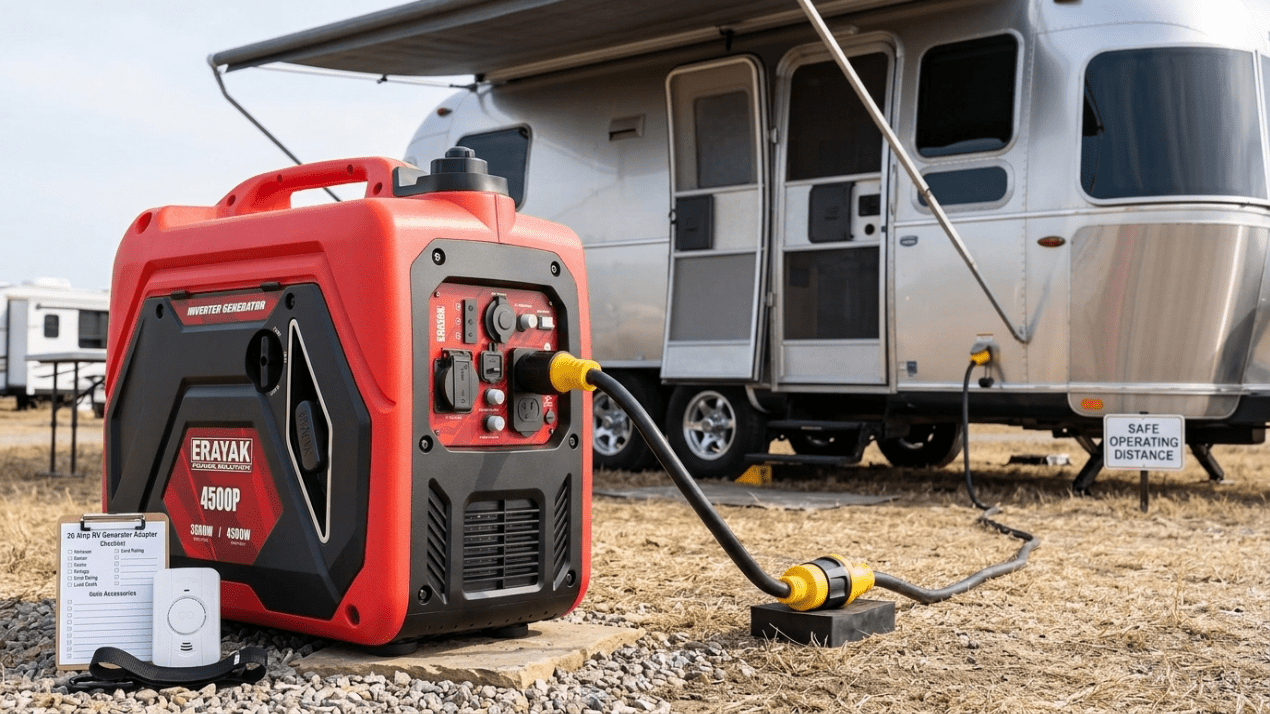
The Erayak 4500P is the gas-only 4,500W-class fit for many 30 amp campers with one rooftop AC. It is gas only, manual recoil start, 55 lb class, with a 2.25 gal fuel tank, up to 8 hours runtime, 60.5 dB, and THD below 1.2%.
Compare the Erayak 4500P Gas Inverter Generator
 Erayak 4500PD: Dual-Fuel RV Flexibility
The 4500PD is the stronger Erayak fit when your 30 ft camper trips overlap with propane planning, storm backup, refrigerator support, and longer off-grid stays. It is the main dual-fuel route for 30A camper comfort loads.
Compare the Erayak 4500PD Dual-Fuel Generator
 Erayak 6800PD/PT: Larger Upgrade Path
Choose the 6800PD or 6800PT series when your camper power plan overlaps with 50 amp selected loads, 120V/240V planning, home backup, sump pump, well pump, or larger RV backup needs.
See the Erayak 6800PD/PT 120V/240V UpgradeGenerator Safety for Camper Use
Never run a fuel generator indoors, inside a camper, in a garage, under an awning, in a storage compartment, in a tent, or near open windows, doors, or vents. Always operate outdoors with proper ventilation and follow the generator manual, camper manual, campground rules, and local safety requirements.
Use working carbon monoxide alarms inside the camper. Keep cords dry, rated for the load, and undamaged. Let the generator cool before refueling, and never use improvised wiring, unsafe adapters, or undersized extension cords.
FAQ: Generator Size for a 30 Ft Camper
What size generator do I need for a 30 ft camper?
Most 30 ft campers with 30 amp service and one rooftop AC are best matched with a 4,000W to 4,500W inverter generator. Lighter setups may use 3,000W to 3,500W, while battery-charging-only camping may need less.
Will a 3,000 watt generator run a 30 ft camper?
It may run lighter loads or some carefully managed AC setups, but it can be tight for a 30 ft camper with a standard rooftop AC plus refrigerator, microwave, and converter charging. A 4,000W to 4,500W class generator gives more practical margin.
Is a 4,500 watt generator enough for a 30 ft camper?
For many 30 amp campers with one rooftop AC, yes, as long as you manage large loads. It can provide useful AC startup margin and running power for selected smaller loads, but it does not let every appliance run at once.
How many watts does a 30 amp camper use?
A standard 30 amp camper is usually 120 volts. 120V x 30A equals 3,600 watts maximum through the camper's 30 amp service. Generator surge watts help with startup, but the camper connection still has limits.
What size generator do I need for a 30 ft camper with a 15,000 BTU AC?
A 15,000 BTU RV AC often points buyers toward the 4,000W to 4,500W inverter class, especially in hot weather or when other loads are running. Exact needs depend on the AC model, soft start, altitude, and load management.
Can I use a 2,000 watt generator for a 30 ft camper?
A 2,000W generator can be useful for charging batteries, lights, fans, electronics, and small loads. It is usually not the best single-generator answer for a 30 ft camper with standard rooftop AC use.
Should I choose gas or dual fuel for a 30 ft camper?
Gas-only is simple and often provides the strongest output. Dual fuel is useful when you want gasoline plus propane flexibility for camping and outage planning. Leave enough sizing margin when using propane for AC-heavy loads.
For Many 30 Ft Campers, 4,000W-4,500W Is the Practical RV AC Range
If your 30 ft camper has 30 amp service and one rooftop AC, a 4,000W to 4,500W inverter generator is usually the most comfortable range. If you only need charging and light camping loads, you can go smaller. If you have 50 amp service, two AC units, or home-backup crossover needs, plan a larger selected-load setup.
