

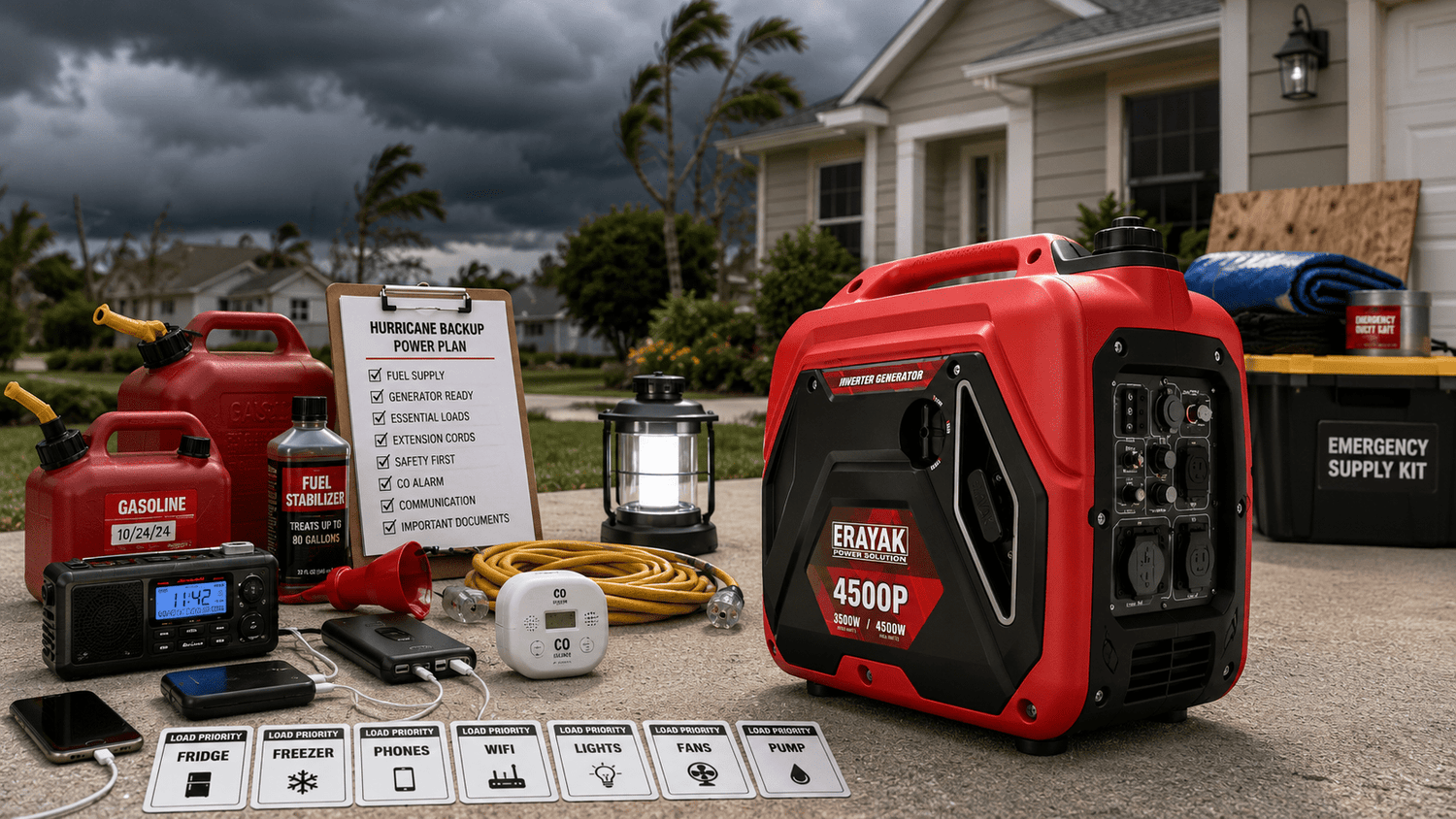
Hurricane Backup Power Plan: Fuel, Generator Placement, and Essential Loads
A hurricane backup power plan is not just about owning a portable generator. It is about knowing how much fuel you need, where the generator will sit safely, which loads matter most, what cords and accessories are required, and how your family will use limited power during a multi-hour or multi-day outage.
Quick Answer
A good hurricane backup power plan should include three parts: fresh fuel stored in approved containers, a safe outdoor generator placement plan away from doors, windows, vents, garages, and enclosed spaces, and a prioritized list of essential loads such as refrigerator, freezer, phone charging, WiFi router, LED lights, fans, sump pump, medical device chargers, and selected kitchen appliances.
Do not try to run every appliance at once. During a hurricane outage, portable generator power should be managed in rotation. Keep food cold, stay connected, maintain basic lighting and airflow, protect priority pumps, and only run high-demand appliances such as coffee makers, microwaves, kettles, heaters, or cooking appliances one at a time.
Why a Hurricane Backup Power Plan Matters
Hurricanes create a different kind of outage than a short neighborhood blackout. Roads may be blocked, fuel stations may be crowded or closed, cell service may be unstable, and power restoration may take longer than expected. A generator can help, but only if the fuel, cords, placement, and load plan are ready before the storm arrives.
Power Depends on Fuel
Fresh fuel, approved containers, and a rotation plan help prevent stale gasoline, hard starts, and last-minute fuel shortages.
Location Affects Safety
Generator exhaust contains carbon monoxide. Placement must be planned before wind, rain, debris, and panic make decisions harder.
Not Everything Runs at Once
A load priority list helps protect food, communication, lighting, airflow, pumps, and medical charging without overloading the generator.
Part 1: Fuel Plan Before the Storm
Fuel planning should happen before hurricane warnings begin. Old gasoline, dirty containers, or fuel left sitting in the generator tank can create hard starting, rough running, surging, and carburetor clogging. Your generator is only as ready as the fuel behind it.
| Fuel Planning Step | What to Do | Why It Matters |
|---|---|---|
| Use approved fuel cans | Store gasoline only in proper containers designed for fuel | Reduces spill, vapor, and contamination risk |
| Label every can | Write fuel type and purchase date | Prevents old or unknown fuel from being used during an emergency |
| Rotate fuel | Use older fuel first and refill with fresh gasoline | Reduces stale fuel and carburetor clogging risk |
| Use stabilizer when appropriate | Add to fresh fuel according to product label and generator manual | Supports longer storage planning |
| Prepare refueling tools | Keep funnel, gloves, flashlight, and rags with the fuel kit | Makes night or storm recovery refueling easier |
| Store fuel safely | Keep fuel upright, sealed, and away from flame, heat, living areas, and children | Reduces fire and household safety risks |
Part 2: Safe Generator Placement
Generator placement is one of the most important parts of hurricane backup planning. During a storm, people may be tempted to move the generator closer to the house, under a porch, near a garage, or beside a window to protect it from rain. That can create serious carbon monoxide risk.
| Placement Area | Safe or Unsafe? | Why |
|---|---|---|
| Outdoors, away from doors/windows/vents | Safer choice | Helps keep exhaust away from living spaces |
| Inside garage with door open | Unsafe | Carbon monoxide can still build up and enter the home |
| Covered porch or enclosed patio | Unsafe | Exhaust can collect near openings and occupied spaces |
| Near window AC unit or open window | Unsafe | Exhaust can be pulled into the home |
| Beside basement/crawlspace vent | Unsafe | CO can enter low openings and spread inside |
| Dry, stable outdoor surface with exhaust pointed away | Safer choice | Supports airflow, stability, and safer exhaust direction |
Part 3: Choose Essential Loads First
A portable generator should not be treated like whole-home utility power unless your system is professionally sized and connected through proper transfer equipment. Most homeowners should build a priority list of essential loads and rotate them.
| Priority Level | Essential Loads | Power Planning Tip |
|---|---|---|
| Critical | Medical device chargers, phone charging, emergency radio | Keep these above comfort and convenience loads |
| Food protection | Refrigerator, freezer, deep freezer | Run in rotation to maintain safe temperature and reduce overload |
| Water protection | Sump pump, selected well pump, septic pump where applicable | Check startup watts and avoid stacking with other heavy loads |
| Communication | WiFi router, modem, laptop, power banks | Use low-load windows to charge devices |
| Basic comfort | LED lights, fans, small air purifier, CPAP where applicable | Prioritize airflow and sleep safety during hot outages |
| Convenience | Coffee maker, microwave, kettle, toaster, small cooking appliances | Run one at a time after critical loads are stable |
How to Rotate Loads During a Hurricane Outage
Load rotation means powering the most important appliances in planned windows instead of trying to run everything continuously. This helps extend fuel, reduce overload, and keep the generator operating more smoothly.
| Rotation Window | Suggested Loads | What to Avoid |
|---|---|---|
| Food cooling window | Refrigerator, freezer, deep freezer | Avoid microwave, kettle, coffee maker, and pump startup at the same time |
| Charging window | Phones, power banks, laptop, modem, router, battery radio | Avoid cluttered cords and wet plug connections |
| Pump window | Sump pump, selected water-related pumps | Avoid stacking with compressor loads and high-watt appliances |
| Comfort window | Fans, LED lights, CPAP, small medical chargers | Avoid unnecessary high-watt appliances overnight |
| Kitchen window | Coffee maker, microwave, kettle, toaster | Run one heating appliance at a time |
| Rest window | Only critical low-load devices | Do not run a generator near sleeping areas or open windows |
Extension Cord and Connection Planning
Cords are part of the emergency power system. A damaged, undersized, wet, or overloaded cord can create heat, voltage drop, or shock hazards. Choose cords before hurricane season and label them for intended use.
Use Proper Outdoor Cords
Use grounded outdoor-rated extension cords that match the load, distance, and generator outlet.
Keep Connections Elevated
Keep plugs and adapters away from puddles, wet grass, rain runoff, mud, and storm debris.
No Backfeeding
Do not plug a generator into a wall outlet. Use direct appliance cords or a properly installed transfer switch.
Before, During, and After the Hurricane
A hurricane backup plan is easier to follow when it is broken into timing stages. Prepare before the storm, operate carefully during the outage, and restore the generator correctly after power returns.
| Timing | Action | Why It Matters |
|---|---|---|
| Before hurricane season | Test generator outdoors, inspect cords, label fuel cans, update load plan | Find problems before emergency conditions |
| When storm is forecast | Charge power banks, cool refrigerator/freezer, confirm fuel, stage cords and lights | Reduces generator runtime pressure later |
| Before starting generator | Move generator outdoors to planned location, check oil and fuel, disconnect loads | Supports safer startup and smoother operation |
| During outage | Add loads gradually, rotate priority appliances, monitor fuel and cords | Helps avoid overload and unsafe connections |
| Before refueling | Turn off generator and let it cool | Reduces fire and burn risk |
| After power returns | Cool generator, inspect, clean, handle fuel, update maintenance log | Prepares the generator for the next outage |
Recommended Erayak Setup by Hurricane Backup Need
Erayak 2400P: Compact Hurricane Essentials
Choose the Erayak 2400P when your hurricane backup plan focuses on phones, power banks, LED lights, fans, WiFi router, laptop, emergency radio, and small electronics.
- Good fit for compact emergency power
- Useful for charging, lights, fans, router, laptop, and small electronics
- Pair with outdoor-rated cords, fuel plan, CO alarms, and load checklist
Erayak 4500P: Strong Starting Point for Managed Home Backup
Choose the Erayak 4500P when your hurricane plan includes managed home loads such as refrigerator, freezer planning, lights, fans, WiFi, phone charging, laptop, coffee maker timing, and selected household essentials.
- Gas-only portable inverter generator
- Manual recoil start
- 55 lb lightweight design
- 2.25 gal fuel tank
- Up to 8 hours runtime
- THD < 1.2% for sensitive electronics
- 60.5 dB noise level
Erayak 4500PD: Fuel Flexibility for Longer Storm Outages
Choose the Erayak 4500PD when you want gasoline and propane flexibility during hurricane season, storm prep, longer outages, and mixed home and outdoor emergency use.
- Gasoline and propane flexibility
- Useful for longer outage planning and flexible fuel storage
- Good fit for refrigerator, lights, fans, charging, WiFi, coffee timing, and managed emergency loads
Erayak 6800PD / 6800PT: Larger Home Backup, 30A, and 120V/240V Planning
Choose the Erayak 6800 series when your hurricane plan needs more headroom, 30A outlets, selected 120V/240V planning, RV adapter support, pump planning, multiple power zones, and broader home backup overlap.
- 6800W peak power
- 5000W rated power on gasoline at 100% output
- 30A L5-30R outlet
- 30A 120V/240V L14-30R outlet
- Dual 120V household outlets
- TT-30R RV adapter accessory included
Hurricane Generator Safety Checklist
Hurricane outages create pressure, darkness, rain, heat, and urgency. Use a printed checklist so every family member understands the safe generator plan before the storm.
- Run the generator outdoors only, away from doors, windows, vents, garages, crawlspaces, basements, sheds, and enclosed spaces.
- Never run a generator indoors or in a garage, even with doors or windows open.
- Keep the generator away from people, pets, children, windows, vents, doors, and sleeping areas.
- Point exhaust away from the home, neighboring homes, occupied areas, and air intakes.
- Use working carbon monoxide alarms inside the home.
- Use grounded, properly rated, outdoor extension cords.
- Inspect cords for fraying, cuts, crushed insulation, exposed wire, loose plugs, or missing ground pins.
- Do not use frayed, damaged, wet, crushed, or loose cords.
- Keep plug connections dry, elevated, and away from puddles, rain runoff, wet grass, and storm debris.
- Do not backfeed your home through a wall outlet.
- Use a properly installed transfer switch if powering selected home circuits.
- Disconnect loads before starting the generator.
- Add loads gradually after the generator stabilizes.
- Rotate high-demand appliances such as coffee makers, microwaves, kettles, pumps, freezers, heaters, and cooking appliances.
- Turn the generator off and let it cool before refueling or maintenance.
- Store fuel in approved containers away from flame, heat, stoves, grills, living areas, children, and ignition sources.
- Keep fuel cans upright, sealed, labeled, and stored in a cool, dry, ventilated non-living area.
- Do not operate the generator in standing water, flooding, or unsafe storm conditions.
Build Your Hurricane Backup Power Plan Before the Storm
A reliable hurricane backup power plan starts with fresh fuel, safe generator placement, dry rated cords, and a clear load priority list. Protect food, communication, lights, fans, pumps, and essential chargers first. Then rotate comfort and kitchen appliances only when the generator has enough headroom.
FAQ: Hurricane Backup Power Plan
What should a hurricane backup power plan include?
A hurricane backup power plan should include fuel storage, generator placement, extension cord planning, CO alarms, load priority list, maintenance tools, refueling tools, and a clear schedule for rotating essential appliances.
Where should I place a generator during a hurricane outage?
Place the generator outdoors on a dry stable surface, away from doors, windows, vents, garages, crawlspaces, basements, sheds, enclosed spaces, and sleeping areas. Point exhaust away from the home and occupied areas.
What are the most important loads to power during a hurricane outage?
Priority loads usually include phone charging, medical device chargers, refrigerator, freezer, emergency radio, WiFi router, LED lights, fans, sump pump where needed, and other essential devices for safety and communication.
Can I run my refrigerator and freezer at the same time on a generator?
Possibly, depending on generator capacity, starting watts, cord rating, and what else is connected. Avoid starting multiple compressor loads at the same time, and rotate loads when headroom is limited.
How should I store fuel for hurricane generator use?
Store fuel in approved, labeled containers in a cool, dry, ventilated non-living area away from heat, flame, children, and ignition sources. Rotate fuel regularly and use stabilizer when appropriate according to label and generator manual guidance.
Can I plug a generator into a wall outlet during a hurricane outage?
No. Do not backfeed a home through a wall outlet. Power selected appliances directly with properly rated cords, or use a professionally installed transfer switch or approved inlet system.
What Erayak generator is best for hurricane backup power?
Choose the Erayak 2400P for compact emergency essentials, the Erayak 4500P or 4500PD for broader home backup with managed loads, and the Erayak 6800 series for larger home, RV, 30A, 120V/240V, and multi-zone emergency planning.
