

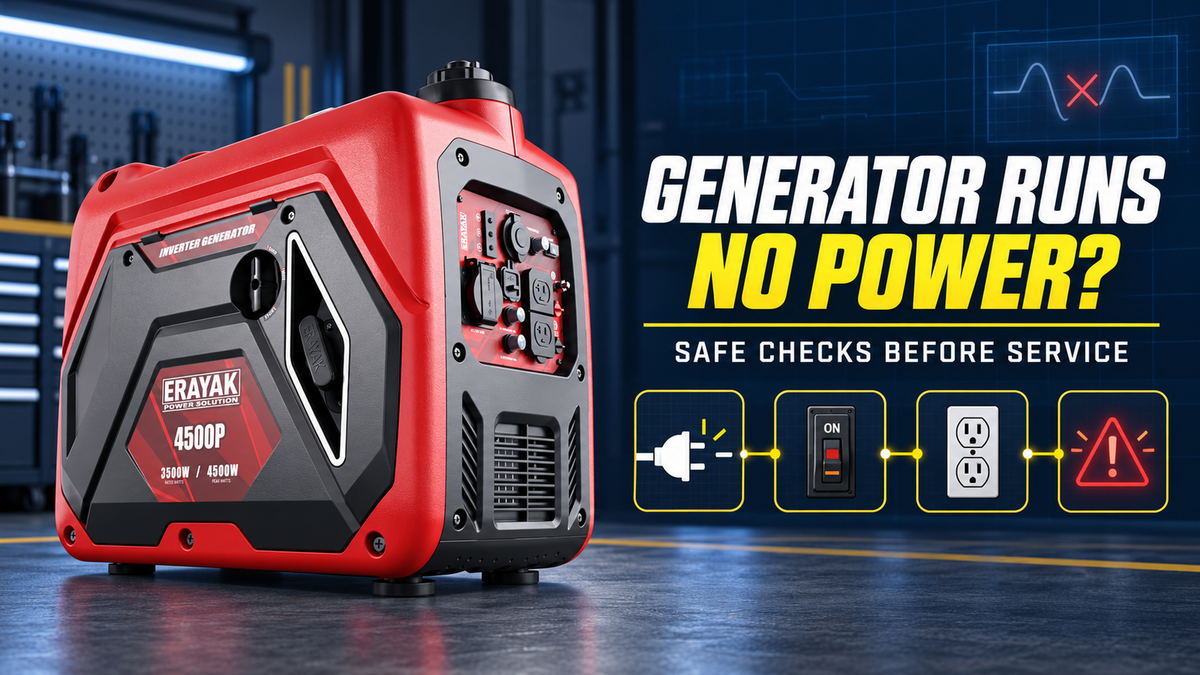
Generator Runs but Has No Power?
If your generator engine runs but the outlets have no power, first disconnect every load and determine whether the loss affects all AC outlets, one outlet, one cord or only the RV or home connection. Then check only the user-accessible breaker, outlet protection and controls identified in the exact manual. A safe no-load restart may restore output after an overload, but persistent blinking indicators, a dark display or no AC output after restart requires support—not an open panel.
This guide is for portable inverter-generator owners who need a practical, symptom-first sequence. It separates external checks from internal electrical work and shows exactly what evidence to record if service is needed.
Safety First: Keep the Generator Outdoors and Closed
Operate a fuel-burning generator outdoors on a dry surface, away from doors, windows and vents. The U.S. Consumer Product Safety Commission advises keeping a portable generator at least 20 feet from the home and never backfeeding house wiring through a wall outlet. Do not remove the control panel, reach behind an outlet, reseat internal wiring or touch electrical parts while the generator is running—or merely because the engine is off.
Quick Answer
A running engine does not prove that usable electricity is reaching the outlets. Unplug all loads, inspect the visible cords and plugs, confirm the correct user-accessible AC switch or breaker position, and follow the model’s shutdown-and-restart procedure. After the generator stabilizes with no load, test one known-good, low-wattage device at one outlet. If every AC outlet remains dead, warning lights continue, the display stays dark, or a breaker trips again with no load, stop and contact support.
First, Find Where the Power Path Stops
“The generator has no power” can describe three different problems. Identifying the scope before resetting anything prevents unnecessary part replacement and gives support a much better starting point.
Every AC Outlet Is Dead
The engine runs, but no connected AC device works. This may involve overload protection, a user-accessible breaker or switch, an outlet-protection device, or an internal output fault.
One Outlet or Device Fails
Other outlets or a known-good test device work. Focus on the affected cord, plug, adapter, outlet or appliance instead of assuming the entire generator has failed.
The Generator Outlet Works
A direct test load works, but the RV or house remains unpowered. The break may be in the cord, adapter, inlet or installed transfer equipment—not the generator output itself.
The Safe No-Output Check
Use this sequence only for visible, user-accessible items. The exact owner’s manual controls whenever it differs from general guidance.
- Make the location safe. Keep the generator outdoors on a dry, level surface. Stop immediately if the unit is wet, smoking, leaking fuel, sparking, unusually hot or producing a burning odor.
- Disconnect every load. Remove appliances, extension cords, RV cables, adapters, chargers and parallel equipment. A generator should be diagnosed with no electrical load unless the exact manual specifies otherwise.
- Inspect the visible connection path. Look for a loose plug, damaged receptacle cover, bent prong, cut or crushed cord, overheated adapter, moisture or debris. Do not insert tools into an outlet or remove a panel.
- Identify the correct user controls. Find the AC output switch, circuit breaker, overload reset or GFCI reset only if the exact model’s panel legend or manual identifies it. Similar-looking generators may use different controls and reset behavior.
- Reset only as the manual allows. With all loads removed, place the accessible breaker or output control in its required reset position. Never hold a breaker on, bypass protection or repeatedly reset a device that trips again.
- Perform a complete shutdown and restart. Turn the generator off using the model’s normal sequence, allow the engine and electrical system to stop, then restart with no load. Let the engine stabilize before reconnecting anything.
- Test one known-good small device. If there is no smell, heat, damage or abnormal indicator, connect one low-wattage device with a sound, outdoor-rated cord to one compatible outlet. Do not use life-critical medical equipment or an expensive sensitive device as the first test.
- Classify the result. If the test device works, add loads one at a time and investigate the original cord or appliance. If no AC outlet works, the display remains dark, indicators continue flashing or protection trips again with no load, stop testing and prepare a support request.
Generator Runs but Has No Power: Diagnosis by Symptom
| What you observe | What it may point to | Safe first check | When to escalate |
|---|---|---|---|
| All AC outlets are dead after an appliance started | Overload protection, breaker state or startup surge | Disconnect all loads and use the manual’s no-load reset sequence | Protection trips again with nothing connected |
| DC or USB output works, but AC does not | The AC and DC paths may be protected or controlled separately | Check only the labeled AC breaker or output control | AC remains absent after the approved restart |
| One outlet fails while another works | Outlet-specific protection, connection or receptacle issue | Stop using the affected outlet; compare with one known-good device | There is heat, discoloration, looseness or repeated failure |
| Display is dark and every AC outlet is dead | Output-system, display-supply or internal connection fault | Record the panel and perform one complete no-load restart | The display stays dark; do not open the housing |
| Output or overload light keeps flashing with no load | Active protection or an internal control fault | Record the exact color and sequence for the exact model | The behavior continues after a correct no-load restart |
| A small test device works, but an air conditioner does not | Compressor startup surge, total load or cord/adapter limitation | Check nameplate running and starting requirements | The setup is within verified limits but protection still trips |
| Generator outlet works, but the RV or house does not | Cord, adapter, inlet or transfer-equipment path | Inspect only visible plugs, cords and approved switch positions | Installed wiring or transfer equipment needs diagnosis |
For a broader overview of starting, stalling and reduced-output symptoms, use the ERAYAK common generator problems hub. If the engine itself will not start, follow the separate generator won’t start troubleshooting guide.
Why an Air Conditioner Can Trigger a No-Power Complaint
An air conditioner may run normally and then demand a higher burst of power when its compressor cycles or restarts. Lowering the thermostat can cause the compressor to start again; the number shown as normal running watts may not describe that brief startup demand. Refrigerators, freezers, pumps and other motor-driven equipment can behave similarly.
If output disappeared when a compressor or motor started, disconnect all loads before attempting a reset. Compare both running watts and starting watts with the generator’s verified rated and peak output. Also account for every background load, including an RV converter, battery charger, refrigerator, microwave, water heater or another appliance that may start automatically.
How to Read Warning Lights and a Dark Display
Indicator colors are not universal. A green light, red light or blinking sequence can mean different things on different generator models and control modules. Even within the same product family, panel legends and software behavior may change by version or market.
Do not diagnose a failed inverter module from color alone. Instead, record the evidence:
- which light is on, off or flashing;
- the color and exact blink sequence;
- whether the display is active or completely dark;
- whether AC, DC and USB outputs behave differently;
- what was connected immediately before output stopped;
- whether a no-load shutdown and restart changed anything.
A steady-running engine with a dark display and no AC output may indicate an internal electrical problem, but an owner should not remove the control panel to confirm it. Internal wiring, inverter modules and energized conductors require model-specific service procedures.
If the Generator Works but the RV or House Still Has No Power
If one known-good device works directly from the generator outlet, the generator is producing at least some electrical output. The next break may be in an RV cord, locking plug, adapter, inlet, surge protector, energy-management system or installed transfer equipment.
Inspect only what is visible and intended for user operation. Confirm that plugs are fully seated, locking connectors are correctly engaged and cords are not cut, scorched, crushed or wet. Use only compatible adapters and stay within the generator, receptacle, cord and connected-equipment ratings.
ERAYAK 2400P and 4500P Output Context
Use the specification for the exact model on the label and current product page. The following verified U.S. product-page figures show why both rated output and peak output matter when diagnosing an overload.
| Model | Rated output | Peak output | Relevant output details | Owner reminder |
|---|---|---|---|---|
| ERAYAK 2400P | 1,800W | 2,400W | 120V AC plus listed DC and USB output; overload protection | DC working does not prove that the AC output path is operating |
| ERAYAK 4500P | 3,500W | 4,500W | 120V household outlets plus one L5-30R; overload protection | Include motor startup demand and all background RV loads |
These specifications are not a reset procedure. Panel controls, outlet protection and service steps must still be confirmed for the exact model and production version.
When to Stop Troubleshooting and Contact Support
Stop immediately if there is a burning smell, smoke, sparks, abnormal heat, melted plastic, moisture inside an outlet, visible shipping damage, a loose receptacle or a breaker that trips repeatedly with no load. Do not continue using an outlet that is discolored, cracked or mechanically loose.
Also stop after one correct no-load restart if every AC outlet remains dead, the display stays dark or an abnormal light pattern continues. These symptoms may require internal electrical diagnosis. Do not open the housing, probe an outlet, “flash” the generator, bypass a breaker or reseat an internal harness without an authorized model-specific procedure.
A clear support video is more useful than repeated resets. Keep the entire generator and control panel visible and record one uninterrupted sequence showing:
- the complete model code and serial label;
- the engine running steadily with all loads removed;
- the breaker and user-accessible control positions;
- the display and every indicator light for at least one full cycle;
- one approved low-wattage test device, if safe to connect;
- the cord, plug and outlet used for the test;
- what was connected when the output first disappeared;
- order number, purchase channel and destination market.
Submit the video, photos and fault description through ERAYAK After-Sales Support. The support page specifically requests order information, product model, warning-light details and a short video when the problem appears during operation.
What Not to Do When the Engine Runs but Output Is Gone
- Do not remove the control panel or reach behind an outlet.
- Do not probe a live receptacle or exposed connector.
- Do not bypass a breaker, overload device, sensor or interlock.
- Do not repeatedly reconnect the same load after each trip.
- Do not improvise an adapter or change internal wiring.
- Do not backfeed a home through a wall or dryer outlet.
- Do not use damaged, wet, undersized or two-prong cords.
- Do not treat one light color as proof that a specific module failed.
How to Prevent Another Loss of Output
- Plan with rated watts and motor starting watts, not peak watts alone.
- Start the highest-surge approved load first, then add smaller loads one at a time.
- Disconnect loads before starting or stopping the generator unless the manual says otherwise.
- Use grounded outdoor-rated cords sized for the load and distance.
- Keep plugs, adapters and outlets dry and protected from damage.
- Test the generator outdoors before an RV trip or emergency season.
- Keep the exact owner’s manual and model information with the generator.
- Record recurring trips instead of repeatedly resetting them.
Frequently Asked Questions
Why is my generator running but the outlets have no power?
The AC output may be interrupted by overload protection, a user-accessible breaker or outlet-protection device, an incorrect output-control position, a damaged cord or an internal electrical fault. Disconnect all loads and follow the exact model’s no-load reset procedure before testing one known-good small device.
Does a portable generator have a reset button?
Some generators have a circuit breaker, overload reset, GFCI reset or AC output control, but the location and sequence vary. Use only the control identified in the exact model’s manual or panel legend. Never hold a breaker on or bypass protection.
Why does DC or USB power work while the AC outlets do not?
DC, USB and AC outputs may use different circuits or protection paths. That symptom helps narrow the problem but does not prove which part failed. Check the labeled user-accessible AC control, then contact support if AC output does not return after the approved restart.
What does a flashing green or red generator light mean?
Light colors and blink patterns are model-specific. Record the exact color, sequence, display behavior and connected load, then compare them with the correct manual. Do not assume that one color always means overload or module failure.
Can I open the panel to check for a loose wire?
No general troubleshooting guide can make that safe. Internal conductors and inverter components require an authorized model-specific procedure. Keep the housing closed and submit photos or video to support when external checks do not restore output.
What should I send ERAYAK Support for a no-output problem?
Send the model and serial number, order information, a description of the original load and one uninterrupted video showing the engine running with no load, breaker positions, display and indicator sequence. Include photos of the cord, plug, outlet or visible damage without opening the generator.
Restore Output Without Guessing at Internal Parts
Start by separating a generator-wide output loss from a single cord, outlet, appliance or RV connection. Remove all loads, use only the exact manual’s user-accessible reset steps and test one small known-good device. If output remains absent or the indicators stay abnormal, stop and let the model number, video and symptoms guide the next service step.
Safety references: U.S. CPSC Portable Generator Safety Alert, OSHA portable-generator safety sheet, and CDC generator placement guidance.

