

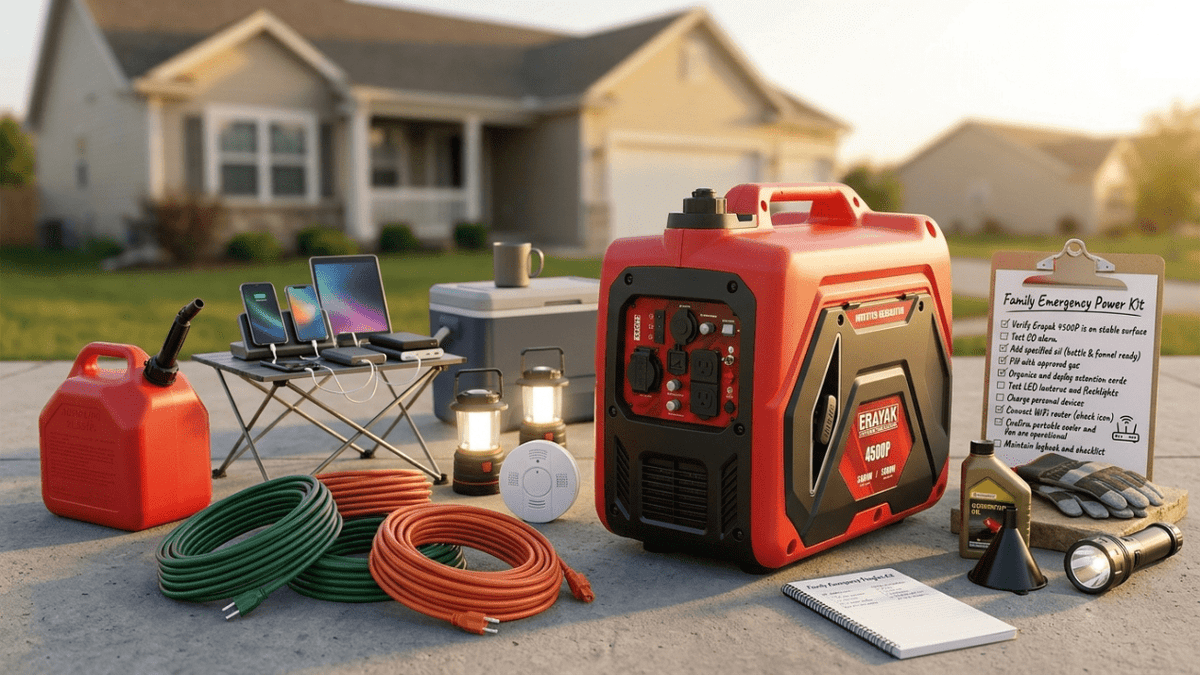
Family Emergency Power Kit: Portable Generator Guide for Home and Camping
A family emergency power kit should work in more than one situation. It should help during a home outage, support a weekend camping trip, power a backyard night, and keep essential devices ready when the grid is unreliable. A portable generator can be the center of that kit when you pair it with the right cords, fuel, lights, chargers, safety tools, and load plan.
Quick Answer
A practical family emergency power kit should include a portable inverter generator, approved fuel container, outdoor-rated extension cords, power banks, LED lanterns, phone chargers, CO alarms, oil and funnel, gloves, flashlight, cord storage, dry charging table, maintenance log, and a printed load list.
For compact emergency and camping power, the Erayak 2400P fits lights, phones, WiFi, fans, power banks, and small electronics. For broader family backup power, camping comfort, refrigerator rotation, coffee maker timing, and multiple devices, the Erayak 4500P or 4500PD is a stronger fit. For larger home, RV, cabin, and outdoor power zones, the Erayak 6800 series provides more headroom and outlet flexibility.
Why Every Family Needs an Emergency Power Kit
A power outage, storm, campsite trip, cabin weekend, or backyard event can all create the same question: what can we safely power, and for how long? A family emergency power kit makes that answer easier because the generator, cords, fuel plan, lights, chargers, and load list are already prepared.
Outage Readiness
Keep phones, LED lights, WiFi, fans, refrigerator rotation, and essential charging available during short outages.
Outdoor Comfort
Use the same power kit for camping lights, phone charging, small fans, power banks, cooler support, and coffee maker timing.
Less Panic, More Planning
A labeled kit reduces last-minute searching for cords, adapters, fuel, oil, flashlights, and charging cables.
Core Family Emergency Power Kit Checklist
Use this checklist as the foundation for a home and camping power kit. Store small accessories in one labeled bin so the kit can move from garage to campsite to backyard without missing key items.
| Kit Item | Purpose | Family Setup Tip |
|---|---|---|
| Portable inverter generator | Provides core emergency and outdoor power | Choose size based on home essentials, camping comfort, and load rotation |
| Approved fuel container | Stores fuel for outages or outdoor trips | Label fuel date and store safely away from living areas |
| Outdoor-rated extension cords | Connects devices safely from generator to power zone | Use grounded cords rated for the connected load and distance |
| LED lanterns and string lights | Low-power lighting | Use efficient lights instead of high-watt work lights |
| Phone chargers and USB hub | Keeps communication devices charged | Charge phones and power banks in batches |
| Power banks | Reduces generator runtime at night | Recharge while generator is already running |
| CO alarms | Supports carbon monoxide awareness | Use inside home, cabin, or RV where people sleep |
| Oil, funnel, and rag | Supports generator maintenance | Check oil before every use |
| Flashlight or headlamp | Helps during setup and night use | Keep spare batteries in the kit |
| Printed load list | Prevents overload mistakes | Mark refrigerator, coffee maker, pump, and cooler as rotation loads |
Home Outage Power Setup
During a home outage, the power kit should support the basics first. Avoid trying to run the whole house. Focus on communication, lighting, food protection, airflow, and short charging windows.
| Home Load | Why It Matters | Power Strategy |
|---|---|---|
| Phones and power banks | Emergency calls, alerts, family coordination | Charge in batches while generator is running |
| LED lights | Safe movement at night | Use efficient lighting to reduce load |
| WiFi router and modem | Communication if internet service is active | Use a dry indoor power point with properly rated cords |
| Refrigerator | Helps reduce food spoilage | Run in planned windows and allow compressor startup headroom |
| Freezer | Protects frozen food during longer outages | Rotate separately and keep the door closed |
| Fans | Heat and humidity comfort | Run after critical charging and refrigeration needs are covered |
Camping and Outdoor Power Setup
The same family emergency power kit can support camping, cabin weekends, and backyard nights. Use a dry charging table, visible cord routes, and low-watt LED lights to keep the setup clean and family-friendly.
| Outdoor Load | Use Case | Power Strategy |
|---|---|---|
| Phones and cameras | Navigation, photos, communication | Charge on a dry table away from cooking and water areas |
| LED string lights | Campsite or backyard visibility | Route cords away from tent entrances and walking paths |
| Small fans | Warm-weather comfort | Use with lights and charging as a low-load comfort setup |
| Portable cooler | Food and drink cooling | Check wattage and avoid starting with high-load appliances |
| Coffee maker | Morning comfort | Run separately from cooler startup, projector, and other heavy loads |
| Projector and speaker | Outdoor movie night | Use after cooking and coffee loads are finished |
Load Priority: What to Power First
A family emergency power kit works best when everyone understands priority. Low-power essentials should come first, while high-demand comfort appliances should be rotated.
| Priority Level | Devices | Generator Strategy |
|---|---|---|
| Priority 1: Communication | Phones, power banks, radio, hotspot | Charge first and recharge whenever generator is running |
| Priority 2: Lighting | LED lanterns, string lights, pathway lights | Use efficient lighting to reduce runtime demand |
| Priority 3: Food protection | Refrigerator, freezer, mini fridge, cooler | Start one compressor load at a time and allow stabilization |
| Priority 4: Comfort | Fans, laptop, TV, projector, speaker | Use after critical charging and food protection are covered |
| Priority 5: High-demand loads | Coffee maker, microwave, kettle, pump, portable AC, heater | Run separately and only if generator capacity supports them |
Generator Accessories for Emergency Kit Planning
Accessories make the generator easier and safer to use. Missing cords, fuel, funnels, or lighting can turn a simple setup into a stressful one.
| Accessory | Why It Helps | Storage Tip |
|---|---|---|
| Cord storage reel or straps | Keeps cords organized and easy to inspect | Label cords by use: home, camping, RV, outdoor table |
| Dry connection box | Helps protect plugs and adapters from wet ground | Keep connections elevated and visible |
| Cable ties and clips | Controls cord paths for lights and charging areas | Keep cords away from walkways, water, and heat |
| Fuel stabilizer | Helps manage stored gasoline when used correctly | Follow stabilizer label and generator manual |
| Spare spark plug and air filter | Supports basic troubleshooting | Use model-compatible parts only |
| Maintenance log | Tracks oil changes, fuel, runtime, and test runs | Store the log with the generator kit |
| Printed safety checklist | Reduces mistakes during stress | Laminate it or keep it in a waterproof pouch |
Recommended Erayak Setup by Family Use Case
Erayak 2400P: Compact Family Emergency Essentials
Choose the Erayak 2400P for a compact family emergency power kit focused on lights, phones, power banks, small fans, WiFi hotspot, laptop charging, campsite electronics, and simple backyard power.
- Strong fit for low-load home and camping essentials
- Good for charging, lights, fans, radio, and small electronics
- Best when refrigerator, coffee maker, cooler, and pump loads are limited or rotated carefully
Erayak 4500P: Best Starting Point for Family Backup and Camping
Choose the Erayak 4500P when your emergency kit needs to support home outage essentials, refrigerator rotation, fans, WiFi, phones, lights, camping comfort, cooler planning, coffee maker timing, and multiple devices.
- Gas-only portable inverter generator
- Manual recoil start
- 55 lb lightweight design
- 2.25 gal fuel tank
- Up to 8 hours runtime
- THD < 1.2% for sensitive electronics
- 60.5 dB noise level
Erayak 4500PD: Fuel Flexibility for Longer Family Power Needs
Choose the Erayak 4500PD when you want gasoline and propane flexibility for longer outages, camping weekends, cabin trips, and family outdoor power. It is useful when fuel planning matters as much as wattage.
- Gasoline and propane flexibility
- Useful for longer outage planning and outdoor power sessions
- Good fit for lights, fans, phones, WiFi, refrigerator rotation, cooler support, and managed comfort loads
Erayak 6800PD / 6800PT: Larger Family Emergency and Outdoor Power Kit
Choose the Erayak 6800 series when your family power kit needs more headroom, selected 120V/240V planning, larger home loads, RV adapter support, cabin power, pump support, and multiple outdoor power zones.
- 6800W peak power
- 5000W rated power on gasoline at 100% output
- 30A L5-30R outlet
- 30A 120V/240V L14-30R outlet
- Dual 120V household outlets
- TT-30R RV adapter accessory included
Family Generator Safety Checklist
A family emergency power kit should be simple enough for everyone to understand, but safe enough to use during stressful situations. Place the generator outdoors, keep exhaust away from people and openings, and keep cords dry and rated for the load.
- Run the generator outdoors only.
- Keep it away from doors, windows, vents, garages, sheds, crawlspaces, porches, RV openings, tents, and enclosed spaces.
- Never run a generator inside a home, garage, shed, tent, RV, vehicle, cabin, basement, crawlspace, or enclosed canopy.
- Point exhaust away from people, homes, RVs, tents, neighbors, and family seating areas.
- Use working carbon monoxide alarms inside the home, cabin, or RV.
- Use properly rated outdoor extension cords.
- Inspect cords for cuts, fraying, crushed insulation, heat damage, loose plugs, or missing ground pins.
- Keep plug, adapter, and cord connections dry and elevated.
- Disconnect loads before starting the generator.
- Add appliances gradually after the generator stabilizes.
- Run coffee makers, microwaves, kettles, pumps, heaters, and AC loads separately when possible.
- Let the generator cool before refueling.
- Store fuel in approved containers away from living areas, flame, heat, grills, and smoking areas.
- Do not plug a generator into a wall outlet to power home wiring.
Build a Family Power Kit Before You Need It
A family emergency power kit should be ready before an outage, storm, camping weekend, or cabin trip. Prepare the generator, fuel, cords, lights, chargers, power banks, CO alarms, maintenance tools, and load list now so the setup is simple later.
FAQ: Family Emergency Power Kit
What should be in a family emergency power kit?
A family emergency power kit should include a portable generator, approved fuel container, outdoor-rated extension cords, LED lights, phone chargers, power banks, CO alarms, flashlight, oil, funnel, gloves, maintenance log, and a printed load list.
Can one generator work for home backup and camping?
Yes. One portable inverter generator can support home backup and camping when loads are managed correctly. Use it for essentials first, then rotate comfort appliances instead of running everything at once.
What should I power first during a family outage?
Power phones, power banks, LED lights, WiFi router, refrigerator rotation, freezer rotation, fans, and critical charging needs before high-demand comfort appliances.
What camping items can a family emergency power kit support?
Common camping loads include phones, power banks, LED lights, small fans, camera batteries, portable cooler, coffee maker timing, speaker, projector, and small outdoor electronics.
Do I need special extension cords for a generator emergency kit?
Use outdoor-rated, grounded extension cords rated for the connected load and distance. Do not use cords with cuts, fraying, crushed insulation, heat damage, loose plugs, or missing ground pins.
Where should I place a generator during home or camping use?
Place it outdoors on dry stable ground, away from doors, windows, vents, garages, tents, RV openings, cabins, sheds, porches, and enclosed spaces. Point exhaust away from people and structures.
What Erayak generator is best for a family emergency power kit?
Choose the Erayak 2400P for compact essentials, the Erayak 4500P or 4500PD for family home backup and camping comfort, and the Erayak 6800 series for larger loads, RV adapter support, cabin power, pump support, and selected 120V/240V planning.
