

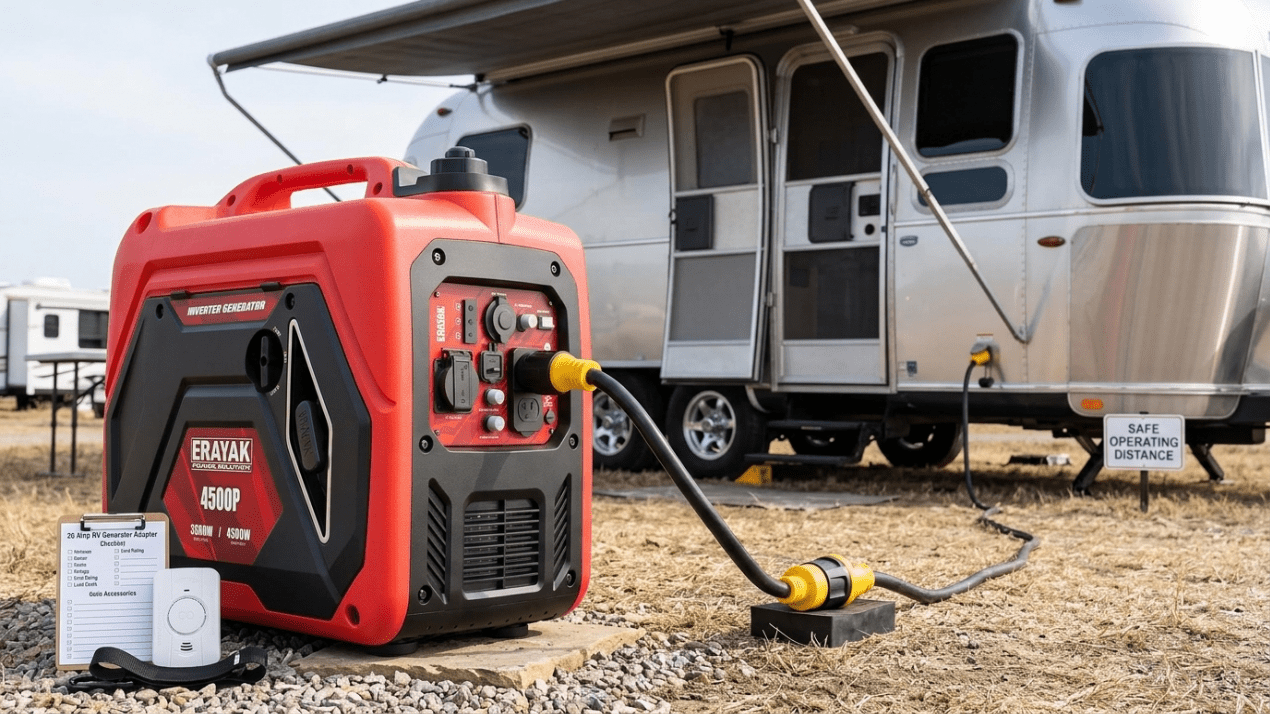
30 Amp RV Generator Adapter Guide: Safe Connection Basics
A 30 amp RV generator adapter can make generator-to-RV connection easier, but the adapter itself does not increase power, change voltage safely, or make every generator compatible with every RV. The right setup depends on your RV inlet, generator outlet, cord rating, adapter type, and the loads you plan to run.
Quick Answer
A 30 amp RV generator adapter is used to connect a portable generator outlet to a 30 amp RV shore power cord or RV inlet when the plug shapes do not match directly. The most common RV 30 amp connection is a TT-30 style 120V RV plug, but generator outlets may use different receptacles such as household outlets, L5-30, or L14-30 depending on the generator.
Before using any RV generator adapter, confirm four things: the voltage is correct, the amperage is appropriate, the plug shape matches, and the generator capacity is enough for your RV loads. A safe generator to RV connection should use properly rated cords, dry connections, correct adapter type, and careful load management.
What a 30 Amp RV Generator Adapter Does
A 30 amp RV generator adapter helps bridge the physical connection between a generator outlet and an RV power cord. It does not automatically make a small generator capable of running a full RV. It also does not change an unsafe voltage into a safe one unless the adapter is specifically designed for the correct application and used with compatible equipment.
Matches Plug Shapes
An adapter may allow a generator outlet to connect to a TT-30 RV cord, twist-lock cord, or other compatible RV power connection.
Does Not Add Watts
If the generator cannot supply the load, an adapter will not fix overload, breaker trips, voltage drop, or appliance startup issues.
Must Match Voltage
RV 30 amp service is typically 120V. Do not connect an RV to an incompatible voltage or outlet configuration.
Common RV Generator Adapter Types
The adapter you need depends on the generator outlet and your RV cord. Always read the labeling on both the generator outlet and the RV power cord before connecting.
| Adapter Type | Typical Use | Important Check |
|---|---|---|
| Household outlet to TT-30 style adapter | Light RV loads from a smaller generator outlet | Do not expect full 30 amp RV capacity from a smaller household outlet |
| L5-30 to TT-30 RV adapter | 30A 120V twist-lock generator outlet to 30A RV cord | Confirm outlet voltage, plug type, cord rating, and generator capacity |
| L14-30 to TT-30 RV adapter | Generator outlet with 120V/240V style receptacle used with compatible adapter | Make sure the adapter provides the correct 120V RV connection and is made for this use |
| TT-30 extension cord | Extends RV 30 amp connection distance | Use a properly rated RV cord and avoid excessive cord length |
| Dogbone RV adapter | Flexible adapter that reduces stress on plug and outlet | Check rating, heat buildup, and plug fit before extended use |
Generator to RV Connection Checklist
Use this generator to RV connection checklist before plugging in. It helps reduce mistakes when setting up in a campground, driveway, tailgate, emergency stop, or off-grid location.
| Connection Step | What to Check | Why It Matters |
|---|---|---|
| 1. Confirm RV inlet | 30 amp RV inlet type and labeling | Prevents using the wrong adapter or cord |
| 2. Confirm generator outlet | Outlet type, voltage, amperage, and breaker rating | Ensures the adapter matches the generator output |
| 3. Confirm adapter rating | Voltage, amp rating, plug type, and outdoor use suitability | Prevents overheating, poor fit, or unsafe connection |
| 4. Inspect RV cord | Cuts, fraying, crushed insulation, loose plug, heat damage | Damaged cords should not be used |
| 5. Place generator safely | Outdoors, away from RV windows, doors, vents, awnings, and people | Reduces carbon monoxide and exhaust risk |
| 6. Start generator first | Let generator stabilize before adding RV loads | Reduces sudden load stress |
| 7. Connect with loads off | Turn off high-demand RV loads before plugging in | Prevents immediate overload or breaker trips |
| 8. Add loads gradually | Start with converter/charger, fridge mode, lights, fan, then larger loads | Helps identify overload before it becomes a problem |
30 Amp RV Load Management Basics
A 30 amp RV system can support many RV essentials, but not all high-demand appliances at the same time. The adapter may fit, but you still need to manage air conditioner startup, microwave use, electric water heater mode, coffee maker, converter/charger, fridge, and battery charging.
| RV Load | Power Behavior | Connection Strategy |
|---|---|---|
| RV converter / battery charger | Can draw more when batteries are low | Let it stabilize before adding high-demand appliances |
| RV air conditioner | High startup demand | A soft start may help, but generator capacity still matters |
| Microwave | High short-term load | Run separately from AC or other heating loads when possible |
| Electric water heater mode | High heating load | Consider propane mode when trying to reduce generator load |
| Refrigerator | Varies by operating mode | Check fridge mode and manage with other loads |
| Coffee maker / kettle | High heating load | Use one high-watt appliance at a time |
| Lights, fans, phone charging | Lower load | Usually easier to support with a properly sized generator |
Common Adapter Mistakes to Avoid
Most 30 amp RV generator adapter problems come from assuming the plug shape is the only thing that matters. Avoid these mistakes before connecting your RV to a generator.
| Mistake | What Can Happen | Better Approach |
|---|---|---|
| Using an adapter without checking voltage | RV equipment damage or unsafe connection | Confirm the generator outlet and adapter provide the correct RV voltage |
| Expecting full 30 amp power from a small outlet | Breaker trips, overload, overheating, or poor performance | Match RV load to the actual generator outlet rating |
| Using damaged RV cords | Shock, overheating, or connection failure | Inspect cords before every connection |
| Connecting with high loads already on | Immediate overload or generator shutdown | Turn off AC, microwave, heater, and high-load appliances before connecting |
| Leaving connections in puddles | Shock and equipment risk | Keep plug, adapter, and cord connections dry and elevated |
| Placing generator under RV awning | Exhaust and carbon monoxide risk | Place generator outdoors, away from RV openings and occupied areas |
RV Generator Cord and Extension Cord Safety
The cord is part of the power system. A good RV generator cord should match the plug type, amperage, voltage, length, and outdoor conditions. A bad cord can cause voltage drop, heat buildup, nuisance shutdowns, or unsafe operation.
| Cord Check | What to Look For | Best Practice |
|---|---|---|
| Plug fit | Loose, cracked, burned, or corroded plug ends | Use only tight, clean, properly fitting plugs and adapters |
| Cord rating | Voltage, amperage, and outdoor use rating | Match cord rating to generator outlet and RV demand |
| Cord length | Long runs can increase voltage drop | Use the shortest practical cord that keeps generator safely away from RV |
| Insulation | Cuts, cracks, flattened sections, exposed conductors | Replace damaged cords immediately |
| Connection protection | Rain, puddles, mud, campsite traffic | Keep adapter and plug connections dry, visible, and off the ground |
Recommended Erayak Setup by RV Connection Need
Erayak 2400P: Compact RV Essentials
Choose the Erayak 2400P for compact RV power needs such as lights, phones, laptops, small fans, WiFi, battery charging, and light-duty camping electronics. Use the correct RV generator adapter only when the connection, voltage, cord rating, and load are compatible.
- Good fit for low-load RV essentials and compact outdoor power
- Best for charging, lighting, small electronics, and light accessory use
- Not intended to make a full 30 amp RV load available through an adapter
Erayak 4500P: Practical RV Backup and Camping Power
Choose the Erayak 4500P when your RV setup includes battery charging, lights, fans, refrigerator mode planning, small appliances, and managed higher-demand loads. Always connect through properly rated cords and compatible adapters.
- Gas-only portable inverter generator
- Manual recoil start
- 55 lb lightweight design
- 2.25 gal fuel tank
- Up to 8 hours runtime
- THD < 1.2% for sensitive electronics
- 60.5 dB noise level
Erayak 4500PD: Fuel Flexibility for RV Travel
Choose the Erayak 4500PD when you want 4,500W-class RV and outdoor power with gasoline and propane flexibility. It is a strong fit for longer trips, campsite use, and fuel-flexible RV power planning when loads are managed carefully.
- Gasoline and propane flexibility
- Useful for RV travel, campsites, outdoor events, and backup planning
- Good fit for lights, fans, charging, refrigerator planning, and managed appliance loads
Erayak 6800PD / 6800PT: 30 Amp RV Adapter Support Included
Choose the Erayak 6800 series when your RV power plan needs more headroom, selected 120V/240V planning, a 30A generator outlet, and RV adapter support. The 6800 series includes a TT-30R RV adapter accessory for RV connection planning.
- 6800W peak power
- 5000W rated power on gasoline at 100% output
- 30A L5-30R outlet
- 30A 120V/240V L14-30R outlet
- Dual 120V household outlets
- TT-30R RV adapter accessory included
RV Generator Adapter Safety Checklist
A generator to RV connection should be treated like a full power system, not just a plug adapter. Check the generator, adapter, cord, RV inlet, load, and placement before every use.
- Read the generator manual, RV manual, and adapter labeling before use.
- Confirm voltage, amperage, plug type, and cord rating before connecting.
- Use only properly rated RV generator adapters and outdoor-rated cords.
- Inspect cords and adapters for heat damage, cracks, corrosion, loose fit, or missing ground pins.
- Never force a plug, modify prongs, or remove a ground pin.
- Turn off high-demand RV loads before connecting the generator.
- Start the generator first, let it stabilize, then connect the RV and add loads gradually.
- Keep adapter and cord connections dry, elevated, and away from puddles.
- Do not overload the generator.
- Place the generator outdoors only, away from RV windows, doors, vents, awnings, slides, and occupied areas.
- Point exhaust away from the RV, people, neighboring campsites, and structures.
- Use working carbon monoxide alarms inside the RV.
- Let the generator cool before refueling.
Build a Safer RV Generator Connection
A 30 amp RV generator adapter is useful only when the generator outlet, RV cord, adapter rating, voltage, and load plan are compatible. For compact RV essentials, choose the Erayak 2400P. For practical RV backup and camping power, choose the Erayak 4500P or 4500PD. For more headroom and included TT-30R RV adapter support, choose the Erayak 6800 series.
FAQ: 30 Amp RV Generator Adapter
What is a 30 amp RV generator adapter?
A 30 amp RV generator adapter connects a compatible generator outlet to a 30 amp RV cord or inlet when the plug shapes do not match directly. It must match the correct voltage, amperage, plug type, and intended use.
Can I connect my RV directly to a generator?
Yes, if the generator outlet, RV cord, adapter, voltage, amperage, and load are compatible. Use properly rated cords and adapters, place the generator outdoors, and add RV loads gradually.
Does a 30 amp RV adapter give me full 30 amp power?
No. An adapter does not increase generator output. Your available power is limited by the generator capacity, outlet rating, adapter rating, cord rating, and the loads running inside the RV.
Can I use a household outlet adapter for a 30 amp RV?
Only for limited light loads when the adapter, outlet, cord, and generator are rated correctly. A small household-style outlet does not provide full 30 amp RV service.
Can a generator run a 30 amp RV air conditioner?
It depends on the generator capacity, AC startup demand, RV loads, and whether a soft start is installed. Turn off other high-demand loads and confirm your generator can handle the startup and running requirements.
What should I check before a generator to RV connection?
Check generator outlet type, adapter rating, RV inlet, cord condition, voltage, amperage, generator capacity, RV load plan, dry connection placement, and safe outdoor generator location.
What Erayak generator is best for 30 amp RV adapter use?
Choose the Erayak 2400P for compact RV essentials, the Erayak 4500P or 4500PD for practical RV backup and managed campsite loads, and the Erayak 6800 series for more headroom and included TT-30R RV adapter accessory support.

