

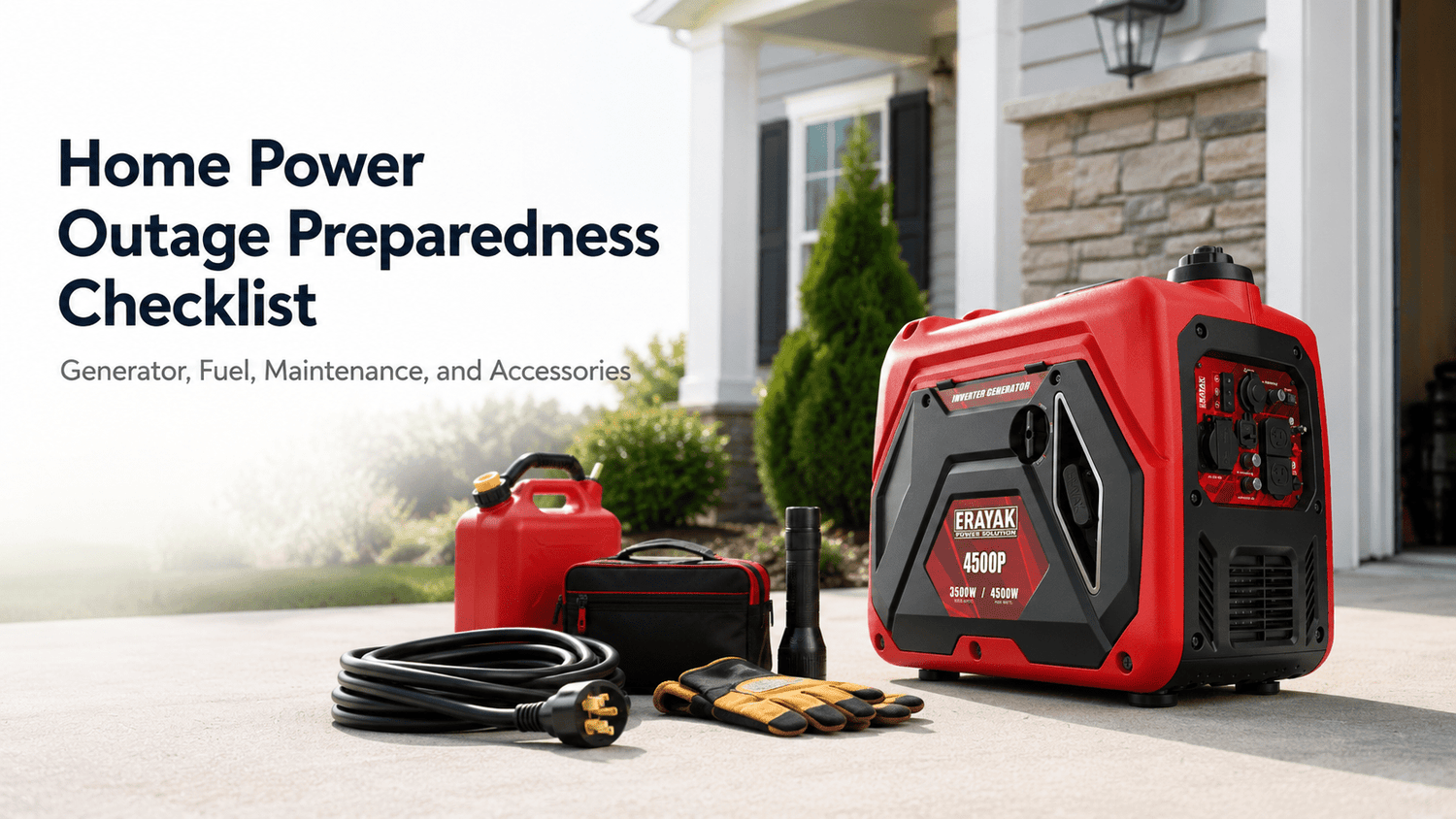
Home Power Outage Preparedness Checklist: Generator, Fuel, Maintenance, and Accessories
A home power outage is easier to manage when the generator, fuel, maintenance supplies, connection plan, and household essentials are ready before the lights go out. The goal is not to collect the most gear. It is to build a simple system that can be set up safely, started reliably, and used without guessing during a stressful outage.
This checklist is designed for portable-generator owners preparing for hurricanes, winter storms, high winds, utility failures, and other unexpected blackouts. Use it as a pre-season audit, a 24-hour storm checklist, and a post-outage reset list.
Quick Answer
A complete home power outage preparedness checklist should cover five things: a tested generator, a safe fuel plan, routine maintenance, correctly rated connection equipment, and a small emergency-accessory kit. Before every outage season, test the generator outdoors, check oil and fuel condition, inspect the air filter and spark plug, verify cords and transfer equipment, test CO alarms, choose a safe outdoor operating location, and write down which loads will be powered first.
For safety, portable generators must be used outdoors only. Current CPSC and CDC guidance says to keep a portable generator at least 20 feet from the home, with exhaust directed away from windows, doors, vents, and other buildings. Never refuel a running or hot generator, and never plug a generator into a wall outlet to energize home wiring.
One-Page Home Power Outage Preparedness Checklist
Generator ready
- ☐ Test-start outdoors before outage season
- ☐ Check oil level and condition
- ☐ Inspect air filter and spark plug
- ☐ Inspect cooling vents, outlets, switches, feet/wheels, and fasteners
- ☐ Keep owner manual and maintenance log with the kit
Fuel ready
- ☐ Use approved, labeled fuel containers
- ☐ Label fuel type and purchase date
- ☐ Rotate stored fuel and follow stabilizer/manual guidance
- ☐ Keep funnel or controlled spout ready
- ☐ Plan enough fuel for realistic loads, not maximum-load assumptions
Safety ready
- ☐ Choose an outdoor operating location at least 20 ft from the home
- ☐ Point exhaust away from windows, doors, vents, and occupied areas
- ☐ Test battery or battery-backup CO alarms
- ☐ Inspect grounded, outdoor-rated cords
- ☐ Confirm transfer equipment if powering home circuits; never backfeed
Accessories ready
- ☐ LED lanterns/headlamps and spare batteries
- ☐ Power banks and battery radio
- ☐ Correct engine oil, funnel, spark plug, air filter, and basic tools
- ☐ Work gloves and dry cord/plug supports
- ☐ Storage cover for use only when generator is off, cool, and dry
Load plan ready
- ☐ List critical medical and communication loads
- ☐ Prioritize refrigerator/freezer and critical pumps as needed
- ☐ Record starting and running watts from appliance labels/manuals
- ☐ Plan to add loads gradually and rotate high-demand appliances
- ☐ Keep printed emergency contacts and utility information nearby
Print tip: Keep a paper copy with the generator manual so the checklist is available even if phones or internet service are unavailable.
7 Days Before an Expected Outage
When severe weather is forecast, the best time to solve generator problems is before stores are crowded and fuel stations have long lines. Give yourself enough time to test, repair, replace, and organize.
Start the generator outdoors and let it stabilize. Listen for surging, hunting, excessive vibration, unusual exhaust, or warning lights. Confirm that the outlets and controls work, then test only the essential loads you actually expect to use. If a generator has been sitting for months, do not assume that old gasoline, a weak battery, or a dirty carburetor will fix itself under emergency conditions.
Walk the planned generator route from storage to the outdoor operating location. Make sure the path will still be usable at night and after rain, snow, or wind. Decide where cords will enter the home, how plugs will stay dry and elevated, and which windows and doors will remain closed while the generator is running.
For hurricane and severe-weather preparation, also use the Storm Prep Generator Checklist.
Generator Readiness: What to Inspect Before You Need It
Use the owner manual for model-specific service intervals and parts. A general readiness check should include engine oil, fuel condition, air filter, spark plug, cooling vents, starter system, outlets, fasteners, feet or wheels, and visible signs of leaks, corrosion, rodent damage, or cracked insulation.
Check oil level before starting. If the oil is dirty, contaminated, smells strongly of fuel, looks milky, or is due for replacement according to the manual, service it before relying on the generator. Keep the correct oil type, a clean funnel, rags, gloves, and a drain container with the maintenance kit.
Inspect the air filter and spark plug. A blocked filter can reduce airflow, while a worn or fouled spark plug can contribute to hard starting or rough running. Keep model-compatible replacements in a labeled bag so they are easy to find during a long outage.
Finish with a short outdoor test run. Start with no loads connected, let the generator stabilize, and then add a modest test load. A generator that starts but cannot carry a normal load is not truly outage-ready.
For a deeper maintenance checklist, see Portable Generator Maintenance Guide: What to Check After 6 Months.
Fuel Preparedness: Plan for Runtime Without Creating a Storage Hazard
Fuel planning should be based on your actual generator, actual loads, and the runtime data in the owner manual. Advertised runtime can change with load, temperature, fuel type, Eco Mode, elevation, and operating conditions, so avoid planning a multi-day outage from a single best-case runtime number.
Store gasoline and other flammable fuels only in approved, labeled containers outside living areas and away from ignition sources, heat, flames, and fuel-burning appliances. Follow local fire codes, container instructions, and generator-manual guidance. Label containers with the fuel type and purchase date, then rotate the supply so old fuel is not forgotten.
If you use fuel stabilizer, add it to fresh fuel and follow the stabilizer label and generator manual. Stabilizer is not a repair for badly degraded or contaminated gasoline. If fuel has an unusual odor, visible water, debris, phase separation, or other signs of contamination, handle it according to local disposal guidance rather than pouring it into the generator.
During an outage, turn the generator off and let it cool before refueling. Keep fuel containers away from the operating generator. For dual-fuel or tri-fuel models, inspect hoses, regulators, fittings, and connections before use and follow the model-specific fuel-change procedure.
Essential Generator Accessories for a Home Outage Kit
Accessories should solve a real operating problem: safe connection, fuel handling, maintenance, lighting, communication, or organization. Keep them together in one clearly labeled tote or cabinet so you are not searching for adapters and flashlights after the power is already out.
| Accessory | Purpose | Preparedness note |
|---|---|---|
| Outdoor-rated grounded extension cords | Direct-to-appliance connection | Match cord rating to load and distance; replace damaged cords. |
| CO alarms with battery power/backup | CO warning inside the home | Test before outage season and keep them on every level/outside sleeping areas per CPSC guidance. |
| Approved fuel containers | Fuel storage | Label fuel type/date and store outside living areas away from ignition sources. |
| Oil, funnel, drain pan | Routine maintenance | Use the oil type and service interval in the generator manual. |
| Spare spark plug and air filter | Basic service | Use model-compatible parts only. |
| LED headlamp/lantern | Night setup and inspection | Hands-free light makes cord and fuel checks easier. |
| Power banks and battery radio | Communication backup | Charge before storm season and recharge after each outage. |
| Work gloves and basic tools | Inspection and simple service | Keep them in the same labeled kit. |
| Dry plug support / cord organizer | Cord management | Keep plugs visible, elevated, dry, and away from walkways. |
| Printed load list and maintenance log | Decision support | Reduces guesswork when the outage is stressful. |
For a deeper accessory guide, see Essential Generator Accessories for Every Home Emergency Kit.
Build a Load Priority List Before the Outage
A generator is easier to use when the household has already agreed on priorities. Start with loads that protect health, communication, food, water, and basic comfort. Typical first-priority items include medical-device charging where applicable, phones, emergency radio, refrigerator or freezer, modem and router, LED lighting, fans, and critical pumps.
Check the nameplate or manual for each appliance. Motor-driven equipment such as refrigerators, freezers, sump pumps, and well pumps can require higher starting power than their running wattage. Leave enough generator headroom for startup surges and add large loads one at a time.
Delay convenience loads until essential loads are stable. Coffee makers, microwaves, kettles, toasters, portable heaters, hair dryers, and electric cooking appliances can consume substantial power for short periods. Running one high-demand appliance at a time is often more practical than trying to power everything simultaneously.
During the Outage: Safe Generator Operating Sequence
Move the generator to the planned outdoor operating location before starting it. Keep it at least 20 feet from the home and other buildings, direct exhaust away from windows, doors, vents, and occupied areas, and keep working CO alarms inside the home. Do not operate in a garage, basement, crawlspace, shed, enclosed porch, or other enclosed or partially enclosed space.
Keep the generator dry and out of standing water. Follow the manufacturer instructions for wet-weather operation; do not improvise a tight enclosure that can trap heat or exhaust. Inspect cord routes before energizing loads and keep connections off wet ground.
Start the generator with loads disconnected, let it stabilize, and then connect essential loads gradually. If you are powering selected home circuits, use a properly installed transfer system that complies with local code. Never backfeed a home through a receptacle or improvised cord.
Monitor the generator during operation. Watch for overload warnings, damaged cords, unusual sound, fuel leaks, excessive vibration, or weather conditions that make operation unsafe. When it is time to refuel, disconnect or shut down loads as appropriate, turn the generator off, and allow it to cool before adding fuel.
For transfer switches, extension cords, placement, and CO safety, see Safe Home Backup Generator Setup.
After Power Returns: Reset the Kit for the Next Outage
Preparedness is not finished when utility power comes back. Let the generator cool, inspect it for leaks or damage, clean off grass and debris, and follow the manual for fuel storage or carburetor procedures. Record runtime and any problems in a maintenance log so the next service decision is based on what actually happened.
Recharge power banks and radios, replace used batteries, restock oil and maintenance parts, inspect cords, and rotate or replenish fuel. Dry the generator completely before applying a storage cover. Store it where it will be protected from moisture and damage but can still be moved outside quickly when needed.
Match the ERAYAK Generator to the Outage Plan
Choose the generator around the loads and connection method you actually need, not simply the largest advertised wattage. Compact essentials, managed 120V household loads, fuel flexibility, and selected 120V/240V circuits are different jobs.
ERAYAK 2400P is a compact gas inverter generator for lighter essentials such as charging, lights, routers, laptops, fans, and other small backup loads. ERAYAK 4500P is a gas-only 120V inverter generator aimed at broader managed loads; the current product page lists manual recoil start, a 2.25-gallon tank, up to 8 hours of runtime depending on conditions, and a 120V 30A L5-30R outlet.
ERAYAK 4500PD adds gasoline and propane flexibility for users who want a dual-fuel outage plan. The ERAYAK 6800 Series is the better fit when the plan requires more headroom, 30A connection options, and selected 120V/240V capability through proper transfer equipment; the current product page lists built-in L14-30R and L5-30R receptacles.
ERAYAK 4500P
Gas-only 120V inverter generator for broader managed household loads.
View ERAYAK 4500PERAYAK 6800 Series
More headroom with 30A outlets and selected 120V/240V planning.
View ERAYAK 6800 SeriesNeed broader sizing help? See the Home Backup Generator Guide.
8 Common Power Outage Prep Mistakes
- Waiting until the outage to discover the generator will not start.
- Keeping unlabeled or stale fuel with no rotation plan.
- Running the generator too close to the home or in a garage, porch, shed, or other enclosed area.
- Using light-duty, damaged, wet, or ungrounded extension cords.
- Trying to power home wiring by plugging the generator into a wall receptacle.
- Refueling while the generator is running or still hot.
- Connecting every appliance at once instead of following a written load priority plan.
- Storing accessories in different places so cords, oil, flashlights, and adapters cannot be found quickly.
FAQ: Home Power Outage Preparedness Checklist
What should be in a home power outage preparedness checklist?
Include a tested generator, approved fuel storage, maintenance supplies, outdoor-rated cords or proper transfer equipment, working CO alarms, lighting, charging gear, a battery radio, basic tools, and a written load priority plan.
How often should I test my generator?
Follow the owner manual and your local preparedness schedule. At minimum, test it before seasons or weather events when outages are more likely, and after long storage or maintenance. Always run test starts outdoors.
How far should a portable generator be from the house?
Current CPSC and CDC guidance says to operate portable generators outdoors at least 20 feet from the home, with exhaust directed away from windows, doors, vents, and nearby buildings.
How should generator fuel be stored for an outage?
Use approved, labeled containers outside living areas and away from heat, flame, sparks, and fuel-burning appliances. Follow local fire codes, container instructions, fuel-stabilizer directions, and the generator manual.
What accessories matter most during a power outage?
Prioritize safe connection equipment, working CO alarms, fuel containers, oil and basic maintenance parts, flashlight or headlamp, power banks, battery radio, gloves, cord management, and a printed load list.
Can I connect a portable generator directly to a house outlet?
No. Never plug a portable generator into a wall outlet to energize home wiring. If you want to power selected circuits, use a properly installed transfer system that complies with local code.
What should I power first during an outage?
Start with health and communication needs, then food protection and critical pumps where applicable. Add loads gradually and check starting as well as running watts for motor-driven appliances.
What should I do with the generator after the outage?
Let it cool, inspect it, clean and dry it, follow the manual for fuel and storage procedures, update the maintenance log, recharge battery accessories, and replace any supplies used during the outage.
Prepare Before the Grid Fails
The most useful outage kit is the one you have already tested. Keep the generator maintained, fuel organized, cords inspected, CO alarms working, and the load plan written down. Then review the kit before hurricane season, winter storm season, and any forecast event that could interrupt utility power.
Explore ERAYAK inverter generators for compact essentials, managed home backup, dual-fuel flexibility, and larger 120V/240V planning.
