

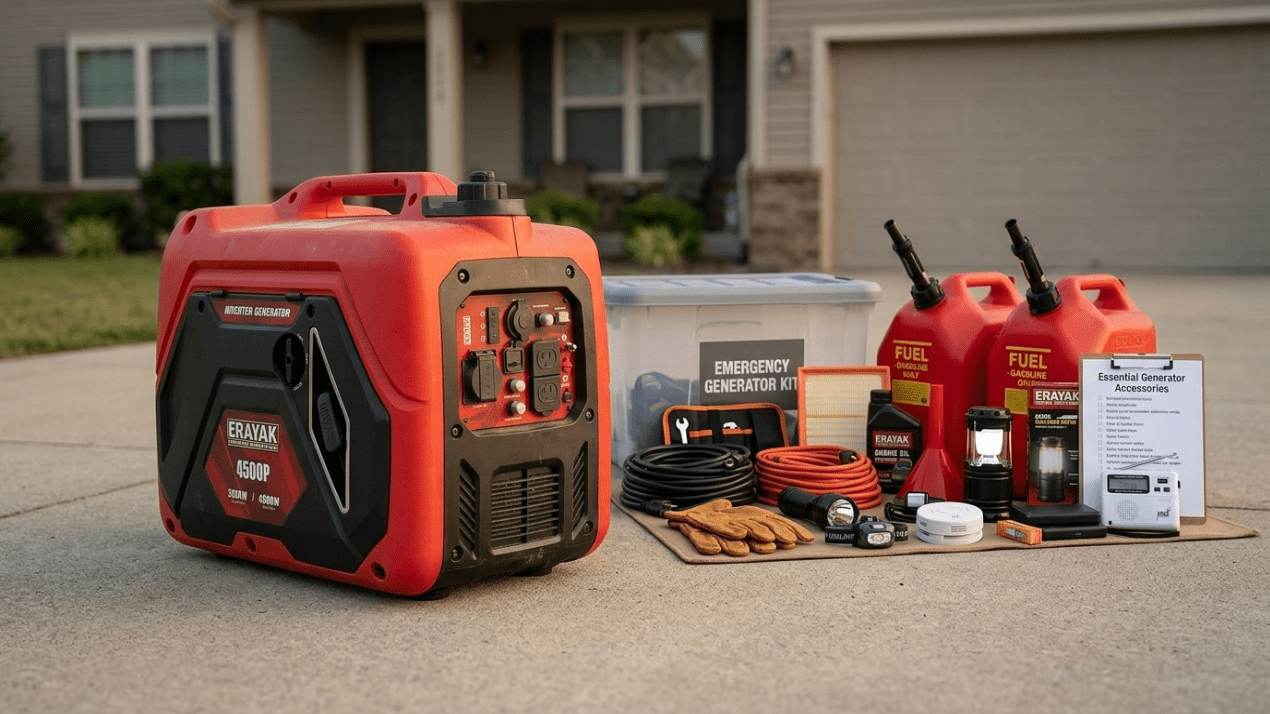
Essential Generator Accessories for Every Home Emergency Kit
A portable generator is only one part of a reliable home emergency power plan. The right generator accessories help you connect loads safely, keep cords organized, store fuel, maintain the generator, monitor carbon monoxide risk, and support your family during storms, outages, hurricanes, winter weather, and unexpected blackouts.
Quick Answer
The most essential generator accessories for a home emergency kit include properly rated outdoor extension cords, a transfer switch or inlet box planning path, carbon monoxide alarms, approved fuel containers, a fuel funnel or siphon, engine oil, spark plug, air filter, basic maintenance tools, flashlight or headlamp, weather cover for storage, wheel kit or transport aid, power strip only where appropriate, and a printed load plan.
For Erayak owners, the 2400P fits compact essentials such as phones, lights, fans, WiFi, laptops, and small electronics. The 4500P is a strong home-backup starting point for managed loads such as refrigerator, lights, router, fans, coffee maker timing, and small devices. The 4500PD adds gasoline and propane flexibility, while the 6800 series supports larger home, RV, 120V/240V, and 30A planning.
Why Generator Accessories Matter in a Home Emergency Kit
A generator can provide emergency power, but accessories determine how useful and safe that power is. During an outage, you may need to run a refrigerator, freezer, WiFi router, phone chargers, lights, fans, sump pump, medical device charger, or selected kitchen appliance. Without the right cords, fuel, safety alarms, and maintenance items, your generator may be harder to use when you need it most.
Power Gets Where It Needs to Go
Properly rated cords and connection planning help move power from the outdoor generator to selected indoor or outdoor loads safely.
You Can Stay Powered Longer
Fuel containers, oil, spare parts, and a load plan help you manage longer outages without guessing.
You Reduce Common Emergency Risks
CO alarms, dry cord routing, proper placement, and transfer switch planning help reduce carbon monoxide, shock, fire, and backfeeding hazards.
Must-Have Generator Accessories
Start your home emergency generator kit with the accessories that support safe operation, practical load management, and basic maintenance.
| Accessory | Why It Matters | Home Emergency Tip |
|---|---|---|
| Outdoor-rated extension cords | Connects generator power to selected appliances | Use grounded, intact cords rated for the load and distance |
| Carbon monoxide alarms | Helps warn of CO risk inside occupied spaces | Place working CO alarms inside the home, especially near sleeping areas |
| Approved fuel containers | Stores fuel for outage runtime | Label and store fuel away from living areas, heat, flame, and ignition sources |
| Fuel funnel or siphon | Reduces spills during refueling | Refuel only after the generator cools |
| Engine oil | Supports maintenance and longer use | Keep the correct oil type recommended by the generator manual |
| Spark plug and air filter | Supports troubleshooting and routine service | Store replacements in a labeled maintenance bag |
| Flashlight or headlamp | Helps with night setup and inspection | Use hands-free lighting when starting or checking the generator |
| Printed load plan | Prevents overload and confusion | List appliances by priority and rotate high-demand loads |
Extension Cords, Adapters, and Power Connection Planning
Cords are often the most overlooked generator accessory. A cord that is too light, damaged, too long for the load, or not rated for outdoor use can create safety and performance problems.
| Connection Accessory | Best Use | What to Avoid |
|---|---|---|
| Heavy-duty outdoor extension cord | Refrigerator, freezer, lights, fans, router, chargers | Thin indoor cords, frayed cords, loose plugs, damaged insulation |
| Generator power cord | Higher-load generator outlets where applicable | Wrong plug type, wrong amperage, damaged connectors |
| Adapter plug | Matching generator outlet to specific load or RV-style connection | Using adapters to exceed outlet, cord, or appliance ratings |
| Inlet box | Cleaner home connection when paired with proper transfer equipment | DIY wiring without a qualified electrician |
| Manual transfer switch | Safer selected-circuit home backup planning | Backfeeding through a wall outlet |
| Cord storage reel or bag | Keeps cords dry, organized, and easy to inspect | Tangled, wet, crushed, or unmarked cords |
Fuel Storage and Refueling Accessories
Fuel planning is part of emergency readiness. Store fuel safely, rotate it when needed, and make refueling easier with the right accessories.
| Fuel Accessory | Purpose | Emergency Kit Tip |
|---|---|---|
| Approved fuel can | Stores gasoline or approved fuel type | Use clearly labeled containers and store safely away from living areas |
| Fuel stabilizer | Helps support fuel storage planning | Follow product label and generator manual guidance |
| Funnel | Reduces spills during refueling | Keep it in a sealed bag to avoid dirt and water contamination |
| Siphon pump | Makes fuel transfer easier | Use carefully and store away from children and ignition sources |
| Fuel log card | Tracks fuel age and usage | Write purchase date, fuel type, and storage notes |
| Work gloves | Protects hands during setup and refueling | Use separate gloves for fuel handling and electrical setup |
Generator Maintenance Accessories
Your emergency kit should include small maintenance items before the outage starts. A generator that will not start after months of storage is usually a planning problem, not a storm problem.
| Maintenance Item | Why It Helps | Storage Tip |
|---|---|---|
| Correct engine oil | Supports oil changes and top-offs | Store the correct type recommended by the manual |
| Oil funnel | Reduces spills during service | Keep a dedicated funnel for oil only |
| Spark plug | Useful for troubleshooting poor starting | Store with spark plug socket or tool |
| Air filter | Supports clean intake airflow | Keep sealed from dust and moisture |
| Basic tool kit | Helps with inspection and small service tasks | Include wrench, screwdriver, pliers, socket, rag, and gloves |
| Maintenance log | Tracks oil changes, test runs, and storage prep | Write date, runtime, oil change, fuel status, and issues |
Lighting, Charging, and Household Emergency Supplies
Some generator accessories are not connected to the generator directly, but they make emergency power easier to use. During a blackout, your family needs lighting, communication, charging, and organization.
| Household Accessory | Use Case | Why It Belongs in the Kit |
|---|---|---|
| LED lanterns | Room lighting and safe walking paths | Reduces need to run many plug-in lights |
| Headlamps | Hands-free setup at night | Useful when checking oil, cords, and fuel |
| Power banks | Phone and small device backup | Can be recharged during generator runtime |
| Battery radio | Weather and emergency alerts | Works even when internet is down |
| Printed emergency contact list | Family and utility contact information | Useful when phone battery or internet access is limited |
| Storage bin with labels | Keeps accessories together | Reduces stress during night outages and storm prep |
Home Emergency Generator Kit Checklist
Use this checklist as a starting point for your home backup generator accessory kit. Adjust the list based on your generator model, appliances, fuel type, local weather risks, and family needs.
| Kit Category | Accessories to Include | Priority |
|---|---|---|
| Electrical connection | Outdoor-rated extension cords, correct adapters, cord bag, transfer switch planning | High |
| Safety | CO alarms, fire extinguisher, gloves, flashlight, dry plug storage, printed safety checklist | High |
| Fuel | Approved fuel cans, funnel, siphon, stabilizer, fuel log | High |
| Maintenance | Oil, oil funnel, spark plug, air filter, basic tools, rags, maintenance log | High |
| Lighting and charging | LED lanterns, headlamps, power banks, USB chargers, battery radio | Medium |
| Organization | Labeled waterproof bin, printed load plan, appliance wattage list, emergency contacts | Medium |
Recommended Erayak Setup by Home Emergency Need
Erayak 2400P: Compact Emergency Essentials
Choose the Erayak 2400P when your home emergency kit focuses on phones, power banks, LED lights, fans, WiFi router, laptop, small electronics, and compact backup needs.
- Best for compact home emergency power kits
- Good for charging, lights, fans, router, laptop, and small electronics
- Pair with outdoor-rated cords, CO alarms, fuel plan, and maintenance kit
Erayak 4500P: Home Backup Starting Point for Managed Loads
Choose the Erayak 4500P when your emergency kit needs more headroom for managed home loads such as refrigerator, freezer planning, lights, fans, WiFi, phone charging, laptop, coffee maker timing, and small household essentials.
- Gas-only portable inverter generator
- Manual recoil start
- 55 lb lightweight design
- 2.25 gal fuel tank
- Up to 8 hours runtime
- THD < 1.2% for sensitive electronics
- 60.5 dB noise level
Erayak 4500PD: Fuel Flexibility for Longer Outages
Choose the Erayak 4500PD when your home emergency kit benefits from gasoline and propane flexibility during longer outages, storm prep, hurricane season, winter weather, or mixed home and outdoor use.
- Gasoline and propane flexibility
- Useful for longer outage planning and flexible fuel storage
- Good fit for refrigerator, lights, fans, charging, WiFi, coffee timing, and managed emergency loads
Erayak 6800PD / 6800PT: Larger Home Backup, RV, 30A, and 120V/240V Planning
Choose the Erayak 6800 series when your emergency power kit needs more headroom, 30A outlets, selected 120V/240V planning, RV adapter support, pump planning, multiple power zones, and broader home backup overlap.
- 6800W peak power
- 5000W rated power on gasoline at 100% output
- 30A L5-30R outlet
- 30A 120V/240V L14-30R outlet
- Dual 120V household outlets
- TT-30R RV adapter accessory included
Generator Accessory Safety Checklist
Generator accessories should make your emergency setup safer, not more complicated. Keep your kit simple, labeled, dry, and easy to inspect before every outage season.
- Run the generator outdoors only, away from doors, windows, vents, garages, crawlspaces, basements, sheds, and enclosed spaces.
- Never run a generator indoors or in a garage, even with doors or windows open.
- Keep the generator away from people, pets, children, windows, vents, doors, and sleeping areas.
- Point exhaust away from the home, neighboring homes, and occupied areas.
- Use working carbon monoxide alarms inside the home.
- Use grounded, properly rated, outdoor extension cords.
- Inspect cords for fraying, cuts, crushed insulation, exposed wire, loose plugs, or missing ground pins.
- Do not use frayed, damaged, wet, crushed, or loose cords.
- Keep plug connections dry, elevated, and away from puddles, snow, wet grass, and rain runoff.
- Do not backfeed your home through a wall outlet.
- Use a properly installed transfer switch or have a qualified electrician plan the connection.
- Disconnect loads before starting the generator.
- Add loads gradually after the generator stabilizes.
- Rotate high-demand appliances such as coffee makers, microwaves, kettles, pumps, freezers, heaters, and cooking appliances.
- Let the generator cool before refueling or maintenance.
- Store fuel in approved containers away from flame, heat, stoves, grills, living areas, children, and ignition sources.
- Keep the user manual, maintenance log, load list, and emergency contacts in the same labeled kit.
Build Your Home Emergency Generator Kit Before the Next Outage
A reliable emergency power setup starts before the storm. Pair your portable generator with outdoor-rated cords, CO alarms, fuel storage, maintenance parts, lighting, charging gear, and a printed load plan. Choose Erayak 2400P for compact essentials, 4500P or 4500PD for broader home backup, and the 6800 series for larger home, RV, 30A, and 120V/240V planning.
FAQ: Essential Generator Accessories
What generator accessories should every home emergency kit include?
Every home emergency generator kit should include outdoor-rated extension cords, CO alarms, approved fuel cans, fuel funnel, engine oil, spare spark plug, air filter, basic tools, flashlight or headlamp, LED lanterns, power banks, maintenance log, and printed load plan.
Do I need a transfer switch for a portable generator?
A transfer switch is the safer path if you want to power selected home circuits. It should be installed by a qualified electrician. Do not plug a generator into a wall outlet to power your home.
What extension cord should I use with a generator?
Use grounded, outdoor-rated extension cords that are properly rated for the appliance load and cord distance. Inspect cords before use and never use frayed, cut, crushed, loose, or damaged cords.
Are carbon monoxide alarms necessary with a generator?
Yes. A portable generator must run outdoors only, but working CO alarms inside the home add an important layer of safety because carbon monoxide can be deadly and cannot be seen or smelled.
What maintenance items should I keep for a generator?
Keep the correct engine oil, oil funnel, spare spark plug, air filter, basic tools, gloves, rags, flashlight, and a maintenance log. Check your generator manual for model-specific service parts and intervals.
How should I store generator fuel for emergencies?
Use approved fuel containers, label them clearly, store them away from living areas, flame, heat, stoves, grills, and ignition sources, and follow fuel storage and rotation guidance from the fuel container, stabilizer, and generator manual.
What Erayak generator is best for a home emergency kit?
Choose the Erayak 2400P for compact emergency essentials, the Erayak 4500P or 4500PD for broader home backup with managed loads, and the Erayak 6800 series for larger home, RV, 30A, 120V/240V, and multi-zone emergency planning.
