

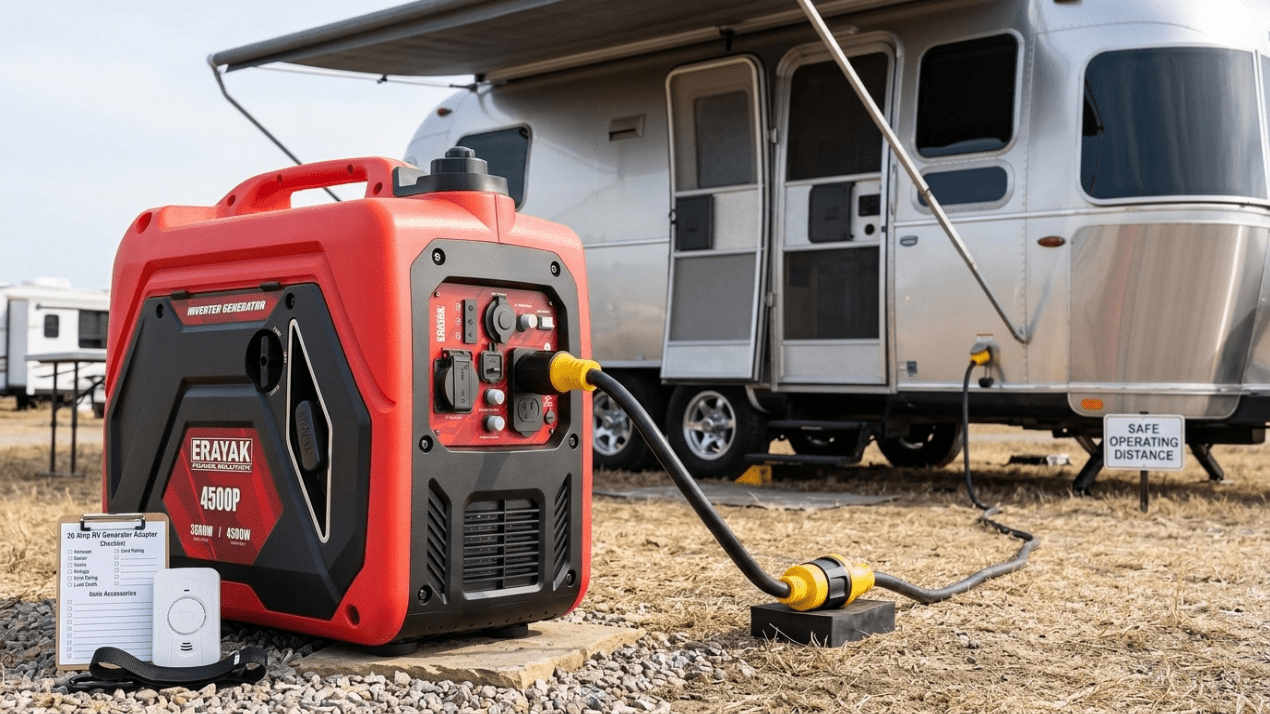
Quiet Generator for RV: 2026 Size, dB & AC Guide
A quiet generator for RV camping should do more than sound polite at the campsite. It needs enough wattage for your real RV loads, clean inverter power for electronics, a safe outdoor setup, and the right balance between portability, fuel choice, and air-conditioner starting margin.
Quick Answer: What Is the Best Quiet Generator for RV Use?
For most 30 amp RVs with one rooftop air conditioner, the best quiet generator is usually a 4,000W to 4,500W enclosed inverter generator. That class gives better startup margin for the RV AC while staying much quieter than many open-frame generators. For lighter RV loads such as battery charging, lights, fans, laptops, router, and small appliances, a 2,000W to 2,400W inverter generator can be the quieter and easier-to-carry solution.
Choose a small inverter generator when you mainly need charging, lighting, fans, and electronics.
Choose the 4,000W-4,500W class for one rooftop AC plus managed smaller loads.
Step up only when you need larger selected loads, 120V/240V planning, or backup crossover use.
Quiet RV Generator Size Chart
Start with the loads you actually need to run. A quiet generator that is too small can overload, run hard, and become less pleasant to use. A generator that is too large may cost more, weigh more, and be unnecessary for simple camping.
| RV Power Need | Practical Generator Range | Best Fit | What to Watch |
|---|---|---|---|
| Battery charging, lights, fans, router, laptops, phones | 2,000W-2,400W inverter | Small quiet camping generator | Not the default answer for standard rooftop AC. |
| Small camper or carefully managed AC setup | 3,000W-3,500W inverter | Possible middle ground | Hot weather, altitude, and converter load can make AC startup harder. |
| 30 amp RV with one rooftop AC plus managed comfort loads | 4,000W-4,500W inverter | Best all-around quiet RV range | Still sequence microwave, coffee maker, electric heater, and water heater. |
| Larger RV, two-AC planning, selected home backup crossover | 5,000W+ or 120V/240V platform | Capacity upgrade | More generator power does not remove the RV inlet or breaker limits. |
How Quiet Should an RV Generator Be?
For RV camping, a good quiet target is around 60 dB or lower when possible, but the number needs context. Generator noise changes with load, distance, surface, exhaust direction, maintenance, and whether the manufacturer measured at quarter load, half load, or rated load.
Typical quiet inverter-generator range for small to midsize units under lighter loads.
Still reasonable for larger enclosed inverter generators, especially compared with open-frame units.
Often too noticeable for close campsites, quiet hours, and RV parks with strict rules.
Decibel reminder: dB is logarithmic. A small-looking difference on the spec sheet can feel much bigger at a campsite.
Can a Quiet Generator Run an RV Air Conditioner?
Yes, but air-conditioner startup is usually the hard part. A rooftop RV AC can require a short surge before settling into lower running watts. That is why many 30 amp RV owners choose the 4,000W to 4,500W inverter class instead of relying on a smaller suitcase generator.
| RV AC Scenario | Generator Approach | Practical Guidance |
|---|---|---|
| No rooftop AC use | 2,000W-2,400W inverter may be enough | Good for quiet charging, fans, lights, and electronics. |
| One 13,500 BTU rooftop AC | 4,000W-4,500W inverter is often the safer RV range | Start the AC before adding large appliances. |
| One 15,000 BTU rooftop AC | 4,500W class with careful load management or soft-start planning | Heat, altitude, and battery converter load can affect startup. |
| Two rooftop AC units | Larger selected-load plan | This is a different problem than a basic quiet 30A RV generator. |
Do not stack heavy loads during AC startup. Avoid starting the air conditioner while the microwave, electric water heater, coffee maker, hair dryer, or electric heater is also running.
Quiet Generator vs Power Station for RV Camping
Some RV owners searching for a quiet generator actually need two different things: silent battery power for small indoor-safe loads and outdoor fuel-powered runtime for longer trips or larger appliances.
| Power Solution | Where It Wins | Limit |
|---|---|---|
| Battery power station | Silent operation, indoor-safe small electronics, phones, laptops, CPAP, lights | Limited by battery capacity and recharge access. Not a fuel generator. |
| Small inverter generator | Outdoor refuelable runtime for light RV loads and battery charging | Usually not the best choice for standard rooftop AC. |
| 4,500W-class inverter generator | Outdoor RV comfort loads, one rooftop AC, refrigerator, microwave sequencing | Still requires fuel, ventilation, load management, and campground-rule awareness. |
Best Erayak Matches for Quiet RV Power
Use the generator that fits the RV job. The quietest small generator is not automatically the right generator for a 30 amp RV with air conditioning.
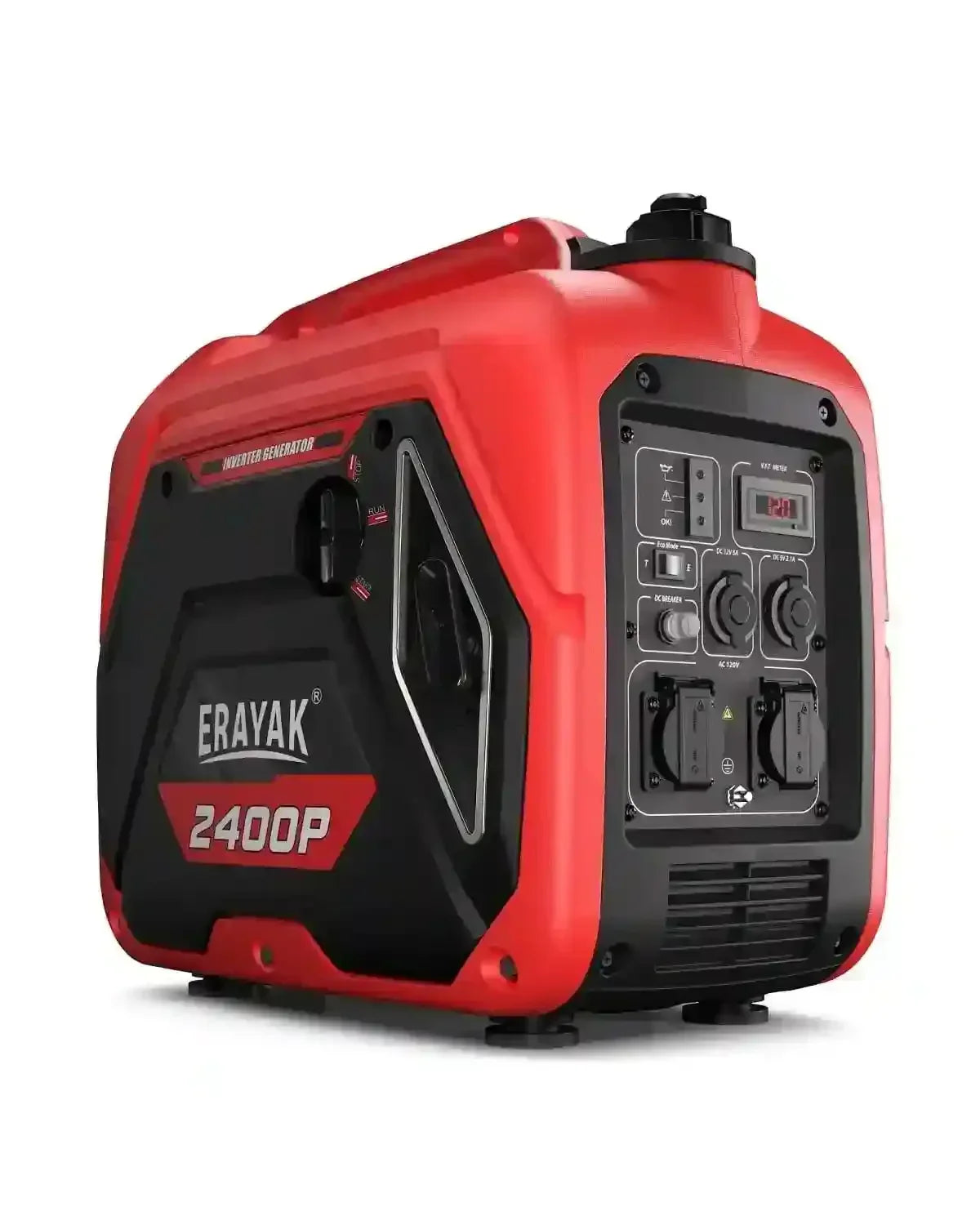
Erayak 2400P: Quiet Light-Load RV Companion
The 2400P is the best Erayak fit when quiet portability matters more than large RV comfort loads. Use it for lighter camping, battery charging, lights, fans, routers, laptops, phones, and compatible small devices.
- Good fit for light RV and camping loads.
- Easy to move compared with larger RV generators.
- Not the default pick for a standard rooftop RV AC.

Erayak 4500P: Gas-Only Quiet 30A RV Fit
The Erayak 4500P is the gas-only fit for RV owners who want the 4,500W class without propane. It is gas only, manual recoil start, 55 lb class, with a 2.25 gal fuel tank, up to 8 hours runtime, 60.5 dB, and THD below 1.2%.
- Best for gas-only 30A RV shoppers.
- Useful headroom for one rooftop AC with managed loads.
- Clean inverter output for RV electronics.

Erayak 4500PD: Dual-Fuel RV and Backup Flexibility
The 4500PD is the stronger Erayak fit when RV camping overlaps with propane planning, storm backup, refrigerator support, and longer outage preparation. It is the natural choice when dual-fuel flexibility matters.
- Gasoline plus propane flexibility.
- Strong fit for 30A RV comfort loads with careful sequencing.
- Better than a small generator for AC-heavy RV use.
Erayak 6800PD/PT: Larger RV and Home Backup Upgrade
Choose the 6800PD or 6800PT series when your RV power plan overlaps with 120V/240V planning, selected home circuits, sump pump, well pump, or larger backup loads. It is an upgrade path, not the quietest small camping option.
See the Erayak 6800PD/PT 120V/240V UpgradeQuiet RV Generator Buying Checklist
Choose inverter power for cleaner electricity for RV electronics, chargers, laptops, routers, and control boards.
Size for AC startup, converter load, refrigerator, microwave sequencing, and appliance habits.
Compare dB ratings only after checking measurement distance and load condition.
Gas-only is simple. Dual fuel adds propane flexibility for camping and outage planning.
Weight matters when loading, unloading, storing, and moving the generator around a campsite.
Check outlet type, cord rating, adapter path, and RV breaker limits before the trip.
Generator Safety for RV Camping
Never run a fuel generator indoors, inside an RV, in a tent, in a garage, in a storage compartment, under an awning, or near open windows, doors, or vents. Always operate outdoors with proper ventilation and follow the generator manual, RV manual, campground rules, and local safety requirements.
Use working carbon monoxide alarms inside the RV. Keep cords dry, rated for the load, and undamaged. Let the generator cool before refueling, and never use improvised wiring, unsafe adapters, or undersized extension cords.
FAQ: Quiet Generator for RV Camping
What is the best quiet generator for an RV?
For light RV loads, a 2,000W to 2,400W inverter generator can be the quietest practical choice. For most 30 amp RVs with one rooftop AC, a quiet 4,000W to 4,500W inverter generator is usually the better all-around fit.
How many watts do I need for a quiet RV generator?
For charging, lights, fans, and small electronics, 2,000W to 2,400W may be enough. For a 30 amp RV with one rooftop air conditioner, many owners should look at 4,000W to 4,500W and manage other large loads carefully.
Is a 2,000 watt generator enough for an RV?
It can be enough for light RV loads such as battery charging, lights, fans, laptops, and small devices. It is usually not the best single-generator answer for a standard rooftop RV air conditioner unless the setup is verified and carefully managed.
Will a quiet 4,500 watt generator run a 30 amp RV?
In many managed-load setups, yes. A 4,500W-class inverter generator can provide useful starting margin for one RV air conditioner and enough running output for selected smaller loads. It still will not let you run every heavy appliance at once.
How quiet should an RV generator be?
A good target is around 60 dB or lower when possible, but compare measurement conditions. Load level, distance, ground surface, exhaust direction, and maintenance all affect real-world noise.
Is dual fuel worth it for RV camping?
Dual fuel is worth considering if you want gasoline output plus propane storage flexibility. Gasoline often provides the strongest output, while propane can be convenient for RV trips and backup planning. Leave sizing margin for AC-heavy loads.
Can I run a quiet generator at a campground?
Only when campground rules allow it. Check quiet hours, generator-hour windows, noise limits, and placement rules before running any fuel generator, even a quiet inverter model.
Choose Quiet RV Power by Load, Not Just dB
The best quiet RV generator is the quietest model that still fits your real camping loads. Choose a small inverter generator for light RV power. Choose a 4,000W to 4,500W inverter generator when you need one rooftop AC plus managed 30 amp RV comfort loads. Step up only when your RV plan overlaps with larger backup needs.
