


Best Generator for Food Trucks in 2026: Quiet Power, Size Chart & Tri-Fuel Guide
A food truck generator has to do more than turn on. It needs enough starting watts for compressors, clean inverter power for POS systems, acceptable noise for events, and a fuel plan that works through a full service window.
Quick Answer: What Is the Best Generator for a Food Truck?
For many food trucks that use propane or gas for cooking, a quiet inverter generator with roughly 5,000W to 8,000W of usable generator capacity is a common planning range for refrigeration, ventilation, pumps, lights, POS equipment, and selected comfort loads. That range is not a substitute for a load calculation: add the watts of everything that runs together, then account for the largest compressor or motor startup event.
Within the current Erayak range, the 6800PD/6800PT platform is the strongest match when the truck's continuous load fits within 5000W rated output and its connections fit the 30A L14-30R or L5-30R outlets. Choose 6800PD for gasoline/propane operation; choose 6800PT only when approved natural-gas access is genuinely useful. The 4500PD is better for lighter 120V carts and concession trailers. A full electric kitchen, multiple fryers, or a 50A truck may require a larger commercial, shore-power, diesel, or battery system designed from the actual panel and equipment list.
A Food Truck Generator Is a Business Power System, Not a Jobsite Accessory
Searchers looking for a food truck generator are usually trying to solve four problems at once: wattage, noise, fuel, and reliability during service.
Compressor surge
Refrigerators, freezers, ice machines, pumps, and air conditioners can draw much more power at startup than they use while running.
Customer-facing noise
A loud open-frame generator can hurt ordering comfort and may be rejected by markets, events, office parks, or venue operators.
Electronics protection
Modern trucks often run POS tablets, routers, printers, smart controls, and card readers. Low-THD inverter output is the safer choice for sensitive electronics.
Fuel planning
Gasoline is common, propane is convenient for many mobile kitchens, and tri-fuel gives more flexibility when natural gas access is available.
Connection matching
Food trucks and concession trailers may use 120V, 30A, or 120V/240V setups. The generator outlet has to match the real inlet and load plan.
Downtime risk
If power fails during lunch rush or an evening event, the loss is not theoretical. Cooling, payment, lighting, ventilation, and food safety can all be affected.
What Size Generator Do You Need for a Food Truck?
There is no single wattage that fits every truck. Add the running watts for everything that may run together, then allow headroom for startup surge and hot-weather operation.
| Food truck load | Typical running watts | Startup / surge concern | Planning note |
|---|---|---|---|
| POS tablet, router, printer, LED lights | 100W to 400W | Low | Use clean inverter power to protect electronics and payment equipment. |
| Prep fridge or reach-in refrigerator | 300W to 900W | Medium to high | Check the compressor label. Startup can be several times running watts. |
| Freezer or ice machine | 500W to 1,500W | High | Do not size from running watts alone. |
| Water pump and hood/exhaust fan | 300W to 1,000W | Medium | Ventilation and pumps often run during the busiest service periods. |
| Small coffee cart or dessert trailer | 2,000W to 4,000W total | Depends on espresso, blender, refrigeration | 4500PD range may fit lighter setups after load review. |
| Typical mixed food truck or concession trailer | 4,000W to 6,000W total | High when AC and refrigeration overlap | 6800PD/PT range is the better Erayak starting point. |
| Heavy electric cooking, multiple fryers, 50A truck | 7,000W+ total | Very high | Have a qualified electrician or builder verify the panel, inlet, and true load before choosing a portable generator. |
Simple sizing method: list every device, write down running watts, identify motor/compressor loads, then add a practical headroom margin. If your equipment only lists volts and amps, watts are approximately volts multiplied by amps. Always use your actual appliance labels and manuals for final sizing.
The Best Food Truck Generator Should Meet These Six Requirements
1. Enough starting watts
Prioritize compressor and motor startup, not only the steady running number printed in a simple product title.
2. Quiet enclosed design
Food trucks operate near customers. A quiet inverter generator is usually more event-friendly than a loud construction-style unit.
3. Low-THD inverter output
Clean power is important for payment terminals, routers, smart controls, refrigeration electronics, and other sensitive devices.
4. Fuel flexibility
Propane can be attractive for mobile kitchens already carrying LPG for cooking. Tri-fuel adds natural gas capability when the site supports it.
5. Correct outlet planning
Match the generator to your truck inlet, cord, breaker, transfer equipment, and load plan. Do not assume a 30A generator is a 50A substitute.
6. Serviceable backup plan
A portable generator can be easier to service or replace than a built-in unit, but the tradeoff is that setup, storage, weather, and security must be planned.
What Is the Best Quiet or "Silent" Generator for a Food Truck?
No fuel-powered generator is truly silent. For customer-facing vending, an enclosed inverter generator is usually the better starting point, but the published dB number only helps when the test distance, load, and operating mode are comparable.
| Quiet-power factor | What to check | Why it matters for a food truck |
|---|---|---|
| Published sound rating | Distance, load percentage, Eco mode, and test method | Two dB numbers are not directly comparable when the test conditions differ. |
| Enclosed inverter design | Factory enclosure and variable-speed operation | Usually more customer-friendly than a construction-style open-frame unit. |
| Placement | Distance from staff, service windows, customers, doors, and air intakes | Moving the source away improves both sound and carbon-monoxide safety. |
| Vibration control | Stable level surface and manufacturer-approved mounting or isolation | Panel and body vibration can make a generator sound louder than its engine rating suggests. |
| Local limits | Venue, market, city, fire, and health-department requirements | A generator can be acceptable at one event and prohibited at another. |
Quiet does not mean close: OSHA advises keeping portable generators as far as possible from work areas and gathering spaces. Never move a generator beside the serving window just because it has an inverter enclosure.
Gas, Propane, or Tri-Fuel: Which Is Better for Food Trucks?
Fuel choice affects storage, refueling, runtime planning, output, and local compliance. Confirm event and local requirements before building a fixed operating routine.
| Fuel option | Best fit | Tradeoff | Erayak routing |
|---|---|---|---|
| Gasoline | Maximum rated output and familiar refueling | Storage smell, spill risk, stale fuel management | 6800PD/PT or 4500P/4500PD depending on load |
| Propane | Food trucks that already plan LPG storage for cooking | Output may be lower than gasoline; tank sizing matters | 4500PD, 6800PD, or 6800PT |
| Natural gas | Sites with approved natural gas access and professional setup | Not available everywhere; output can be lower than gasoline | 6800PT only |
Important: Do not connect a generator to a propane or natural gas system casually. Use the correct hose, regulator, shutoff, ventilation, and professional guidance required by the generator manual, local code, and event rules.
Inverter, Diesel, Battery, or Shore Power for a Food Truck?
The right power source depends on the menu, daily operating hours, available hookups, payload, noise rules, and whether cooking heat comes from electricity or fuel.
| Power source | Best fit | Main advantage | Main limitation |
|---|---|---|---|
| Portable inverter generator | Propane- or gas-cooking trucks with refrigeration, ventilation, pumps, lights, and POS loads | Portable, lower-noise class, and cleaner power for electronics | Must run outdoors; finite rated output and ongoing fuel/maintenance needs |
| Conventional open-frame generator | Budget or industrial locations where noise is less restrictive | More output per purchase dollar in some classes | Often less suitable near customers; compare noise, power quality, and venue rules |
| Diesel commercial generator | High-duty or built-in commercial applications designed around diesel | Can suit long-duty business use when professionally integrated | Higher weight, cost, installation, service, exhaust, and noise planning |
| Battery power station or mobile battery system | POS, lighting, low-to-medium loads, quiet hours, or a professionally designed hybrid setup | No combustion exhaust during battery operation and very low point-of-use noise | Limited by stored kWh, inverter output, recharge time, weight, and purchase cost |
| Shore power | Commissaries, food pods, events, or sites with a verified electrical hookup | No on-site generator exhaust or refueling | Availability, connector, voltage, amperage, and site billing vary |
Battery-system limit: A battery power station may cover light vending or selected circuits, but an all-electric kitchen can require a much larger engineered battery or shore-power system. Match both continuous watts and stored energy to the operating schedule.
Best Erayak Generator Picks for Food Trucks and Concession Trailers
These recommendations are based on practical food truck search intent: quiet operation, inverter power, fuel flexibility, and enough output for common mobile-kitchen loads.

ERAYAK 6800PD / 6800PT Inverter Generator
The 6800 series is the strongest current Erayak match for a food truck whose measured continuous load fits within 5000W rated output. Choose 6800PD when gasoline and propane are enough. Choose 6800PT only when approved natural-gas access is part of the operating plan. Both use the same 6800W peak / 5000W rated 120V/240V platform.
- 6800W peak output and 5000W rated running output.
- 6800PD: gasoline and propane; 6800PT: gasoline, propane, and natural gas.
- 30A 120V/240V L14-30R and 30A 120V L5-30R connection planning.
- Low-THD inverter output for electronics-friendly power.
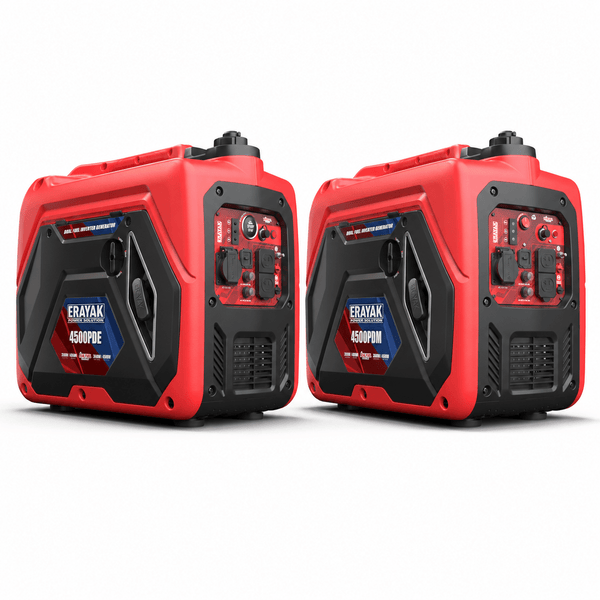
ERAYAK 4500PD Dual-Fuel Inverter Generator
The 4500PD is a better fit for smaller food carts, coffee trailers, dessert vendors, light concession setups, and operators who want propane flexibility without stepping into the larger 6800W platform.
- Dual-fuel operation with gasoline or propane.
- Useful for lighter 120V mobile-vending setups after load review.
- Published 60.5 dB noise rating; compare test conditions and local venue limits.
- Not the right choice for heavy electric cooking or oversized 50A setups.
Food Truck Generator Connection and Safety Notes
A generator that is powerful enough can still create carbon-monoxide, shock, fire, weather, and noise hazards if placement or connections are wrong.
Placement, CO, and fuel
- Never run a generator inside the truck, trailer, garage, tent, shed, or enclosed serving area.
- Wisconsin public-health guidance for food trucks recommends placing it as far away as possible, ideally 20 feet from the truck and people.
- Aim exhaust away from people, structures, service windows, doors, and air intakes.
- Install a working CO detector in the food truck.
- Turn the generator off and let it cool before refueling; keep fuel away from ignition sources.
Electrical and weather protection
- Use intact grounded outdoor cords, inlets, adapters, and breakers rated above the connected load.
- Keep the generator and connections dry; do not operate or handle electrical components while wet.
- Have a qualified electrician or food-truck builder verify 120V, 240V, 30A, 50A, grounding, and panel requirements.
- Do not connect directly to truck wiring unless the system was properly designed and installed for generator input.
- Confirm local health, fire, event, and venue rules before operation.
Sources: Review OSHA portable-generator safety guidance and the Wisconsin food-truck generator safety sheet.
Which Food Truck Generator Should You Choose?
| Your setup | Likely generator class | Best Erayak path | Why |
|---|---|---|---|
| Coffee cart, small dessert stand, light 120V loads | 4,000W to 5,000W class | 4500PD | Dual-fuel flexibility and quiet inverter power for lighter setups. |
| Standard concession trailer with fridge, fan, lights, POS, pump | 5,000W to 7,000W class | 6800PD or 6800PT | More headroom for compressor surge and more connection flexibility. |
| Truck wants propane plus possible natural gas use at approved sites | Tri-fuel inverter class | 6800PT | Gasoline, propane, and natural gas options in one 120V/240V platform. |
| Heavy electric fryers, multiple compressors, 50A service | Professional load design | Verify before purchase | A 6800W portable generator may not be enough for every heavy electric kitchen. |
Food Truck Generator Questions
What size generator do I need for a food truck?
Many small carts can work in the 4,000W to 5,000W class, while many mixed food trucks and concession trailers need a 5,000W to 7,000W class generator or larger. Heavy electric cooking, multiple compressors, or 50A service can require a larger commercial power plan. Always size from your actual appliance labels and startup requirements.
Is a 3,000 watt generator enough for a food truck?
Usually only for very light vending setups. A 3,000W generator can be too small once refrigeration, pumps, fans, lights, payment equipment, and compressor startup are included. For a true food truck kitchen, review the full load before assuming 3,000W is enough.
Is an inverter generator better for a food truck?
In most customer-facing food truck settings, yes. Inverter generators are usually quieter and provide cleaner power than traditional open-frame jobsite generators, which is helpful for POS systems, routers, smart appliance controls, and customer comfort.
Can I use a propane generator for a food truck?
Yes, if the generator supports propane and your setup follows the generator manual, local code, event rules, and safe fuel-handling practices. Propane is popular because many food trucks already plan LPG storage, but output may be lower than gasoline and tank sizing matters.
What is the best quiet generator for a food truck?
The best quiet option is typically an enclosed inverter generator sized for your real load. For Erayak buyers, the 6800PD/6800PT platform is the stronger fit when continuous load stays within 5000W rated output, while the 4500PD is better for smaller carts and lighter concession setups.
Can the ERAYAK 6800PT power a food truck?
It can be a strong fit for many food trucks and concession trailers, especially when the load fits within its 6800W peak and 5000W gasoline rated running output. It is not a universal answer for every heavy electric kitchen. Check your appliance loads, inlet type, voltage needs, and surge requirements before buying.
Can I run a generator near the food truck service window?
No. Keep fuel generators outdoors with proper ventilation and away from open windows, service windows, doors, vents, and customer areas. Carbon monoxide is dangerous, and generator placement should follow the manual, local rules, and venue requirements.
Is a diesel or battery system better for a food truck?
It depends on duty cycle and load. Diesel can suit professionally integrated high-duty systems. Battery power is quiet and produces no combustion exhaust during operation, but stored energy and inverter output can limit long service windows or electric cooking. Shore power is often best when a verified site hookup is available.
How much does a generator for a food truck cost?
Cost varies by rated output, inverter design, fuel type, duty rating, installation, cords, inlet equipment, weather protection, fuel, and maintenance. Price the complete power system after the load calculation rather than choosing the cheapest generator that lists enough peak watts.
Choose the Generator Around the Menu, Not the Other Way Around
If your truck loses power, you can lose refrigeration, payment processing, lighting, ventilation, and sales at the same time. Start with a real load list, account for compressor surge, choose clean inverter power, and match the generator to your fuel and connection plan.

