

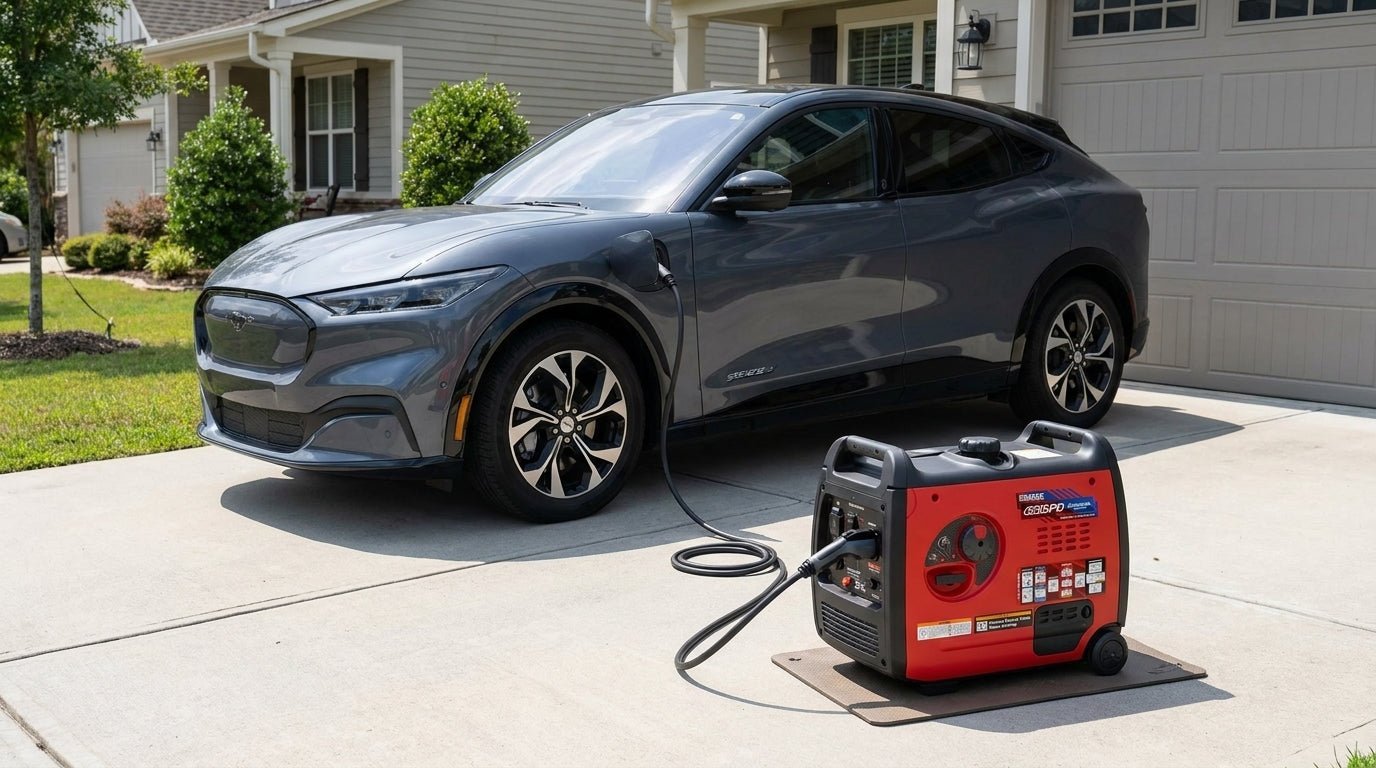
EV Generator Charging: Can You Charge an Electric Car Safely?
Yes, a compatible generator can charge an electric car, but portable setups are usually slow Level 1 emergency backups. Expect roughly 2 to 5 miles of range per charging hour, then confirm the generator, EVSE, grounding setup, cord, and vehicle will accept the session.
Can You Charge an Electric Car With an EV Generator?
Yes, an EV can charge from a compatible generator, but portable generator charging is best treated as a slow emergency or off-grid top-up. The realistic target is usually 120V Level 1 charging at about 10A or 12A, not rapid charging or a complete battery refill.
The U.S. Department of Energy says Level 1 charging typically adds about 2 to 5 miles of range per hour. Tesla lists a maximum 12A output for its Mobile Connector on a common 120V/15A circuit. Actual results still depend on the vehicle, charging losses, temperature, EVSE, and whether the generator power passes the charging system's safety checks.
Primary references: U.S. DOE Alternative Fuels Data Center charging guidance and Tesla Mobile Connector specifications.
What Is an EV Generator?
In this guide, an EV generator means an external portable generator supplying AC power to an EVSE while the vehicle is parked. It does not mean regenerative braking, an onboard range extender, a generator attached to a moving vehicle, or a portable DC fast charger. Those are different systems with different search intent and equipment.
Is EV Generator Charging Possible, Safe, and Worth It?
EV generator charging is possible, but it is not automatically practical. A portable generator can supply AC power to an EVSE, and the EVSE can pass that power to the vehicle if the voltage, frequency, grounding behavior, current limit, and power quality are acceptable. If one of those checks fails, the EV may refuse to charge.
The best use case is emergency range recovery: adding enough miles during an outage, remote stop, storm, campsite stay, or off-grid situation to reach a normal charger. The worst use case is trying to use a fuel generator as a daily EV charging replacement.
The setup is compatible
Use a stable inverter generator, a compatible EVSE, proper current settings, a correctly rated cord, and outdoor generator placement.
The goal is fast charging
Most portable generators are not realistic fast chargers. Level 1 is slow, and higher-power Level 2 charging requires careful 120V/240V planning.
Compatibility and safety faults
EVSE units may reject generator power because of grounding, floating neutral behavior, GFCI interaction, voltage drop, overload, or unstable output.
How Charging an EV With a Generator Works
Your generator does not charge the EV battery directly. The generator supplies AC power to the EVSE. The EVSE communicates the available current, and the EV onboard charger converts AC power into DC power for the battery. If the source does not pass safety checks, the vehicle or EVSE may refuse to charge.
1. Generator output
An inverter generator is the preferred portable source because it is designed to provide cleaner, more stable AC output than many traditional open-frame jobsite generators. That matters because EV charging is a long, steady electrical load.
2. EVSE current limit
The EVSE controls how many amps the vehicle can draw. On a 120V generator setup, many owners start at 10A or 12A to avoid overload and voltage drop.
3. Vehicle acceptance
The car and EVSE must accept the voltage, frequency, wiring condition, ground reference, and available current. If a safety check fails, charging may stop or never begin.
What Size Generator Do You Need to Charge an Electric Car?

The generator size depends on voltage and amperage. For portable emergency charging, the realistic target is usually 120V Level 1 charging. Larger 120V/240V generators can support more advanced plans, but only when the EVSE amperage is adjustable and the generator's rated output is respected.
Do not size from peak watts alone. EV charging is a sustained load, so the generator's continuous rated output, outlet rating, cord rating, and EVSE current setting matter more than the biggest number on the box.
| Charging Setup | Approximate Draw | Generator Class | Best Use Case |
|---|---|---|---|
| 120V at 10A | About 1200W | 2400W+ inverter generator | Emergency top-up Slower charging with more generator headroom. |
| 120V at 12A | About 1440W | 3000W-4500W inverter generator | Best portable fit Practical for 4500PD-style emergency charging. |
| 120V at 16A | About 1920W | 4500W+ inverter generator | Check first EVSE, outlet, cord, and generator rating must all support sustained charging. |
| 240V at 16A | About 3840W | 120V/240V generator with correct L14-30R planning | Advanced setup Requires compatible adjustable EVSE, correct adapter plan, and careful grounding checks. |
| 240V at 24A | About 5760W | Larger than many 6800W peak portable inverter generators can sustain | Do not assume 24A Level 2 can exceed the rated output of this portable generator class. |
Formula: volts x amps = watts. For example, 120V x 12A = about 1440W. 240V x 24A = about 5760W, which is above the 5000W gasoline rated output of the ERAYAK 6800PT.
Important sizing rule: leave headroom. If the EVSE is drawing 1440W continuously, do not also run a refrigerator, heater, microwave, or other heavy load on the same portable generator during the charging session.
Why Level 1 Is the Realistic Portable Generator Setup
Most EV owners searching this topic are not trying to build a permanent charging station. They want to know whether a portable generator can add emergency miles when the grid is down, when they are off-grid, or when they need a backup option.
Best fit for portable emergency charging
Level 1 charging uses 120V power and a portable EVSE. It is slow, but it is realistic for a 4500W-class inverter generator because the current can often be reduced to 10A or 12A.
- Good for emergency range recovery.
- Works with many portable EVSE setups when compatibility checks pass.
- Requires patience, fuel planning, and outdoor generator operation.
Possible only with careful planning
Level 2 generator charging uses 240V and a compatible EVSE. It can be faster, but the EVSE current must be set below the generator's rated output, not just below peak wattage.
- Requires 120V/240V generator output.
- Requires correct EVSE and adapter compatibility.
- 24A Level 2 is often too much for this generator class.
Simple expectation check
At 120V and 12A, the charging draw is about 1.4 kW before losses. The U.S. Department of Energy's general Level 1 guidance is about 2 to 5 miles of range per charging hour. A generator session can therefore add useful emergency range over several hours, but it will not quickly refill a large EV battery.
Grounding, Floating Neutral, and EVSE Faults
Many generator EV charging failures are not caused by wattage. They happen because the EVSE does not like the generator's grounding or neutral configuration. Some portable generators use a floating neutral, while some EVSE units expect a bonded neutral reference before charging.
| Symptom | Possible Cause | What to Do |
|---|---|---|
| EVSE shows ground fault or refuses to start | Floating-neutral generator or ground reference issue | Check the generator manual and EVSE manual. Use only listed bonding equipment when the setup specifically requires it. |
| Generator breaker trips | EVSE amperage set too high | Lower the EV charging current, such as 10A or 12A on 120V, then restart the session. |
| Charging starts, then stops | Voltage drop, overload, poor extension cord, heat, or unstable load | Use a shorter properly rated outdoor cord, reduce current, and avoid running other loads on the generator. |
| EV or EVSE reports abnormal power | Power-quality or compatibility issue | Stop the test. Do not force charging. Review the manuals and use a compatible inverter generator and EVSE. |
Important: Do not describe a neutral-ground bonding plug as a universal fix. Grounding and bonding depend on the generator, EVSE, transfer equipment, GFCI behavior, and local code. If you are unsure, consult a qualified electrician before using any neutral-ground bonding accessory.
Safe Generator-to-EV Charging Checklist
Use this checklist before trying a portable generator EV charging session.
1. Confirm EV and EVSE instructions
Read your vehicle manual and EVSE manual. Some chargers have specific generator, grounding, adapter, GFCI, and extension-cord requirements.
2. Use an inverter generator
For EV charging, choose stable inverter power instead of a rough construction-generator setup. The vehicle may reject poor power quality.
3. Set charging current low first
Start at a reduced amperage such as 10A or 12A on 120V. Increase only if the generator, cord, outlet, EVSE, and vehicle all support the load.
4. Use a properly rated cord
If an extension cord is required, use a grounded outdoor-rated cord with the correct gauge and length for sustained EV charging. Avoid light indoor cords.
5. Keep generator loads simple
Do not run other heavy loads while charging the EV. EV charging is a steady load, so leave generator headroom.
6. Monitor the first session
Watch for breaker trips, EVSE errors, hot plugs, voltage warnings, unusual generator behavior, or fuel/runtime limits. Stop if anything behaves abnormally.
Which Erayak Generator Fits EV Charging?
Match the generator to the charging goal. For most portable EV generator searches, the best answer is not fastest charging. It is safe, reliable emergency top-up charging.
Erayak 4500PD for 120V Level 1 Emergency EV Top-Ups
The Erayak 4500PD is the natural fit for the use case shown in the Tesla test: portable inverter generator power for 120V Level 1 emergency charging at a reduced amperage such as 10A or 12A. It is also useful when propane flexibility matters for outage preparedness, camping power, or emergency planning.
- Best for slow emergency EV charging, not daily charging.
- Good match for portable EVSE use when the EV accepts the setup.
- Keep charging current within the generator, cord, outlet, and EVSE limits.

ERAYAK 6800PT for 120V/240V Tri-Fuel Backup Planning
The ERAYAK 6800PT is the larger planning path when EV charging is only one part of a broader outage plan. It offers 6800W peak and 5000W gasoline rated output with a 120V/240V L14-30R outlet. It still requires an adjustable, compatible EVSE and careful current limits.
- Better fit when 120V/240V backup planning matters.
- Do not assume 24A Level 2 charging, because 240V x 24A is about 5760W.
- Use EVSE settings that stay within rated generator output.
- The 6800PT is tri-fuel; do not confuse it with the dual-fuel 6800PD.

Can This 54lb Generator Charge a Tesla? ERAYAK 4500PD Test
Erayak filmed a real-world test of the Erayak 4500PD charging a Tesla. The useful takeaway is not that a portable generator should replace normal EV charging. The takeaway is that a compatible inverter generator can support slow emergency EV charging when the EVSE accepts the source and the charging current is kept conservative.
Emergency Level 1 charging
A compatible inverter generator can add range slowly when the car, EVSE, generator, and grounding setup all accept the charging session.
Not daily EV charging
Generator charging is slower, fuel-dependent, and less efficient than grid charging. It makes the most sense as backup power during outages, remote stops, or emergencies.
EVSE compatibility
Some EVSE units reject generator power because of voltage, frequency, grounding, neutral reference, GFCI behavior, or adapter issues.
What Not to Do When Charging an EV With a Generator
EV generator charging is possible, but forcing the wrong setup is a bad idea. Follow the CPSC portable-generator carbon-monoxide guidance and treat every failed charge attempt as useful safety feedback.
Do not run the generator indoors
Operate a fuel generator outdoors only, at least 20 feet from the home, garage, RV, doors, windows, and vents, with exhaust directed away. Never use one inside a garage, home, shed, RV, carport, or other enclosed or partly enclosed area. Use working carbon-monoxide alarms.
Do not bypass safety faults
If the EVSE reports a ground fault or power error, do not keep forcing the session. Stop and identify the compatibility issue.
Do not overload the generator
EV charging is a sustained load. Set the EVSE amperage below the generator's continuous rating and leave headroom.
Do not store fuel unsafely
Transport and store fuel only according to the fuel container, vehicle, local-code, and generator manual instructions. Do not carry leaking, unvented, or unsafe fuel containers in a passenger area.
Bottom Line
You can charge an electric car with a portable generator, but the practical use case is narrow: slow emergency charging from a compatible inverter generator setup. Erayak's 4500PD Tesla test supports that emergency-use case, but it should not be framed as a daily charging replacement.
The right expectation matters. A portable generator is not a public fast charger and not the cheapest daily EV charging source. It is a backup power tool. Use a compatible inverter generator, set the EVSE current conservatively, follow EV and EVSE manuals, solve grounding issues properly, and always operate the generator outdoors with proper ventilation.
FAQ: Charging an EV With a Portable Generator
What is an EV generator?
An EV generator usually means an external portable generator used to supply AC power to an EVSE while the electric car is parked. It is different from an onboard range extender, regenerative braking, or a generator attached to a moving vehicle.
Can you charge an electric car with a generator?
Yes. You can charge an electric car with a compatible inverter generator, but it is best for emergency or off-grid top-up charging. The EVSE amperage, generator output, grounding setup, and vehicle compatibility must all be correct.
Is an EV generator a good idea for daily charging?
Usually no. A generator for EV charging is better as an emergency backup or off-grid top-up option. Daily EV charging is normally better handled by a home Level 2 charger, public charging, or a planned charging stop because generator charging is slower, fuel-dependent, noisy, and less efficient.
Can you charge a Tesla with a generator?
Yes, a Tesla can charge from a compatible inverter generator setup. Erayak's 4500PD Tesla test demonstrates the practical emergency Level 1 use case, but owners should still follow Tesla and EVSE instructions and monitor the session.
What size generator do I need to charge an EV?
For 120V Level 1 emergency charging, a 3000W to 4500W inverter generator is a practical range because it can support 10A to 12A charging with headroom. Smaller generators may work at reduced amperage, while 240V charging requires a larger 120V/240V setup and an adjustable compatible EVSE.
Can you use a portable generator for EV charging?
Yes, if the portable generator is properly sized, produces stable inverter power, uses the correct outlet and cord setup, and the EVSE accepts the grounding and power quality. Most portable setups should be treated as slow Level 1 emergency charging.
How fast can a generator charge an EV?
A typical 120V Level 1 session adds about 2 to 5 miles of range per charging hour. Actual generator results depend on the EV, charging losses, temperature, current setting, and whether the EVSE accepts the generator power.
Is an inverter generator better for EV charging?
Yes. An inverter generator is usually the better portable choice because EV charging equipment expects stable power. A rough or unstable generator output can cause the EVSE or vehicle to reject the charge.
Do I need a neutral-ground bonding plug to charge an EV from a generator?
Sometimes, but not always. Some EVSE units require a bonded-neutral reference and may reject a floating-neutral generator. Check your generator manual and EVSE instructions, and use only appropriate listed equipment when the setup requires it.
Can I use a generator to charge an EV indoors or in a garage?
No. Operate a fuel-powered generator outdoors only, at least 20 feet from the home, garage, RV, doors, windows, and vents, with exhaust directed away. Never run one indoors or in any enclosed or partly enclosed area.
Can I charge an EV while driving using a generator?
No. EVs are designed to charge while parked. Do not attempt to charge an EV while driving or while the generator is inside or attached to the vehicle in an unsafe way.
