

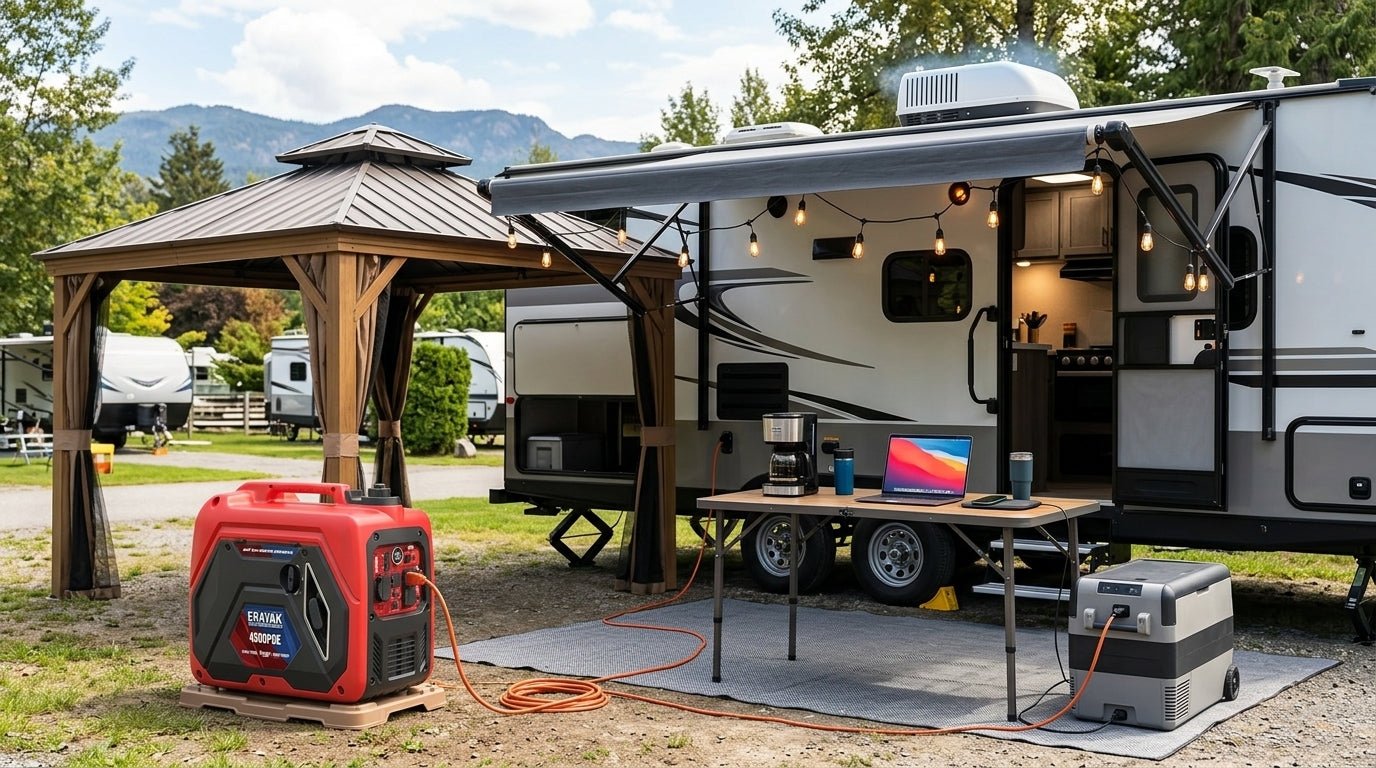
Best 30 Amp Inverter Generator for RV Camping
Choosing a 30 amp RV generator is not just about peak watts. The right inverter generator should be quiet, RV-ready, portable, fuel-efficient, and powerful enough for real camping loads.
 For 30 amp RV owners, the best generator is the one that balances clean power, noise, portability, fuel choice, and real-world camping loads.
For many 30 amp RV owners, a quiet inverter generator in the 4,000–4,500 watt class is the practical sweet spot for RV camping, AC support, boondocking, and weekend travel.
Choose a gas-only inverter generator if you want simple portable power. Choose a dual-fuel model if you want gasoline and propane flexibility. Choose a higher-output dual-fuel or tri-fuel generator if you want one generator for both RV use and home backup.
What Makes a Generator “30 Amp RV-Ready”?
A 30 amp RV-ready generator is not just a generator with a large wattage number. For RV use, the full setup matters: outlet type, adapter compatibility, running watts, startup surge, clean inverter output, noise level, and portability.
Many 30 amp RVs use a TT-30 style shore power connection. Some portable inverter generators use a 30A locking outlet and require the correct RV adapter. That is normal, but it is important to confirm compatibility before buying.
Outlet + Adapter
Confirm whether your RV cord connects directly or needs a proper RV adapter, such as L5-30P to TT-30R.
Running + Surge Watts
Running watts support continuous loads. Surge watts help start motor-driven appliances like an RV air conditioner.
Noise + Portability
A campground generator should be quiet enough to use around people and light enough to move without frustration.
Buyer tip: Do not choose a generator by peak watts alone. Check outlet compatibility, running wattage, surge capacity, THD, runtime, and real-world portability.
How Many Watts Do You Need for a 30 Amp RV?
A 30 amp RV can theoretically draw up to about 3,600 watts at 120V. In real camping use, however, the right generator choice depends on what you plan to run at the same time and whether your largest appliances need extra starting power.
Common RV loads include an air conditioner, refrigerator, converter/charger, microwave, coffee maker, lights, TV, laptop, and small electronics. The RV air conditioner is usually the most important load because it may need a higher startup surge than its normal running wattage.
 A 30 amp RV generator should be chosen around real loads, not peak wattage claims alone.
Practical rule: For many 30 amp RV owners, the goal is not to buy the smallest generator that can barely start the AC. The better goal is to choose a quiet inverter generator with enough headroom for the AC, refrigerator, charger, lights, and small appliances.
For an AC-specific breakdown, link this section to your existing guide on what size generator you need for a 13,500 or 15,000 BTU RV air conditioner.
Why an Inverter Generator Is Better for RV Camping
For RV camping, an inverter generator is usually a better fit than a traditional open-frame generator. The main advantages are quieter operation, cleaner power, and better fuel efficiency at lower loads.
Better for Campgrounds
Inverter generators are typically designed for quieter operation, which makes them a better match for RV parks, camping areas, and nearby neighbors.
Better for Electronics
Low-THD inverter output is better suited for phones, laptops, TVs, chargers, and other sensitive electronics commonly used in RVs.
Smarter Fuel Use
Many inverter generators can adjust engine speed based on load, helping reduce fuel waste when demand is lower.
Easier to Move
For weekend travel and RV storage, weight and portability matter almost as much as wattage.
Gas vs Dual Fuel vs Tri-Fuel: Which Is Better for RV Owners?
Fuel type is one of the biggest decisions when buying a 30 amp RV generator. There is no single best answer for every RV owner. The right choice depends on how you camp, how often you travel, and whether you also want to use the generator for home backup.
| Fuel Type | Best For | Main Advantage | Erayak Product Direction |
|---|---|---|---|
| Gas Only | Weekend RV camping, tailgating, simple portable power | Simple operation, lighter setup, easy refueling | Erayak 4500P |
| Dual Fuel | RV camping, boondocking, propane users, backup flexibility | Gasoline + propane flexibility | Erayak 4500PD / 6800PD |
| Tri-Fuel | RV owners who also want stronger home backup planning | Gasoline + propane + natural gas flexibility | Erayak 6800PT |
 Gas-only, dual-fuel, and tri-fuel generators each fit a different RV and backup power use case.
Best 30 Amp Inverter Generator by Use Case
Instead of choosing only by peak wattage, match the generator to how you actually use your RV. A weekend camper, a long-term boondocker, and a homeowner who also wants backup power may need different solutions.
Erayak 4500P Gas Inverter Generator
Lightweight Gas OptionBest for RV owners who want simple, portable, gas-only inverter power for weekend camping, smaller travel trailers, tailgating, and essential portable power.
- 4500W peak power
- Gasoline only
- Manual recoil start
- 55.12 lb portable design
- 2.25 gal fuel tank
- Up to 8 hours runtime
- 60.5 dB noise level
- THD < 1.2%
- 30A L5-30R outlet with TT-30R RV adapter compatibility
Erayak 4500PD Dual-Fuel Inverter Generator
Fuel FlexibilityBest for RV owners who want the option to run on gasoline or propane for camping, boondocking, emergency backup, and longer trips.
- 4500W peak power
- Gasoline + propane operation
- 30A RV-ready output
- 62 dB at 25% load
- Suitable for RV camping, outdoor use, portable AC, and home essentials
Erayak 6800PD Dual-Fuel Series
RV + Backup UpgradeBest for users who want more output, 120V/240V capability, dual-fuel flexibility, and stronger crossover use between RV camping and home backup.
- 6800W peak power
- 5000W rated power under gasoline at 100% output
- 30A L5-30R outlet
- 30A 120V/240V L14-30R outlet
- TT-30R adapter accessory for RV connection
- Dual 120V household outlets
Erayak 6800PT Tri-Fuel Series
Maximum Fuel OptionsBest for RV owners who also want long-term home backup flexibility with gasoline, propane, and natural gas capability.
- 6800W peak power
- Tri-fuel support
- 120V/240V capability
- 30A RV connection via included TT-30R adapter accessory
- Strong fit for RV plus home backup planning
Important product accuracy: The Erayak 4500P is gas only. Do not describe it as dual-fuel, propane-ready, electric start, or remote start. For the 6800 series, avoid using 50A outlet claims or 5500W rated output.
Common Mistakes When Buying a 30 Amp RV Generator
Only Looking at Peak Watts
Peak watts help with startup surge, but running watts determine what the generator can support continuously.
Ignoring AC Startup Surge
RV air conditioners often need extra starting power. Leave enough headroom instead of running at the limit.
Buying a Loud Generator
A loud open-frame generator may be acceptable on a job site, but it can ruin the camping experience.
Confusing 30A Outlets
L5-30R, TT-30R, and L14-30R are not the same. Confirm the correct adapter and connection setup.
 The most expensive RV generator mistake is buying for wattage alone without checking noise, outlet compatibility, surge capacity, and portability.
Which 30 Amp RV Generator Should You Choose?
The best 30 amp inverter generator for RV camping depends on your actual use case.
Choose Erayak 4500P
Best if you want a simple, lightweight, gas-only inverter generator for weekend RV camping and portable power.
Choose Erayak 4500PD
Best if you want gasoline and propane flexibility for RV camping, boondocking, and backup use.
Choose Erayak 6800 Series
Best if you want higher-output inverter power, 120V/240V capability, and stronger home backup flexibility.
Compare Erayak Inverter Generators for RV Camping
Whether you need a lightweight gas inverter generator for weekend RV trips, a dual-fuel option for propane flexibility, or a higher-output generator for RV and home backup, Erayak offers portable inverter power built for real-world use.
30 Amp RV Inverter Generator FAQ
What size generator do I need for a 30 amp RV?
Many 30 amp RV owners choose an inverter generator in the 4,000–4,500 watt class because it offers a practical balance of RV air conditioner support, appliance use, portability, and quiet operation. Your exact needs depend on your RV air conditioner size, appliance loads, and how many devices you run at the same time.
Is a 4500 watt generator enough for a 30 amp RV?
A 4500 watt inverter generator can be enough for many 30 amp RV setups, especially when loads are managed properly. Always check your specific RV air conditioner startup demand and appliance wattage before relying on any generator.
Can a 30 amp inverter generator run an RV air conditioner?
Yes, many 30 amp inverter generators can run an RV air conditioner, depending on the generator’s running watts, surge capacity, and the air conditioner’s startup requirements. A soft start device may also reduce AC startup surge in some RV setups.
Is dual fuel worth it for RV camping?
Dual fuel can be worth it if you want the flexibility to run on gasoline or propane. Gasoline is easy to find during travel, while propane is convenient for storage and already common in many RV setups.
Do I need a 50 amp generator for a 30 amp RV?
Usually no. If your RV is a 30 amp model, your priority should be choosing a properly sized 30 amp RV generator with enough running power, surge capacity, clean inverter output, and the right adapter setup.
Can I use the same generator for RV camping and home backup?
Yes, but choose carefully. A smaller inverter generator may be excellent for RV camping and essential backup loads, while a larger dual-fuel or tri-fuel generator may be better if you want to support more home backup needs during outages.


