

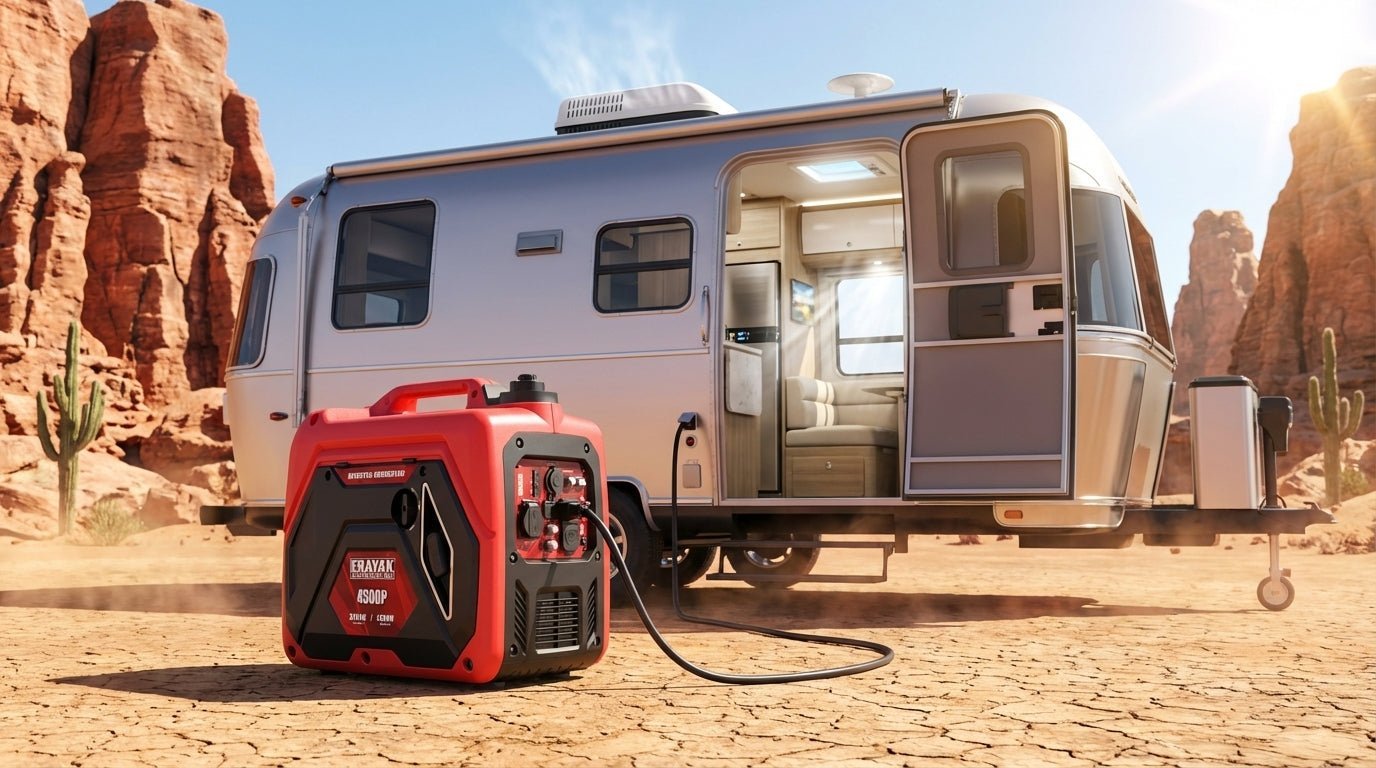
Best RV Generator for Running an AC: 13,500 & 15,000 BTU Guide
The best RV generator for running an air conditioner is not simply the biggest generator you can carry. It is the quiet inverter generator that can start your RV AC, stay within your 30A RV limits, leave room for essential loads, and still make sense for your camping style.
Quick Answer: Best RV Generator for Running an Air Conditioner
For most travel trailers with one 13,500 BTU rooftop AC, a 4,000W to 4,500W inverter generator is the best practical size. It gives enough startup headroom for the AC while still staying portable and campground-friendly. The Erayak 4500PD is the main dual-fuel fit for this use case.
For a 15,000 BTU RV AC, choose more margin or use a soft start. A 4,500W-class generator can work in some 15k BTU setups, especially with soft start and careful load management, but hot weather, altitude, converter load, and microwave use can push it over the edge. The Erayak 6800PD/PT series is the upgrade path when you want more capacity for larger RV or home backup planning.

RV AC Generator Size Chart: 13,500 vs 15,000 BTU
RV air conditioners are compressor loads. They need a short startup surge to start the compressor, then lower running watts to keep cooling. The exact number depends on the AC model, temperature, altitude, wiring, and whether a soft start is installed.
| RV AC Size | Typical Running Watts | Typical Starting Watts | Best Generator Match | Buying Guidance |
|---|---|---|---|---|
| 11,000 BTU | 1,100-1,600W | 2,200-3,000W | 3,000W-4,500W inverter | Easy match Good for smaller campers and lighter AC loads. |
| 13,500 BTU | 1,400-2,000W | 2,800-3,800W | 4,000W-4,500W inverter | Best 4500PD fit Ideal target for one AC plus managed essentials. |
| 15,000 BTU | 1,600-2,400W | 3,300-4,500W+ | 4,500W with soft start, or larger generator | Check carefully Hot weather and extra loads can require more margin. |
| Two RV AC units | 3,000-4,800W+ | High surge if unmanaged | Larger selected-load plan | Not a simple 4500W job Requires load sequencing, soft start, or higher-capacity planning. |
If your RV AC nameplate shows amps instead of watts, use this formula: volts x amps = watts. A standard 30A RV service is 120V, so the theoretical maximum is 3,600W before losses and load-management concerns.
Best Erayak Generators for Running an RV Air Conditioner
The right Erayak choice depends on AC size, fuel preference, and how many other loads you expect to run while the AC cycles.
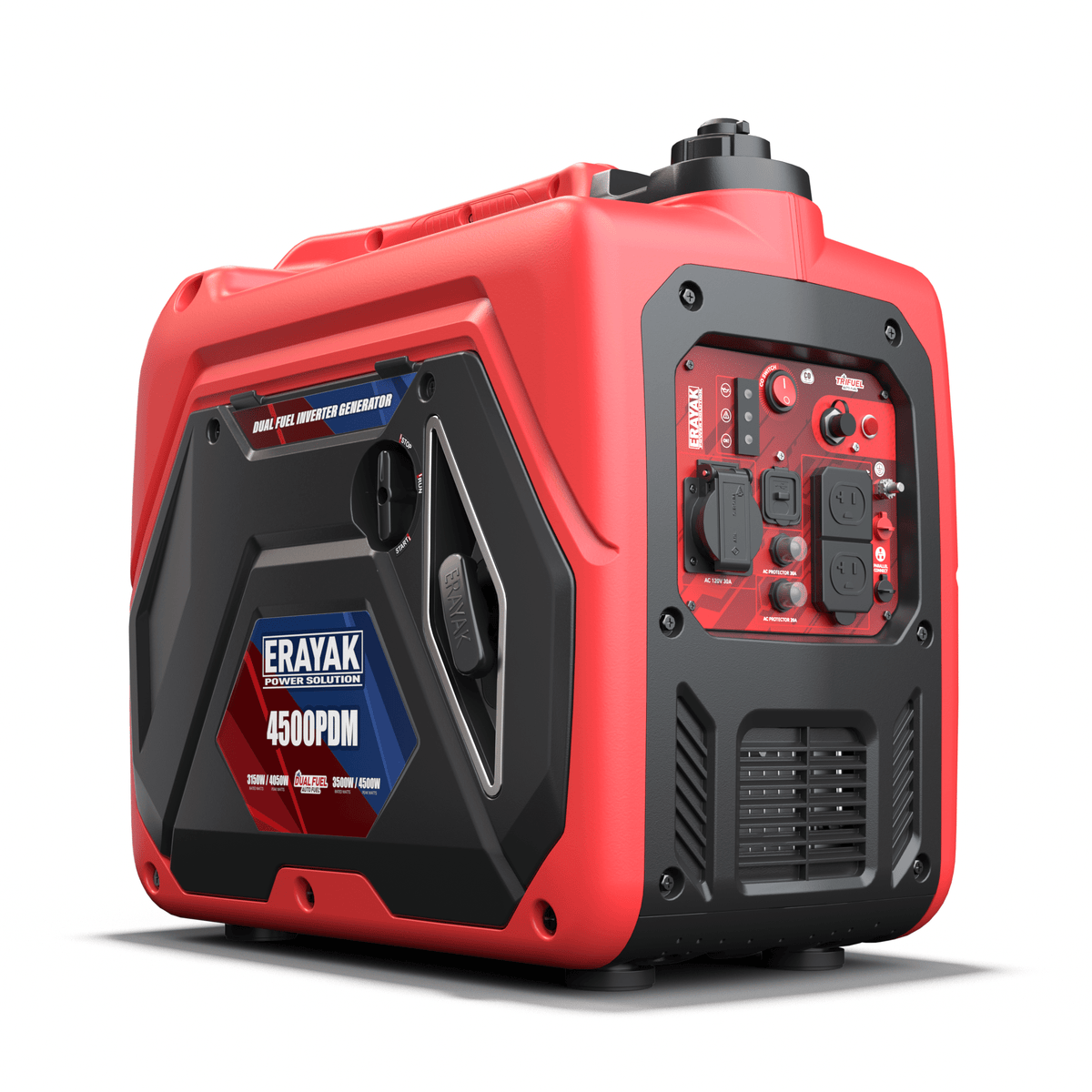 Erayak 4500PD for 13,500 BTU RV AC and Dual-Fuel Camping
The Erayak 4500PD is the primary recommendation for most RV owners who want to run one rooftop AC while keeping propane flexibility for camping and outage preparation. It is the natural fit for 13,500 BTU RV AC users and many managed 15,000 BTU setups when load management is realistic.
- Best fit for one 13,500 BTU RV AC plus managed essentials.
- Good choice when propane flexibility matters.
- Use care with microwave, coffee maker, electric heater, and converter load while AC is starting.
Gas-only alternative

Erayak 4500P
Choose the Erayak 4500P if you want a gas-only 4500W peak / 3500W running inverter generator for RV AC, camping, and home essentials, and you do not need propane.
- Gasoline only.
- Manual recoil start.
- 55 lb class, 2.25 gal fuel tank.
- Up to 8 hours runtime, 60.5 dB, THD under 1.2%.

Erayak 6800PD / 6800PT
Choose the 6800 series when your RV AC plan is part of a bigger backup setup: larger RV loads, selected home circuits, 120V/240V planning, or more capacity than a 4500W-class generator can comfortably provide.
- 6800W peak and 5000W gasoline rated output at 100% output.
- 30A L5-30R and 30A 120V/240V L14-30R outlet planning.
- TT-30R adapter accessory can support RV connection planning.
- 6800PD is dual fuel; 6800PT is tri-fuel.
Do You Need a Soft Start for an RV Air Conditioner?
A soft start reduces the compressor startup surge. It can make the difference between a generator that trips on AC startup and a generator that starts the AC smoothly. It does not reduce the AC's running watts as much as it reduces the initial surge.
| Situation | Soft Start Recommendation | Why |
|---|---|---|
| 13,500 BTU AC + 4500W-class inverter | Helpful but not always required | Many setups can work without one, but soft start improves reliability in heat and altitude. |
| 15,000 BTU AC + 4500W-class inverter | Strongly consider | Startup surge can be near the generator's limit, especially with converter or refrigerator loads. |
| Two AC units | Plan carefully | Soft start helps, but two AC units still require serious load management or a larger setup. |
| Camping in high heat or elevation | Recommended | Generators and AC systems both work harder in tough conditions. |
If you install a soft start, follow the AC manufacturer and soft-start manufacturer instructions. If you are not comfortable working inside RV electrical equipment, use a qualified RV technician.
30A RV Load Management: What Can Run With the AC?
A 30A RV is a 120V system. That means 120V x 30A = 3,600W as the theoretical service limit. In real camping use, your AC, converter/charger, fridge, microwave, coffee maker, and water heater compete for the same available power.
| Load Combination | Likely Result | Practical Advice |
|---|---|---|
| RV AC + lights + phone chargers + TV | Good fit | Small loads are usually fine after the AC is running. |
| RV AC + refrigerator on electric | Usually manageable | Watch startup timing and converter load. Switch fridge to propane if needed. |
| RV AC + microwave | Avoid during AC startup | Use the microwave after the AC is already running, or turn AC off briefly. |
| RV AC + coffee maker + converter charging low batteries | Often too much | These loads can stack quickly. Sequence them instead of running all at once. |
| RV AC + electric water heater | Usually avoid | Use propane water heating when possible to preserve generator headroom. |
Heat and Altitude Can Shrink Your Generator Margin
The old article mentioned summer power loss, and that idea is worth keeping, but it should be framed carefully. Portable generators can lose usable output in high heat and at elevation, and RV air conditioners also work harder when the cabin and roof are hot.
Hot weather
In extreme heat, your AC compressor may cycle harder and more often. If your generator is already near its limit, nuisance trips become more likely.
High altitude
Engines can produce less power at elevation. If you camp in mountain regions, leave more wattage headroom and consider soft start.
Battery converter load
If RV batteries are low, the converter/charger can add a hidden load while the AC is trying to start. This is a common reason a setup works one day and trips another.
Why a Quiet Inverter Generator Is Better for RV AC
RV AC generator buyers usually care about more than startup watts. Campground noise, clean power, portability, and fuel flexibility matter too. That is why inverter generators are the better match for most RV air-conditioner use.
Better campground manners
Inverter generators are usually quieter than traditional open-frame generators, which matters in RV parks, national forests, and boondocking areas with neighbors nearby.
Better for RV electronics
Clean inverter power is a better fit for TVs, laptops, chargers, routers, and RV control boards than rough construction-generator power.
Better trip planning
Dual-fuel models give RV owners more flexibility when propane is already part of the camping setup and gasoline storage is less convenient.
RV AC Generator Buying Checklist
Use this checklist before buying. It will keep you from choosing a generator that looks good on paper but disappoints at a hot campsite.
1. Confirm your AC BTU and startup behavior
Check whether your RV has an 11k, 13.5k, or 15k BTU rooftop AC. If the AC struggles on shore power or trips breakers, plan for more generator margin or soft start.
2. Use running watts, not only peak watts
Peak watts help with startup, but running watts decide what you can keep powered. Leave headroom for converter charging and small RV loads.
3. Match your RV connection
Most 30A RV setups use 120V TT-30 style planning. Use properly rated cords and adapters. Avoid long, undersized extension cords.
4. Plan how you will manage appliances
Microwave, coffee maker, electric water heater, and space heater loads should not be stacked with AC startup. Sequence large loads.
5. Decide whether propane matters
If you camp often and already carry propane, a dual-fuel generator like the 4500PD can simplify trip planning. If you only want gasoline, the 4500P is the simpler route.
6. Consider your future load plan
If RV AC is only one part of a bigger backup strategy, a larger 6800 series generator may make more sense than forcing everything through a 4500W-class unit.
Generator Safety for RV Air Conditioner Use
Running an RV AC from a generator is common, but the generator must be operated safely every time.
Never run a generator indoors
Never operate a fuel generator inside an RV, garage, truck bed with enclosure, shed, tent, or near open windows, doors, or vents. Carbon monoxide can be deadly.
Keep exhaust away from people
Position the generator outdoors on a stable surface with exhaust directed away from the RV and neighboring campsites.
Use proper cords and adapters
Use properly rated RV cords and connectors. Replace damaged, overheated, loose, or undersized cords before powering the AC.
Do not overload the generator
If the generator trips, reduce load. Do not bypass breakers, force adapters, or keep restarting a setup that is clearly overloaded.
Bottom Line
For most RV owners with one 13,500 BTU rooftop air conditioner, the best RV generator is a quiet 4,000W to 4,500W inverter generator with enough startup headroom and a practical RV connection plan. The Erayak 4500PD is the strongest all-around fit when dual-fuel flexibility matters.
If you have a 15,000 BTU AC, camp in extreme heat, run a heavy converter load, or want broader backup capacity, do not rely on the label alone. Consider soft start, reduce simultaneous loads, or step up to the Erayak 6800PD/PT series for more margin.
FAQ: Best RV Generator for Running an Air Conditioner
What size generator do I need for a 13,500 BTU RV air conditioner?
Most 13,500 BTU RV air conditioners are best matched with a 4,000W to 4,500W inverter generator. This gives enough startup headroom while keeping the generator portable and practical for 30A RV camping.
What size generator do I need for a 15,000 BTU RV air conditioner?
A 15,000 BTU RV AC often needs a 4,500W-class generator with soft start and careful load management, or a larger generator if you want more margin. Hot weather, altitude, and extra RV loads can make a smaller setup trip.
Will a 4500 watt generator run an RV air conditioner?
Yes, a 4500W-class inverter generator can run many RV air conditioners, especially 13,500 BTU units. For 15,000 BTU units, soft start and load management are often important.
Can I run my RV AC and microwave at the same time?
Usually you should avoid running the microwave while the RV AC is starting. After the AC is already running, some setups may handle short microwave use, but it depends on generator size, AC draw, converter load, and other appliances.
Do I need a soft start for my RV AC?
A soft start is not always required for a 13,500 BTU AC on a 4500W-class generator, but it is helpful. For 15,000 BTU AC units, hot-weather camping, or high-altitude use, a soft start is strongly worth considering.
Is an inverter generator better for an RV air conditioner?
Yes. An inverter generator is usually better for RV AC use because it is quieter, more campground-friendly, and better suited for RV electronics than a loud open-frame construction generator.
Can a 2400 watt generator run an RV air conditioner?
A 2400W generator is generally better for light RV loads, battery charging, refrigerator use, and small camping loads. It is not the default recommendation for a standard 13,500 BTU or 15,000 BTU rooftop AC unless the setup is a special low-surge or soft-start edge case.
Can I run an RV generator indoors or inside a compartment?
No. Fuel-powered generators must run outdoors with proper ventilation. Never run a portable generator inside an RV, garage, enclosed compartment, or near open windows, doors, or vents.


