

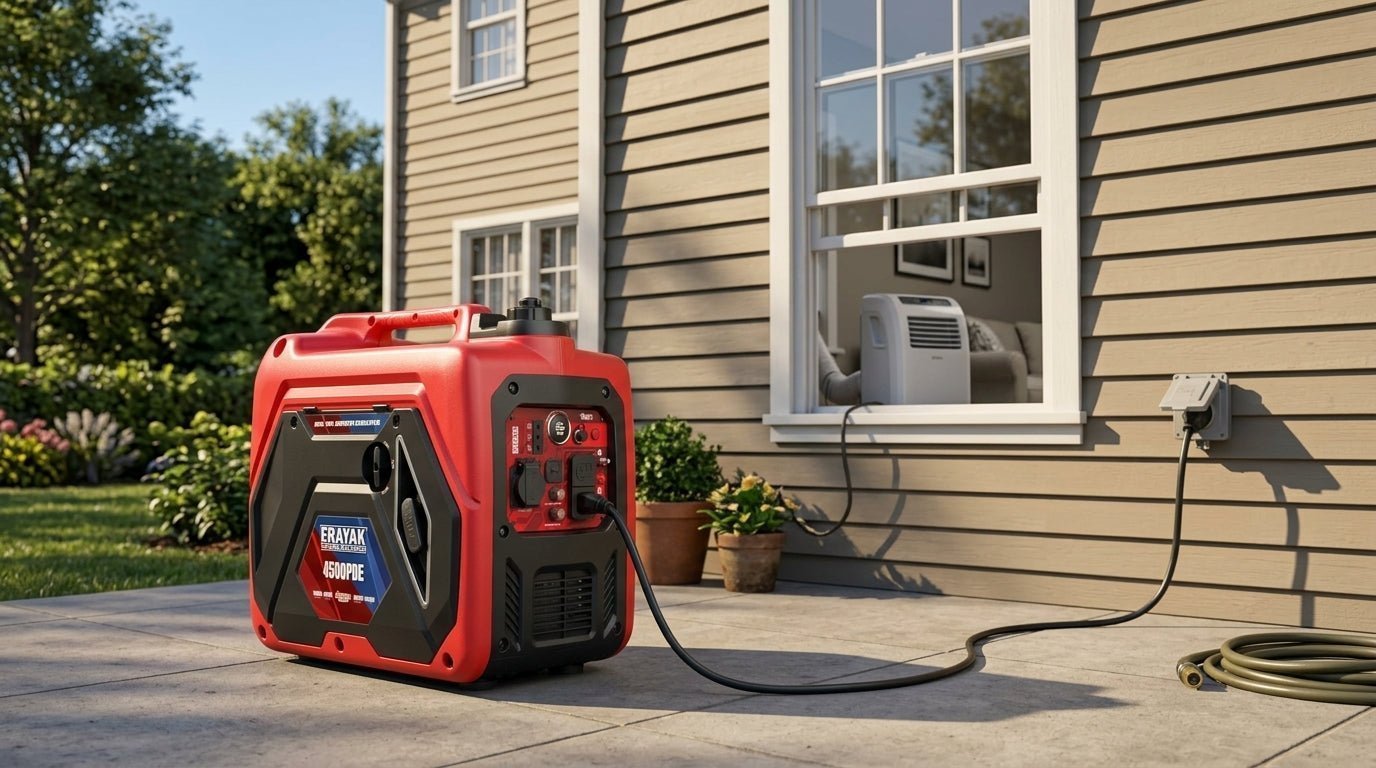
Portable AC Wattage Guide
How Many Watts Does a Portable AC Use?
Most portable air conditioners draw about 500 to 1,600 running watts. Depending on BTU size and compressor design, a conventional unit may need roughly 1,000 to 3,200 starting watts. Compare the chart below, then verify the nameplate on your exact AC before choosing a generator.
Quick Numbers
A portable AC may look like a small appliance, but compressor startup surge matters when you size a generator for blackout cooling, RV power, or emergency backup.
When summer heatwaves hit or severe storms knock out the grid, a portable air conditioner can be a practical way to cool a bedroom, home office, RV sleeping area, or emergency room setup. But before you plug one into a portable generator, you need to know two numbers: running watts and starting watts.
This guide gives you a portable AC wattage chart by BTU, explains how to estimate electricity use per hour, and shows how to choose the right ERAYAK inverter generator for a portable AC, refrigerator, lights, router, and other essential backup loads.
Quick Answer
Quick Answer: Portable AC Watts by BTU
Most portable AC units use about 500-1,600 watts while the compressor is running. A small 5,000-8,000 BTU unit is commonly in the 500-900W range, while a 10,000-14,000 BTU unit is often around 900-1,600W.
These are planning ranges, not a substitute for the label on your unit. For generator use, check both running watts and startup surge. A smaller inverter generator may handle an AC by itself; an AC plus a refrigerator and other essentials usually needs more headroom.

Portable AC Wattage Chart: 5,000 to 14,000 BTU Running and Starting Watts
Most portable AC units fall between 500 and 1,600 running watts, but generator sizing also depends on startup surge. Use the chart as a planning range, then confirm the electrical input on your model's nameplate or in its owner manual.
BTU measures cooling capacity. Watts measure electrical input. They are related, but they are not the same thing. The more accurate way to estimate watts is to check the AC nameplate, owner manual, or energy label. Use this chart as a practical planning range for common portable air conditioner sizes.
Important: Inverter and soft-start AC units may have lower startup surge than older compressor designs. Always size your generator from the actual running watts and starting watts listed by your AC manufacturer whenever available.

| Portable AC Size | Estimated Running Watts | Estimated Starting Watts | Practical Generator Size |
|---|---|---|---|
| 5,000 BTU | 500-700W | 1,000-1,200W | 2,000W inverter generator |
| 8,000 BTU | 700-900W | 1,400-1,800W | 2,400W inverter generator for AC-only or light essentials |
| 10,000 BTU | 900-1,200W | 1,800-2,200W | 2,400-3,500W for AC-only; 4,500W-class for added essentials |
| 12,000 BTU | 1,200-1,400W | 2,400-2,800W | 3,500W+ for AC-only; 4,500W-class recommended with other loads |
| 14,000 BTU | 1,400-1,600W | 2,800-3,200W | 4,000W+ minimum; 4,500W or larger for backup use |
Portable AC Watts by BTU: 8,000, 10,000, 12,000 and 14,000 BTU Answers
The most searched portable AC sizes are 8,000, 10,000, 12,000 and 14,000 BTU, and each size has a different running-watt and starting-watt range. If your exact model lists amps instead of watts, use volts x amps = watts and then check the manual for compressor startup requirements.
Many shoppers search by BTU size, so here are direct answers for the most common portable air conditioner wattage questions.
How Many Watts Does an 8,000 BTU Portable AC Use?
An 8,000 BTU portable AC usually uses about 700 to 900 running watts and may need around 1,400 to 1,800 starting watts. A 2,400W-class inverter generator can work for the AC alone or with very small electronics.
How Many Watts Does a 10,000 BTU Portable AC Use?
A 10,000 BTU portable AC typically uses about 900 to 1,200 running watts, with startup surge often around 1,800 to 2,200 watts. Use a larger generator if you also need a refrigerator, freezer, lights, or router.
How Many Watts Does a 12,000 BTU Portable AC Use?
A 12,000 BTU portable AC often draws about 1,200 to 1,400 running watts and may need 2,400 to 2,800 starting watts. A 4,500W-class inverter generator gives a safer margin for emergency backup loads.
How Many Watts Does a 14,000 BTU Portable AC Use?
A 14,000 BTU portable AC commonly uses about 1,400 to 1,600 running watts, with startup surge around 2,800 to 3,200 watts. For blackout use with household essentials, choose a 4,500W or larger inverter generator.
Running Watts vs Starting Watts: Why Portable AC Startup Surge Matters
Running watts tell you what the portable AC uses after startup; starting watts help determine whether your generator can start the compressor without overloading.
Running watts are the watts your portable AC uses after the compressor is already operating. Starting watts, also called surge watts, are the brief burst of power required when the compressor starts.
This matters because a generator can be overloaded even when the AC's normal running watts look low. For example, a 10,000 BTU portable AC may run at about 1,000W, but it can briefly demand 2,000W or more when the compressor kicks on.

Planning Formula
Use This Generator Sizing Rule
For the cleanest estimate, add up all devices that will run at the same time, then leave extra headroom. Running a generator constantly at its limit is not ideal for noise, fuel use, stability, or long-term reliability.
Portable AC kWh Per Hour: How Much Electricity Does a Portable AC Use?
To estimate portable AC electricity use per hour, divide running watts by 1,000. A 1,000W portable AC uses about 1 kWh for each hour the compressor actively runs. Actual hourly use can be lower when the compressor cycles off or a variable-speed unit reduces output.
| Portable AC Running Watts | Electricity Used Per Hour | Example Cost at $0.19/kWh |
|---|---|---|
| 700W | 0.7 kWh | About $0.13/hour |
| 1,000W | 1.0 kWh | About $0.19/hour |
| 1,400W | 1.4 kWh | About $0.27/hour |
| 1,600W | 1.6 kWh | About $0.30/hour |
The $0.19/kWh column is an example, not a national-rate claim. Replace $0.19 with the rate on your electricity bill. Your actual cost also depends on AC efficiency, room insulation, outdoor temperature, thermostat setting, and how often the compressor cycles.
Does a Portable AC Use More Electricity Than a Window AC?
Portable AC units often use more electricity than similar-size window AC units because the hose system can create heat loss and air pressure changes. The exact difference depends on the model, BTU rating, room layout, and efficiency rating. For generator sizing, do not assume the watts are the same just because two AC units have the same BTU rating.
Practical tip: For backup power planning, check the nameplate watts on your exact AC model. If the label only shows amps, estimate watts with: volts x amps = watts.
What Affects Portable AC Power Consumption?
- BTU size: Larger BTU units usually require more watts because they provide more cooling capacity.
- Room temperature: Hotter rooms and heatwaves keep the compressor running longer.
- Room insulation: Poor insulation, open doors, and direct sun increase runtime.
- Efficiency rating: More efficient units can deliver the same cooling with fewer watts.
- Compressor design: Inverter or soft-start designs may reduce startup surge compared with older compressor systems.
- Extra devices: Fans, refrigerators, routers, TVs, chargers, and lights all add to the generator load.
What Size Generator Do You Need for a Portable AC?
A portable AC alone may fit a 2,400W-class inverter generator, but a portable AC plus a refrigerator usually needs a 4,500W-class generator for better surge headroom.
If you are only running a small portable AC, a 2,400W inverter generator may be enough after you verify the AC starting watts. If you want to run a portable AC during a blackout with a refrigerator, freezer, lights, router, phone chargers, or RV equipment, a 4,500W-class inverter generator is usually the more practical choice.

Planning AC plus food protection? For a deeper load example, read What Size Generator Do I Need to Run a Portable AC and Refrigerator?. That guide is built for summer outage setups where cooling and refrigerator backup need to run together.
Real-World Example
10,000 BTU Portable AC + Refrigerator + Lights
You want to cool one bedroom during a summer outage and keep basic essentials running.
- Portable AC starting surge: 1,800W
- Refrigerator running watts: 600W
- LED lights, router, and phone chargers: 100W
A 2,400W generator may trip its overload protection in this example. A 4,500W-class inverter generator gives more usable margin and is the safer recommendation for this type of emergency setup.
Watch: Match a Portable AC to Generator Power
This short ERAYAK guide shows how running watts, compressor startup surge, and other connected loads affect generator sizing. Use it with the wattage chart above, then confirm the numbers on your own AC before connecting it to a generator.
Best ERAYAK Generator for a Portable AC
For portable AC backup, choose an inverter generator instead of a basic open-frame generator. Inverter generators are designed for cleaner, more stable power, which is better for modern portable AC controls, chargers, laptops, routers, and other sensitive electronics.
Recommended Generator Match
Choose by AC Size and Backup Load
Start with your portable AC's running watts and starting watts, then add the other appliances you need. Use the 2400P for small AC and light essentials, step up to the 4500P or 4500PD for larger AC backup, and choose the 6800PD/PT series only when the portable AC is one part of a larger RV or selected-circuit home-backup plan.

ERAYAK 2400P
Best for: 5,000-8,000 BTU portable AC units, phone charging, laptop use, LED lights, and small outdoor power needs after you verify the AC starting watts.
Choose this when you want a compact generator for a smaller AC or light-duty camping and backup use, not as the default for AC plus refrigerator backup.

ERAYAK 4500P Gas Inverter Generator
Best for: a 10,000-14,000 BTU portable AC with basic household essentials when you want a gas-only inverter generator and do not need propane.
The ERAYAK 4500P is a gas-only inverter generator with manual recoil start, 55 lb weight, 2.25 gal fuel tank, up to 8 hours runtime, 60.5 dB operation, and THD < 1.2%.

ERAYAK 4500PD Dual-Fuel Series
Best for: larger portable AC units plus a refrigerator, freezer, lights, router, and emergency essentials.
Choose the 4500PD series when fuel flexibility matters. Gasoline and propane options make it a stronger fit for storm preparation, RV use, and extended outage planning.

ERAYAK 6800PD / 6800PT Series
Best for: portable AC plus multiple essentials, larger RV backup planning, and higher-capacity 120V/240V selected-circuit home-backup setups.
Choose 6800PD for dual-fuel gasoline/propane flexibility, or 6800PT when you want tri-fuel capability with gasoline, propane, and natural gas support. Output varies by fuel type and operating conditions.
Portable AC Generator Sizing Cheat Sheet
| Your Situation | Recommended ERAYAK Match | Why It Fits |
|---|---|---|
| Small 5,000-8,000 BTU portable AC, phone charging, laptop, LED lights | ERAYAK 2400P | Compact choice for smaller AC units and light essential loads. |
| 10,000-14,000 BTU portable AC with basic household backup, gas-only preference | ERAYAK 4500P Gas Inverter Generator | 4500W peak / 3500W running capacity gives more practical headroom than a small generator. |
| Portable AC plus refrigerator, freezer, lights, router, and fuel flexibility | ERAYAK 4500PD Dual-Fuel Series | Gasoline and propane options are useful for storm season and longer outage preparation. |
| Portable AC is one of several RV or home-backup loads | ERAYAK 6800PD / 6800PT Series | Higher-capacity 120V/240V platform for more complex backup setups. |
| Still comparing generator sizes | ERAYAK Inverter Generator Collection | Compare compact, dual-fuel, and high-capacity inverter generators in one place. |
Generator Safety Notice
Portable generators can produce deadly carbon monoxide. Use them correctly every time.
- Never run a generator indoors.
- Never run a generator in a garage.
- Never run a generator near open windows, doors, vents, or enclosed patios.
- Always operate generators outdoors with proper ventilation.
- Use a transfer switch or properly rated connection equipment when powering selected home circuits.
- Check both your AC manual and generator manual before connecting high-surge appliances.
FAQs: Portable Air Conditioner Watts
How many watts does a portable AC use?
Most portable AC units use about 500 to 1,600 running watts. Small 5,000-8,000 BTU units are usually around 500-900W, while larger 10,000-14,000 BTU units are often around 900-1,600W.
How many watts does a portable air conditioner use when starting?
A portable air conditioner may need around 1,000 to 3,200 starting watts, depending on BTU size and compressor design. This is why generator sizing should be based on starting watts, not only running watts.
How many watts does a 10,000 BTU air conditioner use?
A 10,000 BTU portable air conditioner typically uses about 900 to 1,200 running watts and may require 1,800 to 2,200 starting watts. A 2,400W generator may work for AC-only use, but a 4,500W-class generator is safer if other appliances are connected.
How many watts does a 12,000 BTU AC use?
A 12,000 BTU portable AC often uses around 1,200 to 1,400 running watts, with startup surge often around 2,400 to 2,800 watts. Check your AC nameplate for the exact number.
How many watts does a portable AC use per hour?
Divide running watts by 1,000. A 1,000W portable AC uses about 1 kWh per hour while the compressor is actively running. Multiply that figure by your electricity rate to estimate hourly cost.
Can a 2,000 watt generator run a portable AC?
Yes, but only for smaller portable AC units, usually around 5,000-8,000 BTU, and with limited extra loads. A 2,000W generator is not a good match for a larger portable AC plus a refrigerator or other household essentials.
Can a 2,400 watt generator run a portable AC?
A 2,400W inverter generator can run many small portable AC units and some 10,000 BTU units if the AC starting watts are within the generator's peak rating. It is best for AC-only or light-load setups, not emergency backup with multiple appliances.
What size generator do I need for a portable AC and refrigerator?
For a portable AC and refrigerator together, a 4,500W-class inverter generator is usually a better starting point. This gives more headroom for compressor surge, lights, router, chargers, and normal load changes.
Does a portable AC use more electricity than a window AC?
Often, yes. A portable AC can use more electricity than a similar-size window AC because the exhaust hose and room air pressure can reduce cooling efficiency. Always compare the actual wattage or amperage on the nameplate.
Conclusion: Start With Watts, Then Choose the Generator
Portable AC wattage usually falls between 500 and 1,600 running watts, but generator sizing depends heavily on starting watts. If you only need a small AC and light essentials, the ERAYAK 2400P may be enough. For larger portable AC units, refrigerator backup, and emergency household essentials, the ERAYAK 4500P or 4500PD series gives a more practical power margin. For higher-capacity RV or home-backup setups, step up to the ERAYAK 6800PD/PT series.
Backup Power Planning
Stay Cool When the Grid Goes Down
Compare compact, gas-only, dual-fuel, and high-capacity ERAYAK inverter generators for portable AC backup, AC + refrigerator outage planning, RV power, camping, and selected home essentials.
