

7 Tips to Choose the Best Dual Fuel Generator in 2026
The best dual fuel generator is not simply the biggest model with gasoline and propane ports. It is the generator that matches your real load, your fuel-storage plan, your noise expectations, and whether you need RV power, home essentials, jobsite tools, or emergency backup during storms.
- Gasoline usually gives the strongest output.
- Propane stores well and is useful for backup planning.
- Inverter dual fuel models are better for RVs and electronics.
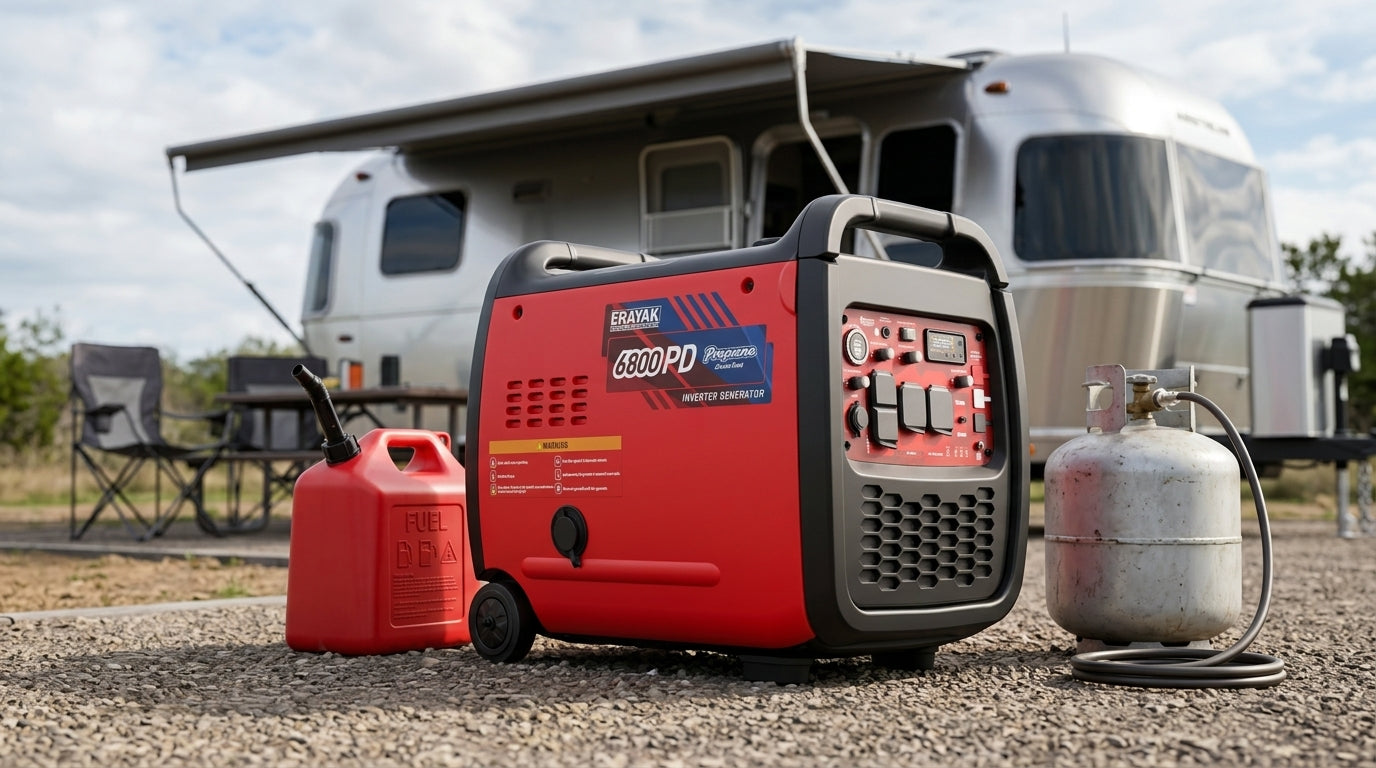
- For larger 120V/240V needs, consider a 6800 series upgrade path.
Quick Answer: What Makes a Dual Fuel Generator Worth Buying?
A dual fuel generator is worth buying when you want the output and convenience of gasoline plus the storage and backup flexibility of propane. For RV camping and home essentials, a quiet dual-fuel inverter generator is usually the best format because it combines fuel flexibility with cleaner power for electronics and lower noise than many open-frame jobsite generators.
Best ERAYAK fit: the ERAYAK 4500PD is the primary dual-fuel route for RV camping, 30 amp-style comfort loads, storm backup, and portable power users who want gasoline and propane flexibility. For bigger home-backup planning, step up to the ERAYAK 6800PD / 6800PT series.

What Is a Dual Fuel Generator?
A dual fuel generator runs on gasoline and propane. That does not mean both fuels produce the same wattage, runtime, or best-use profile. Gasoline is usually the best choice when you need maximum output. Propane is valuable because it stores longer, burns cleaner, and can be easier to keep ready for emergency use.
Highest output in many portable generators, easy to find, but requires rotation and safe storage.
Longer storage life and cleaner handling, but output is commonly lower than gasoline.
Best when you want fuel choice for RV trips, storms, camping, and portable backup.
Gasoline vs Propane: What Changes on a Dual Fuel Generator?
Many shoppers miss this point: a dual fuel generator often produces less running wattage on propane than on gasoline. The exact difference depends on the model, engine, altitude, temperature, regulator setup, and load, but propane derating is normal and should be considered before sizing for RV air conditioners, refrigerators, sump pumps, or tools.
| Category | Gasoline | Propane | Buyer takeaway |
|---|---|---|---|
| Power output | Usually highest | Often lower than gasoline | Size the generator with propane derating in mind if propane is your main fuel |
| Storage | Needs rotation and stabilizer planning | Stores well in approved cylinders | Propane is attractive for emergency readiness |
| Refueling | Fast and common on road trips | Convenient if you already carry propane for RV use | Dual fuel gives you options when one fuel is hard to find |
| Cold weather | Can be easier for high output | Propane performance depends on cylinder size and vaporization | Plan fuel supply for winter backup loads carefully |
| Maintenance feel | Can leave more fuel-system residue if stored poorly | Cleaner handling and storage | Still follow the generator manual for maintenance and oil checks |
7 Tips to Choose the Best Dual Fuel Generator
| Tip | What to check | Why it matters |
|---|---|---|
| 1. Size for the loads you actually run | Running watts, starting watts, AC surge, refrigerator, sump pump, microwave, power tools | Undersizing causes overloads; oversizing adds cost, weight, and fuel use |
| 2. Compare gasoline and propane ratings | Separate wattage ratings for each fuel | Propane output is often lower, so gasoline-only wattage can mislead buyers |
| 3. Choose inverter technology for RVs and electronics | Low THD, clean power, eco mode, enclosed quiet design | Better fit for laptops, RV electronics, routers, CPAP guidance, and smart devices |
| 4. Match the outlet plan | Household outlets, 30A RV needs, L14-30R, transfer-switch compatibility where applicable | Wattage does not help if the generator cannot connect safely to your real load |
| 5. Check noise and portability | dB rating, measurement distance, weight, wheels, handles, storage footprint | RV and campground use rewards quiet, movable generators |
| 6. Plan runtime and fuel storage | Tank size, propane cylinder size, expected load, refueling schedule | Long outages and boondocking trips require a realistic fuel plan |
| 7. Prioritize safety features and support | CO sensor, overload protection, low-oil shutdown, warranty, parts, manual clarity | Safety and serviceability matter more than a slightly lower purchase price |
Dual Fuel Generator Size Chart by Use Case
Use this chart as a planning guide. Always check the generator's gasoline and propane ratings separately, and confirm the starting watts required by your largest motor-driven load.
| Use case | Practical generator class | Best fuel strategy | ERAYAK route |
|---|---|---|---|
| Camping electronics and light loads | 2,000W to 2,500W inverter class | Gasoline for output, propane if available and loads are light | 2400P is the light-load fit, but it is not dual fuel |
| 30 amp RV with one rooftop AC | 4,000W to 4,500W inverter class | Gasoline for maximum AC startup margin, propane for flexibility | 4500PD is the primary dual-fuel RV fit |
| Home essentials during outages | 4,500W to 6,800W+ depending on loads | Propane storage plus gasoline as backup, or larger planned setup | 4500PD for essentials, 6800PD/PT for larger planning |
| Sump pump, well pump, selected circuits | Larger output and 120V/240V planning may be needed | Fuel plan depends on outage length and transfer setup | 6800PD / 6800PT upgrade path |
Dual Fuel vs Tri Fuel: Should You Upgrade?
Dual fuel means gasoline and propane. Tri fuel means gasoline, propane, and natural gas. Dual fuel is usually the simpler portable choice for RVs, camping, jobsites, and 120V essentials. Tri fuel becomes more attractive when your home has natural gas service and you want a more planned backup-power setup.
If you are deciding between the two, see ERAYAK's full tri fuel vs dual fuel generator guide.
Simple rule: choose dual fuel for portable RV and emergency flexibility. Consider tri fuel when natural gas is part of your home-backup plan.
ERAYAK Product Match
Use this product routing to avoid overbuying or choosing the wrong fuel setup.

ERAYAK 4500PD: best dual-fuel fit for RV and home essentials
The ERAYAK 4500PD is the main product match for this article: a 4,500W class dual-fuel inverter generator for RV camping, storm backup, quiet portable power, and users who want gasoline plus propane flexibility.

ERAYAK 4500P: gas-only alternative when propane is not needed
The ERAYAK 4500P is a gas-only inverter generator. Choose it when you want 4,500W class RV and home essentials power but do not need propane capability.

ERAYAK 6800PD / 6800PT: larger backup and 120V/240V planning
Choose the ERAYAK 6800PD if you want a larger dual-fuel path. Choose the ERAYAK 6800PT if tri-fuel capability and natural gas planning matter. The 6800 series is better suited to larger home backup, selected circuits, sump pump, well pump, and more complex outage scenarios.
Dual Fuel Generator Safety Notes
Never run a fuel-powered generator indoors, inside an RV, in a garage, in a shed, in an enclosed porch, or near open windows, doors, vents, or slide-outs. Operate it outdoors with proper ventilation, follow the owner's manual, use working carbon monoxide alarms, and keep exhaust pointed away from people and living spaces.
Propane and gasoline handling basics
- Store fuels only in approved containers and cylinders.
- Check hoses, regulators, and fittings before propane operation.
- Let the generator cool before refueling with gasoline.
- Do not backfeed a home panel without a proper transfer switch installed by a qualified professional.
FAQ: Choosing a Dual Fuel Generator
Is a dual fuel generator worth it?
Yes, if you value fuel flexibility. Gasoline usually provides the strongest output, while propane stores well and is useful for emergency readiness. Dual fuel is especially useful for RV owners, campers, and homeowners preparing for outages.
Does a dual fuel generator make less power on propane?
Often yes. Many generators produce lower running watts and starting watts on propane than on gasoline. Always check the separate fuel ratings before sizing for air conditioners, pumps, refrigerators, or tools.
What size dual fuel generator do I need for an RV?
For light camping loads, a smaller inverter generator may be enough. For a 30 amp RV with one rooftop AC, many buyers should look at the 4,000W to 4,500W inverter class and leave extra margin if they plan to run on propane.
Is dual fuel better than tri fuel?
Dual fuel is usually simpler and more portable for RVs, camping, jobsites, and emergency essentials. Tri fuel is better when natural gas access is part of a larger home-backup plan.
What is the best ERAYAK dual fuel generator?
The ERAYAK 4500PD is the main dual-fuel fit for RV camping, quiet portable power, and home essentials. For larger backup needs, consider the ERAYAK 6800PD dual-fuel path or the ERAYAK 6800PT tri-fuel path.
Can a dual fuel generator power sensitive electronics?
Fuel type alone does not determine power quality. For electronics, look for an inverter generator with clean power and low THD, then follow the device manufacturer's power requirements.
Choose dual fuel when gasoline power and propane readiness both matter
If you want one portable generator for RV trips, storm backup, quiet inverter power, and flexible fuel storage, start with the ERAYAK 4500PD. If your backup plan is larger or includes 120V/240V selected circuits, compare the ERAYAK 6800PD / 6800PT series.

