

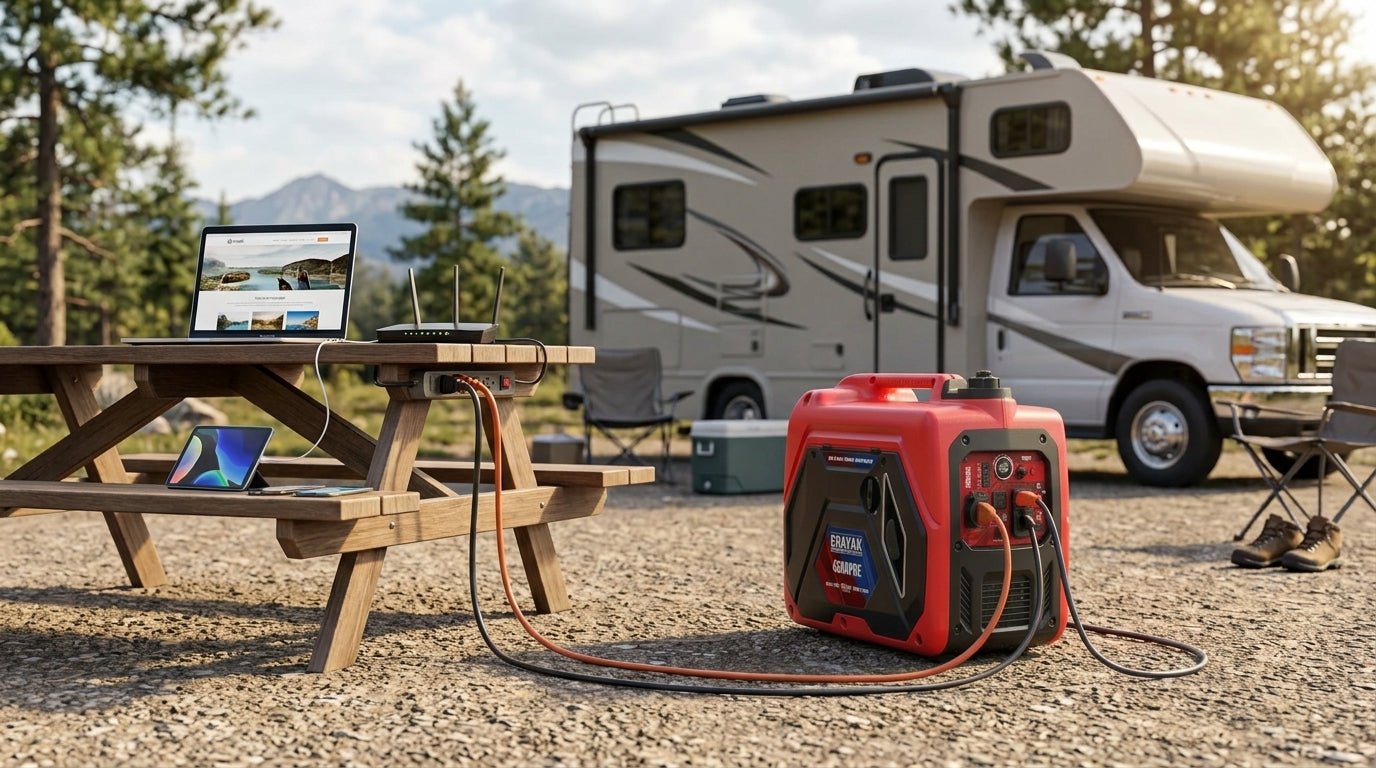
Quietest Portable Inverter Generators: 2026 dB Guide
The quietest portable inverter generators are usually compact enclosed models in the 50-60 dB range at light to moderate load. Bigger 4,500W-class inverter generators may be slightly louder, but they can power RV, jobsite, mobile business, and home-backup loads that small suitcase generators cannot handle.
Quick Answer: What Is the Quietest Portable Inverter Generator?
For fuel-powered generators, the quietest practical choice is usually a small enclosed inverter generator around 50-60 dB at light load. In the Erayak lineup, the Erayak 2400P is the small quiet pick for camping, tailgating, charging, routers, lights, and light backup loads. If you need more power for RV comfort loads, mobile detailing, refrigerator backup, or portable AC planning, step up to the Erayak 4500P gas inverter generator or the Erayak 4500PD dual-fuel series.
Choose a 2,000W-2,400W enclosed inverter when noise and portability matter most.
Choose a 4,000W-4,500W inverter when you need more watts for RV, work, or backup loads.
Noise ratings vary by distance, load, surface, exhaust direction, and test method.
Portable Generator dB Chart: What Quiet Actually Means
Generator noise is measured in decibels, usually written as dB or dB(A). The lower the number, the quieter the generator sounds from the measurement point. The important catch: decibels are logarithmic, so a small number change can feel much bigger than it looks.
| Noise Level | Everyday Comparison | Generator Meaning | Best Fit |
|---|---|---|---|
| 50-55 dB | Refrigerator hum, quiet conversation range | Very quiet for a fuel-powered portable generator | Camping, tailgating, light backup, small electronics |
| 56-60 dB | Conversation-level range | Still considered quiet for inverter generators | RV weekends, light home essentials, work where noise matters |
| 61-65 dB | Noticeable but usually far quieter than open-frame units | Common for larger enclosed inverter generators under load | 4500W-class RV, refrigerator, mobile business, portable AC loads |
| 70 dB+ | Clearly disruptive in close quarters | Often traditional, open-frame, or heavily loaded equipment | Worksite or backup use where noise is less sensitive |
Buyer tip: do not compare dB numbers unless you know the load and distance. A generator rated at quarter load can sound different when starting a compressor, pressure washer, or RV air conditioner.
How to Read Generator Decibel Ratings
A 60 dB generator is not just a little quieter than a 70 dB generator. Because the decibel scale is logarithmic, a 10 dB increase represents a major jump in sound intensity and is commonly perceived as roughly twice as loud to human ears.
Many generator ratings are measured around 20-25 feet away. Closer placement sounds louder.
Eco Mode is quietest at light load. AC startup, pumps, vacuums, and heaters make the engine work harder.
Concrete can reflect sound. Grass or dirt may absorb more vibration and sound energy.
Why Inverter Generators Are Usually Quieter
Traditional open-frame generators often run at a steady high engine speed to maintain output. Inverter generators convert and regulate power electronically, so the engine can slow down when demand is low. Many also use enclosed housings, tuned mufflers, and vibration control to reduce sound.
That does not mean every inverter generator is equally quiet. A small 2,400W inverter running a light load will normally be quieter than a larger 4,500W inverter starting an RV air conditioner. The best choice is the quietest generator that still has enough wattage for the load.
Best Erayak Quiet Inverter Generator Fits
Use the model that matches the job. The quietest generator in the lineup is not always the best generator for RV AC, refrigerator backup, or 120V/240V planning.
 Erayak 2400P: Quietest Small Erayak Pick
The Erayak 2400P is the best fit when low noise, easy carrying, and light-load power matter most. It is a strong match for camping, tailgating, small home essentials, device charging, routers, lights, and compatible CPAP use outdoors with proper generator placement.
- 2400W peak class for light portable power.
- 42 lb class for easy campsite movement.
- Best Erayak fit for quiet small-load searches.
 Erayak 4500P: Quiet Gas 4,500W-Class Option
The Erayak 4500P is the gas-only step-up when you want more usable wattage than a small suitcase generator. It is gas only, manual recoil start, 55 lb class, with a 2.25 gal fuel tank, up to 8 hours runtime, 60.5 dB, and THD below 1.2%.
- Good fit for RV weekends, refrigerator backup, and basic home essentials.
- Cleaner inverter output for sensitive electronics.
- Gas-only simplicity when propane is not needed.
Erayak 4500PD: Quiet Dual-Fuel RV and Backup Fit
The Erayak 4500PD is the stronger fit when quiet inverter power needs to support RV comfort loads, refrigerator backup, portable AC planning, mobile work, or storm-prep flexibility. It adds gasoline and propane flexibility without forcing users into a much larger platform.
- Best Erayak dual-fuel fit for RV and home essentials.
- Better for larger loads than a small suitcase generator.
- Good match when propane planning matters.

Erayak 6800PD/PT: Capacity Upgrade, Not the Small Quiet Pick
Choose the 6800PD or 6800PT series when you need 120V/240V planning, selected home circuits, larger RV backup, sump pump, well pump, or more complex outage loads. This is the higher-capacity route, not the lowest-dB camping choice.
See the Erayak 6800PD/PT 120V/240V UpgradeChoose the Quietest Generator by Use Case
The quietest useful generator is the one that can run your real loads without spending the whole day at maximum output. Undersizing can make a generator louder, less stable, and more frustrating.
| Use Case | Quiet Generator Range | Best Erayak Fit | What to Avoid |
|---|---|---|---|
| Tent camping, tailgating, phones, laptops, router, small fan | 2,000W-2,400W inverter | Erayak 2400P | Buying a larger generator just for light loads. |
| Quiet RV weekends, fridge backup, small appliances, more headroom | 4,000W-4,500W inverter | Erayak 4500P or 4500PD | Expecting a 2,000W class unit to run large RV comfort loads. |
| Mobile detailing, small mobile business, pressure washer planning | 4,000W-4,500W inverter, depending on equipment | Erayak 4500P or 4500PD | Ignoring compressor, vacuum, extractor, or pump startup watts. |
| Selected home backup, 120V/240V loads, well pump planning | Larger inverter generator or transfer-equipment plan | Erayak 6800PD/PT series | Treating a quiet camping generator as a whole-home backup system. |
How to Reduce Generator Noise Safely
Even a quiet inverter generator can sound louder if it is overloaded, placed on a hard reflective surface, pointed toward a campsite or neighbor, or running with poor maintenance. Use these steps to reduce perceived noise without creating a safety hazard.
Eco Mode lets the engine slow down under lighter loads, which can reduce sound and fuel use.
Keep the generator outdoors, ventilated, and away from windows, but orient the exhaust and sound path away from people when safe.
Old fuel, dirty filters, loose panels, and neglected oil changes can make a generator run rougher and louder.
Do not build a DIY sealed sound box around a running generator. Poorly ventilated enclosures can trap heat and exhaust, creating fire and carbon monoxide hazards.
Generator Safety Notice
Never run a fuel generator indoors, inside a garage, inside an RV, in a tent, on a porch, under an awning, or near open windows, doors, or vents. Always operate outdoors with proper ventilation and follow the generator manual, local rules, and campground requirements.
Use working carbon monoxide alarms when camping or preparing for outages. Keep cords rated for the load, dry, and undamaged. Let the generator cool before refueling, and do not use unsafe wiring, undersized extension cords, or improvised adapters.
FAQ: Quiet Portable Inverter Generators
What is considered a quiet portable generator?
A quiet fuel-powered portable generator is usually in the 50-60 dB range at light to moderate load. Larger generators may still be considered quiet if they stay under roughly 65 dB in realistic use, but measurement distance and load matter.
What is the quietest inverter generator size?
The quietest inverter generators are usually small 2,000W to 2,400W enclosed models because the engine is smaller and the loads are lighter. Larger 4,500W-class inverter generators are still much quieter than many open-frame units, but they normally make more sound under load.
Is 60 dB loud for a generator?
For a portable fuel generator, 60 dB is generally quiet. It is near conversation-level sound, but it may still be noticeable in a silent campground or close neighborhood, especially if the generator is heavily loaded or placed on a hard surface.
Are inverter generators quieter than regular generators?
Usually yes. Inverter generators can adjust engine speed under lighter loads and often use enclosed housings, which helps reduce noise compared with many traditional open-frame generators.
Are propane generators quieter than gas generators?
Fuel type alone usually does not make a major noise difference. Enclosure design, muffler design, load, engine size, Eco Mode, maintenance, and placement usually matter more than whether the generator is burning gasoline or propane.
Can a quiet 2400 watt generator run a house?
A 2,400W-class generator can run selected light essentials such as a refrigerator in some cases, router, lights, TV, chargers, and small devices. It is not a whole-home generator and cannot run 240V appliances such as many well pumps, central AC systems, or electric ranges.
What is the best quiet generator for RV use?
For light RV loads, a small inverter generator can work well. For a 30 amp RV with one rooftop AC and comfort loads, many buyers should look at a quiet 4,000W to 4,500W inverter generator and manage microwave, coffee maker, electric heater, and water-heater loads carefully.
Choose the Quietest Generator That Still Fits the Load
If you only need camping lights, charging, a router, small fan, or light backup, the quiet small-generator class is the cleanest fit. If you need RV power, mobile work, refrigerator backup, or portable AC planning, a 4,500W-class inverter generator is often the better balance of quiet operation and usable wattage.


