

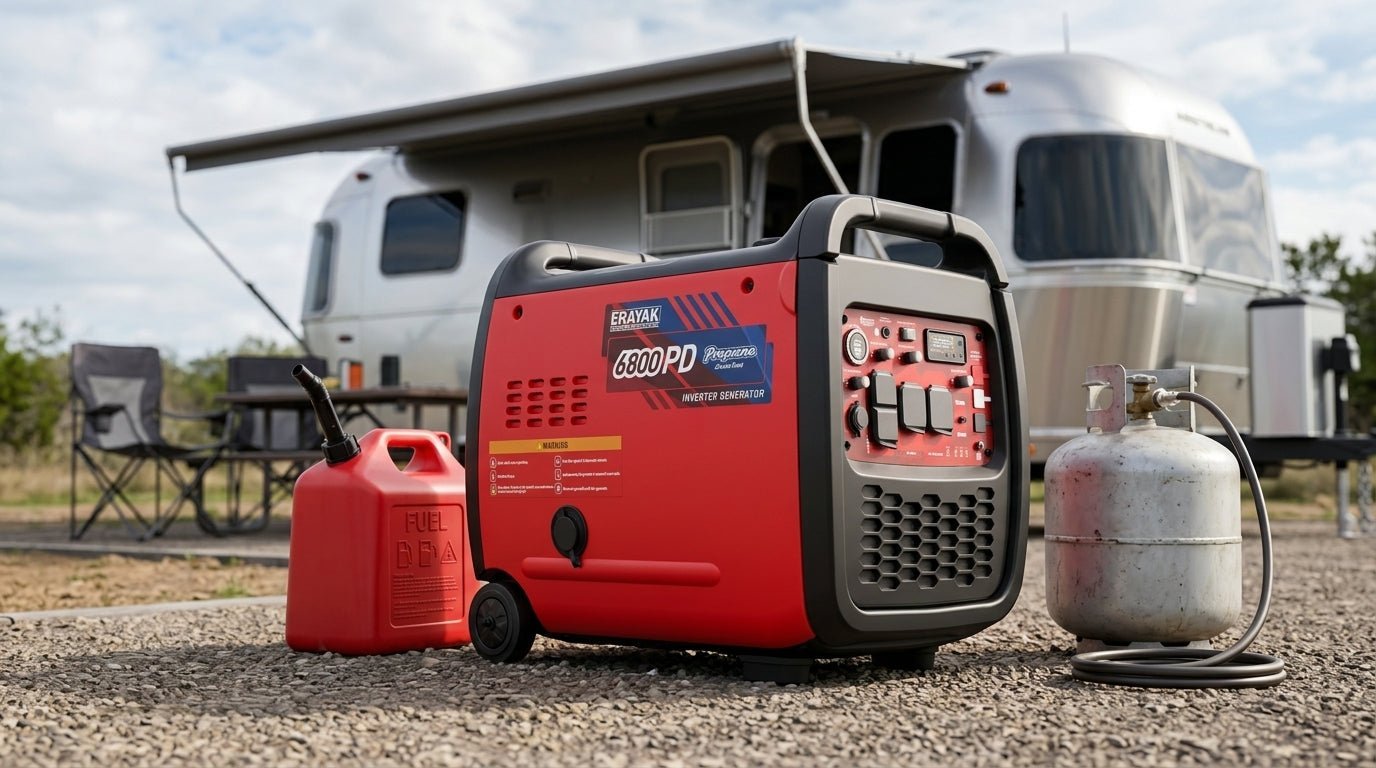
Best Quiet Propane Generator for RVs: 2026 Dual-Fuel Guide
A quiet propane generator for RV use is usually a dual-fuel inverter generator: quiet enough for campground etiquette, flexible enough to run on propane cylinders, and powerful enough for common 30 amp RV loads when sized correctly.
Quick Answer: What Makes a Good Quiet Propane RV Generator?
For most 30 amp RV owners, the best quiet propane generator is a dual-fuel enclosed inverter generator in the 4,000W to 4,500W class. Propane gives you cleaner storage and RV-friendly fuel flexibility, while inverter technology, enclosed housing, Eco Mode, and correct sizing do most of the work on noise.
4,000W-4,500W dual-fuel inverter for one rooftop AC plus managed essentials.
Look for an enclosed inverter design and compare dB ratings at the same load and distance.
Propane often produces less available wattage than gasoline, so check both fuel ratings.
Are Propane Generators Actually Quieter?
Propane itself is not a magic noise-reduction feature. A propane-capable generator can still be loud if it is open-frame, overloaded, poorly maintained, or placed on a hard reflective surface. The quietest RV propane generators are usually quiet because they are inverter generators with enclosed housings.
| Noise Factor | What It Means | Buyer Takeaway |
|---|---|---|
| Inverter design | Engine speed can adjust to load instead of running hard all the time. | More important for quiet operation than fuel type alone. |
| Enclosed housing | Body panels help contain engine and alternator noise. | Usually better for campgrounds than open-frame units. |
| Propane fuel | Clean storage and convenient cylinders, but typically lower output than gasoline. | Great for RV flexibility, but check propane wattage ratings. |
| Load level | Higher electrical load means higher RPM and more sound. | A correctly sized generator is often quieter than an undersized one working hard. |
Best framing: choose a quiet dual-fuel inverter generator, not just any propane generator. The inverter platform and enclosure are what make the unit campground-friendly.

Quiet Propane Generator Size Chart for RVs
RV generator sizing depends on air conditioner startup, microwave use, refrigerator load, battery charging, and how many appliances you expect to run at the same time.
| RV Use Case | Recommended Generator Class | Propane Fit | Notes |
|---|---|---|---|
| Light camping, battery charging, electronics | 2,000W-2,500W inverter | Useful if propane-capable, but not always necessary | Great for quiet hours planning and low loads, but usually not for rooftop AC. |
| 30 amp RV with one rooftop AC and essentials | 4,000W-4,500W dual-fuel inverter | Best overall fit | Manage microwave, coffee maker, and AC loads instead of running everything at once. |
| Larger RV, 120V/240V planning, selected backup loads | 6,800W-class dual-fuel or tri-fuel inverter | Good for larger backup plans | Better for selected circuits, well pump, sump pump, or larger backup planning than quiet tent camping. |
If your RV has a soft-start module on the AC, startup demand may be easier to manage, but you still need to size the generator based on the appliance labels and generator manual.
Key Features to Compare Before Buying
Dual-fuel generators often produce less wattage on propane than gasoline. Check both numbers before planning RV AC use.
A TT-30R or correct RV adapter setup matters for 30 amp RV convenience. Avoid undersized cords or unsafe adapters.
Look for inverter electronics, Eco Mode, and acoustic housing rather than relying on the word "propane" for quiet operation.
Propane run time depends on cylinder size, load, temperature, and regulator setup. Plan extra fuel for hot-weather AC use.
RV users should consider how the generator will be moved, secured, cooled, and placed 20+ feet from openings.
Compare dB ratings only when load percentage and distance are similar. A light-load rating is not the same as AC-startup noise.
Propane vs Gasoline for RV Generator Use
Propane is popular with RV owners because it stores well, travels in familiar cylinders, and avoids gasoline spill concerns. Gasoline usually delivers the highest output from the same dual-fuel generator.
| Fuel | Best For | Tradeoff |
|---|---|---|
| Propane | Long storage, cleaner handling, RV cylinder convenience, backup fuel flexibility | Lower power output than gasoline on many dual-fuel generators, and cold weather can affect cylinder performance. |
| Gasoline | Maximum wattage, easy highway availability, heavy loads, emergency refueling | Shorter storage life, spill concerns, more fuel maintenance planning. |
| Dual fuel | RVers who want propane convenience plus gasoline output when needed | Requires understanding both ratings and switching instructions from the manual. |
30 Amp RV Notes for Quiet Propane Generators
A 30 amp RV service can theoretically use up to 3,600 watts at 120 volts, but that does not mean every 3,600W generator will comfortably start and run a rooftop AC. Starting watts matter, and propane output may be lower than gasoline output.
- Prioritize starting watts for the RV AC, not only running watts.
- Run the AC, microwave, coffee maker, and electric water heater as managed loads.
- Use a properly rated RV cord or adapter setup that matches the generator outlet.
- Consider a soft-start module if AC startup is the main problem.
- Check campground generator hours and noise rules before relying on generator power.
Do not backfeed an RV, home, or outlet with improvised wiring. Use manufacturer-approved cords, listed transfer equipment where required, and a qualified electrician for home backup connections.
Best Erayak Fits for Quiet Propane RV Power
For this topic, the propane-capable model should lead. Gas-only models can still be useful if the buyer decides propane flexibility is not required.
 Erayak 4500PD: Best Fit for Quiet Propane RV Use
The 4500PD is the strongest match for RV owners who want propane flexibility, quiet inverter design, and enough capacity for common 30 amp RV comfort-load planning.
Compare the Erayak 4500PD
 Erayak 4500P: Gas-Only Alternative
If propane is not required, the 4500P is a gas-only 4,500W-class inverter generator with manual recoil start, 55 lb class weight, 2.25 gal fuel tank, up to 8 hours runtime, 60.5 dB, and THD below 1.2%.
Compare the Erayak 4500P
 Erayak 6800PD/PT: Larger Backup Path
Choose the 6800PD or 6800PT series when your RV power plan overlaps with larger home backup, 120V/240V selected loads, well pump, sump pump, or more complex outage planning.
Compare Larger Erayak Inverter GeneratorsGenerator Safety Notice for RV Campgrounds
Propane generators are still fuel-burning generators. Never run one indoors, inside an RV, in a tent, in a garage, under an awning, in a storage compartment, or near open windows, doors, vents, or neighboring sleeping areas. Operate outdoors only with the exhaust pointed away from people and enclosed spaces.
Keep the generator dry, level, ventilated, and at least 20 feet from RV openings when possible. Use working carbon monoxide alarms inside the RV, properly rated cords, secure propane cylinders upright, check for leaks, and let the generator cool before refueling or servicing.
FAQ: Quiet Propane Generators for RVs
What is the best quiet propane generator size for a 30 amp RV?
For many 30 amp RVs with one rooftop AC, a 4,000W to 4,500W dual-fuel inverter generator is the practical target. Check both gasoline and propane ratings, because propane output is often lower.
Are propane generators quieter than gas generators?
Not automatically. Fuel type can affect tone and engine behavior, but inverter design, enclosure, load level, muffler design, and placement usually matter more than propane alone.
Is a propane generator good for RV camping?
Yes, especially for RVers who already carry propane cylinders and want fuel that stores well. A dual-fuel inverter generator gives the most flexibility because it can use propane for convenience and gasoline when maximum output is needed.
Can a propane generator run an RV air conditioner?
It can if the generator has enough starting and running wattage on propane for your specific AC. Many dual-fuel generators produce less output on propane, so verify the propane rating before relying on it for AC startup.
What dB level is quiet for an RV propane generator?
For campground use, many buyers look for enclosed inverter generators around the 60 dB class at a stated distance and load. Compare dB numbers only when the test distance and load percentage are similar.
Do I need a dual-fuel generator for my RV?
You need dual fuel if propane flexibility matters to your travel style. If you only want maximum output and do not plan to carry propane for generator use, a gas-only inverter generator may be simpler.
Choose Quiet Inverter Design First, Then Propane Flexibility
The best quiet propane generator for RV use is usually a dual-fuel enclosed inverter generator that fits your real appliance loads. Propane is excellent for storage and RV convenience, but the quiet performance comes from inverter RPM control, enclosed housing, proper sizing, and safe campground placement.

