

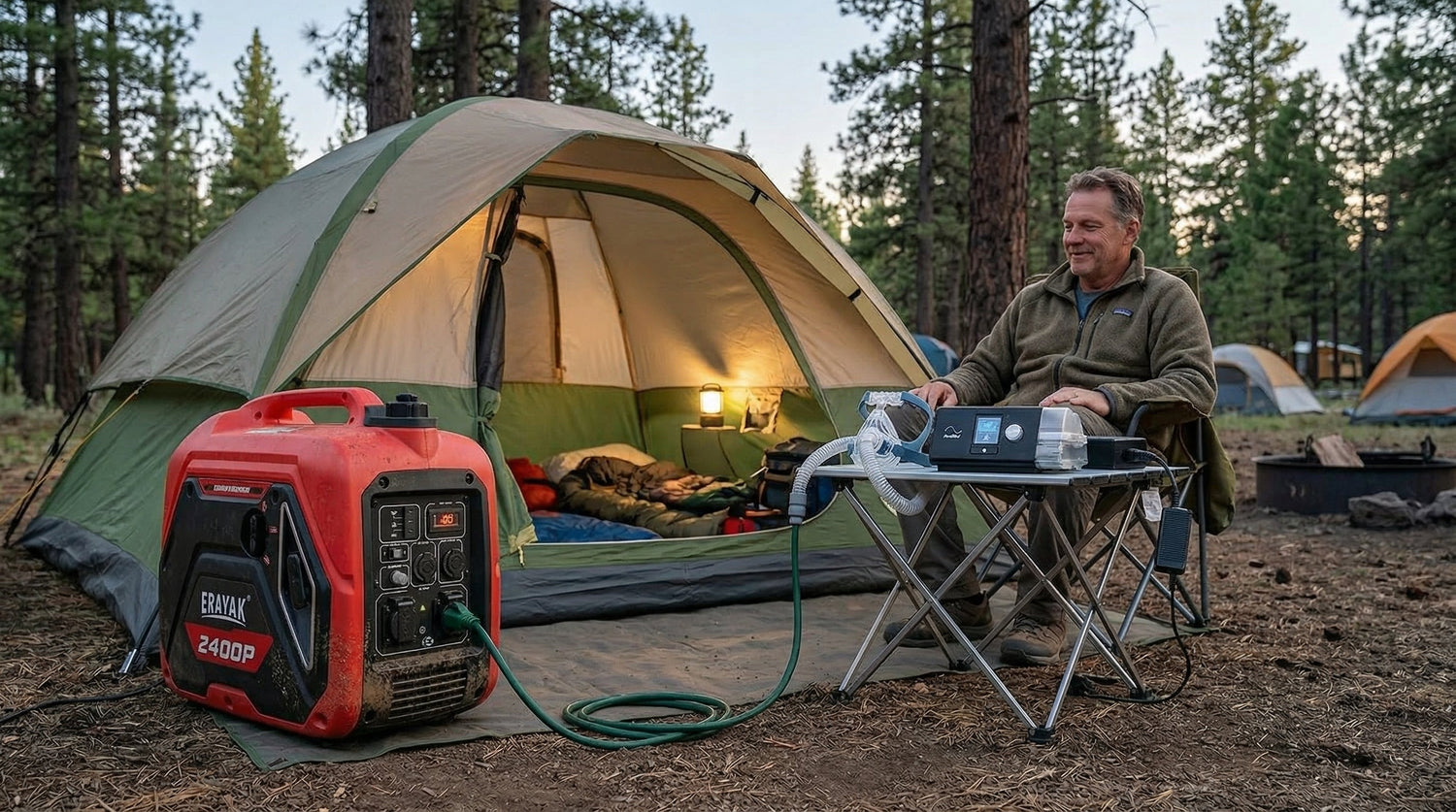
Best Generator for CPAP Camping: 2026 Quiet Power Guide
Camping with a CPAP machine needs a power plan that is quiet, reliable, and safe. For most tent campers, the best overnight setup is a properly sized CPAP battery or power station, with a quiet inverter generator used outdoors during approved hours to recharge batteries and support backup power.
Quick Answer: What Is the Best Generator Setup for CPAP Camping?
The safest practical CPAP camping plan is usually battery power overnight and a quiet inverter generator for daytime recharging. A CPAP machine often uses modest power, but humidifiers and heated tubing can raise energy use. Always check your CPAP manual, power adapter label, and medical guidance before relying on any off-grid setup.
A CPAP-compatible battery or power station placed safely near your sleep area.
Recharge batteries during the day and provide backup power outside the sleeping area.
A quiet inverter generator with stable output, used outdoors with proper distance and airflow.
How Many Watts Does a CPAP Machine Use While Camping?
CPAP power use varies by machine, pressure setting, humidifier use, heated tubing, altitude, and temperature. The label on your AC adapter and the device manual are more reliable than a generic wattage estimate.
| CPAP Setup | Typical Planning Range | Camping Takeaway |
|---|---|---|
| CPAP without humidifier or heated tubing | Often a low-watt load | Best candidate for overnight battery use. |
| CPAP with humidifier | Can use substantially more energy | Plan a larger battery or turn humidification down/off if your clinician and comfort needs allow. |
| CPAP with heated tubing | Additional energy draw | Important in cold-weather camping; test before the trip. |
| BiPAP or higher-pressure device | Varies widely by model and settings | Use the exact device manual and ask your equipment provider before camping off-grid. |
Pre-trip test: run your exact CPAP setup for one full night at home on the battery or power station you plan to use. That is more useful than relying on average wattage charts.
Battery vs Generator: The Best CPAP Camping Strategy
A fuel generator should not be treated like a bedside power source. For sleep, a CPAP battery or portable power station is quieter, safer, and easier to place near your tent or RV bed. A generator becomes useful when you need to recharge that battery during the day or support other camping loads.
| Power Source | Best Role | Watchouts |
|---|---|---|
| CPAP battery pack | Overnight CPAP use inside tent or RV | Must be compatible with your exact machine and long enough for your sleep duration. |
| Portable power station | Overnight CPAP plus small devices | Check pure sine wave output, capacity, recharge time, and idle power draw. |
| Quiet inverter generator | Daytime recharging, backup power, longer trips, RV/campsite loads | Must stay outdoors, far from sleeping areas, and may be restricted by quiet hours. |
Pure Sine Wave Power and CPAP Compatibility
CPAP machines are sensitive medical devices, so the first rule is simple: follow the CPAP manufacturer instructions and use approved power accessories whenever possible. Some CPAP manufacturer guidance recommends pure sine wave inverter output for certain setups, especially when using AC power through an inverter.
Look for input voltage, wattage, DC adapter options, battery guidance, and inverter requirements.
For generator-assisted camping, choose an inverter generator or pure sine wave power station rather than an open-frame construction generator.
No generator can guarantee medical-device compatibility for every CPAP model. Test your exact setup before travel.
Bring spare tubing, filters, extension cords, and a second power option if your therapy depends on nightly use.

How Quiet Should a CPAP Camping Generator Be?
For CPAP camping, the generator should not be near your bed. Even a quiet inverter generator can disturb sleep and can create carbon monoxide risk if placed incorrectly. Use the generator outdoors during allowed hours, then sleep on battery power when possible.
- Choose an enclosed inverter generator for lower sound under light loads.
- Use Eco Mode only when the manual allows it and the load is steady.
- Place the generator far from tents, RV openings, and neighboring sites.
- Respect campground generator hours and quiet hours.
- Do not use a sealed DIY box to make a generator quieter.
CPAP Camping Runtime Checklist
Before you camp, build a small power budget around your actual machine instead of guessing.
Find the CPAP power supply input and output ratings. This gives your real planning baseline.
Humidification and heated tubing can change runtime dramatically.
Run your exact machine, mask, tube, humidity, and battery setup before leaving home.
Know when campground rules allow generator use and how long your battery takes to recharge.
Cold weather, altitude, and battery age can reduce usable runtime.
Use properly rated outdoor cords and keep connections dry, visible, and away from footpaths.
Best Erayak Fits for CPAP Camping Power
For CPAP camping, the generator should usually support daytime charging and campsite backup rather than run beside the tent all night.
 Erayak 2400P: Best Fit for Light CPAP Camping Loads
The 2400P is the best Erayak fit when you need a small inverter generator for recharging a CPAP battery or power station, plus phones, lights, laptops, fans, and other light camping loads.
Compare the Erayak 2400P
 Erayak 4500P: When CPAP Is Part of a Larger RV Load
The 4500P is the gas-only 4,500W-class fit when CPAP support is part of a larger 30 amp RV setup with managed essentials. It is manual recoil start, 55 lb class, with a 2.25 gal tank, up to 8 hours runtime, 60.5 dB, and THD below 1.2%.
Compare the Erayak 4500P
 Erayak 4500PD: Dual-Fuel RV Backup Flexibility
The 4500PD is the better fit if your CPAP power plan overlaps with propane flexibility, RV comfort loads, refrigerator support, and storm backup planning.
Compare the Erayak 4500PDGenerator Safety for CPAP Camping
Never run a fuel generator indoors, inside a tent, inside an RV, in a vehicle, in a garage, under an awning, in a storage compartment, or near open windows, doors, or vents. Carbon monoxide can kill quickly and cannot be detected by smell.
Operate the generator outdoors only, with exhaust pointed away from people and sleeping areas. Use working carbon monoxide alarms in RVs and cabins, keep cords dry and properly rated, and follow the generator manual, campground rules, and CPAP manufacturer instructions.
Do not depend on a running generator as your only overnight CPAP plan. Quiet hours, fuel, weather, mechanical issues, or safety concerns can interrupt generator use. Bring a compatible battery backup whenever your therapy depends on uninterrupted power.
FAQ: CPAP Camping Generators
What is the best generator for CPAP camping?
The best generator is usually a quiet inverter generator used to recharge a CPAP battery or power station during approved hours. For Erayak, the 2400P is the best fit for light CPAP camping loads and battery recharging.
Can I run my CPAP directly from a generator?
Only if your CPAP manufacturer allows that power setup and the generator output matches your device requirements. Many campers prefer a CPAP-compatible battery or pure sine wave power station overnight, with a generator used for recharging.
How many watts does a CPAP machine use?
It depends on the model and settings. A CPAP without humidification is often a low-watt load, while humidifiers and heated tubing can use much more energy. Check your adapter label and test your exact setup before camping.
Is a pure sine wave inverter important for CPAP machines?
For many sensitive electronics and some CPAP setups, pure sine wave output is preferred or recommended by manufacturer guidance. Follow your CPAP manual and use approved power accessories when available.
Is it safe to run a generator overnight for CPAP?
It is usually better to avoid relying on a running fuel generator overnight, especially near tents. Use a compatible battery overnight and recharge it during allowed generator hours. If a generator is used, it must stay outdoors, far from openings and sleeping areas.
Should I turn off the CPAP humidifier while camping?
Turning down or turning off humidification can extend runtime, but comfort and therapy needs vary. Ask your clinician or equipment provider if you are unsure, and test your settings before the trip.
Use Batteries for Sleep, a Quiet Generator for Recharge
The strongest CPAP camping plan is not a generator humming beside your tent. It is a compatible overnight battery or power station, plus a quiet inverter generator like the Erayak 2400P for daytime recharging and campsite backup power.
