

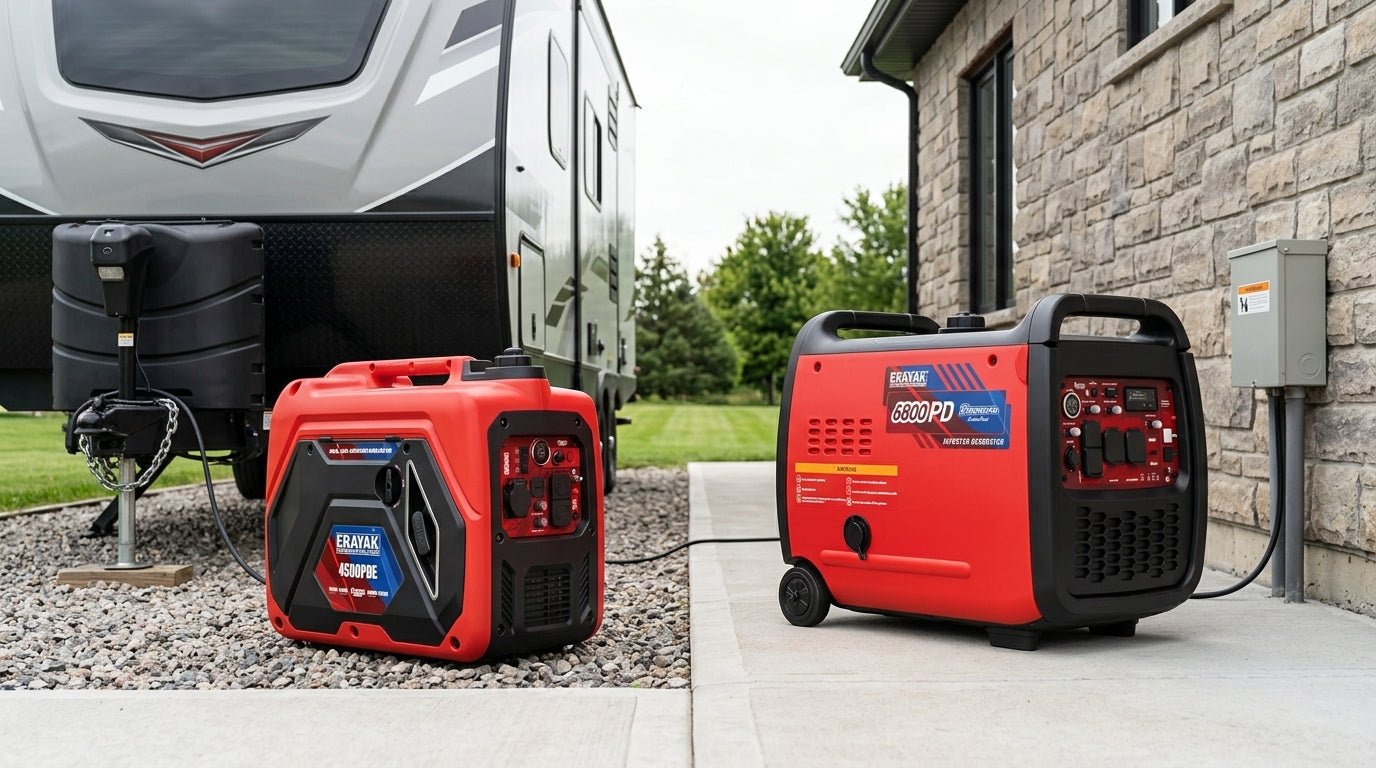
What Size Inverter Generator Do I Need? Wattage Chart
The right inverter generator size depends on what you want to run at the same time, the highest starting-watt appliance, and how much headroom you want for quieter, steadier operation. This guide gives you a practical sizing method for camping, RV travel, home backup, and power tools.
Quick Answer: What Size Inverter Generator Do You Need?
Most campers need a 2,000 to 2,400 watt inverter generator, many RV owners need 3,500 to 4,500 watts, and home backup users often need 4,500 to 6,800 watts or more for selected essential loads. The exact size depends on starting watts, running watts, and whether you plan to run high-demand appliances like an RV air conditioner, refrigerator, microwave, sump pump, well pump, or power tools.
For a safe estimate, add the running watts of everything you want to power at the same time, then add the largest extra starting surge, then choose a generator with about 20% to 30% headroom.
Inverter Generator Size Chart
If you need a quick starting point, use this chart first. Then confirm your exact loads with the calculation method below.
| Generator size | Best fit | Common loads | Main caution |
|---|---|---|---|
| 1,000-2,000W | Phones, laptops, lights, small electronics, very light camping | LED lights, router, TV, CPAP, small chargers | Usually too small for microwaves, RV AC, pumps, or several appliances at once |
| 2,000-2,400W | Camping, small RV loads, refrigerator-only backup, battery charging | Small fridge, lights, laptop, fan, CPAP, battery charger | May not reliably start larger RV AC or portable AC loads without careful load management |
| 3,000-4,500W | RV air conditioner plus essentials, portable AC plus refrigerator, stronger emergency backup | 13,500 BTU RV AC, refrigerator, lights, TV, microwave one at a time | Do not assume every high-demand appliance can run at the same time |
| 5,000-6,800W | Larger home backup, selected circuits, pumps, larger RV planning, jobsite loads | Refrigerator, freezer, sump pump, microwave, selected tools, some 120V/240V planning | Check voltage, outlet type, transfer equipment, and starting surge before buying |
| 7,000W+ | Heavier backup or worksite use | Multiple high-demand appliances or larger tools | May be less portable, louder, and more expensive than needed for normal RV/camping use |
How to Calculate Generator Wattage
The simplest sizing method is to separate continuous running load from temporary starting surge.
- List everything you want to run at the same time. Do not include appliances you can turn off while another starts.
- Find running watts for each item. Check the nameplate, manual, or manufacturer data.
- Find starting watts for motor-driven loads. Refrigerators, pumps, compressors, air conditioners, and power tools may need extra surge.
- Add all running watts.
- Add the largest extra starting surge. Usually you only need to cover the biggest motor starting at one time.
- Add 20% to 30% headroom. This helps reduce overloads and lets the generator run with less strain.
Example: if your running load is 2,200 watts and your largest additional starting surge is 1,000 watts, your minimum surge requirement is about 3,200 watts. With headroom, a 4,000W to 4,500W inverter generator class may be more comfortable than a smaller unit.
Starting Watts vs Running Watts
Running watts are the continuous watts an appliance needs after it is operating. Starting watts, also called surge watts or peak watts, are the short burst needed to start motor-driven appliances.
This difference is why a refrigerator that runs on a few hundred watts can still trip a small generator at startup. It is also why shoppers should not buy only by peak watts. Peak watts help with starting surge; running watts tell you what the generator can support continuously.
Practical rule: For inverter generator sizing, focus first on running watts, then confirm that the generator's surge rating can handle the largest startup load. If you only look at the largest advertised peak number, you may overestimate what the generator can run continuously.
Common Appliance Wattage Chart
Actual wattage varies by appliance age, efficiency, compressor size, altitude, temperature, and startup behavior. Use these as planning ranges, then verify your own equipment.
| Appliance or load | Typical running watts | Typical starting watts | Sizing note |
|---|---|---|---|
| Phone, tablet, camera charging | 10-60W | Usually no major surge | Easy load for small inverter generators |
| Laptop | 50-100W | Usually no major surge | Clean inverter output is useful for electronics |
| CPAP machine | 30-90W | Usually no major surge | Use a battery-first plan for overnight medical equipment when possible |
| Household refrigerator | 150-800W | 600-2,000W | Compressor surge matters more than average running watts |
| Microwave | 1,000-1,800W | Usually close to running watts | Run separately from AC or other large loads on smaller generators |
| Coffee maker | 800-1,500W | Usually close to running watts | Heating loads can consume more wattage than expected |
| 13,500 BTU RV air conditioner | 1,100-1,600W | 2,000-3,500W+ | Soft start and load management can change the required generator size |
| Portable room AC | 800-1,600W | 1,500-3,200W+ | Size by BTU, compressor surge, and what else runs with it |
| Sump pump | 800-1,500W | 1,500-4,000W+ | Check horsepower and nameplate amps |
| Well pump | 1,000-2,500W+ | 3,000-6,000W+ | May require 120V/240V output and professional transfer equipment |
| Power tools or air compressor | 800-2,000W+ | 2,000-5,000W+ | Motor surge and simultaneous tool use drive sizing |
Recommended Inverter Generator Size by Use Case
Camping and small electronics: 2,000-2,400W
This range is usually enough for lights, phones, laptops, a small fridge, fans, CPAP battery charging, and simple campsite loads. It is not the right choice for running many high-watt appliances at once.
RV travel with one AC: 3,500-4,500W
Many RV users choose this range because it can cover a 13,500 BTU RV AC plus basic essentials when loads are managed. Microwave, coffee maker, and AC may still need to be used one at a time.
Home essentials: 4,500-6,800W
For outage planning, this range can support refrigerator/freezer, lights, router, device charging, selected kitchen loads, and some pump scenarios when properly sized.
Portable AC plus refrigerator: 4,000-4,500W+
A small generator may run one appliance, but AC plus refrigerator needs more startup headroom. Size around the compressor surge and avoid starting both at the same time.
Sump pump or well pump backup: 5,000W+
Pumps can have high startup surge. Well pumps may also require 120V/240V output, correct outlet type, and transfer equipment reviewed by a qualified electrician.
Jobsite tools: 5,000-7,000W+
Saws, grinders, compressors, and simultaneous tool use can require more surge capacity than a normal camping generator. Check tool nameplates before choosing.
Real-World Generator Sizing Examples
Example 1: Light camping setup
Loads: LED lights, phone charging, laptop, fan, and a small portable fridge. This setup may stay under 700 to 1,000 running watts with modest surge. A 2,000W to 2,400W inverter generator is usually a comfortable class.
Example 2: RV with one 13,500 BTU air conditioner
Loads: RV AC, converter/charger, refrigerator controls, TV, and outlets. The AC startup surge is the main challenge. Many users should consider the 3,500W to 4,500W class, especially if they want headroom for warm weather, altitude, battery charging, and occasional microwave use.
Example 3: Home outage essentials
Loads: refrigerator, freezer, router, several lights, phone charging, and occasional microwave or coffee maker. A 4,500W class inverter generator can work for many essential-load plans, while larger selected-circuit plans may need 5,000W to 6,800W+ and proper transfer equipment.
Example 4: Sump pump plus refrigerator
Loads: sump pump, refrigerator, freezer, lights, and router. Pump startup can be demanding, so the right size depends on pump horsepower and nameplate amps. A higher-capacity inverter generator with enough surge headroom is usually safer than a small camping unit.
How Much Extra Headroom Do You Need?
In most cases, choose a generator with about 20% to 30% more capacity than your calculated load. Headroom helps with startup surge, hot-weather operation, altitude, aging appliances, and real-world load changes.
Headroom also helps the generator run at a more comfortable load. A generator operating near its limit may be louder, hotter, less fuel-efficient, and more likely to trip overload protection. A properly sized inverter generator can stay quieter and steadier because it is not constantly pushed to the edge.
Power-management tip: You can often use a smaller generator by sequencing loads. For example, turn the RV AC off before using a microwave, or let a refrigerator start before adding a coffee maker. The goal is not to run every appliance at the same time; it is to run the loads that matter safely.
Generator safety notice: Never run a fuel-powered generator indoors, in a garage, under an RV, on a porch, in a shed, or near open windows. Always operate it outdoors with the exhaust pointed away from people, doors, windows, and vents. Use working carbon monoxide alarms when a generator is used for RV or home backup.
Which Erayak Inverter Generator Size Fits Your Needs?
Use this section as a routing guide after you estimate your wattage. The best choice is the one that fits your normal loads with enough headroom, not simply the largest generator available.
| Need | Recommended Erayak path | Why it fits |
|---|---|---|
| Light camping, battery charging, refrigerator-only backup, compact portable power | ERAYAK 2400P | A practical fit for small-load users who value portability and do not need to start a large RV AC or multiple heavy appliances. |
| Gas-only RV/camping power, home essentials, portable AC planning with managed loads | ERAYAK 4500P | A gas-only 4500W inverter generator option for users who want more headroom than a small camping generator without propane or natural gas capability. |
| Dual-fuel RV comfort loads, storm backup essentials, portable AC plus refrigerator | ERAYAK 4500PD | A strong match when fuel flexibility matters and the user wants a 4500W-class inverter generator for RV and home-essential scenarios. |
| Larger selected-load backup, 120V/240V planning, sump pump/well pump scenarios | ERAYAK 6800PD / 6800PT | The higher-capacity path when the plan involves more complex home backup loads, selected circuits, or 120V/240V equipment. |

ERAYAK 2400P Inverter Generator
Best fit when your sizing result points to compact camping, battery charging, a small refrigerator, electronics, or light emergency loads.
- Use when portability matters more than running large AC loads.
- Good starting point for campers who do not need RV air conditioner support.
- Useful product route for readers in the 2,000-2,400W sizing range.

ERAYAK 4500P Gas Inverter Generator
Best fit when your load calculation needs more headroom than a small camping generator and you prefer a gas-only inverter generator.
- Fits RV, camping, portable AC planning, and home-essential use cases when loads are managed.
- Gas-only model; do not choose it if propane or natural gas flexibility is required.
- Useful route for readers landing in the 3,500-4,500W range.

ERAYAK 4500PD Dual-Fuel Inverter Generator
Best fit when your sizing result includes RV comfort loads, portable AC plus refrigerator, storm backup essentials, and the flexibility of gasoline or propane.
- Strong product route for RV and home-essential readers.
- Better fit than 2400P when AC startup surge or multiple essentials are part of the plan.
- Natural match for dual-fuel buying intent inside a sizing article.

ERAYAK 6800PD / 6800PT Series
Best fit when your sizing result points beyond basic RV or camping loads into larger selected-circuit backup, pump planning, or 120V/240V needs.
- Use when refrigerator-only or one-AC planning is not enough.
- Relevant for sump pump, well pump, and more complex outage-prep readers.
- Choose 6800PD for dual fuel or 6800PT when tri-fuel planning is needed.
Compare Erayak Inverter Generators by Wattage
Once you know your running watts and startup surge, compare Erayak inverter generator options for camping, RV use, home essentials, and larger selected-load backup.
FAQ
What size inverter generator do I need for camping?
For lights, phones, laptops, a fan, CPAP battery charging, and a small fridge, many campers are comfortable in the 2,000W to 2,400W range. If you plan to run a portable AC, microwave, or several appliances together, calculate the actual running and starting watts before choosing.
What size inverter generator do I need for an RV?
Many RV users with one air conditioner look at the 3,500W to 4,500W class because RV AC startup surge is often the largest load. Smaller generators can work for light RV loads, while larger RVs, two-AC setups, or 50A planning need a more detailed load calculation.
Is a 2,000 watt inverter generator enough?
A 2,000W inverter generator can be enough for light camping, electronics, fans, small fridges, and battery charging. It is usually not the best choice for RV AC, large portable AC, sump pumps, microwaves plus other loads, or broader home backup.
Is a 4,500 watt inverter generator enough for home backup?
A 4,500W class inverter generator can cover many essential-load plans, such as refrigerator/freezer, lights, router, device charging, and occasional kitchen loads when managed carefully. Larger pumps, 240V loads, central AC, or selected-circuit backup may require a higher-capacity 120V/240V generator and proper transfer equipment.
Should I size a generator by starting watts or running watts?
Use both. Running watts tell you what the generator can supply continuously, while starting watts tell you whether it can handle motor startup surge. Add your simultaneous running watts, then add the largest additional starting surge, then include headroom.
Can I buy a smaller generator and manage loads manually?
Yes, load management can work well. You can avoid running a microwave, coffee maker, AC, and pump at the same time. However, the generator still needs enough surge capacity for the largest appliance you plan to start.


