

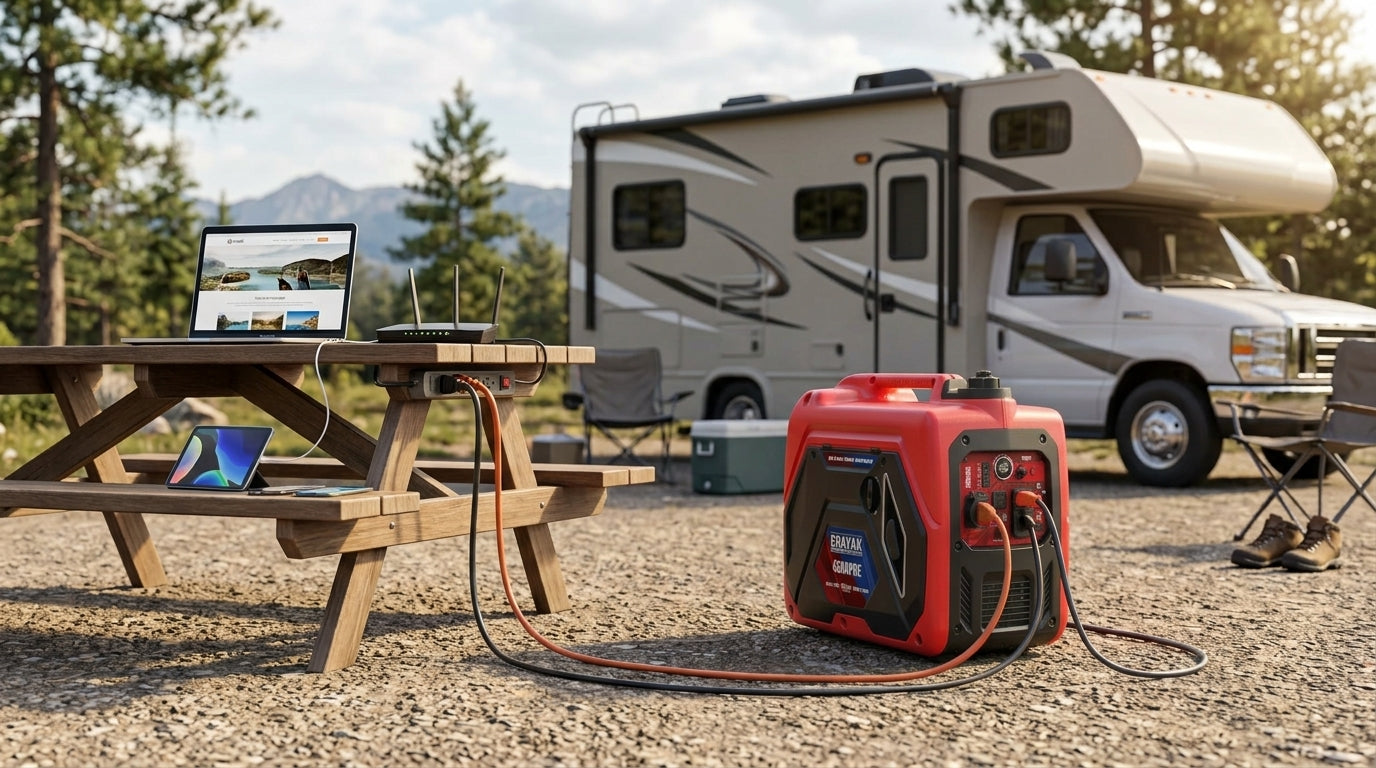
Why Are Inverter Generators Quieter? Noise Reduction Technology Explained
Inverter generators are usually quieter than conventional generators because they can slow the engine under lighter loads, use enclosed acoustic housings, manage vibration, and tune exhaust noise more carefully. The result is not silence, but a smoother and less intrusive sound profile for RV camping, home backup, and neighborhood use.
Quick Answer: Why Inverter Generators Make Less Noise
Inverter generators are quieter because they do not have to run at one fixed high engine speed to produce usable AC power. The engine can slow down when the electrical load is light, while the inverter electronics create stable output. Lower RPM, enclosed body panels, tuned mufflers, and better vibration isolation all reduce the sound you hear.
Variable engine speed lets the generator run quieter when loads are light.
Most quiet inverter models use an enclosed case instead of an exposed open frame.
Noise rises with load, so an inverter generator still gets louder when running an RV AC or heavy tools.
Why Conventional Generators Are Louder
Many conventional generators are loud because the engine must run at a fixed speed to maintain standard AC frequency. That means the engine can stay loud even when you are only powering a small device.
- fixed high engine RPM even during light electrical loads
- open-frame construction with less sound containment
- stronger vibration transfer through the frame
- more exposed exhaust and mechanical noise
That fixed-speed behavior is why many open-frame units sound aggressive even when the electrical demand is modest. Inverter designs solve part of this problem by separating engine speed from clean AC output.
The 5 Technologies That Make Inverter Generators Quieter
Quiet operation comes from a system, not one magic part. The most effective inverter generators combine engine control, enclosure design, airflow, muffler tuning, and stable electronics.
| Noise Reduction Feature | What It Does | Why It Matters |
|---|---|---|
| Variable RPM | Adjusts engine speed to the electrical load | Light loads can run at lower RPM with less combustion noise. |
| Eco Mode | Prioritizes lower RPM when load demand is low | Useful for charging electronics, running lights, or light campsite loads. |
| Enclosed acoustic housing | Surrounds the engine and alternator with a noise-dampening shell | Reduces direct sound leakage compared with open-frame designs. |
| Tuned muffler and exhaust path | Controls exhaust pulses and directs sound away from the operator | Helps soften the sharp exhaust tone that carries across campsites. |
| Vibration isolation | Uses mounts, panel fit, and frame design to reduce rattles | Prevents mechanical buzz from making a quiet engine sound harsher. |
Variable RPM and Eco Mode Are the Biggest Difference
Inverter generators produce power in stages. The engine turns an alternator, the generator converts the output electronically, and the inverter creates stable AC power. Because electronics handle the output quality, the engine can slow down when load is low.
Charging phones, lights, laptops, routers, or small fans can allow lower RPM and quieter operation.
Refrigerators, coffee makers, and battery chargers raise engine speed but can still sound smoother than many open-frame units.
RV air conditioners, heaters, and tools raise RPM significantly. The generator is quieter than a comparable open-frame design, but not silent.
Eco Mode is best for steady light loads. Turn it off or follow your manual when starting high-surge loads that need faster throttle response.
Acoustic Housing, Mufflers, and Vibration Control
Enclosed inverter generators usually sound quieter because the body panels help contain mechanical noise. The best designs also manage airflow so the generator can cool itself without leaving large openings that leak sound.
Reduce direct engine and alternator noise while protecting internal components.
Softens exhaust pulses before the sound leaves the generator.
Good fit reduces rattles, buzzing, and high-frequency noise.
Vibration isolation helps keep engine movement from traveling into the frame.
How Quiet Is an Inverter Generator in dB?
There is no single dB number for all inverter generators. Noise depends on wattage class, load percentage, measuring distance, terrain, exhaust direction, and whether Eco Mode is active.
| Operating Situation | What Usually Happens | Buyer Takeaway |
|---|---|---|
| Small inverter, light load | Usually the quietest practical generator setup | Best for camping electronics, battery charging, routers, lights, and fans. |
| Mid-size inverter, 25-50% load | Balanced sound and capacity for RV and home essentials | Good fit when you need more power without moving to an open-frame unit. |
| Inverter at high load | Engine RPM rises and the generator becomes noticeably louder | Size the generator correctly so it is not constantly straining near maximum output. |
Compare dB ratings carefully. A rating measured at 25% load and 23 feet cannot be fairly compared with another rating measured at rated load or a different distance.
Inverter Generator vs Conventional Generator Noise
Inverter generators are not automatically silent, and conventional generators are not automatically unusable. But for RV parks, campgrounds, neighborhoods, food trucks, and light home backup, inverter designs usually create a more acceptable sound profile.
| Feature | Inverter Generator | Conventional Generator |
|---|---|---|
| Engine speed | Can adjust to load | Often fixed speed |
| Sound character | Smoother and less harsh under light loads | Often louder, sharper, and more constant |
| Housing | Often enclosed | Often open frame |
| Best use | Camping, RVs, electronics, home essentials, quiet neighborhoods | Job sites, high-output work, budget-first utility power |
How to Choose a Quiet Inverter Generator
Do not buy only by the lowest dB number. A smaller generator may be quiet at light load but become louder if it is constantly overloaded. Choose a size that runs your real loads with breathing room.
- Check the dB rating, load percentage, and measurement distance.
- Choose enclosed inverter construction for noise-sensitive RV and camping use.
- Use Eco Mode for light steady loads when the manual allows it.
- Match wattage to the appliance, especially RV AC starting watts.
- Place the generator safely outdoors and point exhaust away from people.
- Maintain oil, filters, spark plug, panels, and fasteners to prevent extra noise.
Best Erayak Fits by Quiet-Power Scenario
Use the technology explanation above to match the generator to the load. The quietest generator is the one that can run your real appliances without living at maximum output.
 Erayak 2400P: Light-Load Quiet Camping
Best fit for charging devices, lights, routers, fans, and small campsite loads where portability and low-noise operation matter most.
Compare the Erayak 2400P
 Erayak 4500P: Gas-Only RV and Home Essentials
The 4500P is a gas-only 4,500W-class inverter generator for RV and home-essential loads. It is manual recoil start, 55 lb class, with a 2.25 gal tank, up to 8 hours runtime, 60.5 dB, and THD below 1.2%.
Compare the Erayak 4500P
 Erayak 4500PD: Dual-Fuel Flexibility
Best fit when quiet inverter power overlaps with propane flexibility, RV comfort loads, refrigerator support, and outage backup planning.
Compare the Erayak 4500PDSafety Notice for Quiet Generator Use
Quiet does not mean indoor-safe. Never run a fuel generator indoors, inside an RV, in a tent, in a garage, under an awning, in a storage compartment, or near open windows, doors, or vents. Operate outdoors only with open airflow, safe cords, and working carbon monoxide alarms where people sleep.
Do not build a sealed DIY sound box around a running generator. Poor ventilation can trap heat and carbon monoxide, creating fire and poisoning hazards.
FAQ: Inverter Generator Noise Reduction
Are inverter generators quieter than regular generators?
Usually yes. Inverter generators can adjust engine speed to load and many use enclosed housings, making them quieter and smoother under light to moderate loads than many conventional open-frame units.
Why are inverter generators quieter?
They are quieter because they use variable RPM, Eco Mode, enclosed body panels, tuned mufflers, and vibration isolation. The inverter electronics allow stable power without forcing the engine to run at one fixed high speed all the time.
Does Eco Mode make a generator quieter?
Yes, when the load is light and steady. Eco Mode lets the engine slow down, which usually reduces sound and fuel use. Heavy startup loads may require normal mode depending on the generator manual.
Are inverter generators silent?
No. They are still fuel engines with exhaust, cooling fans, and vibration. They are quieter than many conventional generators, but sound increases as the electrical load rises.
What makes a quiet inverter generator sound louder?
High load, RV AC startup, hard surfaces, reflective walls, poor maintenance, loose panels, old oil, dirty air filters, and bad placement can all make a generator sound louder.
Is an enclosed inverter generator better for camping?
For noise-sensitive camping, usually yes. Enclosed inverter generators are often better for campgrounds and RV parks because they reduce direct engine noise and can run quieter under light loads.
Quiet Inverter Power Comes From Load-Smart Engineering
Inverter generators are quieter because the engine can slow down when demand is low, while the housing, muffler, airflow, and vibration controls reduce the noise that escapes. For buyers, the practical move is to choose the right wattage class, check the dB rating details, and use safe placement outdoors.


