

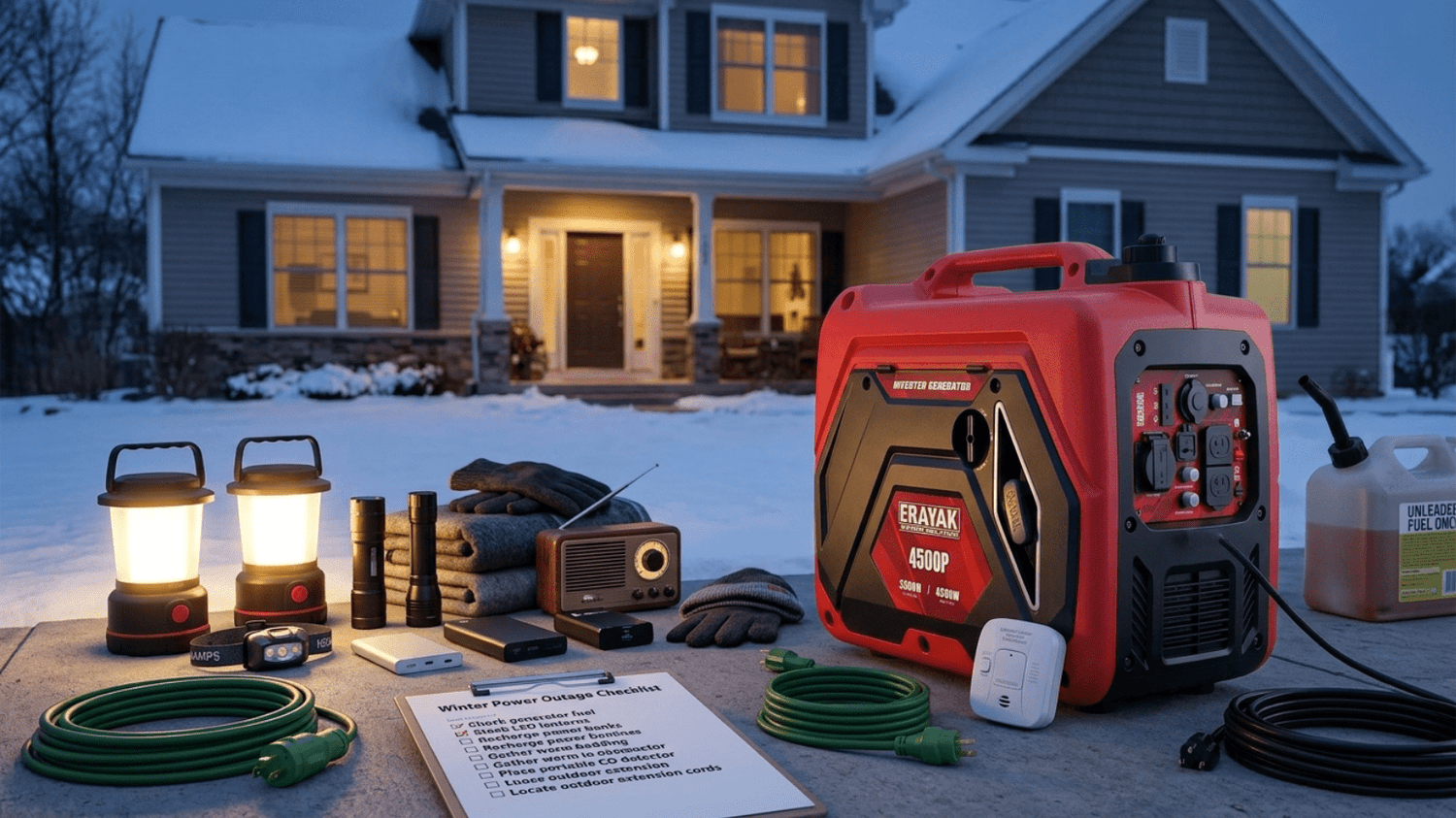
Winter Power Outage Checklist: Heat, Lighting, Battery, and Generator Safety
A winter power outage can quickly become more serious than a short summer blackout. Cold temperatures, frozen pipes, dark evenings, dead phones, weak internet, and heating equipment concerns can all happen at the same time. A practical winter outage plan should cover heat, lighting, batteries, food, communication, and safe generator use before the storm arrives.
Quick Answer
A winter power outage checklist should include safe heat planning, battery-powered lighting, charged power banks, warm clothing, blankets, food and water, medication, emergency contacts, fuel planning, extension cords, carbon monoxide alarms, and a portable generator used outdoors only. Do not run a generator indoors, in a garage, near windows, near vents, or in any enclosed space.
For backup power, prioritize essentials first: phones, battery packs, LED lights, WiFi router, refrigerator, freezer, furnace-related components where compatible, sump pump, and selected small appliances. Use a generator only with proper cords, dry connections, safe placement, and a clear load plan.
Why Winter Outages Need a Different Checklist
Winter outages create problems that do not always appear during mild-weather blackouts. Heat loss can happen quickly, phones may drain faster in cold weather, snow and ice can block access to fuel or equipment, and families may be tempted to use unsafe heat sources indoors.
Warmth Becomes Priority One
Plan how to keep people warm, protect pipes, and support heating-related equipment without using unsafe indoor combustion devices.
Long Nights Need Safer Lighting
Battery lanterns, headlamps, and LED lights reduce trip hazards and help you avoid candles or unsafe improvised lighting.
Generator Safety Matters More
Snow, wind, garages, porches, and closed windows can increase carbon monoxide risk if the generator is placed incorrectly.
Heat and Warmth Checklist
Your first goal in a winter outage is to keep people warm safely. Do not bring outdoor grills, charcoal heaters, camp stoves, or fuel-burning equipment indoors. A generator can support certain heating-related electrical loads, but it must remain outdoors.
| Heat Item | Why It Matters | Winter Outage Tip |
|---|---|---|
| Warm clothing layers | Reduces dependence on powered heat | Use base layers, wool socks, hats, gloves, and insulated outer layers |
| Blankets and sleeping bags | Helps maintain body heat at night | Group family members in one safe room to conserve warmth |
| Safe heating plan | Prevents dangerous indoor combustion use | Never use grills, camp stoves, or generators indoors for heat |
| Pipe protection plan | Helps reduce frozen-pipe risk | Know which faucets, cabinets, and vulnerable areas need attention |
| Thermometer | Tracks indoor temperature | Monitor conditions in rooms used by children, seniors, or pets |
| Carbon monoxide alarms | Critical for combustion and generator safety | Use working CO alarms on every level and near sleeping areas |
Lighting Checklist
Winter outages often happen in the evening or during storms, when visibility is poor. Lighting should be safe, portable, and easy to find in the dark.
| Lighting Item | Best Use | Checklist Tip |
|---|---|---|
| LED lanterns | Room lighting | Place one in the kitchen, one in the main room, and one near stairs |
| Headlamps | Hands-free tasks | Useful for generator setup, cord inspection, and nighttime checks |
| Flashlights | Quick movement around the house | Keep one near each bedroom and emergency kit |
| Rechargeable work light | Garage, basement, or generator staging area | Charge it before winter storms |
| Spare batteries | Backup for flashlights and radios | Store by battery type in a labeled container |
| Glow sticks | Simple low-risk marker lights | Use for stairways, bathrooms, and children’s rooms |
Battery and Communication Checklist
During a winter storm, communication can be as important as heat. Phones, radios, internet equipment, and battery packs help you receive weather alerts, contact family, and manage emergency decisions.
| Battery / Communication Item | Why It Helps | Preparation Tip |
|---|---|---|
| Power banks | Keeps phones and small devices charged | Charge all packs before forecasted winter storms |
| USB charging cables | Prevents device mismatch | Keep USB-C, Lightning, and micro-USB where needed |
| Battery radio | Receives weather and emergency alerts | Store with spare batteries or hand-crank charging option |
| WiFi router backup plan | Keeps internet available if service remains active | Use generator power or battery backup only when safe and needed |
| Printed contact list | Works even if phone battery dies | Include family, neighbors, utility company, pharmacy, and emergency numbers |
| Charging schedule | Reduces generator runtime | Charge phones and power banks in batches during planned generator windows |
Food, Water, and Refrigerator Checklist
Winter outages can disrupt cooking, refrigeration, and water access. Prepare shelf-stable food, drinking water, basic cooking alternatives, and a plan for refrigerator or freezer power.
| Item | Why It Matters | Winter Outage Tip |
|---|---|---|
| Drinking water | Water supply may be interrupted or pipes may freeze | Store enough for drinking, cooking, and basic hygiene |
| Non-perishable food | Reduces need for electric cooking | Keep ready-to-eat meals, canned food, snacks, and manual can opener |
| Refrigerator plan | Protects food during longer outages | Run refrigerator during planned generator windows and keep doors closed |
| Freezer plan | Preserves stored food | Use generator time strategically and avoid frequent opening |
| Cooler and ice packs | Backup cold storage | Move priority items only when needed |
| Pet food and water | Supports animals during outages | Keep a separate pet emergency supply kit |
Portable Generator Checklist
A portable generator can support essential winter outage loads, but only when the setup is planned before the storm. The generator should be maintained, fueled, stored correctly, and operated outdoors with dry rated cords.
| Generator Item | Why It Matters | Before the Storm |
|---|---|---|
| Fresh fuel | Reduces hard starts and carburetor issues | Label fuel cans and rotate old gasoline |
| Engine oil | Protects the engine during cold-weather use | Check level and oil type according to the manual |
| Outdoor-rated extension cords | Connects essential loads safely | Use grounded, intact cords rated for the load and distance |
| CO alarms | Warns of carbon monoxide risk inside the home | Test alarms and replace batteries if needed |
| Transfer switch planning | Supports selected home circuits safely | Use a properly installed transfer switch if connecting to home wiring |
| Snow-cleared outdoor area | Supports safe generator placement | Choose a location away from doors, windows, vents, garages, and enclosed spaces |
| Load checklist | Prevents overload | List priority loads and rotate high-demand appliances |
| Flashlight and gloves | Helps with cold-weather setup | Store with the generator kit |
What to Power First During a Winter Outage
Do not try to power the whole house unless your system is designed for it. Start with essential loads, then rotate higher-demand appliances as needed.
| Priority Level | Examples | Power Strategy |
|---|---|---|
| Priority 1 | Phones, power banks, medical device chargers, battery radio | Charge in planned windows and keep backup batteries ready |
| Priority 2 | LED lights, router, small fans where needed | Use low-load devices to extend generator runtime |
| Priority 3 | Refrigerator, freezer, sump pump, furnace-related electrical components where compatible | Start one major load at a time and confirm running stability |
| Priority 4 | Coffee maker, microwave, kettle, electric cooking appliance | Run separately as short-use loads, not together |
| Avoid stacking | Heaters, large cooking loads, pumps, fridge startup, freezer startup | Check wattage and rotate loads to prevent overload |
Recommended Erayak Setup by Winter Outage Need
Erayak 2400P: Compact Winter Essentials
Choose the Erayak 2400P when your winter outage plan focuses on phones, power banks, LED lights, WiFi router, laptop, small electronics, and compact backup power.
- Good fit for basic winter outage communication and lighting needs
- Useful for phones, power banks, LED lights, small fans, router, laptop, and small electronics
- Pair with CO alarms, outdoor-rated cords, fuel plan, and battery lighting
Erayak 4500P: Strong Starting Point for Managed Winter Loads
Choose the Erayak 4500P when your winter outage setup includes managed home loads such as refrigerator, freezer planning, lights, router, phone charging, laptop, coffee maker timing, and selected household essentials.
- Gas-only portable inverter generator
- Manual recoil start
- 55 lb lightweight design
- 2.25 gal fuel tank
- Up to 8 hours runtime
- THD < 1.2% for sensitive electronics
- 60.5 dB noise level
Erayak 4500PD: Fuel Flexibility for Longer Winter Outages
Choose the Erayak 4500PD when your winter outage plan benefits from gasoline and propane flexibility for longer storms, extended blackouts, and mixed home and outdoor emergency use.
- Gasoline and propane flexibility
- Useful for longer winter outage planning and flexible fuel strategy
- Good fit for refrigerator, lights, router, fans, charging, coffee timing, and managed emergency loads
Erayak 6800PD / 6800PT: Larger Winter Backup, 30A, and 120V/240V Planning
Choose the Erayak 6800 series when your winter outage plan needs more headroom, 30A outputs, selected 120V/240V planning, pump planning, multiple power zones, RV overlap, and broader home backup capability.
- 6800W peak power
- 5000W rated power on gasoline at 100% output
- 30A L5-30R outlet
- 30A 120V/240V L14-30R outlet
- Dual 120V household outlets
- TT-30R RV adapter accessory included
Winter Generator Safety Checklist
Winter generator safety requires extra attention because snow, ice, closed windows, attached garages, and covered porches can make poor placement more tempting and more dangerous.
- Run the generator outdoors only, away from doors, windows, vents, garages, crawlspaces, basements, sheds, porches, and enclosed spaces.
- Never run a generator indoors or in a garage, even with doors or windows open.
- Do not run a generator in an enclosed porch, under a snow-covered shelter, inside an RV, inside a tent, or near an open window.
- Keep generator exhaust pointed away from the home, neighboring homes, people, pets, and occupied areas.
- Keep working carbon monoxide alarms inside the home, especially near sleeping areas.
- Clear snow and ice from the outdoor generator area while keeping the generator away from openings.
- Keep the generator dry, but do not create an enclosed space around it.
- Use grounded, properly rated, outdoor extension cords.
- Inspect cords for fraying, cuts, crushed insulation, exposed wire, loose plugs, heat damage, or missing ground pins.
- Never use frayed, damaged, wet, crushed, or loose extension cords.
- Keep plug connections dry, elevated, and away from snow, slush, puddles, rain runoff, and wet ground.
- Do not backfeed your home through a wall outlet.
- Use a properly installed transfer switch if powering selected home circuits.
- Disconnect loads before starting the generator.
- Add loads gradually after the generator stabilizes.
- Rotate high-demand appliances such as microwave, kettle, coffee maker, pump, refrigerator, freezer, and space-heating loads.
- Let the generator cool before refueling or maintenance.
- Store fuel in approved containers away from flame, heat, living areas, children, pets, and ignition sources.
Prepare Before the Next Winter Outage
A winter outage plan should cover warmth, lighting, battery charging, food protection, communication, and safe generator operation. Build your checklist before snow and ice arrive. Choose Erayak 2400P for compact essentials, 4500P or 4500PD for broader managed home backup, and the 6800 series for larger 30A, 120V/240V, pump, RV, and multi-zone winter power planning.
FAQ: Winter Power Outage Checklist
What should I prepare before a winter power outage?
Prepare warm clothing, blankets, LED lanterns, headlamps, flashlights, power banks, battery radio, food, water, medication, fuel, carbon monoxide alarms, outdoor-rated cords, and a generator load plan if you use a portable generator.
Can I run a generator in the garage during a winter storm?
No. Never run a generator in a garage, basement, shed, crawlspace, enclosed porch, RV, tent, or indoor area, even if doors or windows are open. Run it outdoors only and away from doors, windows, vents, and enclosed spaces.
What should I power first during a winter outage?
Prioritize phones, power banks, medical chargers, LED lights, router, refrigerator, freezer, sump pump, and furnace-related electrical components where compatible. Add loads gradually and rotate high-demand appliances.
How can I keep warm during a winter outage without power?
Use warm clothing layers, blankets, sleeping bags, insulated rooms, and safe heat planning. Do not use outdoor grills, charcoal, camp stoves, or generators indoors for heat.
What lighting is best for a winter blackout?
LED lanterns, headlamps, flashlights, rechargeable work lights, spare batteries, and glow sticks are practical options. Avoid relying only on your phone flashlight because phone battery should be saved for communication.
Can a generator power a gas furnace during a winter outage?
Some gas furnaces need electricity for the blower, controls, and ignition system, but safe connection depends on the furnace, generator, transfer switch setup, and local electrical requirements. Do not improvise wiring. Use a properly installed transfer switch or consult a qualified electrician.
What Erayak generator is best for winter backup power?
Choose the Erayak 2400P for compact essentials, the Erayak 4500P or 4500PD for broader managed winter home backup, and the Erayak 6800 series for larger 30A, 120V/240V, pump, RV, and multi-zone planning.
