

Portable vs Standby vs Battery Backup: Choosing the Right Home Backup Power System
The right backup system depends less on the biggest power number and more on what must stay on, how long outages last, whether automatic operation matters, and how much setup you are willing to manage.
Quick Answer: Which Home Backup Power System Is Best?
Choose a portable inverter generator when you want a flexible, budget-conscious way to power selected essentials during occasional or extended outages and you can safely operate and refuel it outdoors. Choose a standby generator when automatic startup, longer outages, larger loads, and being protected while away from home justify professional installation and ongoing maintenance. Choose a battery backup when quiet operation, fast switchover, indoor electronics, and short-to-medium outages matter more than indefinite runtime.
For many households, the most resilient answer is a hybrid: a battery carries silent, immediate loads first, while a portable or standby generator supports longer outages after stored energy runs low.
Portable Generator vs Standby Generator vs Battery Backup
No single system wins every category. Start with the tradeoffs that affect your actual outage: the loads you need, the hours or days you need them, and whether anyone will be home to start and monitor the equipment.
| Decision factor | Portable inverter generator | Standby generator | Battery backup |
|---|---|---|---|
| Best use | Selected essentials, RV crossover use, occasional to extended outages | Automatic whole-home or selected-circuit backup for frequent outages | Quiet electronics and essentials backup for short-to-medium outages |
| Startup | Manual setup and start | Usually automatic through installed transfer equipment | Fast or automatic when integrated correctly |
| Energy source | Stored fuel that can be replenished | Connected natural gas or propane supply, depending on system | Stored electricity recharged from the grid, solar, or a compatible source |
| Outage duration | Can continue as long as safe fuel and maintenance are available | Designed for longer service when fuel supply and maintenance allow | Limited by usable battery capacity and recharge access |
| Noise and exhaust | Engine noise and combustion exhaust; outdoor operation only | Engine noise and combustion exhaust; permanently installed outdoors | Quiet at the point of use with no combustion exhaust |
| Installation | Direct cords for plug-in loads or professional transfer equipment for circuits | Professional site, fuel, permit, and electrical work | Portable units can be simple; whole-home systems require professional integration |
| Maintenance | Fuel care, oil, testing, and engine maintenance | Scheduled engine and system service | Battery monitoring and capacity management; less routine engine service |
| Mobility | Can serve home, RV, camping, or jobsite needs | Fixed to one property | Ranges from portable power stations to fixed home batteries |
How the Three Systems Deliver Backup Power
Portable generators make power on demand
A portable generator uses an engine and fuel to produce electricity. Its useful outage time depends on load, tank size, fuel availability, refueling, and maintenance. It can power appliances directly with properly rated cords or selected circuits through approved transfer equipment.
Standby generators automate the same basic job
A standby generator is installed outside and connected to the home's electrical system and fuel supply. An automatic transfer switch can detect a utility outage, isolate the grid, start the generator, and supply the planned circuits without someone rolling out equipment.
Batteries deliver stored energy
A battery backup stores energy in watt-hours or kilowatt-hours and releases it through an inverter. It is quiet and fast, but runtime falls as the load rises. Solar may recharge a compatible system during a long outage, but weather, panel output, system design, and household consumption still set the limits.
This is why comparing only watts can mislead. Generator output tells you how much load it can support at once. Battery output matters too, but battery capacity tells you how long that load can run.
Six Questions That Decide Which Backup System You Need
1. What must stay powered?
Separate must-run loads from comfort loads. A router, phones, LED lights, and a laptop need far less power than a refrigerator, sump pump, well pump, furnace blower, electric water heater, or central air conditioner. Motor-driven appliances also may need extra starting watts for a few seconds.
2. How long do outages usually last?
A battery may be ideal for brief interruptions because it is quiet and immediate. During a multi-day outage, a refillable generator can be easier to sustain if fuel is safely available. A standby system is strongest when long outages are common and manual deployment would be difficult.
3. Does the backup need to work when nobody is home?
Portable generators require a person to move, connect, start, monitor, refuel, and shut them down. A properly installed standby generator or integrated home battery can respond automatically. That may be decisive for frequent travelers, second homes, sump-pump protection, or households where manual setup is unrealistic.
4. Do you need plug-in appliances or home circuits?
A portable battery or generator can directly supply selected plug-in loads. Hardwired equipment and panel circuits need a properly designed connection. Whole-home batteries and standby generators are integrated systems; portable generators require approved transfer equipment if they will feed home circuits.
5. Can you manage fuel, noise, and engine maintenance?
Fuel-powered equipment trades stored-energy limits for refueling and engine care. Batteries trade engine maintenance and exhaust for a finite energy reserve. Homeowners with noise restrictions, limited outdoor clearance, or no safe fuel-storage plan may find batteries easier, while rural users facing long outages may value fuel-based endurance.
6. Is your budget for equipment only or a complete installed system?
Compare the complete path, not just the box price. Portable plans may need outdoor-rated cords, inlet equipment, a manual transfer switch, an interlock where permitted, secure fuel storage, and weather protection that does not trap exhaust. Standby and whole-home battery plans may include design, permits, site work, electrical upgrades, and professional installation.
When a Portable Inverter Generator Is the Best Fit
A portable inverter generator is often the value-focused choice for a detached home that needs selected essentials rather than automatic whole-home power. It can also serve an RV, campsite, or other mobile use, so the purchase is not tied to one property.
Portable generator advantages
- Lower entry cost than many permanently installed systems.
- Refillable energy source for outages that outlast a battery's stored capacity.
- Flexible use across home backup, RV travel, and outdoor applications.
- Inverter models can provide a quieter, more electronics-friendly option than many conventional open-frame generators.
- Fuel-flexible models can reduce dependence on a single stored fuel.
Portable generator limitations
- Manual deployment, monitoring, refueling, and maintenance.
- Fuel storage and availability become part of the outage plan.
- Fuel generators must remain outdoors and well away from building openings.
- Panel connection requires approved transfer equipment and professional planning.
- They are not automatic protection when the home is empty.
If you already know portable backup is the right system type, use Erayak's home power outage generator guide to compare essential loads, starting watts, 120V versus 120V/240V needs, and practical portable-generator sizes.
When a Standby Generator Is the Best Fit
A standby generator is the strongest choice when the backup must operate automatically and support a larger portion of the home for frequent or prolonged outages. The equipment is installed outdoors and paired with transfer equipment that separates the utility supply from backup power.
Standby generator advantages
- Automatic response without moving equipment or running extension cords.
- Better fit for larger load plans and households that want normal routines during outages.
- Useful when nobody may be home to deploy a portable system.
- Can draw from an installed natural gas or propane supply, depending on the system.
Standby generator limitations
- Higher installed cost and longer planning timeline.
- Requires site clearance, permits, electrical work, fuel planning, and scheduled service.
- Still creates engine noise and exhaust outside the home.
- Fixed to one property and not useful for RV or mobile power.
Standby systems deserve serious consideration for households with repeated multi-day outages, hard-to-move residents, remote properties, or critical systems that cannot depend on someone being present. For medical equipment, build a separate continuity plan with the equipment manufacturer and qualified professionals rather than relying on any single backup source.
When a Home Battery Backup Is the Best Fit
Battery backup ranges from a portable power station for a router and laptop to a professionally installed whole-home battery system. The common benefit is quiet stored energy with no combustion exhaust at the point of use. The common constraint is capacity: once the stored kilowatt-hours are used, the system needs a recharge source.
Battery backup advantages
- Quiet operation and fast power delivery.
- No engine fuel handling or routine oil changes.
- Good match for electronics, communications, lights, and short outages.
- Can integrate with solar and household energy management when designed for it.
- Portable systems can be simpler for renters or locations where a fuel generator cannot be safely placed.
Battery backup limitations
- Runtime is limited by usable watt-hours or kilowatt-hours.
- Heating, cooling, pumps, and other high-draw loads can deplete capacity quickly.
- Solar recharging is variable and depends on system design, daylight, weather, and load.
- Whole-home battery installation can be a major electrical project.
- Capacity and output must both match the appliances you expect to run.
Best Home Backup Choice by Scenario
Short urban outage
Best starting point: battery backup. A portable power station can keep communications, lights, laptops, and selected small loads available without engine noise or fuel handling. Confirm the unit's output and capacity before adding a refrigerator or pump.
Occasional storm, essential loads
Best starting point: portable inverter generator. This fits homeowners who need a refrigerator, freezer, lights, router, and selected 120V loads and can safely deploy equipment outdoors.
Frequent multi-day outages
Best starting point: standby or hybrid. Automatic operation and a planned fuel supply reduce the manual burden. A battery can cover the first minutes or quiet overnight loads.
Well pump or selected 240V circuits
Best starting point: 120V/240V generator or engineered battery system. Check voltage, starting surge, panel connection, and transfer equipment with a qualified electrician.
RV and home crossover
Best starting point: portable inverter generator. One mobile unit can support camping and selected home-outage loads, provided the voltage, outlets, and wattage match both plans.
Solar-equipped home
Best starting point: integrated home battery. The system must be designed for outage operation; ordinary grid-tied solar may shut down when the grid fails unless compatible islanding and storage equipment are installed.
How to Size a Home Backup Power System
- Build a critical-load list. Write down only what must run during an outage, including voltage and whether each load is plug-in or hardwired.
- Record running and starting watts. Use appliance labels, manuals, or measured data. Pumps, compressors, and motors can have short starting surges.
- Estimate energy over time. For a battery, multiply average watts by expected hours to estimate watt-hours, then add reasonable margin for losses and uncertainty.
- Confirm 120V or 240V requirements. Many plug-in essentials are 120V. Some well pumps, HVAC equipment, and home circuits require 240V.
- Choose the connection plan. Direct cords can serve selected plug-in loads. Home circuits require approved transfer equipment and professional installation.
- Plan the outage after the outage starts. Decide how you will refuel, recharge, shed loads, test equipment, and respond if the first backup source becomes unavailable.
Do not add every appliance nameplate watt and assume all loads run continuously. A better plan identifies which loads run together, which can be cycled, and which motor has the largest starting surge. That produces a smaller, more realistic system without sacrificing the essentials.
When a Hybrid Battery-and-Generator Plan Is Smarter
A hybrid plan assigns each technology the job it does best. A battery can handle immediate switchover, communications, lights, electronics, and quiet overnight loads. A fuel generator can support heavier loads or recharge compatible equipment during a longer outage, subject to manufacturer instructions and safe connection practices.
This can reduce generator run time, fuel use, and late-night noise without asking the battery to carry a multi-day outage alone. It also creates redundancy: if fuel is temporarily unavailable, stored energy covers the smallest critical loads; if cloudy weather limits solar recharge, the generator provides another path.
Where Erayak Portable Generators Fit
Erayak is the portable selected-load path in this comparison. These products are not substitutes for a permanently installed standby generator or a whole-home battery. They fit homeowners who want flexible inverter power for outage essentials and, in many cases, RV use.
Erayak 4500PD Dual-Fuel Inverter Generator
A practical fit for many refrigerator, freezer, router, lighting, small-device, and selected portable-AC plans where gasoline and propane flexibility matters. It also makes sense for buyers who want one portable generator for home backup and RV use.
- Portable dual-fuel path for gasoline or propane planning.
- Best suited to selected 120V loads rather than automatic whole-home backup.
- Allows a more flexible stored-fuel plan than a gas-only model.
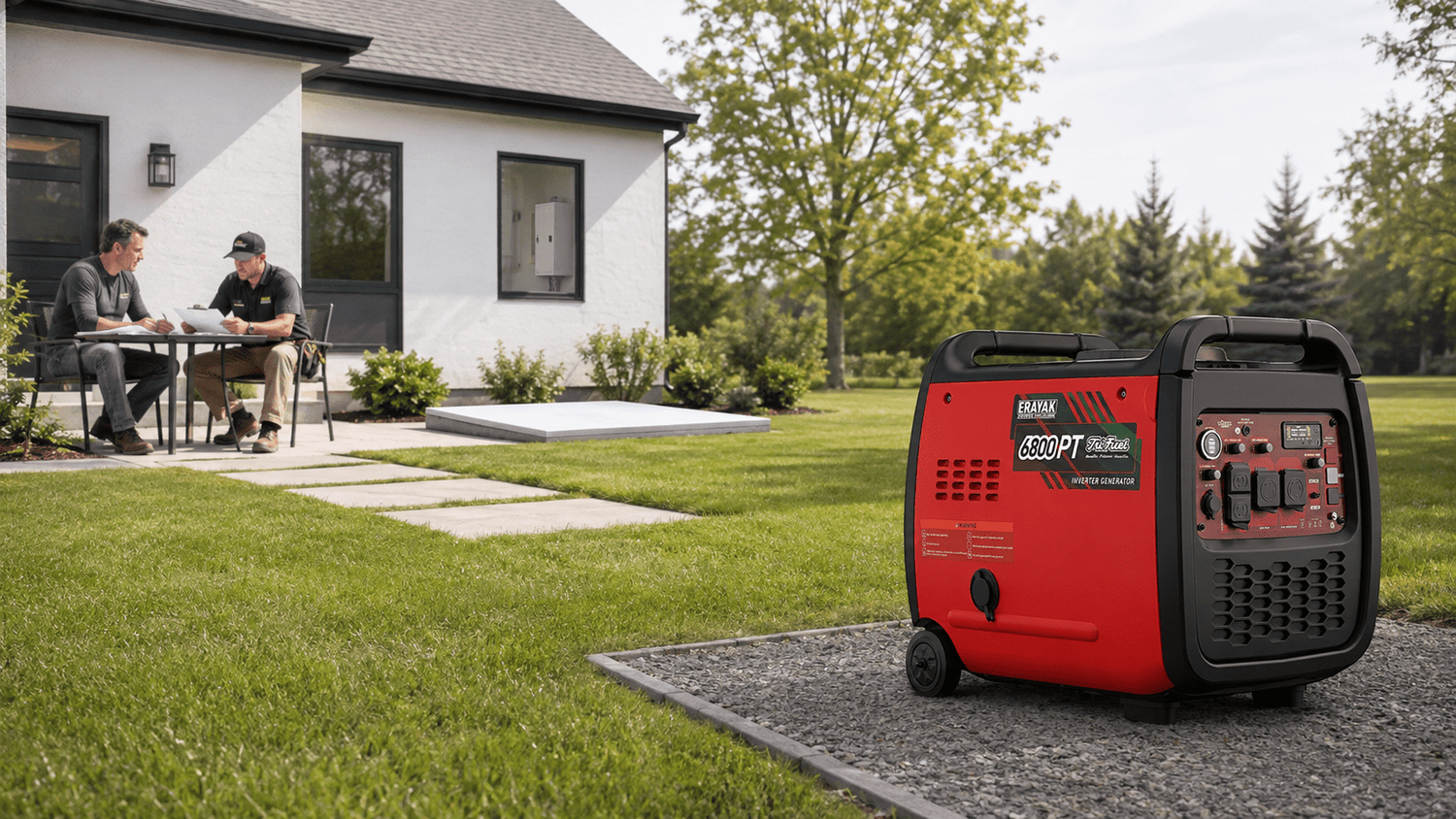
Erayak 6800PT Tri-Fuel Inverter Generator
The higher-capacity portable path when the outage plan needs 120V/240V output, selected-circuit backup, or tri-fuel flexibility. It provides 6,800W peak output and 5,000W gasoline rated output; actual output depends on fuel and operating conditions.
- Gasoline, propane, and natural gas flexibility.
- 120V/240V capability for properly planned selected circuits.
- Requires the correct connection equipment and electrician-confirmed setup.
Generator Safety and Home Connection Rules
Fuel-powered generators produce deadly carbon monoxide. Quiet operation, inverter technology, propane capability, or natural gas capability does not make a generator safe indoors.
- Never run a fuel generator indoors, in a garage, basement, shed, crawlspace, enclosed porch, or near open windows.
- Follow the U.S. Consumer Product Safety Commission guidance to operate a portable generator outdoors, at least 20 feet from the home, with exhaust directed away from doors, windows, and vents.
- Install and test carbon monoxide alarms on every level and outside sleeping areas.
- Use only properly rated outdoor extension cords and keep electrical connections dry according to the generator manual.
- Never backfeed a home through a wall outlet or dryer outlet.
- Use an approved transfer switch or permitted interlock for home circuits. The Electrical Safety Foundation International explains that transfer equipment prevents dangerous backfeed.
- Have a qualified electrician confirm voltage, neutral, grounding, inlet, transfer equipment, load plan, and local-code requirements.
Frequently Asked Questions
Is a home battery better than a generator for power outages?
A battery is better for quiet, fast, low-maintenance backup when the required loads and outage duration fit its capacity. A generator is usually easier to sustain through a long outage because fuel can be replenished. The best choice depends on watts, required hours, recharge or fuel access, and installation needs.
Is a standby generator better than a portable generator?
A standby generator is better when automatic operation, larger loads, frequent outages, and protection while nobody is home justify professional installation. A portable generator is better when lower cost, mobility, RV crossover use, and selected-load backup are more important.
Can a battery backup power an entire house?
Some professionally installed battery systems can support a whole home or a large group of circuits, but runtime depends on usable kilowatt-hours and the household load. HVAC, electric heat, water heating, pumps, and cooking can consume stored energy quickly, so load management and system sizing are critical.
Can a portable generator power home circuits?
Yes, when the generator has the required voltage and capacity and connects through approved transfer equipment installed according to local code. Never connect a portable generator to a home outlet or use an improvised backfeed cord.
How long will a home battery last during an outage?
Divide usable watt-hours by average load watts for a rough estimate. Actual runtime is lower because of inverter losses, changing appliance cycles, temperature, and battery reserves. A 2,000Wh battery at a steady 400W load has an ideal estimate of five hours before real-world adjustments.
Can I run a portable generator in a garage with the door open?
No. Never run a fuel generator in a garage, even with the door open. Operate it outdoors at least 20 feet from the home with exhaust pointed away from windows, doors, vents, and other buildings.
Do I need a transfer switch for a portable generator?
You need approved transfer equipment if the generator will power home circuits. For selected plug-in appliances, properly rated outdoor extension cords may be used according to the generator and appliance instructions. A qualified electrician should design any panel connection.
Is a battery-and-generator hybrid worth it?
It can be. A battery handles quiet, immediate loads, while a generator extends the plan during longer outages. Confirm that the equipment is compatible and follow manufacturer, grounding, charging, and transfer requirements.
Choose the System Type First, Then Size the Equipment
If a portable inverter generator fits your outage plan, compare Erayak options by required load, voltage, fuel flexibility, and connection method. Keep the product choice tied to the appliances and circuits you actually need.
