

Best Inverter Generator for Camping: Quiet Power, RV Loads & Buying Guide
The best inverter generator for camping is quiet, portable, and sized for the loads you actually run: lights, phones, CPAP, RV batteries, a mini fridge, or an RV air conditioner. For most campers, that means choosing between a compact 2,000W-class generator and a 4,500W-class RV-ready inverter generator.
Quick Answer: What Is the Best Inverter Generator for Camping?
For light camping, the best inverter generator is usually a compact 2,000W to 2,500W model that can run lights, chargers, fans, CPAP equipment, a small fridge, or recharge RV batteries. For RV camping with a rooftop air conditioner, microwave use, or more comfort loads, a 4,500W inverter generator is a better fit.
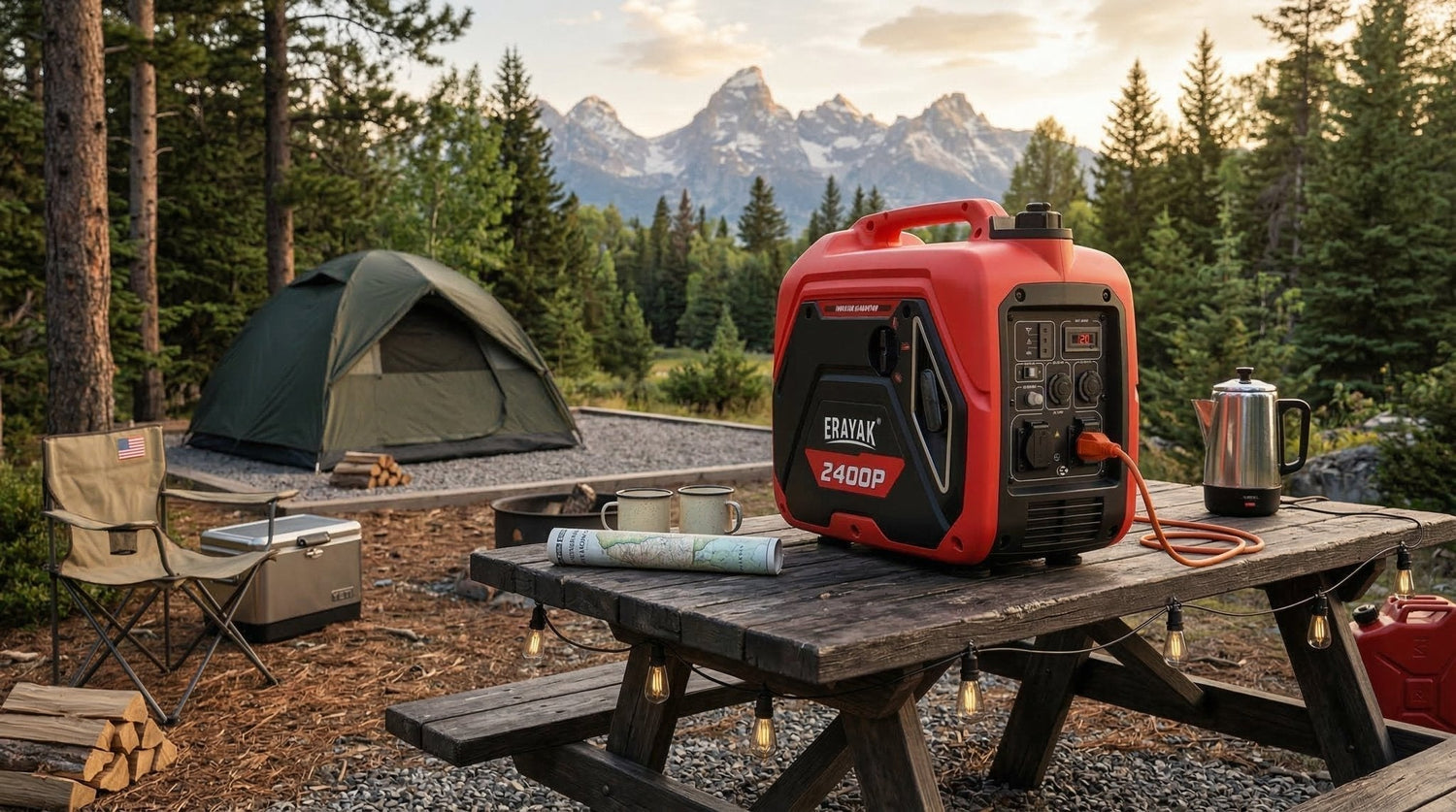
If you want a simple ERAYAK match, choose the ERAYAK 2400P for lighter camping and battery-charging use, the ERAYAK 4500P when you want more gas-powered headroom, and the ERAYAK 4500PD when dual-fuel flexibility matters for RV camping and outage-ready essentials.
Camping Inverter Generator Size Chart
The right camping generator size depends less on the word "camping" and more on what you plug in at the same time. Start with running watts, then leave headroom for startup surge from compressors, pumps, and air conditioners.
| Camping load | Typical use | Suggested inverter generator class | ERAYAK fit |
|---|---|---|---|
| Phones, lights, fan, laptop | Tent camping, picnic shelter, small campsite | 1,000W to 2,000W | 2400P gives extra headroom |
| CPAP, small fridge, device charging | Quiet overnight camping and backup comfort loads | 2,000W to 2,500W | 2400P |
| RV battery charging, fridge, fan, lights | Weekend RV camping and boondocking | 2,400W to 4,500W | 2400P for light loads; 4500P/4500PD for more margin |
| RV rooftop AC with load management | 30A-style RV comfort camping | 3,500W to 4,500W+ | 4500P or 4500PD |
| RV AC plus refrigerator and extra essentials | Camping plus outage-ready flexibility | 4,500W class or larger | 4500PD for dual fuel; 6800PD/PT if 120V/240V planning matters |
 Why an Inverter Generator Is Usually Best for Camping
An inverter generator is usually the best generator type for camping because it is designed for quieter operation, more efficient low-load running, and cleaner power than many traditional open-frame generators. That matters when you are powering phones, laptops, RV electronics, battery chargers, fans, refrigerators, or campsite comfort gear.
Quieter campsite power
Inverter generators are commonly chosen for camping because they can run at lower engine speed under light loads, helping reduce noise when you are only charging batteries or running small appliances.
Cleaner power for electronics
Inverter output is a better match for sensitive electronics than many conventional generators, especially when you are charging laptops, phones, camera batteries, and RV electronics.
Better load matching
Instead of buying the biggest unit possible, camping shoppers should choose enough wattage for real loads while keeping the generator portable and practical.
Best Inverter Generator Size by Camping Scenario
Best for light tent camping
Choose a compact inverter generator when your loads are phones, LED lights, a fan, laptop charging, a small appliance, or CPAP support. A 2,400W-class generator gives useful headroom without moving into a bulky RV-focused size.
Best for RV battery charging
For RV house batteries, the charger or converter usually limits charging speed once the generator can supply enough power. A quiet, portable inverter generator is often more practical than oversizing.
Best for RV AC camping
Rooftop RV air conditioners need more startup headroom than small campsite loads. A 4,500W-class inverter generator is a stronger match when you want to run one RV AC with sensible load management.
Power Station vs Inverter Generator for Camping
Portable power stations and inverter generators both belong in camping power planning, but they solve different problems. A power station is better for silent, indoor-safe charging of small electronics. A fuel-powered inverter generator is better when you need refillable outdoor runtime, RV battery charging, refrigerator support, or higher-watt camping loads.
| Need | Power station | Inverter generator |
|---|---|---|
| Silent operation | Best choice | Quieter than open-frame generators, but not silent |
| Indoor or tent use | Usually appropriate when used as directed | Never indoors, tents, RV interiors, or enclosed spaces |
| Longer outdoor runtime | Limited by battery capacity and recharge speed | Can continue running outdoors with safe refueling practices |
| RV AC and larger camping loads | Only large, costly battery systems may work | Usually the more practical match |
Where ERAYAK Inverter Generators Fit for Camping
Use product recommendations only after you know the camping load. A light tent camper does not need the same generator as an RV owner trying to run rooftop AC, and a 50A RV owner should think in terms of load management rather than full shore-power replacement.

ERAYAK 2400P: light camping and battery charging
Best fit for campers who want a compact inverter generator for lights, chargers, fans, CPAP support, small appliances, and RV battery charging.
See the ERAYAK 2400P
ERAYAK 4500P: gas-only 4,500W camping headroom
Best fit for campers who want more wattage for RV comfort loads and do not need propane. The 4500P is gas only, manual recoil start, 55 lb, with a 2.25 gal tank, up to 8 hours runtime, 60.5 dB noise rating, and THD under 1.2%.
Compare the ERAYAK 4500P Gas Generator
 ERAYAK 4500PD: dual-fuel RV camping flexibility
Best fit when RV camping overlaps with portable AC planning, refrigerator/freezer backup, and storm-prep essentials. Choose it when propane flexibility matters.
Compare the ERAYAK 4500PD Dual-Fuel GeneratorCamping Generator Buying Checklist
- Noise: choose a quiet inverter generator and follow campground quiet-hour rules.
- Running watts: add the appliances you will run at the same time.
- Starting watts: leave surge headroom for AC units, refrigerators, and compressors.
- Portability: match generator size to how often you move camp.
- Fuel plan: decide whether gas-only or dual fuel fits your trip style.
- RV connection: confirm outlet type, adapter needs, and load-management limits.
- Safety: operate fuel generators outdoors only, far from openings and enclosed spaces.
FAQ: Best Inverter Generator for Camping
What size inverter generator is best for camping?
For light tent camping, a 2,000W to 2,500W inverter generator is usually enough for lights, chargers, fans, CPAP support, small appliances, and RV battery charging. For RV AC or larger comfort loads, a 4,500W-class inverter generator is usually the better starting point.
Is an inverter generator better than a regular generator for camping?
Usually, yes. Inverter generators are popular for camping because they are generally quieter, better suited to electronics, and more efficient at light loads than many conventional open-frame generators.
Can a camping inverter generator run an RV air conditioner?
Many RV rooftop air conditioners require more startup headroom than small campsite loads. A 4,500W-class inverter generator is a more practical match for one RV AC with load management, but the exact answer depends on AC size, soft start, altitude, temperature, and other loads running at the same time.
Is a portable power station better than a generator for camping?
A portable power station is better for silent charging and indoor-safe small electronics when used as directed. An inverter generator is better for refillable outdoor runtime, RV battery charging, refrigerator support, and higher-watt camping loads.
Can I run a camping generator inside an RV or tent?
No. Fuel generators produce carbon monoxide and must never run inside an RV, tent, camper, garage, or enclosed space. Operate the generator outdoors with proper ventilation and keep it away from windows, doors, and vents.
Build your camping power setup around what you actually run
The best inverter generator for camping is not automatically the smallest or the largest. Choose enough wattage for your real campsite loads, then balance noise, portability, fuel flexibility, and RV connection needs.

