

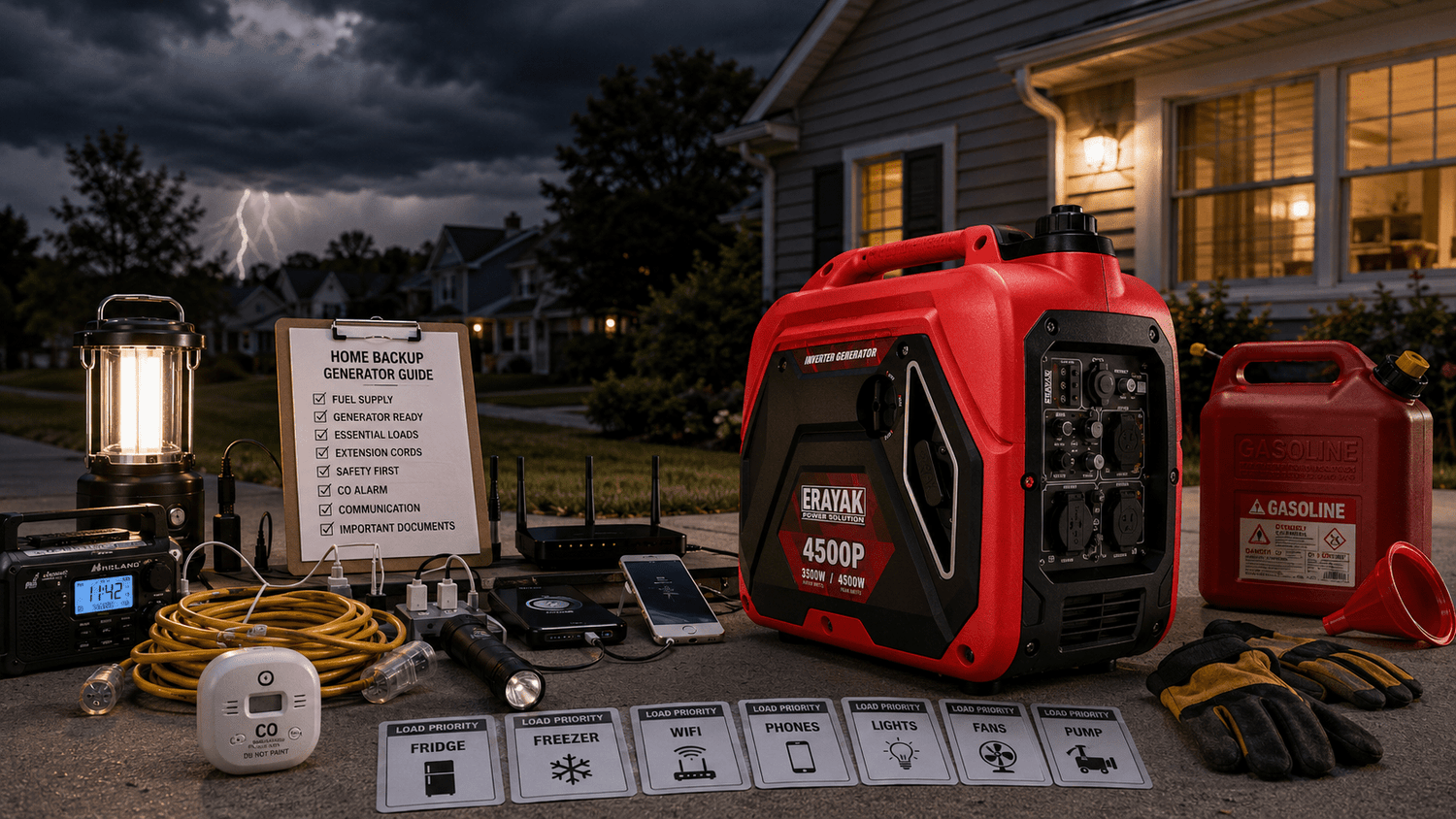
Home Backup Generator Sizing Guide: What Can It Run During an Outage?
A home backup generator does not need to run every appliance in your house to be useful. The right size depends on your must-run loads, starting watts, fuel plan, and whether you are backing up essentials or selected 120V/240V circuits.
Shop ERAYAK inverter generators for home backupAdd the running watts of the appliances you need at the same time, then add the largest startup surge from a motor-driven load such as a refrigerator, sump pump, furnace blower, well pump, or air conditioner. Choose a generator with enough continuous rated watts and surge capacity for that plan.
Quick Answer: What Size Generator Do You Need During an Outage?
For many U.S. homes, a 3,500W to 4,500W generator can cover basic outage essentials such as a refrigerator, freezer, lights, Wi-Fi router, phone charging, and one or two small appliances if loads are managed carefully. A 5,000W to 7,000W class generator is a stronger fit when you also need a sump pump, furnace blower, microwave, window AC, or selected 120V/240V backup circuits.
If your plan includes central AC, an electric water heater, an electric furnace, a large well pump, or multiple high-surge loads, you may need a larger generator, professional load calculation, transfer equipment, or a standby system instead of a basic cord-connected portable setup.
How to Size a Home Backup Generator
The most reliable way to size a portable generator is to build a must-run list, not a wish list. During an outage, most households care first about food, water, communication, heat or cooling, basic lighting, and medical or safety-critical devices.
Write down the appliances you need during the outage: refrigerator, freezer, sump pump, furnace blower, router, lights, chargers, microwave, coffee maker, or a small AC.
Add only the loads you expect to run at the same time. You can rotate high-draw appliances instead of running everything continuously.
Motors and compressors often need more watts for a few seconds at startup. Size for the largest surge load you expect to start while other essentials are already running.
Important: Appliance wattage varies by brand, age, efficiency, motor size, and startup behavior. Always check the nameplate, manual, or manufacturer specifications for your specific appliances before buying or connecting a generator.
Running Watts vs Starting Watts
Running watts are the continuous watts an appliance needs after it is operating. Starting watts, sometimes called surge watts, are the extra watts needed for a short startup moment. This matters most for refrigerators, freezers, sump pumps, well pumps, furnace blowers, and air conditioners.
For example, a refrigerator may run at a few hundred watts but need much more when the compressor starts. If your generator is sized only for running watts, it may overload when a motor starts.
| Load Type | Why It Matters | Sizing Tip |
|---|---|---|
| Resistive loads | Lights, phone chargers, some heaters, and simple electronics usually have lower startup surge. | Add their running watts to the total. |
| Motor loads | Refrigerators, pumps, blowers, and AC units may need a startup surge. | Add running watts, then allow room for the largest startup event. |
| High-draw heat loads | Electric water heaters, electric furnaces, ranges, and dryers can draw thousands of watts. | Usually not ideal for small portable-generator backup unless planned by a qualified electrician. |
Home Appliance Wattage Chart for Outage Planning
Use this chart as a planning range, then confirm your actual appliance labels. Starting watts can vary widely, especially for older refrigerators, pumps, compressors, and HVAC equipment.
| Appliance or Load | Typical Running Watts | Startup Surge Risk | Outage Priority |
|---|---|---|---|
| Refrigerator | 150-800W | Medium to high | High |
| Freezer | 150-700W | Medium to high | High |
| Sump pump | 600-1,500W | High | High in flood-prone homes |
| Gas furnace blower | 400-900W | Medium to high | High in cold weather |
| Wi-Fi router and modem | 15-60W | Low | Medium to high |
| LED lights | 5-15W each | Low | Medium |
| Microwave | 1,000-1,800W | Low to medium | Optional, use briefly |
| Window AC or portable AC | 600-1,600W | Medium to high | High in heat, but size carefully |
| Well pump | 700-2,000W+ | High | High, often needs professional sizing |
| Electric water heater | 3,000-4,500W+ | Low to medium | Usually not for essentials-only portable backup |
For critical medical devices, well pumps, hardwired HVAC, or transfer-switch use, confirm requirements with the equipment manufacturer and a licensed electrician.
What Different Generator Sizes Can Run During an Outage
| Generator Size Range | Typical Outage Use | What It May Run | Best Fit |
|---|---|---|---|
| 2,000-3,000W | Light essentials | Refrigerator, router, lights, phone charging, one small appliance if loads are rotated | Short outages, light backup, camping crossover use |
| 3,500-4,500W | Essentials backup | Refrigerator, freezer, router, lights, chargers, sump pump or microwave when managed carefully | Practical portable backup for many homes |
| 5,000-7,000W | Stronger selected-load backup | Essentials plus furnace blower, sump pump, microwave, window AC, or selected 120V/240V circuits depending on setup | Storm backup, longer outages, more load flexibility |
| 8,000W+ | Large selected-load or partial-home backup | More circuits and larger motor loads, depending on surge capacity and transfer equipment | Homes with pumps, larger appliances, or more complex backup needs |
Load management matters: A smaller generator can often do more than expected if you start high-surge appliances one at a time and avoid running a microwave, pump, AC, and refrigerator compressor startup all at the same moment.
Example Outage Load Plans
Refrigerator, freezer, Wi-Fi router, phone charging, and several LED lights. This is the lowest-stress plan for short outages and can often fit in an essentials-size portable generator range.
Refrigerator, sump pump, freezer, router, lights, and occasional microwave use. This needs more surge awareness because the sump pump and refrigerator may start unexpectedly.
Refrigerator, lights, router, furnace blower in winter or a small window/portable AC in summer. Avoid stacking AC startup, pump startup, and microwave use together.
Simple Sizing Example
Suppose your must-run list includes a refrigerator, freezer, router, several LED lights, and a sump pump. You might have a modest running-watt total, but the refrigerator, freezer, and sump pump can all create startup surges. A 3,500W to 4,500W class generator may work if you manage loads carefully, while a 5,000W to 7,000W class generator gives more breathing room.
When You Need 120V/240V Backup
If your plan includes selected circuits through a transfer switch, a well pump, certain furnace systems, or other 240V needs, do not size by a simple appliance chart alone. Confirm voltage, starting load, connection method, and code requirements with a licensed electrician.
ERAYAK Product Match for Home Backup Sizing
Choose based on your outage plan. If you only need essentials, do not oversize blindly. If you need more circuits, 120V/240V support, or longer outage flexibility, step up to a higher-capacity backup setup.
ERAYAK 4500PD Dual-Fuel Inverter Generator
Best fit for essentials-focused home backup when you want a portable inverter generator for loads like a refrigerator, freezer, lights, router, chargers, and carefully managed outage appliances.
Its dual-fuel flexibility can be useful for storm planning when gasoline availability is uncertain and propane storage is part of your emergency plan.
Compare the ERAYAK 4500PD Dual-Fuel GeneratorERAYAK 6800PD / 6800PT Series
Best fit when portable AC is only one load and you also want higher-capacity home backup, selected 120V/240V circuits, RV use, or more flexible outage planning.
The ERAYAK 6800 series is rated at 6800W peak and 5000W rated under gasoline at 100% output. The 6800PD is the dual-fuel path, while the 6800PT is the tri-fuel path. Do not assume every home load can run at once; use a real load plan.
See the ERAYAK 6800PD/PT 120V/240V UpgradeStart with your must-run appliance list.
Shop the ERAYAK inverter generator lineup and match your outage plan to the generator’s rated watts, surge capacity, fuel type, outlets, and connection method.
Shop ERAYAK inverter generatorsGenerator Safety Notice
Never run a fuel-powered generator indoors. Never run a generator in a garage, basement, shed, crawlspace, enclosed porch, or near open windows or doors. Always operate outdoors with proper ventilation and direct exhaust away from people, pets, and living spaces.
Use battery-powered carbon monoxide alarms, follow the generator manual, keep the generator dry, and never backfeed a home through a wall outlet. For home circuits, use properly installed transfer equipment and a licensed electrician.
FAQ: Home Backup Generator Sizing
What size generator do I need to run a refrigerator during an outage?
Many refrigerators can run on a 2,000W class generator if the generator has enough surge capacity and the refrigerator is the main motor load. If you also need a freezer, sump pump, lights, router, and small appliances, a 3,500W to 4,500W class generator is usually a more practical range.
Will a 4,500W generator run a refrigerator and sump pump?
Often, yes, if the sump pump is not unusually large and loads are managed carefully. The key is startup surge. Avoid starting the sump pump, refrigerator, freezer, microwave, and AC at the same time.
What can a 6,800W generator run during an outage?
A 6,800W peak generator with sufficient rated output can support a stronger selected-load backup plan than a small essentials generator. Depending on the model, outlets, fuel type, and setup, it may support essentials plus selected 120V/240V loads. Confirm your actual appliance wattage and use proper transfer equipment for home circuits.
Can a portable generator run central AC?
Sometimes, but central AC often has high startup demand and may require a larger generator, soft-start equipment, and professional sizing. Many homeowners use a window AC or portable AC as a more manageable outage-cooling load instead.
Do I add all starting watts together?
Not always. In real use, motors usually do not all start at the same second. A practical method is to add the running watts of the loads you need at the same time, then allow room for the largest startup surge that could occur while those loads are running.
Is an inverter generator better for home backup?
An inverter generator can be a strong choice for selected home backup because it typically provides cleaner power for electronics and can be quieter and more fuel-conscious than many conventional open-frame generators. Match the generator size and outlets to your actual outage plan.
Size for the outage you actually plan to live through.
The best home backup generator is not always the biggest one. Start with your must-run loads, account for starting watts, manage high-draw appliances, and choose the ERAYAK generator that gives your household the right balance of capacity, fuel flexibility, portability, and safe connection options.
Shop ERAYAK inverter generators for outage backup