

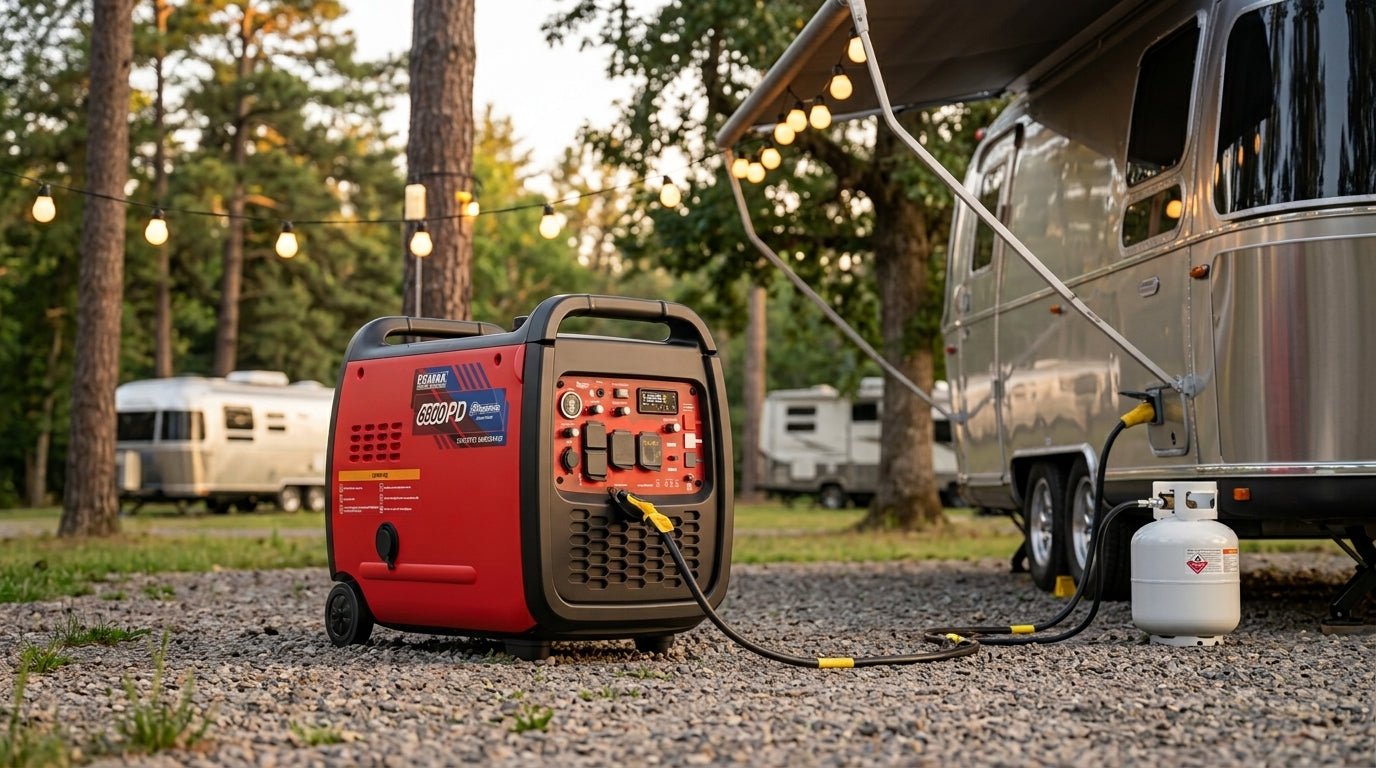
Best Generator for a 30 Amp RV: Size, AC & Quiet Picks
A 30 amp RV does not automatically need a huge generator. The best choice is usually a quiet inverter generator in the 4,000W to 4,500W class, with enough startup power for one RV air conditioner and enough running power for managed comfort loads.
Quick Answer: What Size Generator for a 30 Amp RV?
For most 30 amp RVs, the best generator size is a quiet 4,000W to 4,500W inverter generator. A 30A RV service is 120V x 30A, or 3,600 watts maximum. In real use, you need enough surge power to start the RV air conditioner and enough running power for lights, converter charging, refrigerator, TV, router, and small appliances used carefully.
The Erayak 4500PD is the strongest all-around Erayak fit for a 30A RV because it matches the RV comfort-load use case and adds gasoline/propane flexibility. The Erayak 4500P is the gas-only alternative. The 2400P is better for light loads and battery charging, not standard RV AC. The 6800PD/PT series is the upgrade path for bigger RV and home backup plans.

What 30 Amp RV Power Really Means
A standard 30 amp RV hookup is typically 120 volts, not 240 volts. That means the simple math is:
120V x 30A = 3,600 watts. That is the maximum service size before normal losses, cord limits, startup surge, and practical load management.
This is why a 30 amp RV generator decision is not just about buying the biggest number on the box. A generator may advertise peak watts for startup, but your RV comfort depends on running watts, surge handling, outlet compatibility, noise, fuel choice, and whether you manage large loads one at a time.
For startup surge
RV air conditioners, refrigerators, and pumps may need a short startup surge before settling into lower running watts.
For steady comfort
Running watts decide what you can keep powered continuously after the large loads are already running.
For fewer trips
Microwave, coffee maker, electric heater, and water heater loads should be sequenced instead of stacked with AC startup.
30 Amp RV Generator Size Chart
Use this chart as a practical buyer guide. The right generator depends on whether you need lights and battery charging only, one RV AC, or broader backup capacity.
| Generator Class | Best For | 30A RV Fit | What to Watch |
|---|---|---|---|
| 2,000W-2,500W inverter | Battery charging, lights, router, TV, small appliances | Light loads only | Not the default choice for a standard 13,500 BTU RV AC. |
| 3,000W-3,500W inverter | Smaller campers, managed loads, some AC setups with soft start | Possible but tight | Startup surge and converter load can cause trips. |
| 4,000W-4,500W inverter | Most 30A RVs with one rooftop AC | Best practical fit | Still manage microwave, coffee maker, electric heater, and water heater. |
| 5,000W-6,800W class | Larger RV plans, selected home backup, more headroom | Upgrade path | More capacity can help, but it does not turn a 30A RV into unlimited power. |
A 4,500W generator is popular for 30A RVs because the extra peak margin helps with AC startup while the running output still aligns with realistic 30A RV load management.

Best Erayak Generators for a 30 Amp RV
The strongest recommendation depends on whether you want propane flexibility, simple gas-only use, or a larger backup platform.

Erayak 4500PD Dual-Fuel Inverter Generator
The Erayak 4500PD is the best Erayak match for most 30 amp RV owners who want quiet inverter power, RV comfort loads, and gasoline/propane flexibility. It is the natural fit for one rooftop AC plus managed essentials.
- Best match for 30A RV camping and boondocking.
- Good fit for one 13,500 BTU RV AC with load management.
- Propane flexibility is useful when RV camping already involves propane planning.
- Use care with microwave, coffee maker, converter charging, and electric heater loads.

Erayak 4500P
Choose the Erayak 4500P if you want the same 4,500W peak class for a 30A RV but do not need propane. It is gas only, manual recoil start, about 55 lb, with a 2.25 gal fuel tank, up to 8 hours runtime, 60.5 dB, and THD under 1.2%.

Erayak 2400P
Choose the Erayak 2400P for lighter camping loads, RV battery charging, small electronics, lights, and fridge-only edge cases. It is not the default choice for standard 30A RV air-conditioner use.

Erayak 6800PD / 6800PT
Choose the Erayak 6800 series when your 30A RV generator plan is part of a larger backup strategy. Use the exact planning facts: 6800W peak, 5000W gasoline rated output at 100% output, 30A L5-30R, 30A 120V/240V L14-30R, and TT-30R adapter accessory for RV connection planning.
Can a 30 Amp RV Generator Run the Air Conditioner?
Yes, a properly sized 30A RV generator can run many RV air conditioners, especially one 13,500 BTU rooftop AC. The key is startup surge and load management.
| RV AC Setup | Best Generator Approach | Practical Guidance |
|---|---|---|
| One 11,000 BTU RV AC | 3,000W-4,500W inverter | Usually manageable Smaller AC loads are easier. |
| One 13,500 BTU RV AC | 4,000W-4,500W inverter | Best 4500PD fit Start AC before adding large appliances. |
| One 15,000 BTU RV AC | 4,500W with soft start, or larger generator | Check carefully Hot weather, altitude, and converter load matter. |
| Two RV AC units | Larger selected-load plan | Not a basic 30A setup Requires careful sequencing and higher-capacity planning. |
If your AC struggles to start, a soft-start kit can reduce startup surge. It does not remove the need to manage running watts, but it can make AC startup much smoother.
TT-30, Adapters, and 30 Amp RV Connection Planning
Many RV shoppers search for a “30 amp generator” because they want a clean connection to the RV. The connection matters, but it is not the only thing that matters.
Common 30A RV plug
A TT-30 RV plug is a 120V RV connection. Do not confuse it with a 240V dryer outlet or 50A RV pedestal.
Use the right accessory
If your generator does not have the exact RV outlet, use only properly rated adapters and cords that match the generator and RV instructions.
Avoid voltage drop
Long, undersized cords can heat up and reduce voltage. Use a properly rated RV cord, and replace worn or damaged connectors.
Why Quiet Inverter Power Matters for a 30 Amp RV
For RV camping, the best generator is not just powerful. It also needs to be reasonable around people, pets, and campground rules. That is why quiet inverter generators usually make more sense than open-frame construction generators.
Campground comfort
Quiet enclosed inverter generators are easier to live with during long camping days than loud open-frame models.
Clean power
Inverter power is a better fit for RV electronics, laptops, chargers, TVs, routers, and control boards.
Fuel management
Eco-mode behavior can help reduce noise and fuel use when the RV is running smaller loads instead of the AC compressor.
30 Amp RV Generator Buying Checklist
1. Start with your largest load
For most 30A RVs, the largest load is the rooftop air conditioner. Size the generator around AC startup, then manage smaller loads around it.
2. Check running watts, not just peak watts
Peak watts help start motors. Running watts decide what the generator can support continuously.
3. Decide whether dual fuel matters
Propane can be useful for RV camping and storage planning. Gasoline may be simpler for users who do not want propane flexibility.
4. Avoid under-sizing for AC comfort
A small generator may charge batteries and run lights, but that does not make it a good match for a 13,500 BTU RV AC.
5. Plan appliances one at a time
Do not run RV AC startup, microwave, coffee maker, electric heater, and converter charging at the same time.
6. Keep connection gear boring and correct
Use properly rated cords, adapters, and generator outlets. Avoid improvised wiring or damaged plugs.
Generator Safety for 30 Amp RV Camping
A generator can make RV camping more comfortable, but it must be operated safely every time.
Never run a generator indoors
Never operate a fuel-powered generator inside an RV, garage, tent, enclosed compartment, shed, or near open windows, doors, or vents. Carbon monoxide can be deadly.
Point exhaust away from people
Place the generator outdoors on a stable surface with exhaust directed away from the RV and neighboring campsites.
Use rated RV cords
Use properly rated outdoor/RV cords and connectors. Replace loose, melted, cracked, or overheated plugs immediately.
Do not backfeed or improvise
Do not connect a generator through unsafe wiring, household dryer outlets, or homemade adapters. Follow manuals and local electrical rules.
Bottom Line
For most 30 amp RV owners, the best generator is a quiet 4,000W to 4,500W inverter generator with enough surge capacity for one rooftop AC and enough running output for managed comfort loads. The Erayak 4500PD is the best Erayak fit if you want dual-fuel flexibility; the 4500P is the gas-only alternative.
If your camping plan is only lights, charging, and light appliances, the 2400P may be enough. If your 30A RV plan is part of a larger RV/home backup setup, step up to the 6800PD/PT series instead of forcing a smaller generator to do too much.
FAQ: Best Generator for a 30 Amp RV
What size generator do I need for a 30 amp RV?
Most 30 amp RV owners should look at a 4,000W to 4,500W inverter generator. This size gives enough margin for one RV air conditioner plus managed smaller loads.
How many watts is a 30 amp RV?
A standard 30 amp RV is usually 120 volts. 120V x 30A equals 3,600 watts. In real use, leave headroom for startup surge, cord limits, and load management.
Will a 4500 watt generator run a 30 amp RV?
Yes, a 4500W-class inverter generator is one of the most practical sizes for a 30 amp RV. It can run many one-AC RV setups with careful management of microwave, coffee maker, converter, and heating loads.
Can a 2400 watt generator run a 30 amp RV?
A 2400W generator can power light 30A RV loads through the right connection setup, but it is not the default choice for running a standard rooftop RV AC. It is better for battery charging, lights, small electronics, and light camping loads.
Do I need a TT-30 outlet on my generator?
A TT-30 style RV connection is convenient, but the generator still needs enough wattage and surge capacity for your loads. If using adapters, choose properly rated RV accessories and follow both generator and RV instructions.
Can I run my RV AC and microwave at the same time?
Usually you should avoid running the microwave while the RV AC is starting. After the AC is already running, some setups may handle short microwave use, but it depends on generator capacity and other connected loads.
Is a quiet inverter generator better for a 30 amp RV?
Yes. A quiet inverter generator is usually the better RV fit because it is more campground-friendly, provides cleaner power for electronics, and can adjust engine speed under lighter loads.
Can I run a portable generator inside my RV compartment?
No. A portable fuel generator must run outdoors with proper ventilation. Never operate one inside an RV, garage, enclosed compartment, or near open windows, doors, or vents.
