

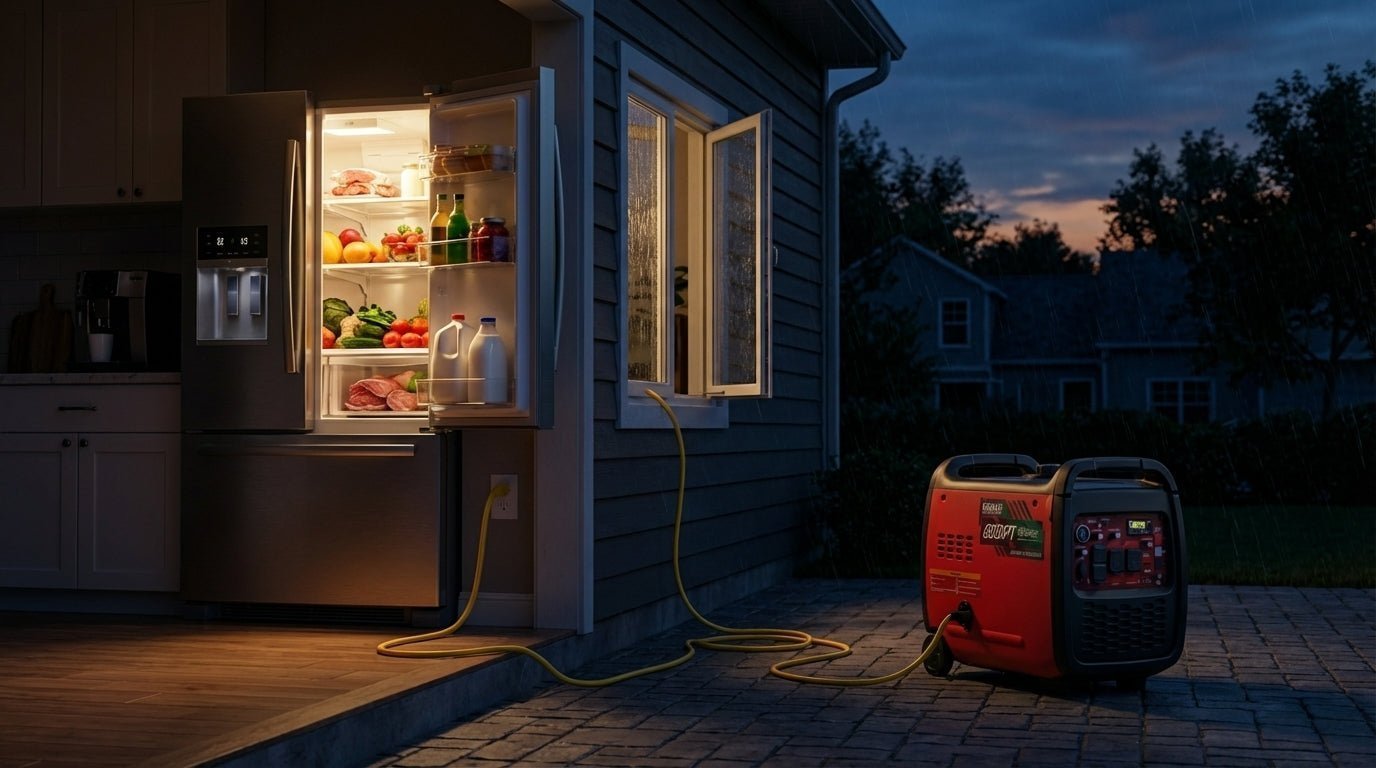
Refrigerator + Freezer Generator Guide
What Size Generator Do I Need to Run a Refrigerator and Freezer?
For one refrigerator, a generator with roughly 1,500-2,400W of peak output can fit many models after you verify the compressor's starting demand. For a refrigerator and separate freezer, plan around 2,200-3,500W. Move to the 3,500-4,500W class when you also want lights, Wi-Fi, fans, a TV, or more startup margin.
The exact answer is on your appliance label or watt meter. Size the generator for both continuous running watts and the brief compressor startup surge.
Quick Answer
Best Generator Size for a Refrigerator and Freezer
A 2,000W generator can run many standard refrigerators by themselves. For a refrigerator and separate freezer, a 2,200-3,500W inverter generator is a more practical planning range. Choose 3,500-4,500W when you also need outage essentials or want more room for two compressors starting close together.
These are planning ranges, not universal appliance ratings. Confirm your refrigerator and freezer nameplates or measure them with a watt meter before buying. A fuel-powered generator must run outdoors; for indoor backup, use a properly rated battery power station.
Generator Size Chart for Refrigerators and Freezers
The ranges below are conservative starting points for planning. Refrigerator designs vary widely, and a compressor, defrost heater, ice maker, or second appliance can change the load. Your measured watts and appliance manual should take priority over any general chart.
| What You Want to Power | Planning Range | What to Verify | Practical Generator Class |
|---|---|---|---|
| Mini fridge only | Often below a full-size refrigerator | Startup watts and power-station compatibility | 1,000W+ may work after measurement |
| One modern refrigerator | Low running draw with a brief compressor surge | Nameplate amps, startup peak, defrost cycle | 1,500-2,400W peak; 2,000W+ is the common comfort range |
| Older, large, or garage refrigerator | Can draw more in heat or during defrost | Actual peak with a watt meter | 2,000-2,400W+ after measurement |
| One chest or upright freezer | Usually a compressor load similar to a small refrigerator | Startup peak and ambient temperature | 1,500-2,400W peak after measurement |
| Refrigerator + separate freezer | Two compressor loads may overlap | Both running loads plus the larger startup event | 2,200-3,500W; choose more margin if starts may overlap |
| Refrigerator + freezer + lights, router, TV, fans | Two compressors plus steady essential loads | Total running watts and the largest startup event | 3,500-4,500W inverter generator |
| Refrigerator + freezer + sump pump or portable AC | Multiple motor loads with high startup demand | All nameplates, load priority, 120V/240V needs | 4,500-6,800W+; calculate the full system |
Do not size from annual EnergyGuide kWh alone. Annual energy use is useful for estimating battery runtime, but a fuel generator must also handle the refrigerator's short startup peak. Check the appliance nameplate, owner's manual, or a plug-in watt meter.
How Many Watts Does a Refrigerator or Freezer Use?
A refrigerator does not draw one fixed number all day. The compressor cycles on and off, and other components such as the defrost heater, fans, and ice maker may run at different times. That is why two refrigerators of the same size can have different generator requirements.
Running Watts
This is the electricity used while the appliance is operating normally. Your generator's continuous or running output must cover the combined running watts of everything connected.
Starting Watts
This is the brief peak when a compressor or motor starts. Your generator's peak or surge output must cover that event without tripping its overload protection.
If the nameplate lists volts and amps instead of watts, multiply them for a conservative input estimate:
Nameplate Estimate
Volts × Amps = Watts
Nameplate amps can be higher than normal measured draw, and they may not show the exact compressor inrush. Use the appliance manual or a watt meter with peak capture when possible.
How to Calculate the Right Generator Size
Use two checks. The first protects continuous operation; the second protects compressor startup.
- List every load you will run at the same time. Include the refrigerator, freezer, lights, router, fans, TV, chargers, pumps, or AC.
- Add all running watts. Keep the total below the generator's rated running output.
- Identify the largest starting event. Use the appliance's listed total starting watts or measured peak.
- Add other loads already running. The refrigerator may start while the freezer, router, and lights are still on.
- Leave operating margin. Do not plan to run continuously at the generator's maximum rating.
Peak-Load Formula
Largest Total Starting Watts + Other Running Watts
If a manual lists only additional starting watts, add that extra surge to the total running load instead. Do not add both methods or you will double-count the same appliance.
Example: Refrigerator + Chest Freezer + Small Essentials
| Load | Example Value | How It Counts |
|---|---|---|
| Refrigerator | 1,200W total starting demand | Largest startup event |
| Chest freezer | 200W running | Already running |
| Router, LED lights, chargers | 150W running | Already running |
| Calculated peak | 1,550W | 1,200W + 200W + 150W |
A generator above the calculated 1,550W peak may handle this example, but the real appliances may draw more, both compressors may restart close together, and continuous output may be lower than peak output. This is why a 2,200-3,500W class is often more comfortable for a refrigerator and freezer than choosing the smallest mathematically possible unit.
Can a 2,000 Watt Generator Run a Refrigerator?
Yes, a 2,000W generator can run many standard refrigerators when its peak output exceeds the refrigerator's measured startup demand and the total running load stays below the generator's continuous rating.
A 2,000W unit may still be too small for an older refrigerator, a high startup peak, or a refrigerator plus several other loads. Check whether the product's advertised 2,000W number is peak watts or running watts; those ratings are not interchangeable.
| Generator Class | Likely Fit | Main Limitation |
|---|---|---|
| 1,000-1,500W | Measured mini fridge or efficient refrigerator | Little surge margin; verify carefully |
| 2,000-2,400W | One refrigerator plus a few small loads | May be tight for a separate freezer or another motor load |
| 2,200-3,500W | Measured refrigerator and freezer combination | Manage simultaneous startup and high-watt appliances |
| 3,500-4,500W | Refrigerator, freezer, and common outage essentials | Still calculate pumps, heaters, microwaves, and AC separately |
| 5,000W+ | Broader selected-load backup | May require 120V/240V planning and professional connection equipment |
What Size Generator Runs a Refrigerator and Freezer Together?
For the two appliances by themselves, start your comparison around the 2,200-3,500W class after measuring both loads. Choose the upper end when the appliances are older, located in a hot garage, or likely to restart together after an outage.
Choose a 3,500-4,500W inverter generator when the plan also includes lights, Wi-Fi, a TV, fans, laptop charging, or extra startup margin. A sump pump, well pump, microwave, electric heater, or portable AC can move the requirement higher and should be calculated as a separate motor or high-watt load.
Fridge Only
Prioritize portability and enough measured startup capacity. A 2,000-2,400W peak class is a practical comparison range for many homes.
Fridge + Freezer
Plan for two compressors and use 2,200-3,500W as a comparison range after checking both appliances.
Home Essentials
Step into 3,500-4,500W or larger when refrigeration is one part of a broader outage plan.
What Makes a Good Generator for Refrigerator Backup?
Verified Surge Capacity
Compare the appliance's startup demand with the generator's peak output, then confirm the generator has enough continuous output for everything running.
Inverter Output
An inverter generator is a practical choice when the backup plan also includes modern appliance controls, routers, laptops, phones, and other sensitive electronics.
Fuel and Runtime Plan
Match gasoline, propane, or tri-fuel flexibility to the likely outage length, storage rules, and fuel availability. Never store or handle fuel contrary to local rules or the owner's manual.
Best Indoor Generator for a Refrigerator: Use a Battery Power Station
Searches for an "indoor generator" usually mean a battery power station. Only an appropriately rated battery power station belongs indoors. Gasoline, propane, natural-gas, and diesel generators produce carbon monoxide and must remain outdoors.
Battery Power Station
Check two separate ratings: output watts must handle compressor startup, while watt-hours determine approximate runtime. Account for inverter losses, refrigerator cycling, room temperature, and battery reserve.
Fuel-Powered Generator
Better suited to longer outages when safe outdoor operation and refueling are possible. It must be at least 20 feet from the home, with exhaust directed away from buildings and openings.
Battery Runtime Estimate
Usable Watt-Hours ÷ Average Load Watts
This is only a planning estimate. Startup compatibility and usable battery capacity must both be confirmed. ERAYAK power-station recommendations should be added only after final LiFePO4 models, specifications, and URLs are confirmed.
Best ERAYAK Generator Match for Refrigerator Backup
Choose by the full backup load, not the appliance name alone. The compact model fits a measured refrigerator-only plan; the 4500W class fits refrigeration plus common essentials; the 6800 series fits broader selected-load backup.
Intent-Matched Picks
Three Generator Classes, Three Backup Plans
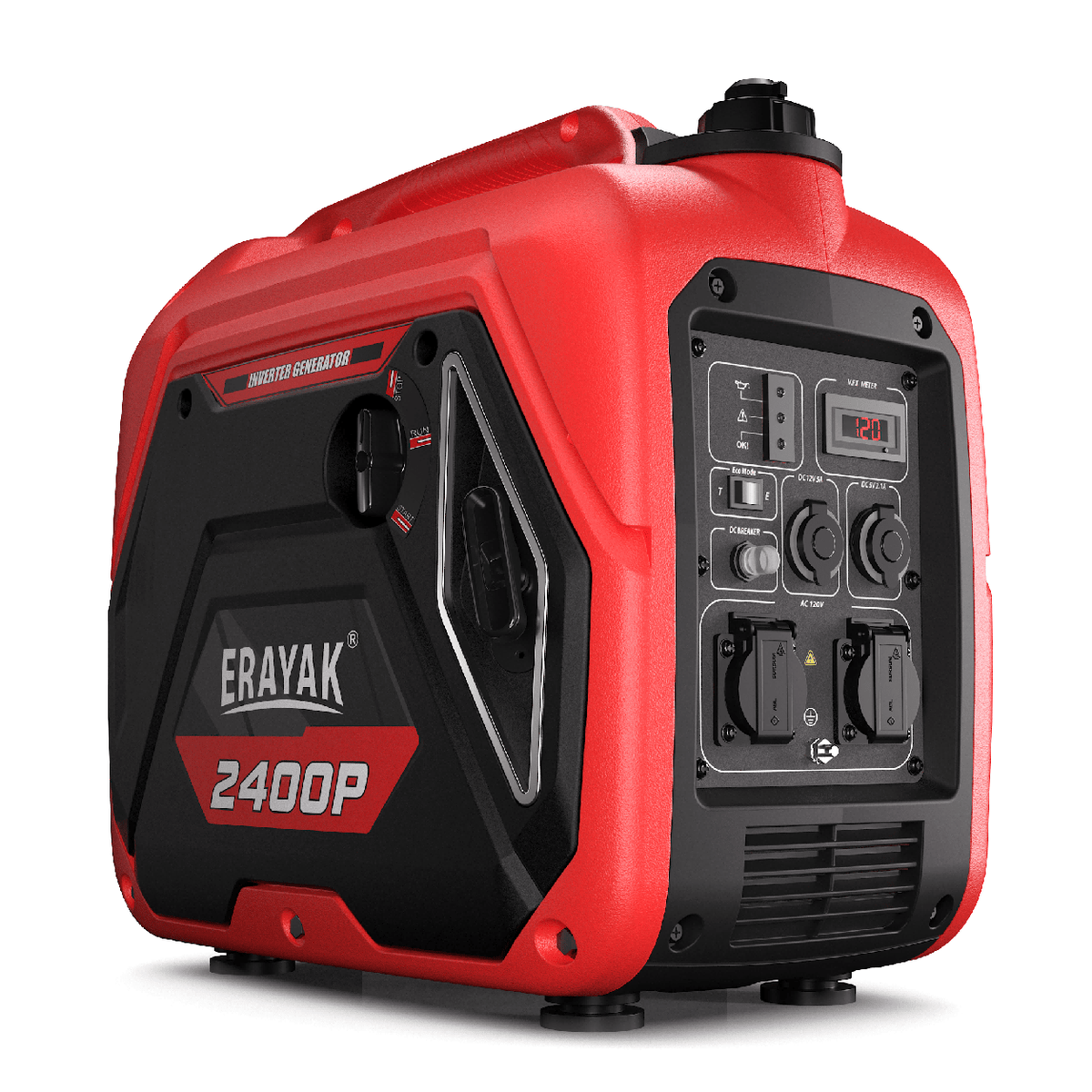
ERAYAK 2400P
Best for: a refrigerator that has been measured within the generator's limits, plus a few low-watt essentials.
The 2400P is the compact choice. Verify compressor startup before purchase and avoid adding a separate freezer or other motor load without recalculating.
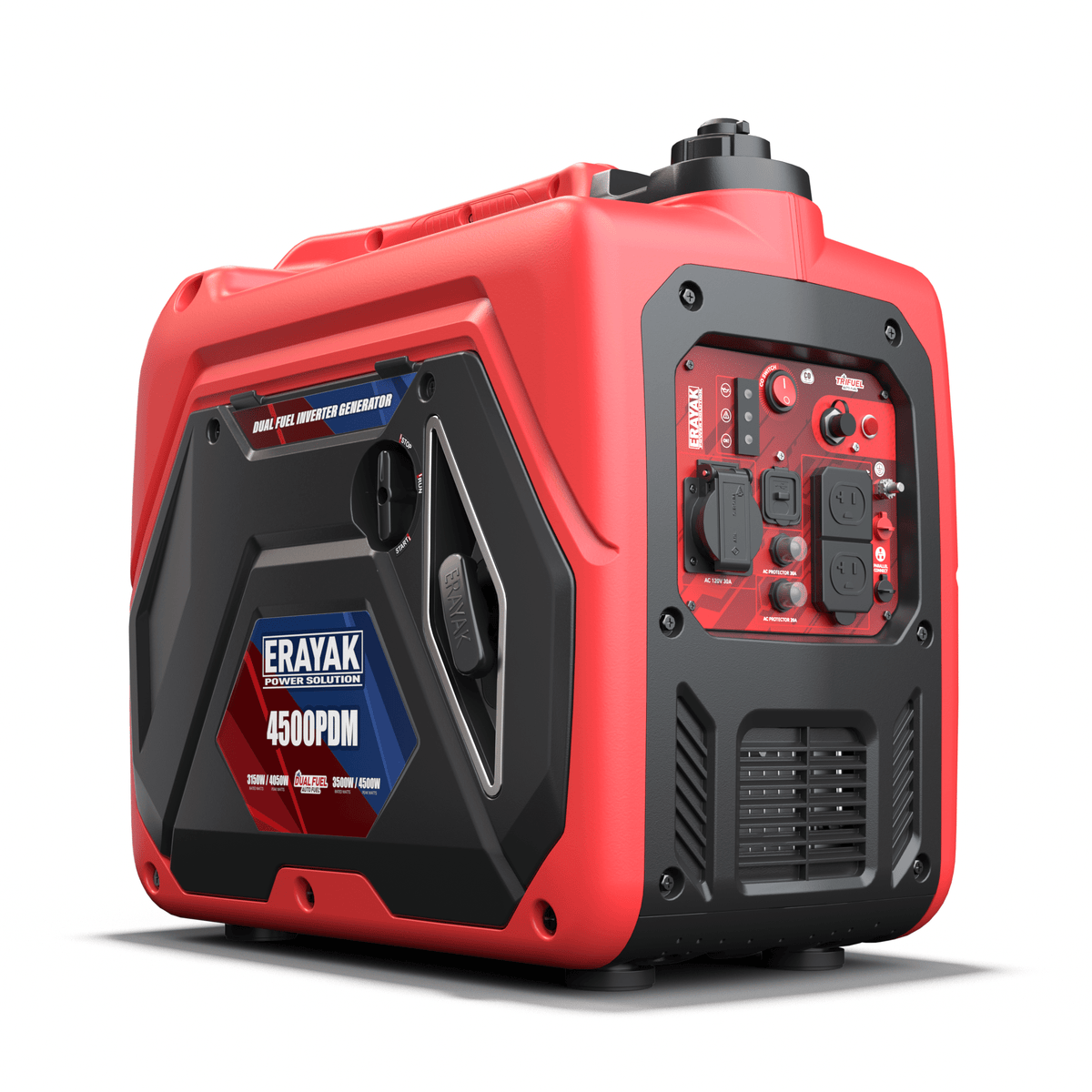
ERAYAK 4500PD Series
Best for: refrigerator, freezer, lights, router, fans, and other managed outage essentials when dual-fuel flexibility matters.
Choose manual-recoil 4500PDM or electric-start 4500PDE with recoil backup. Confirm output by fuel and manage major loads one at a time.
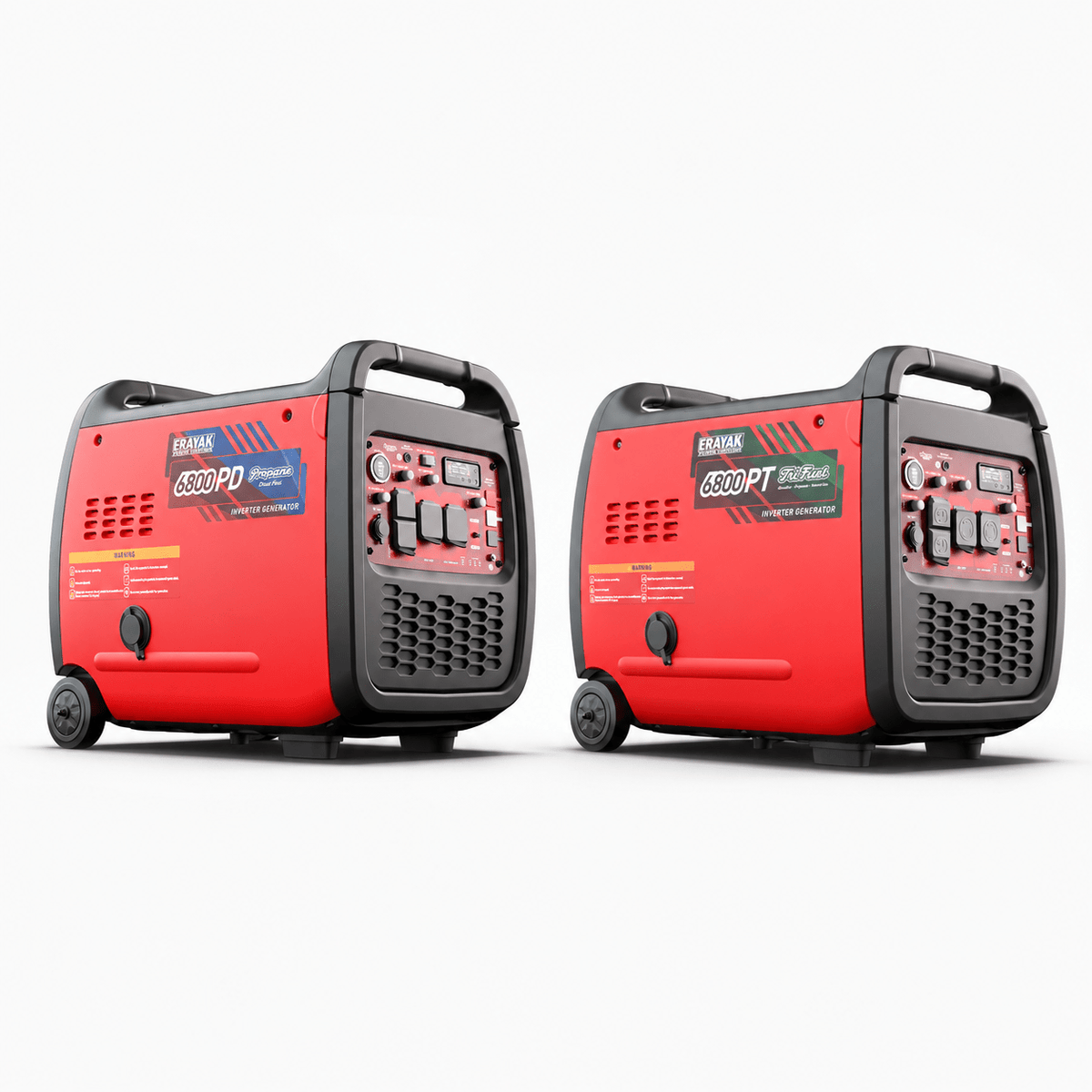
ERAYAK 6800PD / 6800PT
Best for: refrigeration as part of a larger selected-load plan that may include a sump pump, RV power, portable AC, or selected home circuits.
6800PD is dual fuel; 6800PT is tri-fuel. Use a qualified setup for home-circuit connections and calculate output for the selected fuel.
Need to compare the full range? Browse the ERAYAK inverter generator collection.
How to Run a Refrigerator on a Generator Safely
Portable generators can produce lethal carbon monoxide. The U.S. Consumer Product Safety Commission says to operate a portable generator outside only, at least 20 feet from the house, with exhaust directed away from the home and other buildings.
- Keep the generator outdoors. Never run it in a home, garage, basement, crawlspace, shed, porch, or other enclosed or partly enclosed area.
- Stay at least 20 feet away. Point exhaust away from doors, windows, vents, and nearby buildings.
- Use working CO alarms. Install battery-operated or battery-backup alarms on every level and outside sleeping areas.
- Use the correct connection. For one appliance, follow the generator and appliance manuals and use a properly rated outdoor extension cord. For home circuits, use equipment installed by a qualified electrician.
- Never backfeed a wall outlet. A transfer switch or other code-compliant equipment is required for selected home circuits.
- Manage loads deliberately. Start the generator, allow it to stabilize, then connect loads one at a time.
Generator Safety Notice
Never use a fuel-powered generator indoors or in a garage, even with doors and windows open. Follow the generator manual and current CPSC carbon monoxide guidance. If a CO alarm sounds or poisoning is suspected, get outside immediately and call 911.
Keep Food Safe During a Power Outage
Generator runtime is not a substitute for temperature checks. The FDA says an unopened refrigerator keeps food cold for about 4 hours. A full freezer holds temperature for about 48 hours, or about 24 hours if half full, when the door remains closed.
Use Appliance Thermometers
Keep the refrigerator at or below 40°F and the freezer at or below 0°F. Use the thermometer reading, not appearance or smell alone, to judge food safety.
Keep Doors Closed
Every opening releases cold air. Follow current FDA power-outage food guidance when deciding whether food is safe.
FAQs: Generators for Refrigerators and Freezers
What size generator do I need to run a refrigerator and freezer?
Start around 2,200-3,500W after checking both appliances. Choose 3,500-4,500W when you also want lights, Wi-Fi, fans, a TV, or more margin for compressors starting close together.
What size generator do I need for one refrigerator?
Many refrigerators fit a 1,500-2,400W peak generator class, and 2,000W or more is a common comfort range. The generator's peak output must exceed the refrigerator's startup demand, and its running output must cover the total continuous load.
Can a 2,000 watt generator run a refrigerator?
Yes, a 2,000W generator can run many standard refrigerators if its peak rating covers compressor startup and its running rating covers all connected loads. Check the appliance and generator ratings before use.
Can a 2,000 watt generator run a refrigerator and freezer?
It may run a measured, efficient combination with careful load management, but it can be tight if both compressors start close together. A 2,200-3,500W class gives more practical margin for two separate appliances.
What is the best indoor generator for a refrigerator?
Use a battery power station with enough output watts for compressor startup and enough watt-hours for the required runtime. Fuel-powered generators must never run indoors, in a garage, or in another enclosed area.
How do I calculate refrigerator generator size?
Add the running watts of all simultaneous loads, then check the largest total starting-watt event plus the running watts of the other loads. Leave operating margin and verify whether each advertised generator rating is peak or continuous.
Can a generator damage a refrigerator?
Incorrect voltage, overloads, undersized cords, poor connections, or unsafe wiring can cause problems. Follow both manuals, stay within ratings, use the correct cord or professionally installed transfer equipment, and avoid backfeeding.
How long will food stay cold without power?
The FDA says an unopened refrigerator keeps food cold for about 4 hours. A full freezer holds temperature for about 48 hours, or about 24 hours if half full, when the door remains closed.
Bottom Line: Size for the Startup Event, Then Add Your Outage Loads
For one measured refrigerator, compare generators in the 1,500-2,400W peak class. For a refrigerator and freezer, start around 2,200-3,500W. Use 3,500-4,500W when refrigeration is part of a wider essentials plan, and calculate pumps, heaters, microwaves, and air conditioners separately.
Build Your Backup Plan
Compare ERAYAK Inverter Generators by Total Load
Start with appliance nameplates, calculate startup and running watts, then choose the ERAYAK generator class that leaves sensible operating margin.


