

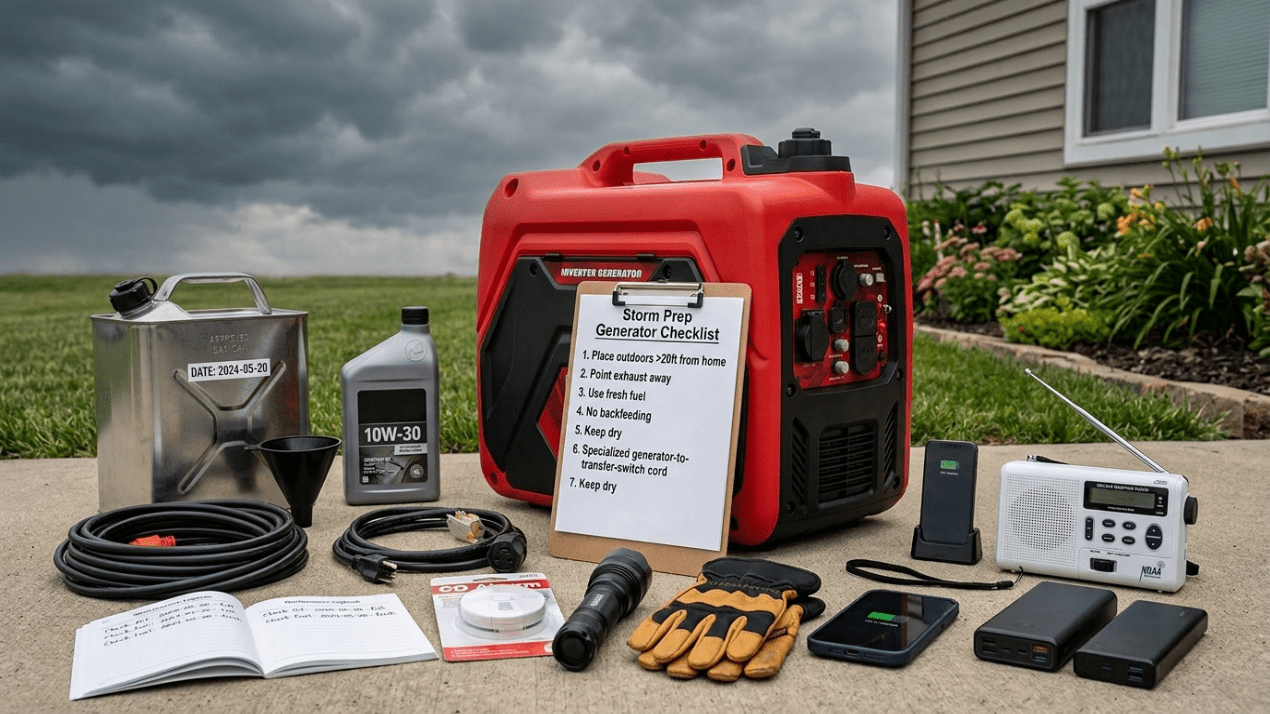
Storm Prep Generator Checklist: Maintenance, Fuel and Safe Connections
A storm prep generator checklist helps you prepare before the outage starts. The goal is simple: make sure your generator starts, your fuel is ready, your cords and adapters are safe, and your emergency power plan focuses on the loads that matter most during hurricanes, thunderstorms, winter storms, and extended blackouts.
Quick Answer
Before storm season, check generator oil, fuel condition, air filter, spark plug, battery if equipped, extension cords, adapters, CO alarms, fuel storage, and your emergency power load list. Do a safe outdoor test run before the storm, not during the outage.
For hurricane generator prep, focus on refrigerator, freezer rotation, phones, WiFi, LED lights, fans, sump pump planning, and medical-adjacent charging needs before comfort appliances. A good emergency power setup uses safe outdoor placement, properly rated cords, dry connections, and load rotation.
What to Do Before the Storm
Storm preparation should happen before rain, wind, flooding, and outages make setup harder. Do not wait until the lights go out to find fuel, cords, oil, adapters, or the owner’s manual.
Test the Generator
Start the generator outdoors, let it warm up, connect a light load, listen for rough running, then shut it down according to the manual.
Prepare Fuel
Fill approved gas cans, label fuel dates, check propane cylinders if using a compatible dual-fuel model, and store fuel safely.
Build Your Load List
Decide what you will power first: refrigerator, freezer, phones, WiFi, lights, fans, pump planning, and essential chargers.
Generator Maintenance Checklist
Maintenance is the first part of any storm prep generator checklist. A generator may sit for months, then be expected to start immediately during an emergency. Check the basics before storm season.
| Maintenance Item | What to Check | Storm Prep Action |
|---|---|---|
| Engine oil | Level, color, smell, contamination, service interval | Top off or change oil according to the owner’s manual |
| Fuel system | Old fuel, stale odor, water, debris, cracked fuel lines | Use fresh fuel and follow manual guidance for old fuel |
| Air filter | Dust, blockage, oil saturation, rodent debris | Clean or replace according to the manual |
| Spark plug | Carbon buildup, corrosion, worn electrode, cracked insulator | Inspect or replace with a model-compatible plug |
| Battery if equipped | Charge level, terminals, corrosion, cable condition | Charge or maintain before storm season |
| Cooling vents | Leaves, dust, grass, nests, blocked airflow | Clear all vents before test run |
| Outlets and control panel | Cracks, loose covers, corrosion, damaged switches | Do not use damaged outlets until inspected or repaired |
| Test run | Start, idle, warm-up, light load, shutdown | Confirm operation before the storm arrives |
Fuel and Runtime Preparation
Fuel planning is one of the most important parts of hurricane generator prep. A generator can only protect your emergency power loads if you have safe fuel storage, enough runtime planning, and a refill routine that avoids hot-engine refueling.
| Fuel Prep Item | Why It Matters | Best Practice |
|---|---|---|
| Approved gas cans | Stores emergency gasoline safely | Use approved containers and label fuel purchase dates |
| Fuel stabilizer | Helps manage stored fuel when used correctly | Follow stabilizer label and generator manual |
| Fresh fuel | Reduces hard-start and rough-running issues | Refresh questionable fuel before storm season |
| Propane planning | Useful for compatible dual-fuel or tri-fuel models | Inspect cylinder, hose, regulator, and connection condition |
| Runtime schedule | Prevents unnecessary fuel use | Rotate refrigerator, freezer, charging, lights, and comfort loads |
| Refueling plan | Reduces fire risk | Turn off the generator and let it cool before refueling |
Safe Cords, Adapters, and Home Connections
A safe emergency power setup depends on the connection method. Some homes use direct appliance cords. Others use a professionally installed inlet, transfer switch, or approved interlock setup. Never improvise a connection during a storm.
| Connection Item | What to Check | Safe Setup Rule |
|---|---|---|
| Outdoor-rated extension cords | Cuts, fraying, crushed insulation, missing ground pin, correct rating | Use cords rated for load, distance, and outdoor conditions |
| Generator cord | Plug type, voltage, amperage, cord condition | Match generator outlet and connected equipment |
| Adapters | Rating, plug type, voltage, heat damage, loose fit | Use only compatible adapters for the intended connection |
| Dry connection point | Rain, puddles, mud, cord path | Keep plugs and adapters dry, elevated, and visible |
| Transfer equipment | Manual transfer switch, inlet, or approved interlock | Use only properly installed transfer-ready equipment |
| Wall outlet backfeeding | Unsafe attempt to power home wiring | Never plug a generator into a wall outlet |
Emergency Power Load Priority
During a storm outage, the goal is not to power everything. The goal is to keep critical systems running, protect food, maintain communication, provide safe lighting, and support basic comfort.
| Priority Level | Emergency Power Loads | Load Strategy |
|---|---|---|
| Priority 1 | Phones, power banks, LED lights, battery radio | Charge whenever generator is running |
| Priority 2 | WiFi router, modem, laptop | Use when internet service remains available |
| Priority 3 | Refrigerator and freezer | Allow startup headroom and rotate operation |
| Priority 4 | Fans, small comfort loads, TV for updates | Run after critical food and communication loads are managed |
| Priority 5 | Sump pump, well pump, selected larger loads | Check starting watts, connection method, and generator capacity |
| Lower Priority | Microwave, coffee maker, space heater, portable AC, high-watt appliances | Use one at a time only if generator capacity allows |
During-Storm Generator Use Checklist
When the power goes out, follow a calm routine. Start the generator safely, let it stabilize, then add loads gradually. Avoid rushing, overloading, or moving the generator into unsafe locations to protect it from rain.
| During-Storm Step | What to Do | Why It Matters |
|---|---|---|
| Place generator outdoors | Use a safe ventilated location away from openings | Reduces carbon monoxide risk |
| Keep generator dry | Use safe weather planning without blocking ventilation or exhaust | Reduces electrical and equipment risk |
| Start with no loads | Disconnect appliances before starting | Helps prevent overload at startup |
| Add loads gradually | Connect refrigerator, then smaller loads, then comfort loads | Helps identify overload before shutdown |
| Monitor cords | Check heat, wet connections, trip hazards, cord strain | Supports safer long-duration operation |
| Refuel safely | Turn off, cool down, then refuel | Reduces fire risk |
After-Storm Inspection and Storage
Once utility power returns, do not simply put the generator away wet and dirty. A quick after-storm inspection helps prevent storage problems before the next emergency.
| After-Storm Item | What to Check | Storage Action |
|---|---|---|
| Exterior | Dirt, rain exposure, debris, oil residue | Let cool, wipe clean, and dry before storage |
| Oil | Level, color, contamination, service hours | Record run time and change oil if due |
| Fuel | Remaining gasoline, fuel age, storage plan | Follow manual for fuel stabilizer or storage method |
| Cords and adapters | Heat marks, moisture, damage, loose plugs | Dry, inspect, label, and store properly |
| Maintenance log | Date, runtime, fuel used, issues found | Update log before storing the generator |
| Accessory kit | Oil, funnel, plug tool, flashlight, gloves, CO alarm batteries | Restock before the next storm season |
Recommended Erayak Setup by Storm Need
Erayak 2400P: Compact Emergency Power Kit
Choose the Erayak 2400P for compact storm prep focused on phones, power banks, LED lights, WiFi router, laptop, battery radio, and small emergency electronics.
- Good fit for basic emergency power and compact outage kits
- Accessory focus: fuel can, outdoor extension cord, oil funnel, CO alarms, flashlight, and maintenance log
- Best when refrigerator, pump, and high-demand loads are limited or rotated carefully
Erayak 4500P: Best Starting Point for Storm Essentials
Choose the Erayak 4500P when your storm prep generator checklist includes refrigerator, freezer rotation, phones, WiFi, LED lights, fans, laptop, battery chargers, and basic household emergency loads.
- Gas-only portable inverter generator
- Manual recoil start
- 55 lb lightweight design
- 2.25 gal fuel tank
- Up to 8 hours runtime
- THD < 1.2% for sensitive electronics
- 60.5 dB noise level
Erayak 4500PD: Fuel Flexibility for Hurricane Generator Prep
Choose the Erayak 4500PD when you want 4,500W-class emergency power with gasoline and propane flexibility for longer outages, storm preparation, and more flexible fuel planning.
- Gasoline and propane flexibility
- Useful for longer storm outages and flexible fuel planning
- Good fit for refrigerator, freezer rotation, lights, phones, WiFi, fans, and managed household loads
Erayak 6800PD / 6800PT: Larger Emergency Power and Connection Planning
Choose the Erayak 6800 series when your emergency power plan includes larger essential loads, sump pump support, selected 120V/240V planning, RV adapter support, or multiple home power zones through proper connection planning.
- 6800W peak power
- 5000W rated power on gasoline at 100% output
- 30A L5-30R outlet
- 30A 120V/240V L14-30R outlet
- Dual 120V household outlets
- TT-30R RV adapter accessory included
Storm Generator Safety Checklist
Storm conditions make generator safety harder. Rain, wind, darkness, flooding, wet cords, and urgency can lead to mistakes. Use this checklist every time.
- Run the generator outdoors only.
- Keep it away from doors, windows, vents, garages, porches, sheds, crawlspaces, basements, and enclosed areas.
- Point exhaust away from people, homes, neighbors, doors, windows, and air intakes.
- Use working carbon monoxide alarms inside the home.
- Keep the generator dry without blocking ventilation or exhaust.
- Never place the generator in standing water, floodwater, or storm surge areas.
- Use properly rated outdoor extension cords.
- Inspect cords for cuts, fraying, crushed insulation, loose plugs, heat damage, or missing ground pins.
- Keep plugs, adapters, and connections dry, elevated, and visible.
- Disconnect loads before starting the generator.
- Add appliances gradually after the generator stabilizes.
- Do not overload the generator.
- Turn off and cool the generator before refueling.
- Store fuel away from living areas, flame, sparks, heaters, grills, and direct heat.
- Never plug a generator into a wall outlet to power home wiring.
- Use proper transfer equipment for home circuit backup.
Prepare Your Emergency Power Setup Before the Storm
A reliable storm prep generator checklist starts with maintenance, fuel, safe connections, and a clear emergency power load plan. Use the Erayak 2400P for compact essentials, the 4500P or 4500PD for practical household storm backup, and the 6800 series for larger loads and connection flexibility.
FAQ: Storm Prep Generator Checklist
What should be on a storm prep generator checklist?
A storm prep generator checklist should include oil, fuel, air filter, spark plug, battery if equipped, test run, extension cords, adapters, CO alarms, fuel storage, safe placement, emergency load list, and after-storm storage plan.
How do I prepare a generator for hurricane season?
For hurricane generator prep, inspect maintenance items, use fresh fuel, prepare approved gas cans, test the generator outdoors, organize cords and adapters, check CO alarms, and list priority loads before the storm arrives.
What emergency power loads should I run first?
Start with phones, power banks, LED lights, battery radio, WiFi router, refrigerator, freezer rotation, fans, and any critical charging needs. Add larger loads only if the generator and connection method support them.
Can I use extension cords during a storm outage?
Yes, but use properly rated outdoor extension cords. Inspect them before use, keep connections dry and elevated, and avoid cords with cuts, fraying, crushed insulation, heat damage, loose plugs, or missing ground pins.
Can I connect a generator to my home during a storm?
You can power appliances directly with properly rated cords or use properly installed transfer equipment. Never plug a generator into a wall outlet to power home wiring.
Should I test my generator before a storm?
Yes. Test the generator outdoors before severe weather arrives. Check oil, fuel, startup, light load operation, shutdown, cords, and accessories before you need emergency power.
What Erayak generator is best for storm prep?
Choose the Erayak 2400P for compact emergency essentials, the Erayak 4500P or 4500PD for practical household storm backup, and the Erayak 6800 series for larger loads, selected 120V/240V planning, and RV adapter support.


