

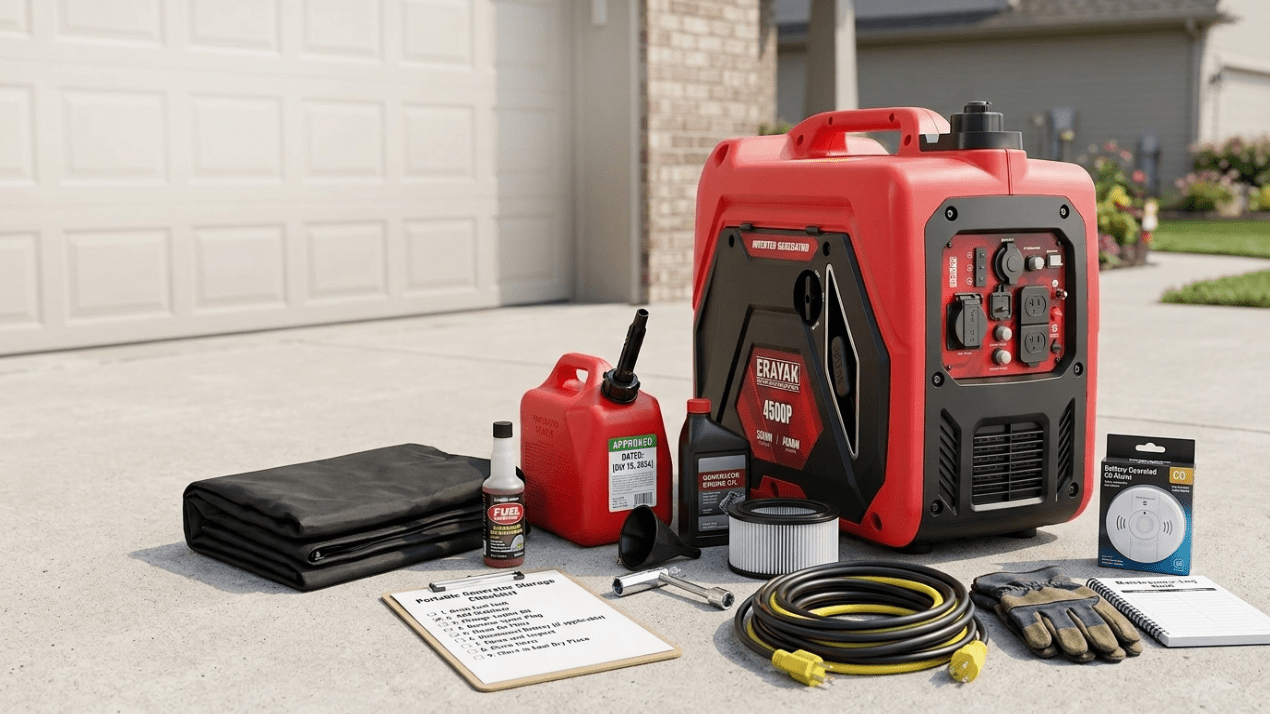
Portable Generator Storage Guide: How to Store It Between Seasons
Portable generator storage matters because most generators spend more time waiting than running. A clean storage routine helps prevent stale fuel, oil problems, weak batteries, rodent damage, dirty filters, corroded outlets, and missing accessories before the next outage, RV trip, camping weekend, or jobsite project.
Quick Answer
To store a portable generator between seasons, let it cool, clean the exterior, inspect fuel and oil, follow the manual for fuel stabilizer or draining, check the air filter and spark plug, protect cords and accessories, disconnect or maintain the battery if equipped, cover the generator only after it is cool, and store it in a dry, ventilated, pest-resistant location.
A good generator storage guide should also include a restart plan. Before using the generator again, check fuel, oil, cords, outlets, cooling vents, air filter, spark plug, and do a safe outdoor test run.
Why Portable Generator Storage Matters
A generator that runs well today can become hard to start after months of storage if fuel, oil, battery, vents, cords, or accessories are ignored. Seasonal storage is part of ownership, especially for home backup owners who may only use a generator during storms or outages.
Prevents Stale Fuel Issues
Stored fuel can age or become contaminated. A fuel plan helps reduce hard starts and rough running later.
Protects Key Components
Oil, air filter, spark plug, and cooling vents should be checked before a generator sits unused for months.
Keeps Accessories Together
Cords, funnels, maintenance tools, CO alarms, adapters, and load lists should be stored with the generator kit.
Generator Storage Checklist
Use this checklist before long-term storage, after storm season, after camping season, or when the generator will sit unused for several months.
| Storage Step | What to Do | Why It Matters |
|---|---|---|
| Cool down | Turn off the generator and let it cool fully | Prevents burns and reduces fire risk during handling |
| Clean exterior | Wipe dust, mud, grass, oil residue, and salt from the housing | Keeps debris from blocking vents or hiding leaks |
| Fuel plan | Use fuel stabilizer or drain fuel according to the manual | Helps reduce stale fuel and fuel-system problems |
| Oil check | Check level, color, smell, and change interval | Clean oil helps protect the engine during storage and restart |
| Air filter | Inspect for dirt, dust, oil saturation, or damage | Supports easier starting and smooth running later |
| Spark plug | Inspect or replace if worn, carboned, or damaged | Reduces hard-start problems after storage |
| Battery if equipped | Charge, disconnect, or maintain according to manual | Prevents weak electric-start performance |
| Cords and accessories | Inspect, coil, label, and store dry | Prevents missing or damaged accessories during the next outage |
| Storage cover | Cover only when generator is off and cool | Protects from dust while avoiding trapped heat |
| Maintenance log | Record date, oil, fuel status, battery, and issues | Makes the next restart easier and more predictable |
Fuel Stabilizer and Fuel Storage Planning
Fuel is one of the most important parts of portable generator storage. If gasoline sits too long, it can contribute to starting problems or rough running. Follow your owner’s manual for whether to drain fuel, run the carburetor dry, or use fuel stabilizer.
| Fuel Storage Item | Storage Purpose | Best Practice |
|---|---|---|
| Fuel stabilizer | Helps manage stored gasoline when used correctly | Use according to stabilizer label and generator manual |
| Approved gas can | Stores emergency fuel | Label fuel date and rotate stored fuel |
| Fuel shutoff valve | Helps isolate fuel system on some generators | Set according to manual before storage |
| Carburetor storage method | Reduces fuel residue in small passages | Follow manual guidance for draining or running dry |
| Propane equipment | For dual-fuel or tri-fuel models | Inspect hose, regulator, cylinder storage, and connections |
Oil, Air Filter, and Spark Plug Checks
Before storage, check the engine basics. Oil protects internal parts, the air filter helps the engine breathe, and the spark plug helps the generator start again after months of sitting.
| Component | What to Check | Storage Action |
|---|---|---|
| Engine oil | Level, color, smell, contamination, service interval | Change if dirty, old, contaminated, or due by manual |
| Oil fill area | Dirt, dust, oil residue | Wipe clean before and after service |
| Air filter | Dirt, debris, oil saturation, damage | Clean or replace according to manual |
| Spark plug | Carbon buildup, gap, corrosion, cracked insulator | Inspect or replace with model-compatible part |
| Cooling vents | Leaves, dust, rodent nests, grass, blocked airflow | Clean before storage and before restart |
Battery, Cords, Outlets, and Accessories
Storage is not only about the engine. Cords, adapters, outlets, batteries, tools, and accessories should be checked and organized so the generator kit is ready when the next outage happens.
| Item | Storage Check | Owner Tip |
|---|---|---|
| Battery if equipped | Charge level, terminals, corrosion, cable condition | Maintain or disconnect according to manual |
| Extension cords | Cuts, fraying, crushed insulation, missing ground pin | Replace damaged cords before storage |
| RV or transfer adapters | Plug wear, cracks, heat marks, loose fit | Store adapters in a labeled dry bin |
| Outlets and panel | Dust, corrosion, cracked covers, damaged switches | Do not use damaged outlets until inspected |
| Maintenance tools | Oil funnel, drain pan, plug wrench, gloves, rags | Keep tools with the generator kit |
| CO alarms | Battery status and placement plan | Check alarms before outage season |
Generator Cover and Storage Location
A generator cover helps protect against dust, but it should be used correctly. Do not cover a hot generator, and do not use a basic storage cover while the generator is running. Store the generator in a dry, clean, pest-resistant area with good access for future inspection.
| Storage Location Factor | Why It Matters | Best Practice |
|---|---|---|
| Dry area | Reduces corrosion and outlet damage | Avoid damp corners, standing water, and direct weather exposure |
| Ventilated storage | Reduces odor and trapped moisture | Do not seal a dirty or damp generator under plastic |
| Pest protection | Rodents can damage wiring, filters, and vents | Inspect for nesting signs before restart |
| Accessible location | Emergency use requires fast setup | Do not bury the generator behind heavy storage items |
| Correct cover | Protects from dust and scratches | Cover only when cool and follow cover instructions |
How to Restart After Storage
Before the next outage or trip, do a restart check. Do not assume the generator is ready because it was stored well. Check fuel, oil, cords, outlets, battery, vents, and accessories before starting.
| Restart Step | What to Check | Why It Matters |
|---|---|---|
| Inspect exterior | Leaks, cracks, rodent damage, loose parts | Catches obvious problems before startup |
| Check oil | Level and condition | Prevents low-oil or dirty-oil operation |
| Check fuel | Freshness, smell, contamination, valve position | Reduces hard starting and rough running |
| Check air filter and vents | Dust, nests, leaves, blocked airflow | Helps prevent overheating and poor running |
| Inspect cords | Damage, rating, plug condition | Reduces shock, overheating, and performance issues |
| Outdoor test run | Start, warm up, light load, shutdown | Confirms readiness before emergency use |
Erayak Generator Storage Notes
Erayak 2400P: Compact Storage Kit
The Erayak 2400P is a compact inverter generator often used for phones, lights, WiFi, battery charging, camping, and small emergency loads. Store it with a simple kit: fuel plan, oil funnel, maintenance log, outdoor extension cord, CO alarm, and clean cover.
- Good fit for compact emergency and outdoor power
- Storage focus: fuel, oil, cords, cover, and basic maintenance tools
- Best for owners who want a small ready-to-use backup kit
Erayak 4500P: Storage for Home Backup and General Use
The Erayak 4500P is a gas-only portable inverter generator used for home backup, camping, outdoor events, and general power needs. Before storage, focus on fuel condition, oil check, air filter, spark plug, cooling vents, cords, and a clearly labeled accessory bin.
- Gas-only portable inverter generator
- Manual recoil start
- 55 lb lightweight design
- 2.25 gal fuel tank
- Up to 8 hours runtime
- THD < 1.2% for sensitive electronics
- 60.5 dB noise level
Erayak 4500PD: Dual-Fuel Storage Planning
The Erayak 4500PD adds gasoline and propane flexibility. Storage planning should include gasoline fuel management, propane hose and regulator inspection, oil check, air filter, spark plug, cords, and fuel-specific accessory organization.
- Gasoline and propane flexibility
- Useful for longer outage planning and flexible fuel storage
- Storage focus includes both gasoline and propane accessory checks
Erayak 6800PD / 6800PT: Larger Backup Storage Kit
The Erayak 6800 series is built for larger emergency, outdoor, and selected 120V/240V planning. Store it with properly rated cords, RV adapter accessories, fuel plan, oil kit, maintenance log, and a restart checklist.
- 6800W peak power
- 5000W rated power on gasoline at 100% output
- 30A L5-30R outlet
- 30A 120V/240V L14-30R outlet
- Dual 120V household outlets
- TT-30R RV adapter accessory included
Storage and Restart Safety Checklist
Storage is maintenance, but restart is operation. When you test the generator after storage, treat it like normal generator use and place it outdoors only.
- Let the generator cool fully before cleaning, covering, or storing.
- Store fuel in approved containers away from living spaces, flame, sparks, and heat.
- Use fuel stabilizer or drain fuel only according to the manual.
- Do not cover a hot generator.
- Do not use a basic storage cover while the generator is running.
- Keep cords, adapters, and tools dry and organized.
- Inspect for rodent damage before restart.
- Check oil before starting after storage.
- Inspect extension cords and adapters before use.
- Run test starts outdoors only.
- Keep the generator away from doors, windows, vents, garages, sheds, porches, crawlspaces, RV openings, and enclosed spaces.
- Use working carbon monoxide alarms inside the home or RV.
Store Your Generator So It Is Ready Next Season
A portable generator is only useful if it starts when needed. Before storage, check fuel, oil, filters, spark plug, cords, accessories, battery, cover, and storage location. Before restart, inspect everything again and run a safe outdoor test.
FAQ: Portable Generator Storage
How should I store a portable generator between seasons?
Let it cool, clean the exterior, manage fuel according to the manual, check oil, inspect the air filter and spark plug, organize cords and accessories, maintain the battery if equipped, cover it only when cool, and store it in a dry protected area.
Should I drain gas before storing a generator?
Follow your owner’s manual. Some storage routines use fuel stabilizer, while others recommend draining fuel or running the carburetor dry. The correct method depends on the generator and fuel system.
Should I use fuel stabilizer for generator storage?
Fuel stabilizer can help manage stored gasoline when used correctly. Follow the stabilizer label and generator manual, and label stored fuel with the purchase date.
Can I put a generator cover on right after use?
No. Let the generator cool completely before covering it. A basic storage cover should not be used while the generator is running unless it is specifically designed and rated for that use.
Where is the best place to store a portable generator?
Store it in a dry, clean, ventilated, pest-resistant location where it is protected from standing water, corrosive chemicals, heavy clutter, and direct weather exposure.
What should I check before starting a generator after storage?
Check fuel, oil, air filter, spark plug, cooling vents, cords, outlets, battery if equipped, leaks, rodent damage, and accessories. Then do a safe outdoor test run with a light load.
Can I test a generator inside a garage after storage?
No. Never run a generator inside a garage, even with the door open. Test it outdoors only, away from doors, windows, vents, garages, sheds, RV openings, and enclosed areas.
