
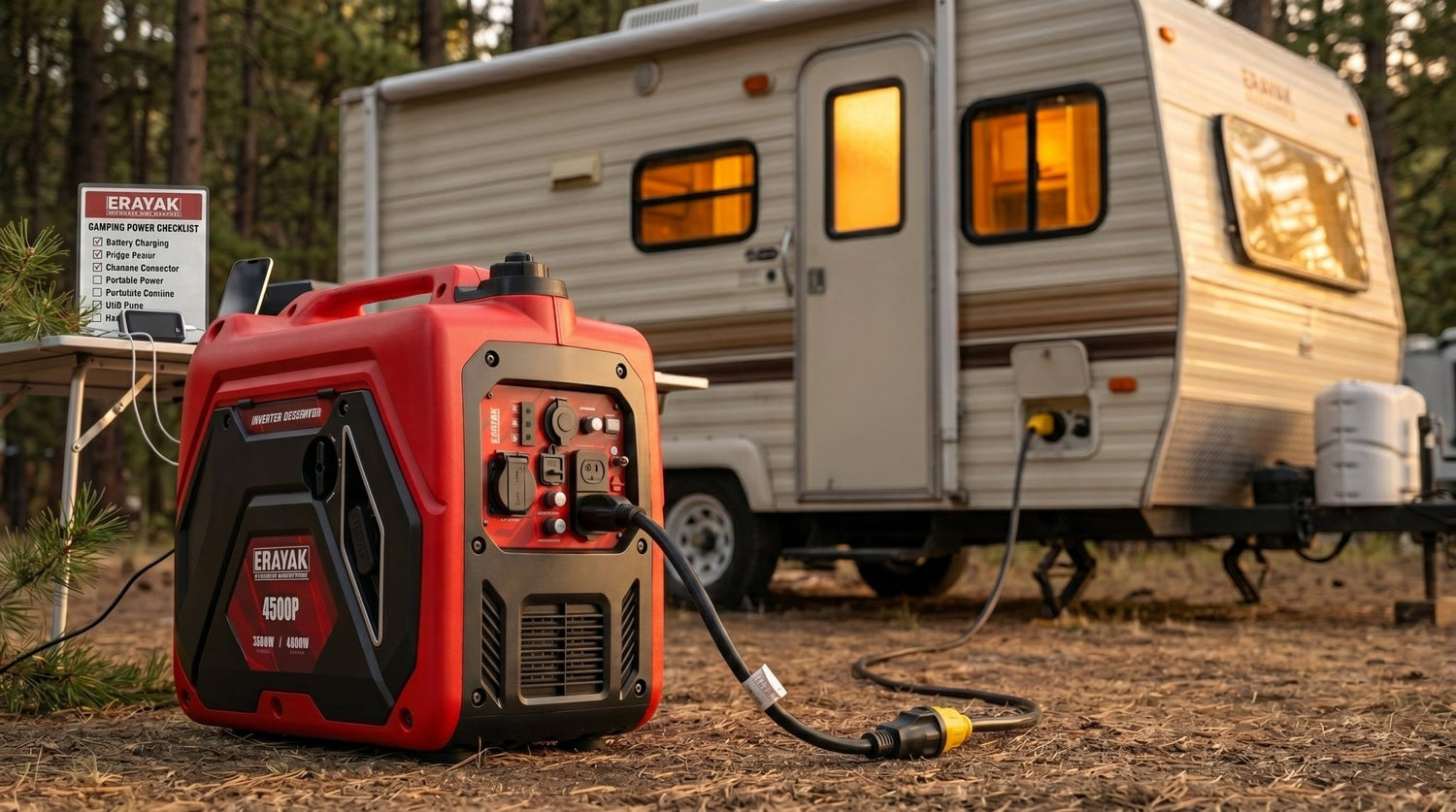
Can a Generator Charge an RV Battery?
Yes, a portable generator can charge an RV battery, but the right setup depends on whether you are charging through the RV converter, a standalone battery charger, or an inverter/charger. This guide explains generator sizing, charger watts, RV load management, and which Erayak generator fits your camping setup.
Quick Answer
A generator can charge an RV battery when connected through the proper charging equipment. In most RVs, this means plugging the RV into generator power so the RV converter/charger can charge the house batteries. You can also use a compatible standalone battery charger.
For RV battery charging plus lights, phone charging, Wi-Fi, and small electronics, a 2,400W-class inverter generator may be enough. For practical camping use with battery charging, RV refrigerator, microwave load management, and RV air conditioner planning, a 4,500W-class inverter generator is usually the better starting point. For heavier RV loads, choose the Erayak 6800 series.
How Generator RV Battery Charging Works
A generator does not usually connect directly to an RV battery. Instead, the generator provides AC power to the RV or to a battery charger. The RV converter/charger then converts that AC power into DC charging power for the RV house batteries.
RV Converter/Charger
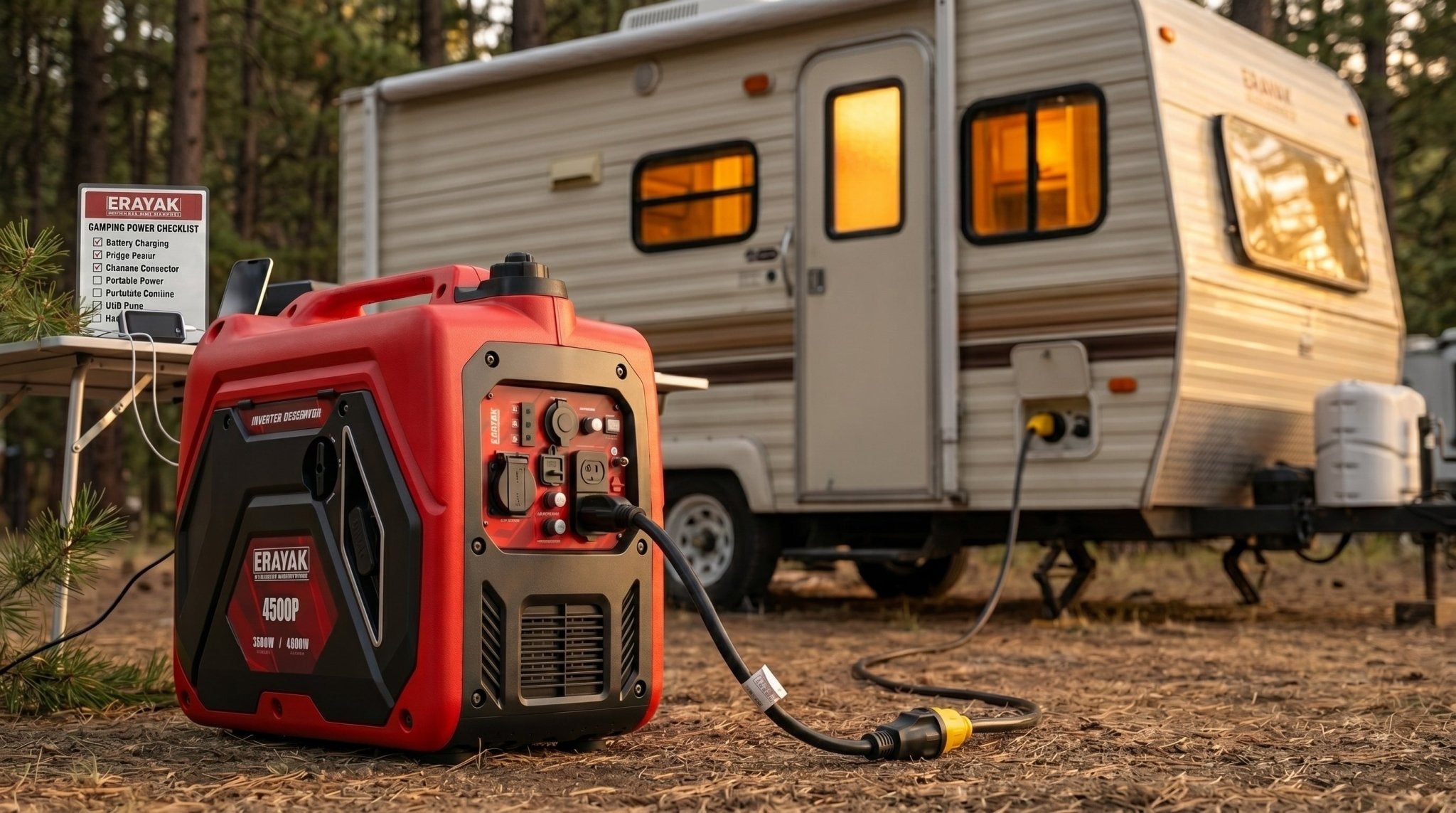
Plug the RV into generator power, and the RV converter charges the house batteries while powering 12V systems.
Standalone Battery Charger
Use a compatible charger connected to the battery bank according to the charger and battery instructions.
Inverter/Charger
Some RVs use inverter/charger systems that can charge batteries and support AC loads when properly connected.
How Many Watts Does an RV Battery Charger Use?
RV battery charger wattage depends on charging amps, battery voltage, battery state of charge, converter efficiency, and whether other RV loads are running at the same time. A converter may draw more power when batteries are low and less power as batteries approach full charge.
| Charging Setup | Estimated Load Level | Generator Planning Note |
|---|---|---|
| Small standalone battery charger | Low | Often easy for a compact inverter generator |
| RV converter charging lightly discharged batteries | Low to moderate | Good fit for compact RV power setups |
| RV converter charging deeply discharged batteries | Moderate | Converter may draw more power during bulk charging |
| Large inverter/charger | Moderate to high | May require generator configuration or charge-rate adjustment |
| Battery charging + RV AC or microwave | High temporary load | Manage large loads carefully or use more generator headroom |
RV Battery Charging Generator Size Chart
Use this chart as a practical planning guide. Exact wattage depends on your RV converter, battery bank, charger settings, and other appliances.
| RV Charging / Camping Setup | Typical Load Level | Recommended Generator Class | Erayak Fit |
|---|---|---|---|
| Battery charger only | Low | 2,000W–2,400W class | Erayak 2400P |
| RV converter + lights + phone charging | Low to moderate | 2,400W class | Erayak 2400P |
| RV battery charging + refrigerator | Moderate | 2,400W–4,500W | Erayak 2400P or 4500P |
| Battery charging + microwave load management | Moderate to high temporary load | 4,500W-class recommended | Erayak 4500P or 4500PD |
| Battery charging + RV air conditioner | High during AC startup | 4,500W–6,800W | Erayak 4500PD or 6800 Series |
| Larger RV or inverter/charger system | Varies | 6,800W-class planning range | Erayak 6800 Series |
RV Converter vs Standalone Battery Charger
Many RV owners charge batteries through the built-in RV converter. This is convenient because you can plug the RV into generator power and let the converter manage charging. A standalone charger can also work, but it must match the battery type, battery voltage, and charging profile.
| Charging Method | Best For | Generator Planning Note |
|---|---|---|
| RV converter/charger | Typical RV shore-power charging | Most convenient for normal camping use |
| Standalone smart charger | Direct battery-bank charging | Must match battery chemistry and voltage |
| Inverter/charger | Larger RV electrical systems | May require charge-rate settings and more generator capacity |
Charging Lithium vs Lead-Acid RV Batteries
Battery chemistry matters. Lead-acid, AGM, and lithium RV batteries can require different charging profiles. A generator only supplies power; the charger or converter controls how the battery is charged.
If your RV has lithium batteries, make sure the converter or charger supports lithium charging. If it does not, battery charging may be slow, incomplete, or inappropriate for the battery system.
RV Battery Charging + Appliances
Battery charging is often a background load. The problem comes when you add high-demand appliances such as an RV microwave, coffee maker, electric water heater, or rooftop air conditioner.
On a 4,500W-class generator, battery charging plus basic loads is usually manageable, but RV AC startup and microwave use need load management. For larger RVs or more simultaneous loads, the Erayak 6800 series gives more headroom.
| RV Scenario | What You Want to Power | Recommended Erayak Size |
|---|---|---|
| Battery charging only | House battery recharge | Erayak 2400P |
| Battery charging + small electronics | Lights, phones, router, laptop | Erayak 2400P |
| Battery charging + RV fridge | Charging plus food cooling | Erayak 2400P or 4500P |
| Battery charging + microwave | Charging plus short cooking cycles | Erayak 4500P or 4500PD |
| Battery charging + RV AC | Charging plus cooling with load management | Erayak 4500P or 4500PD |
| Battery charging + AC + heavier loads | Larger RV power plan | Erayak 6800 Series |
Best Erayak Generator for RV Battery Charging
Erayak 2400P: Compact Generator for RV Battery Charging
The Erayak 2400P is a compact inverter generator for RV battery charging, lights, phone charging, router, laptop, and small camping electronics when total load is carefully managed.
- Good for RV battery charging and small camping loads
- Useful for lights, charging, router, and electronics
- Best when microwave and AC use are limited or managed separately
Erayak 4500P: Gas-Only RV Generator for Charging + Essentials
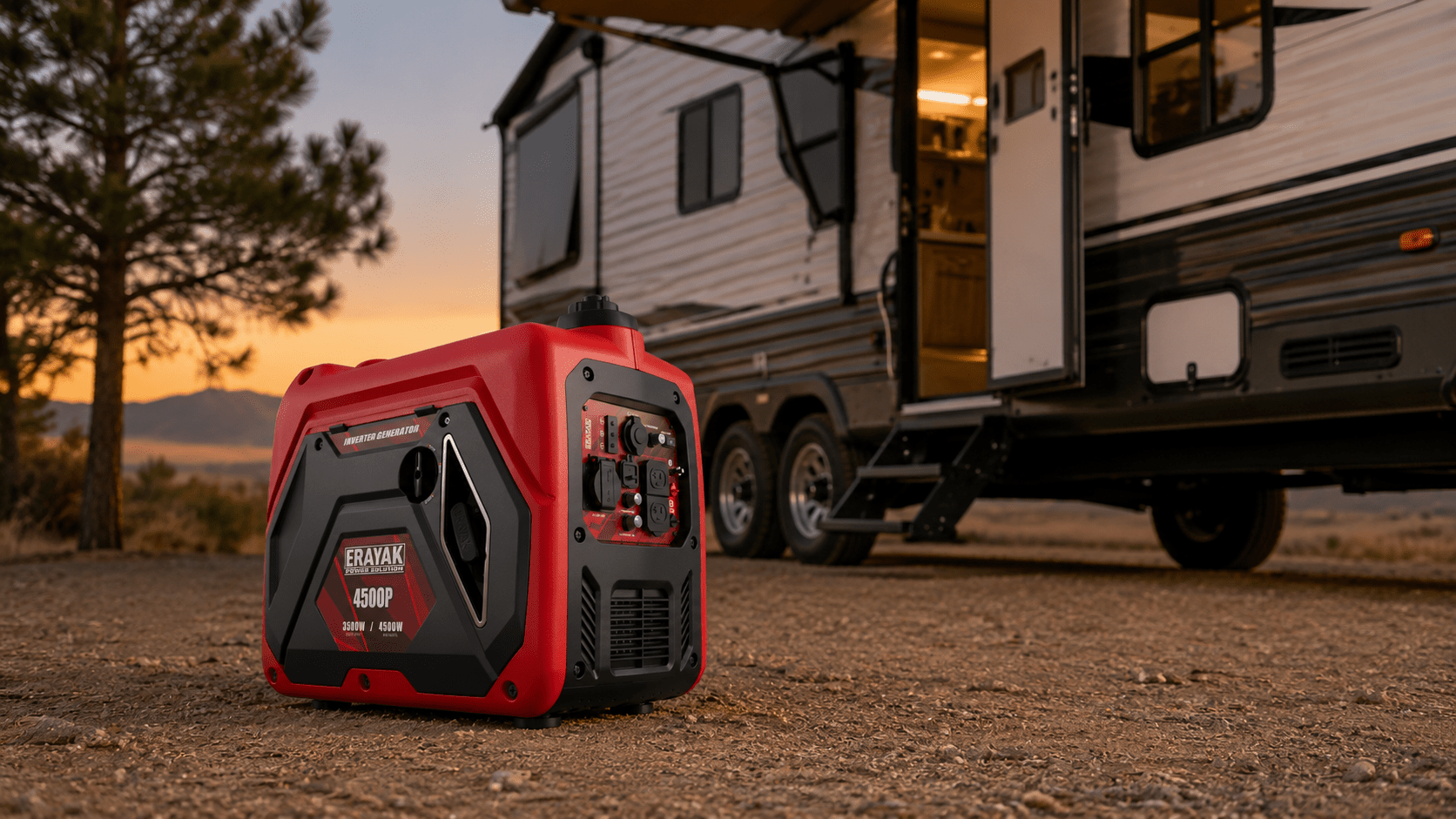
The Erayak 4500P is a strong match for RV owners who want a 4,500W-class inverter generator for battery charging plus refrigerator support, lights, electronics, microwave load management, and RV AC planning.
- Gas-only portable inverter generator
- Manual recoil start
- 55 lb lightweight design
- 2.25 gal fuel tank
- Up to 8 hours runtime
- THD < 1.2% for sensitive electronics
- 60.5 dB noise level
Erayak 4500PD: Dual-Fuel Flexibility for RV Battery Charging
The Erayak 4500PD is a practical 4,500W-class option for RV battery charging and camping essentials when you want gasoline and propane flexibility for boondocking, storm backup, and longer road trips.
- Useful for charging plus RV essentials
- Dual-fuel flexibility for RV and outage preparedness
- Good match for travel trailers, camping, and portable power needs
Erayak 6800PD / 6800PT: More Headroom for Larger RV Power Plans
Choose the Erayak 6800 series when you need more surge margin, 120V/240V flexibility, or a larger RV and home backup plan.
- 6800W peak power
- 5000W rated power on gasoline at 100% output
- 30A L5-30R outlet
- 30A 120V/240V L14-30R outlet
- Dual 120V household outlets
- TT-30R RV adapter accessory included
Runtime and Charging Tips
Charging runtime depends on battery capacity, state of charge, charger amperage, converter efficiency, generator load, and fuel supply. Batteries charge fastest during the early bulk stage and slow down as they approach full charge.
Charge During Bulk Stage
Generator charging is often most efficient when batteries are lower and can accept higher charge current.
Manage Big Loads
Avoid microwave, coffee maker, and RV AC startup while the charger is drawing heavily.
Use the Right Charger
Match the charger to your battery type, voltage, and recommended charging profile.
RV Generator Safety Tips
A generator must run outdoors only, with exhaust directed away from RV windows, doors, roof vents, tents, people, pets, and neighboring campsites. Never run a generator inside an RV, storage compartment, truck bed with a cover, garage, or enclosed space.
- Operate the generator outdoors only.
- Keep exhaust away from RV windows, doors, roof vents, and neighboring campers.
- Use working carbon monoxide alarms inside the RV.
- Use properly rated cords and adapters.
- Do not overload the generator.
- Keep the generator dry and away from standing water.
- Let the generator cool before refueling.
- Follow campground generator-hour rules.
Charge Your RV Batteries and Keep Camping Essentials Running
For RV battery charging and small loads, the Erayak 2400P is a compact option. For practical RV camping with battery charging, refrigerator support, electronics, microwave load management, and AC planning, choose the Erayak 4500P or 4500PD. For heavier RV loads, choose the Erayak 6800 series.
FAQ: Generator to Charge RV Battery
Can a generator charge an RV battery?
Yes. A generator can charge an RV battery when connected through the RV converter/charger, inverter/charger, or a compatible standalone battery charger.
What size generator do I need to charge an RV battery?
For RV battery charging plus small loads, a 2,400W-class inverter generator may work. For charging plus RV refrigerator, microwave load management, and AC planning, a 4,500W-class generator is often more practical.
Can a 2,000 watt generator charge an RV battery?
Yes, a 2,000 watt generator can often support RV battery charging, but total load matters. Battery charging plus microwave, AC, or heavy appliances may require more generator capacity.
Can I charge an RV battery directly from a generator?
Usually you should not connect a battery directly to a generator outlet. Use the RV converter/charger, inverter/charger, or a compatible standalone battery charger.
Can I charge lithium RV batteries with a generator?
Yes, if your charger or RV converter supports the lithium battery charging profile required by your battery system. The generator supplies AC power; the charger controls the charging process.
Can I run RV AC while charging batteries?
Yes, if the generator has enough capacity. RV AC compressor startup is usually the bigger challenge. A 4,500W-class generator may work with load management, while heavier RV loads may need the Erayak 6800 series.
Is an inverter generator good for RV battery charging?
Yes. An inverter generator is a good choice for RV battery charging because it provides stable power for converters, chargers, RV appliances, and sensitive electronics when properly sized.
What is the best Erayak generator for RV battery charging?
For RV battery charging plus small loads, consider the Erayak 2400P. For RV battery charging plus camping essentials, consider the Erayak 4500P or 4500PD. For battery charging plus AC, microwave, and heavier loads, consider the Erayak 6800 series.

Dejar un comentario
Todos los comentarios se revisan antes de su publicación.
Este sitio está protegido por hCaptcha y se aplican la Política de privacidad de hCaptcha y los Términos del servicio.