

What Size Generator Do You Need for a Septic Pump?
A septic pump or sewage ejector pump may not run constantly, but when it is needed during a power outage, it can be critical. This guide explains generator sizing, starting watts, refrigerator backup, safe connection methods, and which Erayak generator fits your home backup plan.
Quick Answer
For many residential septic pumps or sewage ejector pumps, a 4,500W-class inverter generator is a practical starting point because it gives enough headroom for pump startup surge plus basic home essentials. A smaller generator may run some 120V pumps by themselves, but pump motors can draw several times their running watts for a brief moment at startup.
For larger pumps, 240V pumps, multiple pumps, or selected home circuits, consider a 120V/240V generator such as the Erayak 6800 series and work with a licensed electrician.
Septic Pump vs Sewage Ejector Pump
Homeowners use the terms septic pump, sewage pump, and sewage ejector pump in different ways. In many homes, the pump moves wastewater from a lower basin, basement bathroom, laundry area, or septic system component to a higher drain line, sewer line, or septic system. Sewage ejector pumps are commonly used when fixtures sit below the main sewer or septic line.
From a generator-sizing perspective, the important details are the same: motor horsepower, running watts, starting watts, voltage, circuit requirements, and whether the pump is plug-in or hardwired.
How Many Watts Does a Septic Pump Use?
Septic pump wattage varies by horsepower, pump design, head height, voltage, and load. A small 1/3 HP pump may require far less power than a larger 1 HP pump. The key issue is that pump motors often need extra starting watts for a brief moment when the motor starts.
Running Watts
The power the pump uses after it is already moving water or wastewater.
Starting Watts
The temporary surge required when the motor starts. This can be much higher than running watts.
Total Outage Load
The pump may share generator capacity with a refrigerator, freezer, lights, router, and chargers.
Septic Pump Generator Size Chart
Use this chart as a practical planning guide. Exact requirements depend on the pump model, voltage, head pressure, startup demand, and other loads.
| Backup Setup | Typical Load Concern | Recommended Generator Class | Erayak Fit |
|---|---|---|---|
| Small 120V septic pump only | Motor startup surge | 2,400W–4,500W depending on pump specs | Erayak 2400P or 4500P |
| 1/2 HP sewage ejector pump only | Higher starting watts | 4,500W-class recommended for margin | Erayak 4500P or 4500PD |
| Septic pump + lights + router + charging | Pump surge plus small loads | 4,500W-class recommended | Erayak 4500P or 4500PD |
| Septic pump + refrigerator | Pump surge plus refrigerator compressor surge | 4,500W–6,800W | Erayak 4500PD or 6800 Series |
| 240V pump or selected home circuits | Voltage and surge margin | 120V/240V generator recommended | Erayak 6800 Series |
Can a Portable Generator Run a Septic Pump?
Yes, a portable generator can run many septic pumps or sewage ejector pumps if the generator has enough running watts, enough starting watts, and the correct voltage. The generator also needs a safe connection method.
Some pumps plug into a dedicated outlet. Others are hardwired into the home’s electrical system. If the pump is hardwired, do not improvise a connection. Use a properly installed transfer switch, inlet, or electrician-approved backup method.
120V vs 240V Pump Requirements
Many residential sewage ejector pumps are 120V, but not all septic-related pumps are the same. Larger pumps, lift station pumps, and some rural septic system components may require 240V.
| Pump Type | Common Voltage | Generator Planning Note |
|---|---|---|
| Plug-in basement sewage ejector pump | Often 120V | Confirm outlet, amps, and startup requirement |
| Residential septic effluent pump | 120V or 240V depending on system | Check control panel and pump documentation |
| Lift station or larger pump | May be 240V | Consider 120V/240V generator and electrician planning |
| Hardwired pump system | System-specific | Use transfer switch or approved backup wiring method |
Septic Pump + Refrigerator Backup
In a real outage, the septic pump is rarely the only load. Most homeowners also want to keep food cold, lights on, phones charged, and Wi-Fi available. Both pump motors and refrigerator compressors can create startup surge, so headroom matters.
For a septic pump plus refrigerator backup setup, a 4,500W-class inverter generator is often the practical starting point. For larger pump systems, multiple motor loads, or selected circuits, step up to a 120V/240V generator with more capacity.
| Outage Scenario | What You Want to Power | Recommended Erayak Size |
|---|---|---|
| Pump only | Septic or sewage ejector pump backup | Erayak 2400P only if pump specs allow; otherwise 4500P |
| Pump + router + lights | Sanitation plus basic communication | Erayak 4500P |
| Pump + refrigerator | Sanitation plus food safety | Erayak 4500P or 4500PD |
| Pump + refrigerator + freezer + essentials | Practical household outage backup | Erayak 4500PD or 6800 Series |
| 240V pump or selected home circuits | Larger home backup plan | Erayak 6800 Series |
Best Erayak Generator for Septic Pump Backup
Erayak 2400P: Compact Backup for Small 120V Pump Loads
The Erayak 2400P may be suitable for smaller 120V pump-only backup scenarios if the pump’s running watts, starting watts, and connection method are compatible.
- Best for carefully verified small-load backup
- Useful for lights, router, charging, and small electronics
- Always verify pump startup requirements first
Erayak 4500P: Gas-Only Backup for Pump + Essentials
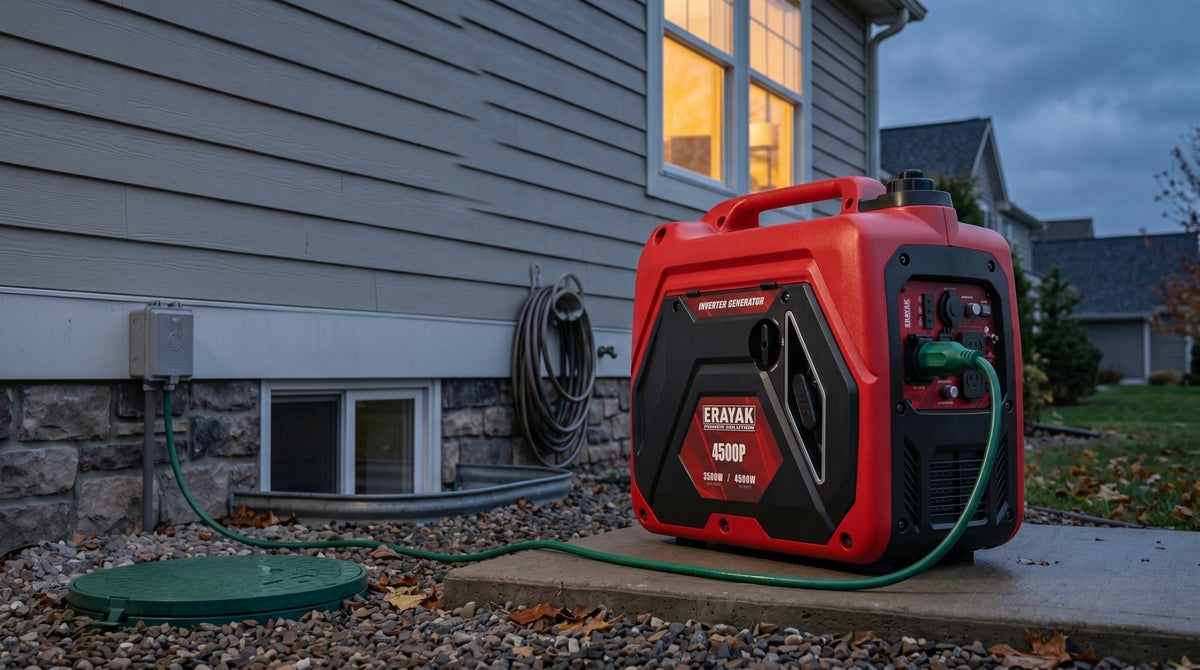
The Erayak 4500P is a strong fit for many homeowners who want a 4,500W-class inverter generator for a septic pump or sewage ejector pump plus refrigerator, lights, router, and charging.
- Gas-only portable inverter generator
- Manual recoil start
- 55 lb lightweight design
- 2.25 gal fuel tank
- Up to 8 hours runtime
- THD < 1.2% for sensitive electronics
- 60.5 dB noise level
Erayak 4500PD: Dual-Fuel Flexibility for Storm Outages
The Erayak 4500PD is a practical 4,500W-class option for septic pump plus refrigerator backup when homeowners want gasoline and propane flexibility during storms and longer outages.
- Useful for pump plus refrigerator backup
- Dual-fuel flexibility for outage preparedness
- Good match for rural homes, storm season, RV, camping, and portable power needs
Erayak 6800PD / 6800PT: More Headroom for 120V/240V Backup
Choose the Erayak 6800 series when you need 120V/240V flexibility, more surge margin, or selected-circuit backup for a septic pump, refrigerator, freezer, furnace blower, lights, router, and other critical loads.
- 6800W peak power
- 5000W rated power on gasoline at 100% output
- 30A L5-30R outlet
- 30A 120V/240V L14-30R outlet
- Dual 120V household outlets
- TT-30R RV adapter accessory included for RV connection
Generator Safety and Connection Tips
Septic pump backup often involves wet locations, dedicated circuits, hardwired equipment, and motor startup loads. Safety matters. Operate the generator outdoors only, keep it away from windows, doors, vents, and garages, and use carbon monoxide alarms indoors. The CDC warns that portable generators produce carbon monoxide, an odorless and colorless gas that can kill without warning. The Red Cross also recommends using a transfer switch installed by an electrician when connecting a generator to home wiring.
- Operate the generator outdoors only.
- Never run a generator in a garage, basement, shed, crawlspace, or enclosed porch.
- Keep exhaust away from windows, doors, vents, and intake openings.
- Use working carbon monoxide alarms inside the home.
- Use properly rated outdoor extension cords only when the pump connection allows it.
- Use a transfer switch or electrician-approved method for hardwired pumps.
- Do not backfeed your home through a wall outlet.
- Keep cords and connections away from standing water.
- Start large motor loads one at a time.
- Let the generator cool before refueling.
Protect Your Home During Septic Pump Outages
A septic pump or sewage ejector pump can be a critical load during an outage. Start with the Erayak 4500P or 4500PD for pump plus essentials, consider the Erayak 2400P only for smaller verified pump-only scenarios, or choose the Erayak 6800 series for larger 120V/240V selected-circuit backup.
FAQ: Generator for Septic Pump Backup
Can a generator run a septic pump?
Yes. A generator can run many septic pumps or sewage ejector pumps if it has enough running watts, enough starting watts, and the correct voltage.
What size generator do I need for a septic pump?
For many residential septic pump backup scenarios, a 4,500W-class inverter generator is a practical starting point because it provides headroom for motor startup surge and basic home essentials.
Can a 2,000 watt generator run a septic pump?
It may run some smaller 120V pumps, but it can be marginal because pump motors need startup surge. Check the pump nameplate and manual before relying on a 2,000W generator.
What size generator for a sewage ejector pump?
Many homeowners should plan around a 4,500W-class generator for a sewage ejector pump, especially if they also want to power a refrigerator, lights, router, or chargers.
Can I run a septic pump and refrigerator on the same generator?
Yes, if the generator can handle both the pump startup surge and refrigerator compressor startup surge. A 4,500W-class inverter generator is often a practical choice for this setup.
Do septic pumps need 120V or 240V?
Some residential pumps are 120V, while larger septic-related pumps may require 240V. Check the pump nameplate, control panel, and installation manual before choosing a generator.
What is the best Erayak generator for septic pump backup?
For septic pump plus essentials, consider the Erayak 4500P or 4500PD. For smaller verified pump-only loads, the Erayak 2400P may fit. For 120V/240V backup or selected circuits, consider the Erayak 6800 series.
