

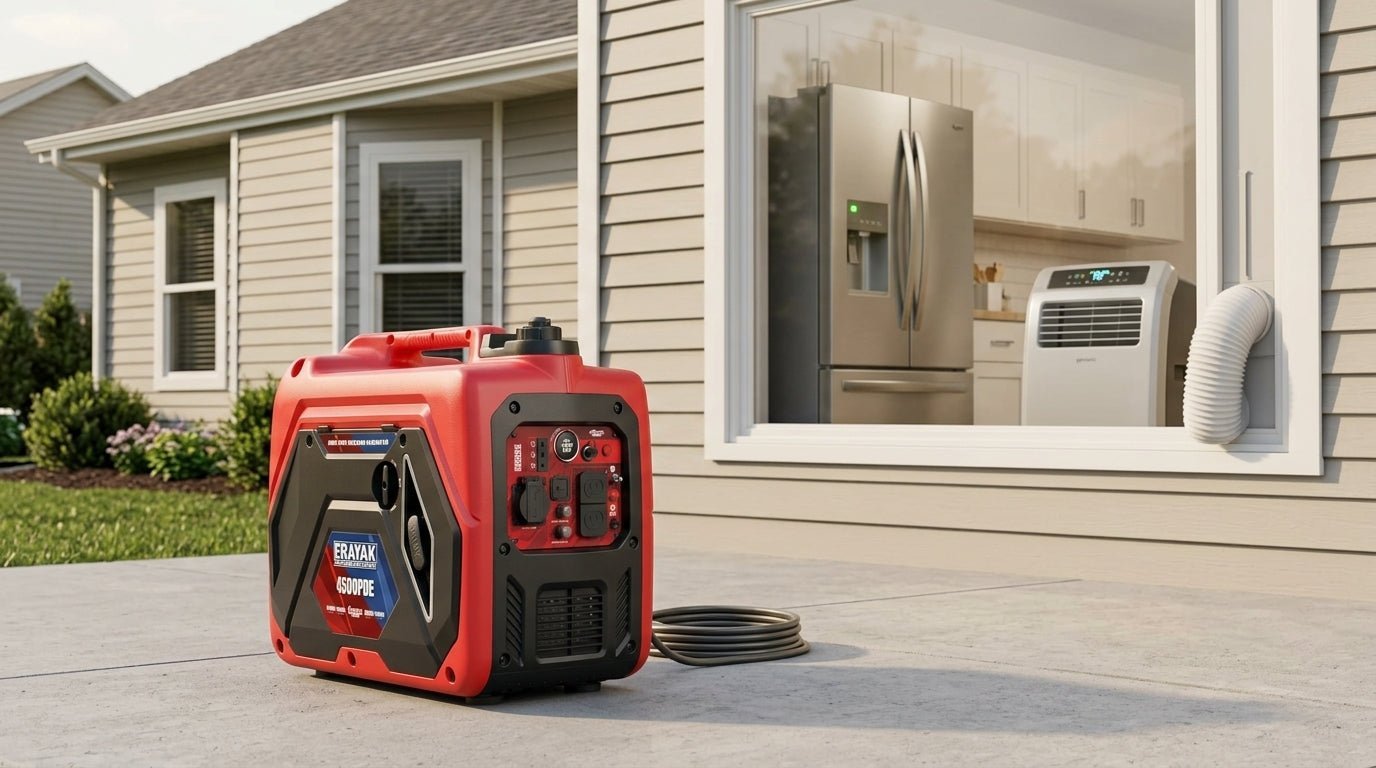
Portable AC + Fridge Generator Guide
What Size Generator Do I Need to Run a Portable AC and Refrigerator?
Yes, a generator can run a portable AC and refrigerator at the same time if it has enough starting watts for both compressor loads. For many outage setups, the practical answer is a 3,500W to 4,500W inverter generator, with a 4,500W-class model being the safer starting point when the AC is 10,000 BTU or larger.
Use this guide to compare 2,000W, 2,400W, 4,500W and higher-capacity generator choices for AC plus fridge backup.
Quick Answer: What Size Generator Runs AC and Fridge Together?
Yes, a generator can run a portable AC and refrigerator at the same time if it has enough starting watts and running watts. For a typical portable AC and refrigerator, choose at least a 3,500W to 4,500W inverter generator. A 2,000W generator is usually too small for both at the same time. A 2,400W generator may work only in limited light-load setups, such as a small portable AC with no other major appliances. A 4,500W-class generator is the more practical choice for a 10,000 BTU portable AC, refrigerator, router, lights and phone charging.
If you want the simplest ERAYAK match for the main search intent, start with the ERAYAK 4500PD Dual-Fuel Series. Choose the ERAYAK 6800PD / 6800PT Series when the portable AC and refrigerator are only part of a larger home or RV backup plan.
In This Guide
Generator Size Chart for Portable AC and Refrigerator
Use this chart as a planning range. Exact wattage depends on your portable AC BTU rating, refrigerator size, compressor design, outdoor temperature, altitude, extension cords and other connected loads. Always check the nameplate or owner manual for both appliances.

| Backup Setup | Typical Running Load | Starting Surge Risk | Practical Generator Size | ERAYAK Match |
|---|---|---|---|---|
| Refrigerator only | 400W-800W | 1,200W-1,600W or higher | 2,000W-2,400W inverter generator | ERAYAK 2400P |
|
Small portable AC only 5,000-8,000 BTU |
500W-900W | 1,000W-1,800W | 2,000W-2,400W for AC-only use | ERAYAK 2400P |
|
Portable AC + refrigerator 8,000-10,000 BTU AC |
1,200W-2,000W | 2,500W-3,600W depending on startup timing | 3,500W-4,500W inverter generator | ERAYAK 4500PD |
|
Larger portable AC + refrigerator 12,000-14,000 BTU AC |
1,800W-2,600W | 3,000W-4,800W depending on appliance surge | 4,500W-class or larger | ERAYAK 4500P / 4500PD |
| Portable AC + fridge + freezer + lights/router | 2,200W-3,200W+ | Multiple compressor loads can overlap | Higher-capacity inverter generator | ERAYAK 6800PD / 6800PT |
Planning note: Appliances usually do not all hit maximum surge at the exact same second, but a real outage is messy. Leave margin for hot weather, cycling compressors, long cords, altitude and small essentials such as a router, lights and phone chargers.
Can a 2,000W, 2,400W or 4,500W Generator Run AC and Fridge?
Many shoppers compare generator sizes by wattage first. That is useful, but the real question is whether the generator can handle compressor startup surge without tripping.
2,000W Generator
A 2,000W generator is usually not recommended for a portable AC and refrigerator together. It may run a refrigerator alone or a small portable AC alone, but both compressor loads can exceed its usable surge margin.
2,400W Generator
A 2,400W inverter generator can be useful for a refrigerator, small AC, camping loads and light essentials. For AC plus fridge, treat it as a limited edge-case option, not the safest general recommendation.
4,500W Generator
A 4,500W-class inverter generator is the practical starting point for many portable AC plus refrigerator setups, especially when the AC is 10,000 BTU or larger and you also need lights, router and chargers.
Why Starting Watts Matter More Than Running Watts
A portable air conditioner and a refrigerator both use compressors. After they are already running, the power draw may look manageable. The harder part is the brief surge when a compressor starts.
Portable AC Surge
A 10,000 BTU portable AC may run around 900W-1,200W, but startup surge can often reach 1,800W-2,200W. Larger portable AC units may surge higher.
Refrigerator Surge
A refrigerator may run around 400W-800W, but the compressor can briefly need about 1,200W-1,600W or more depending on the model, age and operating conditions.
Real-World Headroom
If the AC starts while the refrigerator and router are already running, a small generator may trip. More headroom helps the generator handle cycling loads during hot weather.
Load Examples
Can a Generator Run a Portable AC and Refrigerator at the Same Time?
Yes, if the generator has enough starting watts and you manage other loads carefully. These examples show why AC plus fridge backup usually needs more than a small suitcase generator.
8,000 BTU Portable AC + Fridge
Running load may be around 1,200W-1,700W. Startup demand can still exceed 2,500W. A 2,400W generator may be tight; a 4,500W-class generator is safer.
10,000 BTU Portable AC + Fridge + Router
This is the strongest fit for a 4,500W-class inverter generator. It gives more margin for AC surge, refrigerator cycling, Wi-Fi, lights and phone charging.
12,000-14,000 BTU AC + Fridge + Freezer
This setup can push beyond a simple 4,500W plan if compressor loads overlap. Consider a higher-capacity inverter generator when you add a freezer or more home backup loads.
How to Calculate Portable AC + Refrigerator Generator Size
The safest calculation is not just “AC watts + refrigerator watts.” Use the running load of everything that stays on, then add the largest likely startup surge and a safety margin.
Running watts of active devices + largest starting surge + margin
Example: a 10,000 BTU portable AC runs at 1,000W and starts around 2,000W. A refrigerator runs at 600W and starts around 1,400W. Lights and router use 100W. If the AC starts while the refrigerator and small devices are already running, peak demand could be around 2,700W before extra margin. A 4,500W-class inverter generator gives a safer cushion than a 2,400W generator.
Avoid this mistake: Do not add only running watts. A generator that looks large enough on running watts can still trip when the AC or refrigerator compressor starts.
What Not to Run With a Portable AC and Refrigerator
When your generator is already powering compressor appliances, avoid stacking high-wattage heating or cooking appliances. These loads can push even a properly sized generator past its limit.
Microwave
A microwave can add 1,000W-1,500W or more. Use it only after checking available generator capacity and turning off other large loads when needed.
Electric Heater
Electric heaters are heavy continuous loads and usually do not belong in the same small-generator plan as a portable AC and refrigerator.
Coffee Maker / Hair Dryer
These can draw high wattage quickly. If you must use them, avoid running them while the AC compressor is cycling.

Best ERAYAK Generator Match for Portable AC and Refrigerator Backup
Choose the generator by your actual load. The smallest generator is not always the best value if it causes overload trips during a summer outage. At the same time, oversizing without a load plan can add weight, fuel use and cost you may not need.

Light-Load Option
ERAYAK 2400P
Best for: refrigerator-only backup, small portable AC units, camping, lights, phone charging, routers and light essentials.
Use the 2400P when portability and low noise matter more than running multiple compressor appliances at the same time.

Gas-Only 4500W Option
ERAYAK 4500P Gas Inverter Generator
Best for: users who want a gas-only 4500W inverter generator for portable AC, refrigerator backup, RV/camping use and home essentials.
The 4500P is gas only, manual recoil start, about 55 lb, 2.25 gal fuel tank, up to 8 hours runtime, 60.5 dB and THD < 1.2%.

Best Fit for This Article
ERAYAK 4500PD Dual-Fuel Series
Best for: portable AC + refrigerator backup, storm preparation, RV weekends and users who want gasoline and propane flexibility.
This is the strongest recommendation for the core search intent of this article: a generator to run a portable AC and fridge during a power outage.

Higher-Capacity Upgrade
ERAYAK 6800PD / 6800PT Series
Best for: portable AC plus multiple essentials, freezer backup, RV power planning and selected home-backup loads that need more capacity.
Choose 6800PD for dual-fuel gasoline/propane flexibility, or 6800PT when you want tri-fuel capability with gasoline, propane and natural gas support.
Generator Safety Notice
Portable generators can produce deadly carbon monoxide. A generator that runs a portable AC and refrigerator must still be used outdoors only.
- Never run a generator indoors.
- Never run a generator in a garage.
- Never run a generator near open windows, doors, vents or enclosed patios.
- Always operate generators outdoors with proper ventilation.
- Use properly rated outdoor extension cords and avoid overloading the generator.
- Use a transfer switch or code-compliant equipment when connecting a generator to home circuits.
FAQs: Generator for Portable AC and Refrigerator
What size generator do I need to run a portable AC and refrigerator?
For most portable AC and refrigerator setups, a 3,500W to 4,500W inverter generator is the practical range. If the portable AC is 10,000 BTU or larger, a 4,500W-class inverter generator is usually the safer starting point.
Can a generator run a refrigerator and air conditioner at the same time?
Yes, if the generator has enough starting watts and running watts. The most common problem is compressor startup surge, so avoid buying based only on running watts.
Can a 2,000 watt generator run a portable AC and fridge?
Usually not recommended. A 2,000W generator may run a refrigerator alone or a small portable AC alone, but both together can overload it when either compressor starts.
Can a 2,400 watt generator run a portable AC and refrigerator?
Only in limited light-load situations. A 2,400W inverter generator is better used for refrigerator-only backup, small AC-only use or camping essentials. For AC plus fridge, step up to a 4,500W-class generator.
Is a 4,500 watt generator enough for a portable AC and refrigerator?
Often yes, assuming the AC starting watts and refrigerator starting watts are within the generator rating and you avoid other major loads. This is why the ERAYAK 4500PD is the main recommendation for portable AC plus refrigerator backup.
What size generator for portable AC, refrigerator and freezer?
If you add a freezer, starting surge becomes more demanding. A 4,500W generator may work for careful setups, but a higher-capacity generator such as the ERAYAK 6800PD/PT series gives more margin for multiple compressor loads.
Can the same generator run a window AC and refrigerator?
Yes, the same sizing logic applies to a window AC and refrigerator: check the nameplate running watts, allow for compressor startup surge, and leave headroom. A small window AC may be easier to support than a large portable AC, but a higher-BTU window unit plus a refrigerator can still require a 3,500W to 4,500W inverter generator or larger.
What is better for AC plus fridge backup: gas, dual fuel or tri fuel?
Choose gas-only if you want a simpler gasoline generator. Choose dual fuel if propane storage and outage flexibility matter. Choose tri fuel when natural gas support is part of your backup plan and your setup is compatible.
Can I use a generator inside if it is just for a refrigerator and AC?
No. Never run a gasoline, propane or natural gas generator indoors, in a garage, near windows or in any enclosed or partially enclosed space. Use it outdoors with proper ventilation every time.
Backup Power Planning
Keep Your Room Cool and Your Food Protected During an Outage
Compare ERAYAK inverter generators for portable AC backup, refrigerator protection, RV power, camping and selected home essentials. Start with your appliance wattage, then choose a generator with enough surge headroom.
