

Can a Generator Run a Portable AC During a Summer Power Outage?
Yes, a properly sized generator can run many portable air conditioners during a summer outage. The key is sizing for both running watts and starting surge, then leaving enough headroom for the refrigerator, lights, router, phone charging, and other essentials.
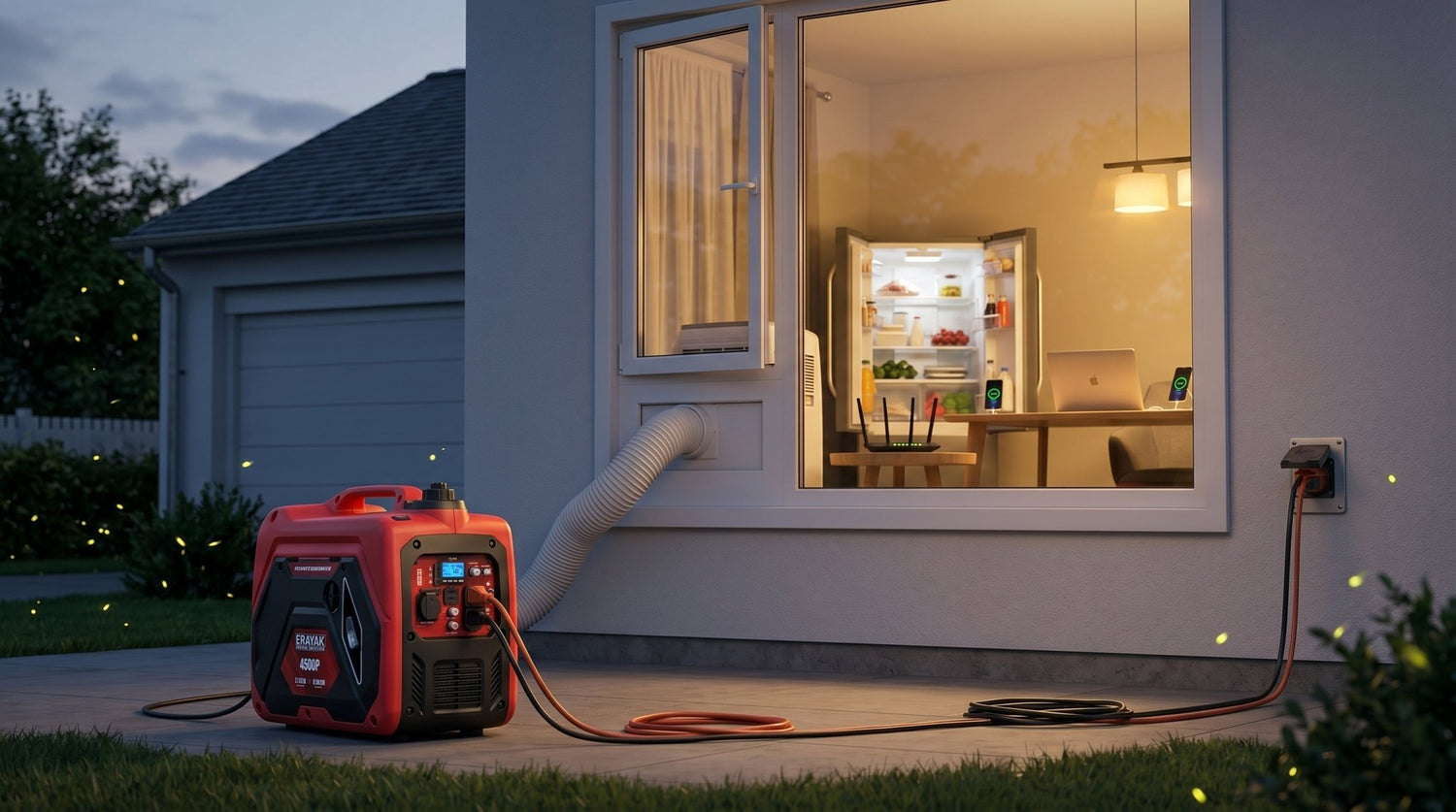
 Summer outage backup power starts with correct generator sizing and safe outdoor operation.
A generator can run a portable AC during a summer power outage if the generator has enough wattage for the AC's running load and startup surge. Many portable AC units use roughly 500 to 1,600 running watts, but startup surge can be significantly higher when the compressor kicks on.
For a small portable AC by itself, a smaller inverter generator may be enough. For a more realistic outage setup, portable AC plus refrigerator, lights, router, and device charging, you usually want more wattage headroom.
Table of Contents
- How many watts does a portable AC use?
- Why starting watts matter during an outage
- What size generator do you need for a portable AC?
- What else can you run with the AC?
- Why an inverter generator makes sense
- ERAYAK generator options for portable AC backup
- Safe generator setup during a summer outage
- FAQ
How Many Watts Does a Portable AC Use?
Portable AC wattage varies by BTU rating, efficiency, compressor design, outdoor temperature, thermostat setting, and whether the unit is already running or just starting. The most important thing to understand is that an air conditioner has two power numbers: running watts and starting watts.
Running watts are what the AC needs after it is already operating. Starting watts, also called surge watts, are the brief extra power needed when the compressor starts.
| Portable AC Size | Typical Running Watts | Possible Starting Watts | Generator Sizing Note |
|---|---|---|---|
| 5,000-8,000 BTU | About 500-900W | Often 1,000W+ | May work with a smaller inverter generator if few other loads are connected. |
| 10,000 BTU | About 900-1,200W | Can be much higher at compressor startup | Leave room for surge and other essentials. |
| 12,000 BTU | About 1,100-1,500W | Startup surge can be significant | A mid-size inverter generator is usually a more practical choice. |
| 14,000 BTU | About 1,300-1,600W | May require substantial startup headroom | Do not size only by running watts; plan for surge and other appliances. |
Tip: Always check the nameplate or manual for your specific portable AC. BTU size is useful, but the actual wattage printed on your unit is more accurate than a general chart.
For a deeper wattage chart by BTU size, read the related guide: How Many Watts Does a Portable AC Use?
Why Starting Watts Matter More Than Many Homeowners Expect
During a summer outage, a portable AC does not draw power in one smooth line. When the compressor cycles on, the AC may briefly need much more power than it uses while running.
The AC fails to start
The compressor may try to start, draw a large surge, and fail to get running.
The generator overloads
The generator may trip overload protection when the compressor starts.
Other devices shut off
Lights, routers, chargers, or refrigerators may drop out if the generator is overloaded.
This is why it is usually better to size the generator for the full outage setup, not just the portable AC label.
What Size Generator Do You Need for a Portable AC?
The right generator size depends on the portable AC's running watts, startup surge, and the other loads you want to power at the same time.
| Outage Setup | Typical Loads | Generator Sizing Direction | Best Use Case |
|---|---|---|---|
| Portable AC only | One smaller portable AC | May work with a smaller inverter generator if startup surge is within capacity. | Short outages, light cooling, minimal other loads. |
| Portable AC + basic devices | AC, phone charging, LED lights, router | Choose extra headroom so compressor startup does not trip the generator. | Summer evening outages and remote work needs. |
| Portable AC + refrigerator | AC, refrigerator, lights, router, chargers | A mid-size inverter generator is usually more practical. | Most realistic home outage plan. |
| Portable AC as part of larger backup | AC plus multiple home essentials | Consider a higher-capacity inverter generator with more voltage and outlet flexibility. | Longer outages and broader home backup planning. |
Practical rule: Add up the running watts of everything you plan to power, then leave extra room for the highest startup surge. Do not size the generator right at the edge of your expected load.
What Else Can You Run With a Portable AC?
During a summer power outage, the AC may be the most noticeable comfort load, but it is rarely the only thing that matters. A practical home backup plan usually prioritizes a small group of essentials.
 A practical outage setup may include cooling, food protection, lighting, router power, and device charging.
Cooling and food protection
A portable AC can help make one room more comfortable. A refrigerator or freezer helps protect food during longer outages.
Lights, router, and charging
LED lights, Wi-Fi equipment, laptops, phones, and small electronics add up, but they are usually easier to support than motor-driven loads.
The mistake is trying to power everything at once. In a real outage, load management matters. Start with the AC and the refrigerator separately if needed, avoid high-draw appliances at the same time, and monitor the generator load.
Why an Inverter Generator Makes Sense for Portable AC Backup
A portable AC is not the only device on your outage list. Routers, laptops, phones, TVs, and other electronics are often part of the same backup plan.
Better for mixed loads
Inverter generators are designed to provide cleaner power for sensitive electronics while still supporting practical household essentials.
More practical headroom
Choosing a generator with extra capacity helps reduce overload problems when the AC compressor or refrigerator cycles on.
Better outage experience
For home backup, noise, portability, power quality, and safe outdoor placement all matter.
ERAYAK Generator Options for Portable AC Backup
The best ERAYAK option depends on your portable AC size, startup surge, and how many other home essentials you want to run.
ERAYAK 2400P
Light LoadBest suited for smaller portable AC use cases, light camping, and limited emergency loads. Consider it for 5,000-8,000 BTU portable AC scenarios where the AC's startup surge and other loads are within the generator's capacity.
See the ERAYAK 2400P for Light Backup LoadsERAYAK 4500P Gas Only
Gasoline OptionFor users who want a gasoline-only inverter generator with more headroom than a small unit. The 4500P is gas only, manual recoil start, 55 lb, has a 2.25 gal fuel tank, up to 8 hours runtime, 60.5 dB noise rating, and THD < 1.2%.
Compare the ERAYAK 4500P Gas Inverter GeneratorERAYAK 4500PD Series
Best MatchA strong fit for many portable AC backup plans, especially when you want to run a 10,000-14,000 BTU portable AC along with practical home essentials such as a refrigerator, lights, router, and charging devices.
Compare the ERAYAK 4500PD Dual-Fuel Generator for Portable AC BackupERAYAK 6800PD / 6800PT Series
Upgrade PathFor larger backup plans where the portable AC is only one part of the load. The 6800 series is better suited for users considering broader home backup, RV power, 120V/240V flexibility, and more complex outage planning.
See the ERAYAK 6800PD/PT Series for 120V/240V Home BackupImportant: Product fit depends on your actual portable AC wattage, compressor surge, extension cord setup, fuel choice, altitude, temperature, and other connected loads.
Safe Generator Setup During a Summer Outage
Cooling is important during a summer outage, but generator placement is more important. A fuel-powered generator produces exhaust that can be deadly in enclosed or poorly ventilated areas.
 Operate fuel-powered generators outdoors only, away from windows, doors, garages, and enclosed spaces.
Generator Safety Notice
- Never run indoors.
- Never run in a garage.
- Never run near open windows.
- Always operate outdoors with proper ventilation.
Use the generator outdoors and away from openings
Do not place the generator inside the house, inside a garage, on a porch, in an enclosed patio, near an open window, or near a door. Outdoor placement and ventilation are non-negotiable.
Keep the setup dry and stable
Place the generator on stable, dry ground. Do not operate it in standing water. Use outdoor-rated cords in good condition and route them carefully to reduce trip hazards and cord damage.
Start with a load plan
Before connecting appliances, decide what matters most. A portable AC, refrigerator, router, lights, and phone charging may be a realistic plan. High-draw appliances should not be added casually.
How to Size Your Generator in 4 Steps
Find your portable AC running watts
Check the appliance label, manual, or manufacturer specification. Do not rely only on BTU size.
Account for compressor startup
Starting surge can be much higher than running watts. Leave enough headroom for the AC to start reliably.
Add essential backup loads
Include the refrigerator, router, LED lights, laptop, phone chargers, and any required communication devices.
Choose extra capacity
Select a generator with practical headroom instead of running everything at the absolute limit.
Bottom line: If you only need a small portable AC, you may not need a large generator. If you want cooling plus refrigerator, lights, router, and daily essentials, the ERAYAK 4500PD Series is often the more practical starting point for portable AC backup planning.
Portable AC Generator FAQ
Can a 2000W generator run a portable AC?
It depends on the portable AC size and startup surge. A small 5,000-8,000 BTU portable AC may work with a 2000W-class generator if the starting surge is within capacity and few other loads are connected. Larger 10,000-14,000 BTU portable AC units usually need more headroom.
Can a 4500W inverter generator run a portable AC and refrigerator?
In many cases, a properly sized 4500W-class inverter generator can support a portable AC plus a refrigerator and smaller essentials, but the final answer depends on the actual wattage and startup surge of both appliances.
Why does my generator trip when my portable AC starts?
The most common reason is compressor startup surge. The portable AC may use a manageable amount of power while running, but briefly demand much more when the compressor starts.
Can I run a portable AC overnight on a generator?
Possibly, but runtime depends on fuel tank size, load level, Eco mode behavior, temperature, and how often the AC compressor cycles. For safety, the generator must remain outdoors with proper ventilation, never indoors, never in a garage, and never near open windows.
Is an inverter generator better for portable AC backup?
An inverter generator is often a good choice for portable AC backup because outage setups usually include more than the AC. Homeowners may also need routers, laptops, phones, lights, and other electronics.
Can I plug a portable AC directly into a generator?
Follow both the generator manual and the portable AC manual. Use a properly rated outdoor extension cord when needed, avoid damaged or undersized cords, keep the generator outdoors, and do not overload the generator.
Choose Backup Power Around the Loads You Actually Need
A portable AC can make one room more comfortable during a summer outage, but reliable backup power starts with a full load plan. Check your AC wattage, account for compressor surge, add the refrigerator and daily essentials, then choose a generator with enough headroom to run safely and consistently.
