

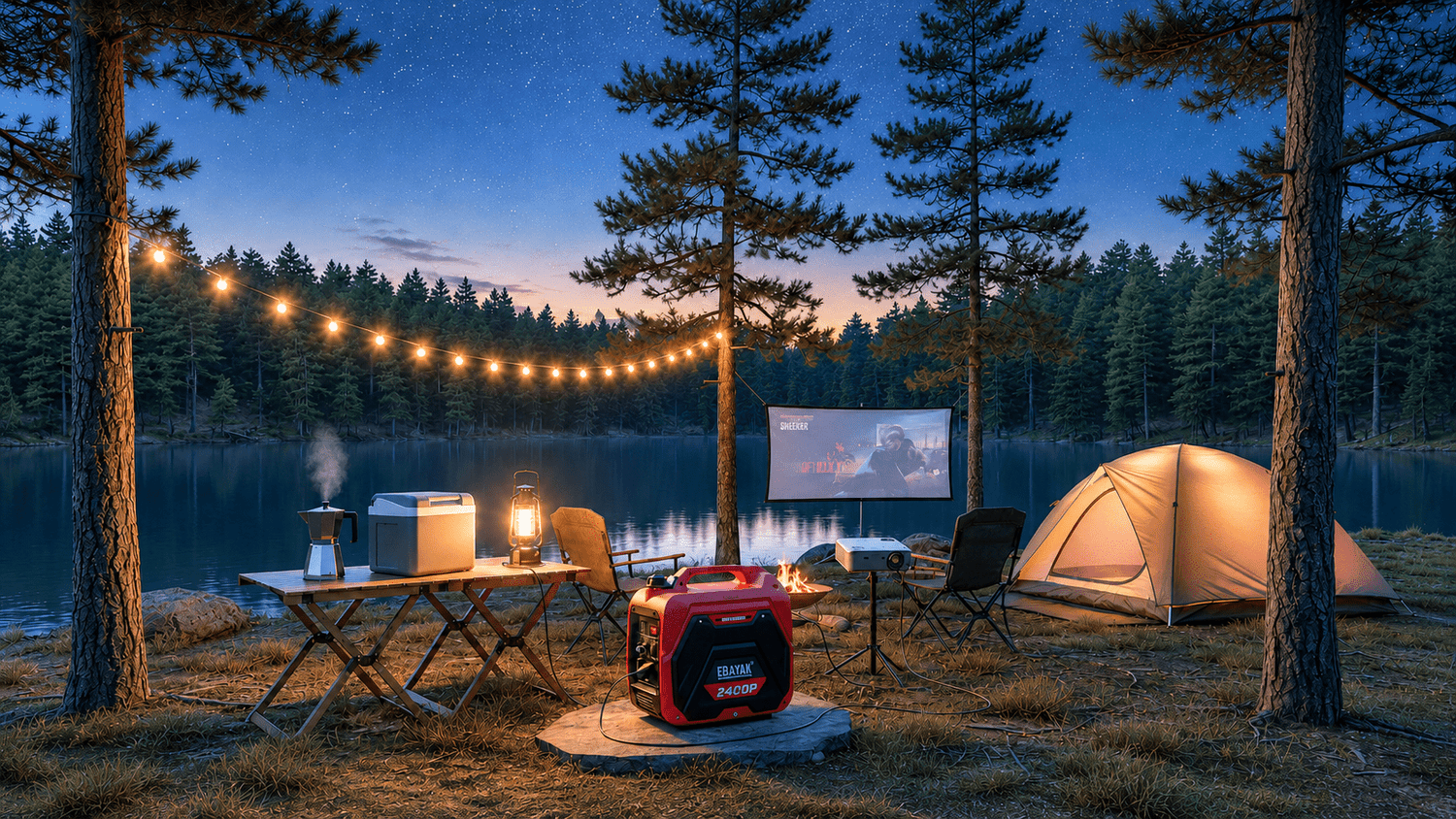
How Far Should a Generator Be From a Tent or Campsite?
For camping, generator distance is not just about noise. The bigger issue is carbon monoxide, an invisible and odorless exhaust hazard that can drift toward tents, RVs, vehicles, and nearby campsites.
Quick Answer: Use the 20 Foot Rule
Place a portable fuel generator at least 20 feet away from tents, RV doors, windows, vents, vehicles, and sleeping areas, with the exhaust pointed away from people and enclosed spaces. If the campsite gives you room, 25 feet or more is safer, especially when wind could push exhaust back toward a tent, camper, or neighboring site.
Under 20 feet from a tent, door, window, vent, vehicle, or sleeping area.
20-25 feet away, outdoors, dry, stable, ventilated, and pointed away from camp.
25+ feet away with safe cords, clear airflow, no trip hazards, and no overnight tent use.
Never run a generator inside a tent, screen room, vehicle, RV, garage, truck bed cap, storage compartment, or under an awning. Open flaps, windows, or doors do not make an enclosed or partially enclosed space safe.
Generator Distance Chart for Campsites
The 20 foot rule is a practical minimum for portable generators near tents and campsite openings. More distance is useful when people are sleeping, wind is shifting, or sites are close together.
| Distance | Safety Meaning | Use at a Campsite? | What to Do |
|---|---|---|---|
| 0-10 ft | Too close to tents, vehicles, RVs, doors, windows, and vents | No | Move the generator farther away before starting it. |
| 10-19 ft | Still too close for many tent and opening scenarios | No as a default setup | Do not treat this as the safe zone just because the generator is outdoors. |
| 20-25 ft | Common minimum safety target for portable generator placement | Yes, if exhaust points away and airflow is clear | Use outdoor-rated cords and keep the generator dry and stable. |
| 25+ ft | Better safety margin when the campsite allows it | Best for tents and quiet camping | Confirm the cord is correctly rated for the load and does not create a trip hazard. |
20 feet is a minimum, not a guarantee. Wind, terrain, nearby walls, vehicle placement, and open tent doors can all change where exhaust travels.
Why Generator Distance Matters More Than Campers Realize
Portable generators burn fuel and produce carbon monoxide. CO cannot be seen or smelled, and symptoms can feel like headache, dizziness, nausea, weakness, or confusion. In a tent or RV, that risk becomes more serious because sleeping people may not notice symptoms in time.
Exhaust can drift into tent openings, RV vents, vehicles, cabins, and neighboring campsites.
Distance helps lower perceived sound, especially at night or in tight campgrounds.
Generators need open airflow and should be kept away from fabric, dry leaves, fuel, and gear.
Safe Placement for Tents, RVs, Vehicles, and Houses
The same principle applies everywhere: keep the generator outside, far from enclosed spaces, and away from anything that could pull exhaust back toward people.
| Setup | Minimum Placement Target | Key Rule | Better Alternative |
|---|---|---|---|
| Tent camping | At least 20 ft from tent doors and sleeping areas | Do not run a fuel generator while people sleep in a tent. | Charge a battery power station during approved hours for overnight CPAP, phones, or lights. |
| RV campsite | At least 20 ft from doors, windows, vents, and neighboring rigs | Point exhaust away from the RV and install working CO alarms inside. | Use Eco Mode and run only during allowed generator hours. |
| Vehicle camping | At least 20 ft from open doors, windows, hatchbacks, and roof tents | Do not run a generator near a sleeping vehicle or under a vehicle awning. | Use stored battery power overnight and recharge during the day. |
| Home backup near a house | At least 20 ft from windows, doors, vents, and other openings | Exhaust must point away from the structure and neighbors. | Use a properly installed transfer switch for home circuits. |
Wind Direction and Terrain Can Override a Tape Measure
A generator can be 20 feet away and still be poorly placed if wind pushes exhaust back into the campsite. Before starting the generator, look at tent doors, RV vents, neighboring sites, trees, slopes, vehicle walls, and cooking shelters.
Face the exhaust outlet away from tents, RVs, vehicles, doors, windows, vents, and neighboring sites.
Do not place the generator in a ditch, hollow, or low spot where exhaust can linger.
Reflective surfaces can bounce sound and disrupt airflow around the exhaust.
Do not cover the generator with a blanket, box, tarp wrap, or unventilated DIY enclosure.

Safe Cord Management for a 20-25 Foot Generator Setup
Moving the generator farther away only works if the cord setup is safe. Use heavy-duty outdoor-rated cords sized for the load and keep connections off wet ground.
- Use cords rated for outdoor use and the amperage you plan to draw.
- Keep cords out of footpaths, fire rings, cooking areas, and standing water.
- Do not run cords through zipped tent doors where fabric can pinch or damage insulation.
- Inspect cords for cuts, soft spots, melted plugs, and loose connectors before each trip.
- Do not daisy-chain light-duty household cords to reach a distant generator.
For RVs, match the cord and connector to the generator outlet and RV service. A 30A RV load needs properly rated RV equipment, not a thin household extension cord.
Generator Distance Also Helps With Noise and Campground Etiquette
Distance reduces perceived noise, but it does not replace campground rules. Many campgrounds limit generator hours, enforce quiet hours, or restrict generator sound levels. A quiet inverter generator helps, but you still need safe placement and courteous timing.
| Goal | What Helps | What to Avoid |
|---|---|---|
| Lower noise at the tent | More distance, Eco Mode, lighter electrical loads, soft ground | Running high loads late at night or near neighboring tents |
| Reduce vibration | Stable level ground, no loose panels, regular maintenance | Putting the generator on hollow decking, truck beds, or unstable boards |
| Follow rules | Check quiet hours and generator windows before starting | Assuming a quiet generator is allowed at any time |
Pre-Start Campsite Generator Checklist
Keep at least 20 feet between the generator and tents, RV openings, vehicles, doors, windows, and vents.
Make sure exhaust points away from people, sleeping areas, and nearby campsites.
Use only in open outdoor air. Do not place the generator under an awning or inside a shelter.
Use outdoor-rated cords that match the load and keep plugs dry and visible.
Confirm generator hours, quiet hours, and any site-specific distance requirements.
Use batteries for overnight tent needs instead of running a fuel generator near sleeping campers.
Best Erayak Fits for Safe Campsite Power
For this topic, the product decision should come after the safety setup. Choose the smallest quiet inverter generator that can handle the load you actually need, then place it correctly.
 Erayak 2400P: Light Camping Loads
Best fit for charging phones, laptops, cameras, routers, lights, fans, and small campsite electronics during approved generator hours.
Compare the Erayak 2400P
 Erayak 4500P: Gas-Only RV and Campsite Power
The 4500P is a gas-only 4,500W-class inverter generator for RV and campsite loads that need more capacity than a small charging generator. It is manual recoil start with a 2.25 gal tank, up to 8 hours runtime, 60.5 dB, and THD below 1.2%.
Compare the Erayak 4500P
 Erayak 4500PD: Dual-Fuel Flexibility
Best fit when camping power overlaps with RV comfort loads, propane flexibility, refrigerator support, and storm backup planning.
Compare the Erayak 4500PDGenerator Safety Notice
Fuel generators are outdoor-only equipment. Never run one indoors, inside a tent, inside an RV, in a vehicle, in a garage, under an awning, in a storage compartment, near open windows, or in any partially enclosed space. Carbon monoxide can kill quickly and cannot be detected by smell.
Use working carbon monoxide alarms in RVs, cabins, and homes. Keep the generator dry, level, ventilated, and away from children, pets, fuel containers, dry brush, and fabric. Let the engine cool before refueling and follow the generator manual, campground rules, and local safety requirements.
FAQ: Generator Distance From Tents and Campsites
How far should a generator be from a tent?
Use at least 20 feet as the minimum distance from a tent, tent door, or sleeping area. If space allows, 25 feet or more gives a better safety margin, especially when wind changes direction.
Can I run a generator next to my tent if the exhaust points away?
No. Exhaust direction helps, but it does not make a close generator safe. Keep the generator at least 20 feet away and never run it beside or inside a tent.
Can I run a generator while sleeping in a tent?
It is safer to avoid running a fuel generator while people sleep in a tent. For overnight needs such as CPAP, phones, or lights, charge a battery power station during approved generator hours and use stored power overnight.
How far should a generator be from a house?
Keep a portable generator at least 20 feet away from windows, doors, vents, and other openings, with exhaust directed away from the house and neighboring homes.
Is 15 feet far enough for a portable generator?
Do not use 15 feet as the default safe distance. Many safety recommendations use at least 20 feet from openings and enclosed spaces, and more distance is better when wind or terrain could move exhaust back toward people.
Where should I put a generator at an RV campsite?
Place it outdoors at least 20 feet from RV doors, windows, vents, and neighboring rigs. Point exhaust away, keep cords rated and dry, and use working CO alarms inside the RV.
Can I cover a generator with a tarp at a campsite?
Do not wrap a running generator in a tarp or place it inside an unventilated enclosure. Use only manufacturer-approved or properly ventilated weather protection that keeps exhaust and cooling airflow clear.
Keep the Generator 20+ Feet Away and Treat Wind as Part of the Setup
A safe campsite generator setup starts with distance, airflow, and exhaust direction. Use 20 feet as the minimum, choose 25+ feet when possible, keep the generator outdoors in open air, and rely on battery power instead of a running fuel generator for overnight tent needs.


