

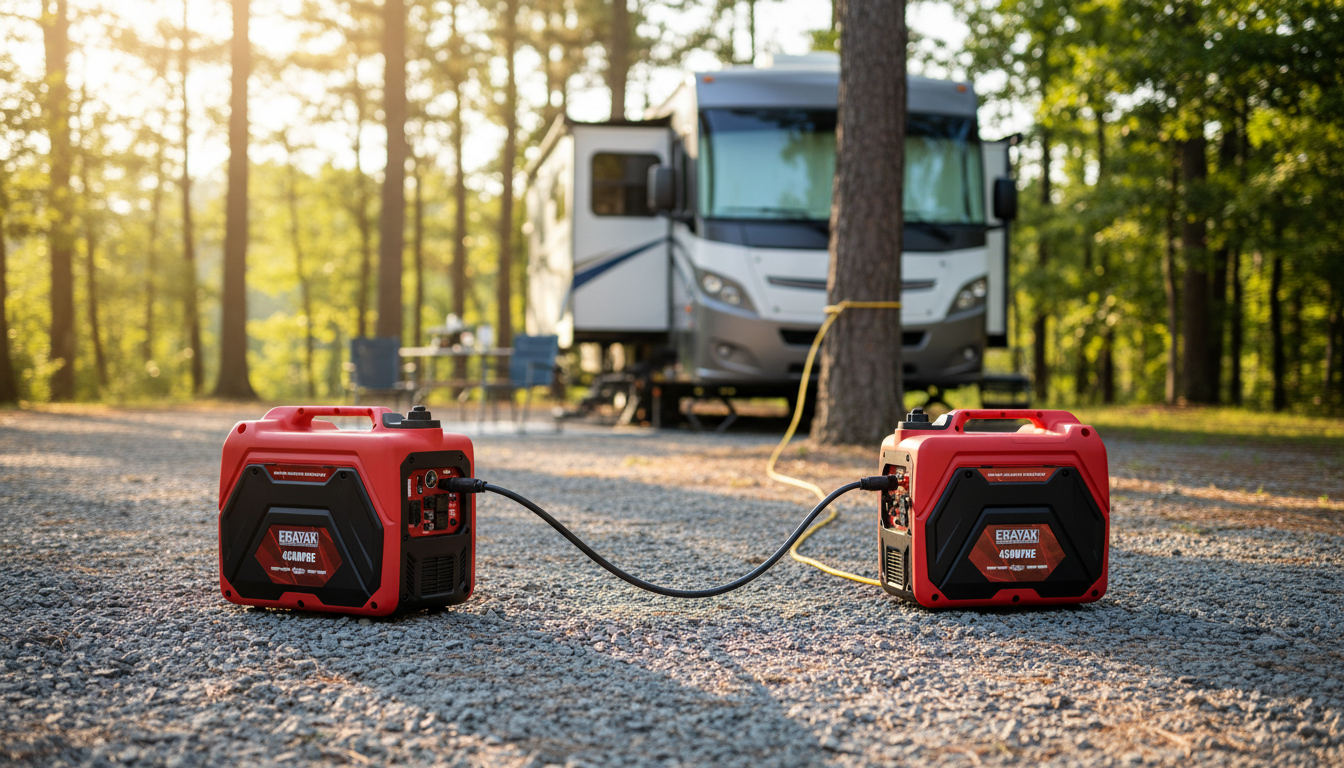
Can You Parallel Two Inverter Generators? How It Works, What You Can Run, and Safety Rules
Yes, you can parallel two compatible inverter generators, but only with the correct manufacturer-approved parallel kit or cable system. The setup can give you more usable power for RV air conditioners, tools, and temporary backup loads while keeping the portability of two smaller units.
- Use only compatible inverter generators with parallel ports.
- Use the correct parallel kit or cable set, not DIY wiring.
- Same brand, same series, and same wattage class is the safest default.
- Total output is limited by the kit, breakers, outlets, and generator ratings.
Yes. Two parallel-capable inverter generators can be connected with a compatible parallel kit so their inverter modules synchronize voltage, frequency, and phase. The combined output is then available through the parallel kit outlet, often a 30A RV-style outlet or another rated receptacle depending on the kit.
The important part is compatibility. Do not assume any two inverter generators can be paralleled just because both have outlets. Use the generator manuals, matching parallel ports, and the exact kit recommended for those models.
How Parallel Inverter Generator Operation Works
An inverter generator creates power in stages. It makes raw power, converts it, and then digitally rebuilds stable AC output. Because the final output is electronically controlled, compatible units can synchronize through dedicated parallel ports.
The parallel kit does more than physically connect two generators. It provides the correct conductors, connectors, outlet, and overload protection for the combined output. In a proper setup, the load is shared between the two generators instead of forcing one unit to carry everything.
| Part of the system | What it does | Why it matters |
|---|---|---|
| Parallel-capable generators | Provide compatible inverter output and parallel ports. | Standard household outlets are not used for synchronizing generators. |
| Parallel kit or cable | Connects the two inverter systems and provides a rated output outlet. | Prevents unsafe DIY connections and helps keep the load properly managed. |
| Combined outlet | Supplies power to the RV cord, appliance, or transfer setup. | Your usable output is limited by this outlet and breaker rating. |
For clean-power context, see the THD in generators guide.
How to Parallel Two Inverter Generators Safely
Always follow the exact manual for your generator and kit. The sequence below is a practical overview, not a replacement for the manufacturer procedure.
| Step | What to do | Why it matters |
|---|---|---|
| 1 | Confirm both generators are parallel-capable and compatible with the same kit. | Prevents mismatched output, overload, and warranty problems. |
| 2 | Place both generators outdoors on stable ground with exhaust pointed away from people and openings. | Reduces carbon monoxide and heat risks. |
| 3 | Connect the parallel kit to the correct parallel ports before applying heavy loads. | The kit is designed for synchronization; household outlets are not. |
| 4 | Start the generators according to the manual and let them stabilize. | Gives the inverter modules time to settle before appliance startup. |
| 5 | Plug the RV or appliance into the parallel kit outlet and add loads gradually. | Prevents both generators from seeing a sudden overload. |
| 6 | Stay below the rated running watts and outlet amps of the combined setup. | Peak watts are temporary; running watts are your real limit. |
Never connect two generators through their standard outlets, homemade cords, backfeeding adapters, or modified wiring. Use the approved parallel system for the exact generator models.
Do Parallel Generators Need to Be the Same Model?
The safest default is yes: same brand, same series, same wattage class, and the exact kit the manufacturer lists for those units. Some manufacturers allow specific cross-model pairings, but that should come from the manual or compatibility chart, not from guesswork.
| Generator pairing | Recommendation | Reason |
|---|---|---|
| Same model + approved kit | Best choice | Most predictable load sharing and compatibility. |
| Same brand, listed compatible models | Usually acceptable if manual-approved | Some brands allow specific same-series combinations. |
| Different wattage classes | Only if manufacturer-approved | Usable output may be limited by the smaller unit or kit rating. |
| Different brands | Avoid unless explicitly approved | Parallel ports, wiring, protection, and synchronization logic may differ. |
| Non-inverter generators | Do not parallel casually | Conventional generator synchronization requires specialized equipment and expertise. |
What Can Two Parallel Inverter Generators Run?
The answer depends on each generator's running watts, starting watts, the parallel kit rating, and the appliance startup surge. Two smaller inverter generators in parallel can often act like a single mid-size inverter generator, but the exact combined output is not always the simple sum of every number on the box.
| Load | Parallel setup fit | Planning note |
|---|---|---|
| RV 13,500 BTU air conditioner | Often realistic with enough starting watts | Soft start improves reliability, especially in hot weather. |
| RV 15,000 BTU air conditioner | Possible with the right setup | Check compressor surge and avoid other heavy loads at startup. |
| Microwave or coffee maker | Usually possible | Run one heating appliance at a time when near capacity. |
| Refrigerator, lights, router, chargers | Easy for most parallel setups | Still account for refrigerator startup surge. |
| Electric heater or hair dryer | High draw | These loads can consume most of a 30A budget quickly. |
If your main goal is RV air conditioning, compare this with the quiet 30 amp RV generator guide.
Two Smaller Generators vs One Larger Generator
Parallel operation is useful, but it is not always the simplest choice. Some buyers are better served by one larger inverter generator, especially if they do not want to manage two engines, two oil changes, two fuel tanks, and a parallel kit.
You want lighter lifting, occasional high output, backup redundancy, and flexibility to run only one unit for small loads.
You want simpler setup, fewer cables, one maintenance schedule, and one set of controls.
Do not assume parallel output gives every outlet type. Match the kit outlet to your RV cord or appliance plan.

Single-Generator Alternative: ERAYAK 4500P or 4500PD
If you are comparing parallel setups only because one small generator is not enough, a single 4500W-class inverter generator may be easier. The ERAYAK 4500P is the gas-only option with confirmed clean inverter output, 60.5 dB operation, and THD below 1.2%. The ERAYAK 4500PD is the dual-fuel upgrade if gasoline plus propane flexibility matters.
- Choose 4500P for gas-only simplicity and portable RV/camping power.
- Choose 4500PD for dual-fuel RV camping and selected backup loads.
- Choose a parallel setup only when your generator models and kit are explicitly compatible.
Parallel Generator Safety Rules
Both generators must run outdoors only. Never operate fuel generators inside an RV, tent, garage, shed, basement, carport, or near open windows. Keep exhaust pointed away from people, doors, windows, and vents, and use working carbon monoxide alarms.
- Use only the manufacturer-approved parallel kit or listed compatible cable set.
- Never parallel through household outlets or modified extension cords.
- Do not exceed the running watts, outlet amperage, or breaker rating of the combined system.
- Keep both generators on stable, dry ground with enough airflow.
- Use properly rated outdoor cords and avoid damaged plugs or loose connectors.
- Stop and troubleshoot if either generator hunts, overheats, trips, or shows overload warnings.
Parallel Works Best When Compatibility Is Clear
Two inverter generators can be a smart way to get more power without carrying one heavy unit. The setup is best for RV travelers, campers, and backup users who want modular power. But the safe answer is not "any two generators." It is compatible generators, the correct kit, careful load planning, and strict outdoor operation.


