

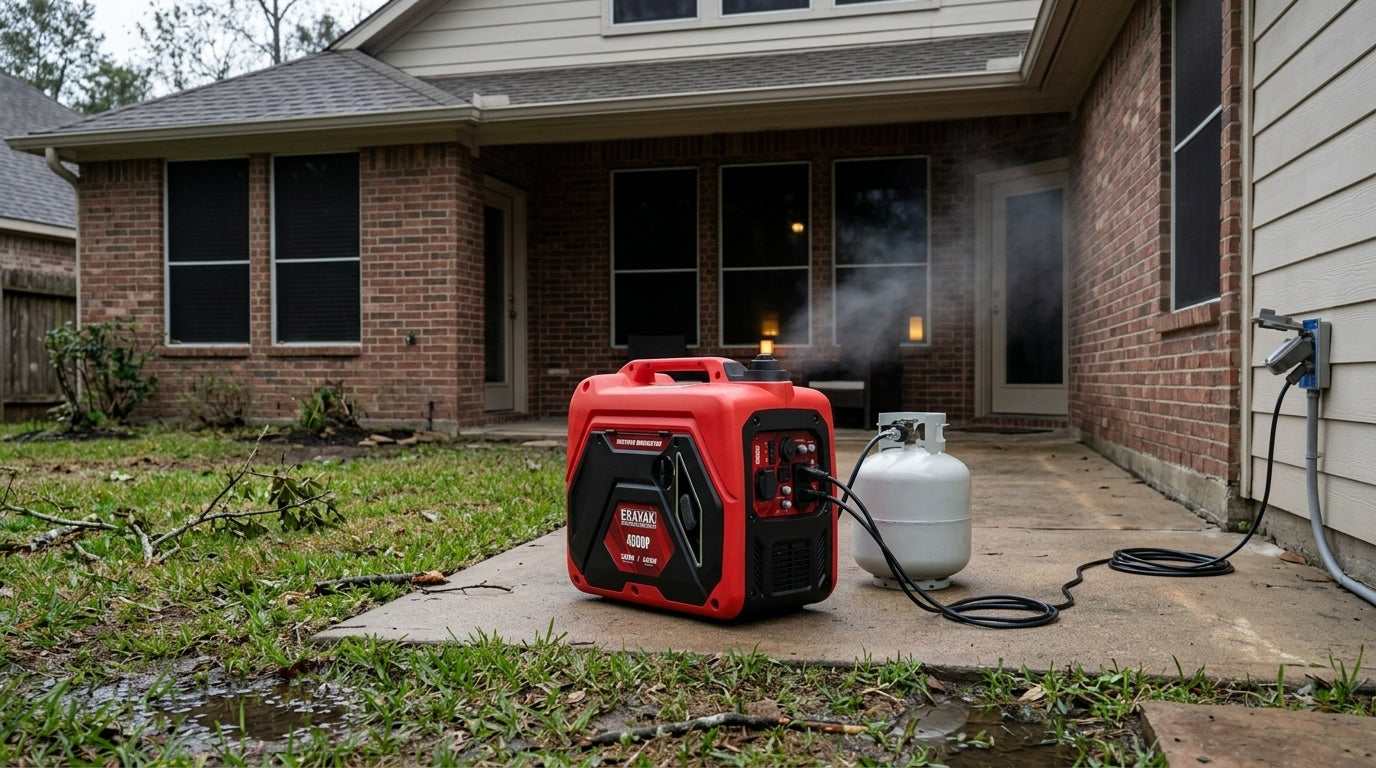
What Size Generator for a Transfer Switch? 30A vs 50A Inlet Guide
A transfer switch does not decide your backup capacity by itself. Your real limit is the smallest matched part of the system: generator output, outlet rating, inlet box, cord, breaker, transfer switch, wiring, and the loads you run at the same time.
Quick Answer
For many portable home-backup setups, a 30A 120V/240V transfer switch or inlet pairs well with generators in roughly the 5,000W to 7,500W class, especially models with an L14-30 style outlet. A 50A inlet is for larger generator systems and only makes sense when the generator, breaker, cord, wiring, transfer equipment, and load plan are all designed for 50A service.
If your generator only has a 30A 120V/240V outlet, installing a 50A inlet will not magically give you 50A of power. It can create confusion unless the entire system is correctly designed by a qualified electrician. For Erayak buyers, the ERAYAK 6800PT fits the 30A selected-circuit home-backup path with 120V/240V capability, 6800W peak output, and 5000W gasoline rated output at 100% output.
What Does Transfer Switch Size Actually Mean?
When shoppers ask what size generator they need for a transfer switch, they are usually mixing together three different questions:
- Generator size: how many watts the generator can produce continuously and for startup surge.
- Connection size: whether the generator outlet, inlet box, cord, and breaker are 30A, 50A, or another rating.
- Load size: what appliances or circuits you want to run at the same time.
A transfer switch or interlock is a safety and routing device. It does not create power. If your generator can deliver 30A, your practical backup plan must be built around that generator output, even if the house has a 100A or 200A service panel.
Best rule: size the generator around the loads first, then match the transfer switch, inlet, cord, and breaker to the generator output and local code.
30A vs 50A Generator Inlet: Which Do You Need?
A 30A inlet is common for portable 120V/240V generator setups. A 50A inlet is common for larger generators with higher output. The right choice is not about buying the biggest inlet. It is about matching the inlet to the generator and wiring system.
| Setup | Common connection | Typical generator class | Best fit | Important note |
|---|---|---|---|---|
| 30A 120V/240V inlet | L14-30 style connection | Often around 5,000W to 7,500W portable generators | Selected circuits, refrigerator/freezer, lights, router, furnace blower, sump pump, some well pump plans | Good match for many portable inverter generator home-backup setups. |
| 50A 120V/240V inlet | 14-50 or CS-style connection depending on equipment | Often larger portable or standby-class systems | Larger selected loads, more simultaneous circuits, bigger transfer equipment | Only useful if generator output, cord, wiring, breaker, and transfer equipment support it. |
| 120V-only inlet or transfer setup | Model-specific 120V connection | Smaller portable generators | Limited 120V essentials | Does not support 240V loads such as many well pumps. |
For the ERAYAK 6800PD/PT platform, plan around the 30A 120V/240V L14-30R outlet and selected loads. Do not describe it as a 50A generator.
How Many Watts Is a 30A or 50A Transfer Switch?
Watts depend on voltage. A 30A connection at 120V is not the same as a 30A connection at 240V. For split-phase home backup, many generator inlets are 120V/240V.
Basic formula: Volts x Amps = Watts
30A at 240V is about 7,200W theoretical maximum. 50A at 240V is about 12,000W theoretical maximum. Your usable generator output may be lower because the generator's rated watts, fuel type, temperature, altitude, and surge loads all matter.
| Connection | Theoretical calculation | What to remember |
|---|---|---|
| 30A at 120V | 120V x 30A = 3,600W | Useful for 120V-only planning, but not the same as split-phase 120V/240V backup. |
| 30A at 240V | 240V x 30A = 7,200W | The outlet may be rated for this, but the generator's continuous output can be lower. |
| 50A at 240V | 240V x 50A = 12,000W | This requires a larger generator and a complete 50A-rated system. |
Example: a generator with a 30A L14-30R outlet may not produce 7,200W continuously. The ERAYAK 6800 series is rated at 6800W peak and 5000W gasoline rated output at 100% output, so the load plan should be based on the 5000W rated output, with headroom for starting surge.
How to Match Generator, Inlet Box, Cord, Breaker, and Transfer Switch
A safe transfer-switch setup is a matched system. Upgrading one part does not upgrade the entire system.
The generator must match the plan
- Check rated watts, peak watts, and fuel-specific output.
- Confirm whether the generator provides 120V only or 120V/240V.
- Confirm the outlet type, such as L14-30R.
- Leave room for motor-starting surge.
The connection hardware must match
- Inlet box rating must match the intended connection.
- Generator cord must match the outlet and inlet.
- Breaker and wiring must be sized correctly.
- Transfer switch or interlock must be approved for the panel and setup.
Do not use adapters to force a mismatch. If a generator, inlet, cord, or transfer switch does not match, ask a qualified electrician to redesign the setup rather than improvising.
Common Home Backup Load Plans
Most portable generator transfer-switch setups are selected-load systems. That means you choose what matters most instead of trying to run every circuit in the house.
| Backup goal | Common loads | Connection direction | Generator planning note |
|---|---|---|---|
| Basic essentials | Refrigerator, freezer, router, lights, phone charging | Extension cords or small transfer setup | Often does not require 240V. |
| 120V comfort backup | Fridge/freezer, portable AC, lights, router, TV, small kitchen loads | 120V essential-load planning or selected circuits | Use load management and avoid starting multiple high-surge loads at once. |
| Selected home circuits | Refrigerator, sump pump, furnace blower, lights, router, garage door opener | 30A transfer switch or interlock setup is common | Good fit for many 120V/240V portable generator systems. |
| Well pump or 240V planning | 240V well pump plus selected 120V essentials | 120V/240V generator with transfer equipment | Check pump nameplate data and starting surge. Do not guess. |
| Larger simultaneous loads | Multiple pumps, larger AC, electric water heater, more circuits | May require larger 50A-class system or standby planning | A 30A portable inverter generator may not be the right class. |
30A vs 50A Transfer Switch Mistakes to Avoid
Mistake 1: Buying a 50A inlet for a 30A generator
A 50A inlet does not increase generator output. If the generator output is 30A, the load plan still needs to stay within the generator's rated capacity.
Mistake 2: Sizing from the home panel rating
A 200A panel does not mean you need a generator that powers 200A. Portable generators are usually used for selected circuits during outages.
Mistake 3: Forgetting fuel-specific output
Propane and natural gas output can be lower than gasoline output. Leave more headroom when sizing loads on those fuels.
Mistake 4: Ignoring starting surge
Pumps, refrigerators, furnace blowers, and compressors can need extra startup watts. Do not size only by running watts.
Erayak Product Fit: 30A Selected-Circuit Backup
If your goal is a 30A selected-circuit transfer switch or interlock setup, the ERAYAK 6800PD/PT platform is the most relevant Erayak class because it supports 120V/240V planning. Choose based on fuel needs.
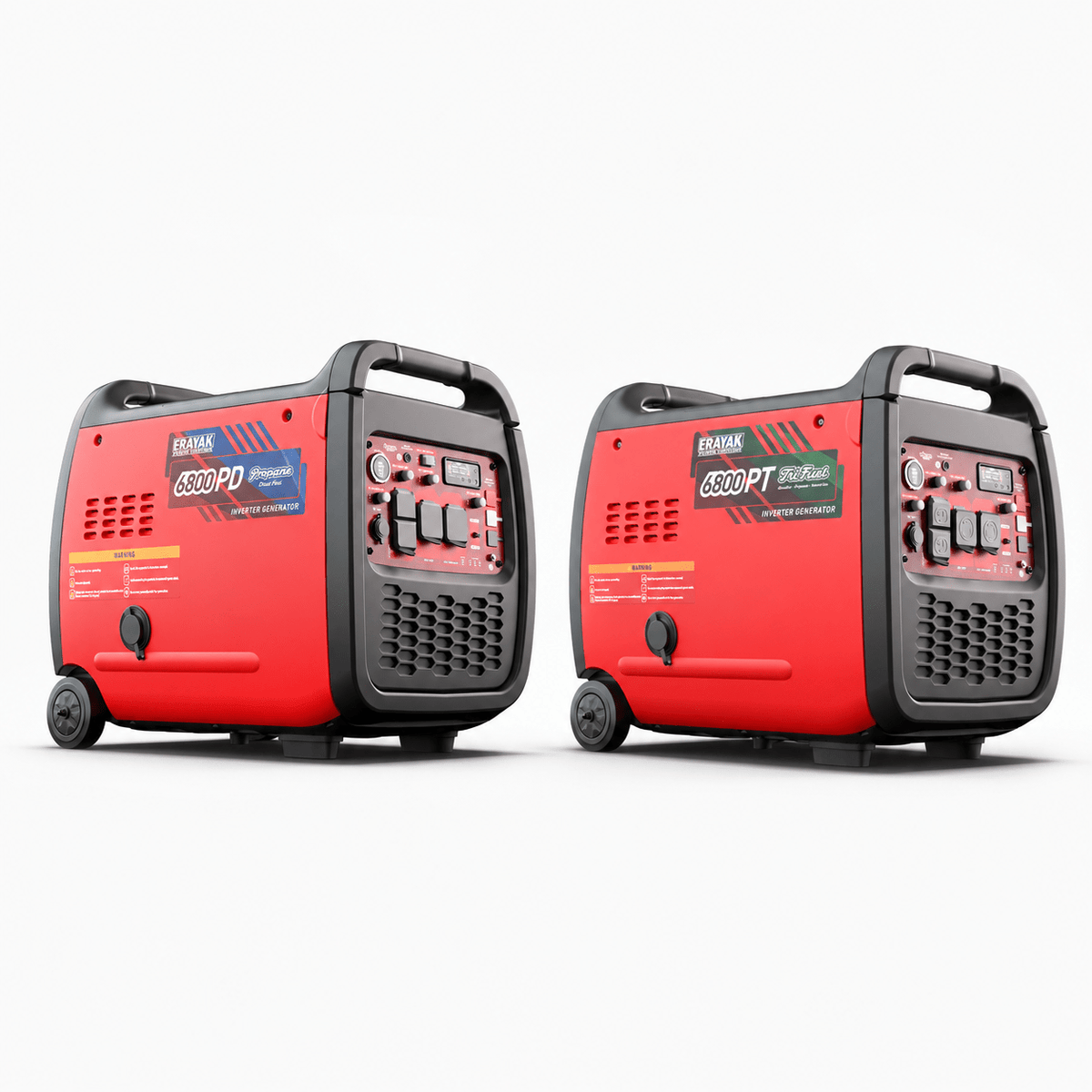
ERAYAK 6800PT: Tri Fuel for 30A 120V/240V Planning
The ERAYAK 6800PT is the stronger fit if you want gasoline, propane, and natural gas flexibility for a selected-circuit home-backup plan. It is especially relevant for homes considering longer outages, well pump planning, sump pump planning, or natural gas readiness.
- 6800W peak and 5000W gasoline rated output at 100% output
- 120V/240V capability with 30A L14-30R planning
- Tri fuel flexibility: gasoline, propane, and natural gas
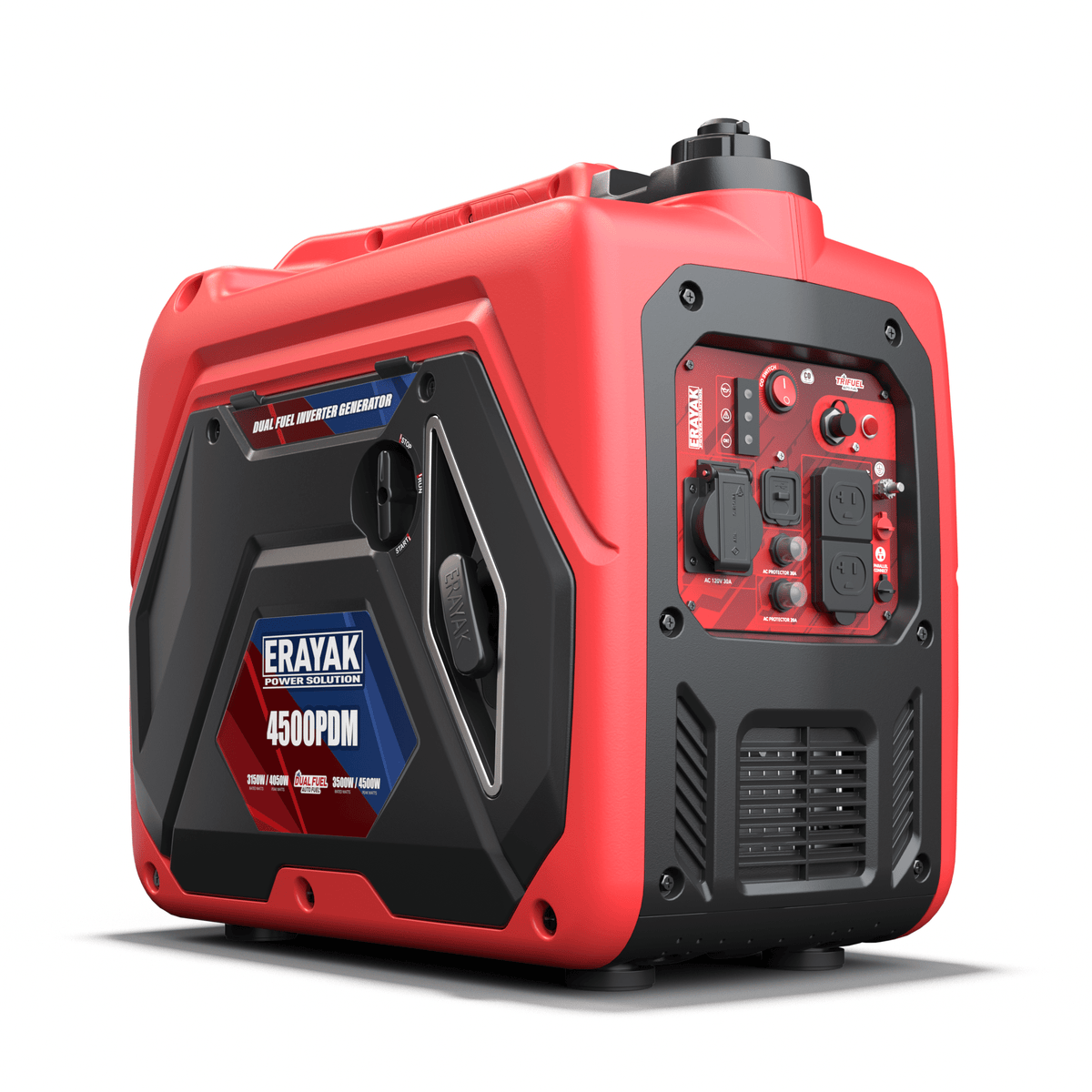
ERAYAK 4500PD: Dual Fuel for 120V Essentials
If you do not need 240V circuits or a 120V/240V transfer setup, the ERAYAK 4500PD can be a better fit for refrigerator/freezer backup, RV use, portable AC planning, and common 120V outage loads.
- Gasoline and propane flexibility
- Good match for RV and essential-load backup
- Simpler choice when natural gas and 240V are not part of the plan
What about the 6800PD? Choose the ERAYAK 6800PD when you want the 6800 platform with gasoline and propane. Choose the 6800PT when natural gas is part of your home-backup fuel plan.
Safety Notes for Transfer Switch and Inlet Planning
Generator safety notice: fuel-powered generators must run outdoors only. Never operate a generator indoors, in a garage, in a shed, on an enclosed porch, or near open windows, doors, or vents. Carbon monoxide can be deadly. Use working CO detectors and follow the generator manual.
- Do not backfeed a home through a wall outlet or dryer outlet.
- Use a properly installed transfer switch or approved interlock kit for panel-connected backup.
- Use a qualified electrician for panel, breaker, inlet, transfer switch, and interlock work.
- Use a qualified professional for natural gas connections and confirm gas supply capacity.
- Follow local code, generator instructions, and transfer equipment instructions.
Related Guides
FAQ: Generator Size for Transfer Switches and Inlets
What size generator do I need for a transfer switch?
Size the generator by the loads you want to run, not by the transfer switch alone. Many selected-circuit portable home-backup setups use generators in the 5,000W to 7,500W class with a 30A 120V/240V inlet, but your exact answer depends on running watts, starting surge, voltage, fuel type, and simultaneous loads.
Is a 30 amp generator enough for a house?
A 30A portable generator setup can be enough for selected home loads such as refrigerator, freezer, lights, router, furnace blower, sump pump, and some well pump plans. It is not meant to run every circuit in a house at once.
Do I need a 30A or 50A generator inlet?
Use the inlet size that matches the generator output, cord, breaker, wiring, and transfer equipment. A 30A inlet is common for many portable 120V/240V generators. A 50A inlet only makes sense when the whole system is designed for 50A.
Can I use a 50A inlet with a 30A generator?
Do not assume this is acceptable. A 50A inlet with a 30A generator can create mismatch and confusion unless a qualified electrician designs the full system correctly. It will not increase the generator's output.
How many watts is a 30 amp generator inlet?
A 30A 240V connection is 7,200W by formula, but actual usable power depends on the generator's rated output. For example, the ERAYAK 6800 series should be planned around 5000W gasoline rated output at 100% output, not the theoretical inlet maximum.
Can a 30A generator run a well pump?
Sometimes, if the generator provides the required voltage and enough starting surge for that specific pump. Check the pump nameplate, voltage, running amps, locked-rotor amps, and other loads. Many well pump setups require 120V/240V planning and professional transfer equipment.
What happens if my generator is smaller than my transfer switch?
The generator still limits the available power. A larger transfer switch or inlet does not create more watts. If you run too many loads, the generator can overload, trip, stall, or fail to start motor loads.
Can I install a transfer switch myself?
Panel-connected transfer switch, interlock, inlet, breaker, and wiring work should be handled by a qualified electrician and must follow local code. This is not the place to improvise.
Bottom Line
For most portable generator home-backup buyers, a 30A 120V/240V transfer switch or inlet is the practical selected-circuit path. A 50A inlet is only useful when the generator and the entire electrical setup are designed for 50A capacity.
If your backup plan includes selected circuits, an L14-30 style connection, 120V/240V loads, and possible natural gas fuel planning, the ERAYAK 6800PT is the strongest Erayak fit. If your plan is simpler 120V essentials or RV-style outage power, compare the ERAYAK 4500PD instead.


