

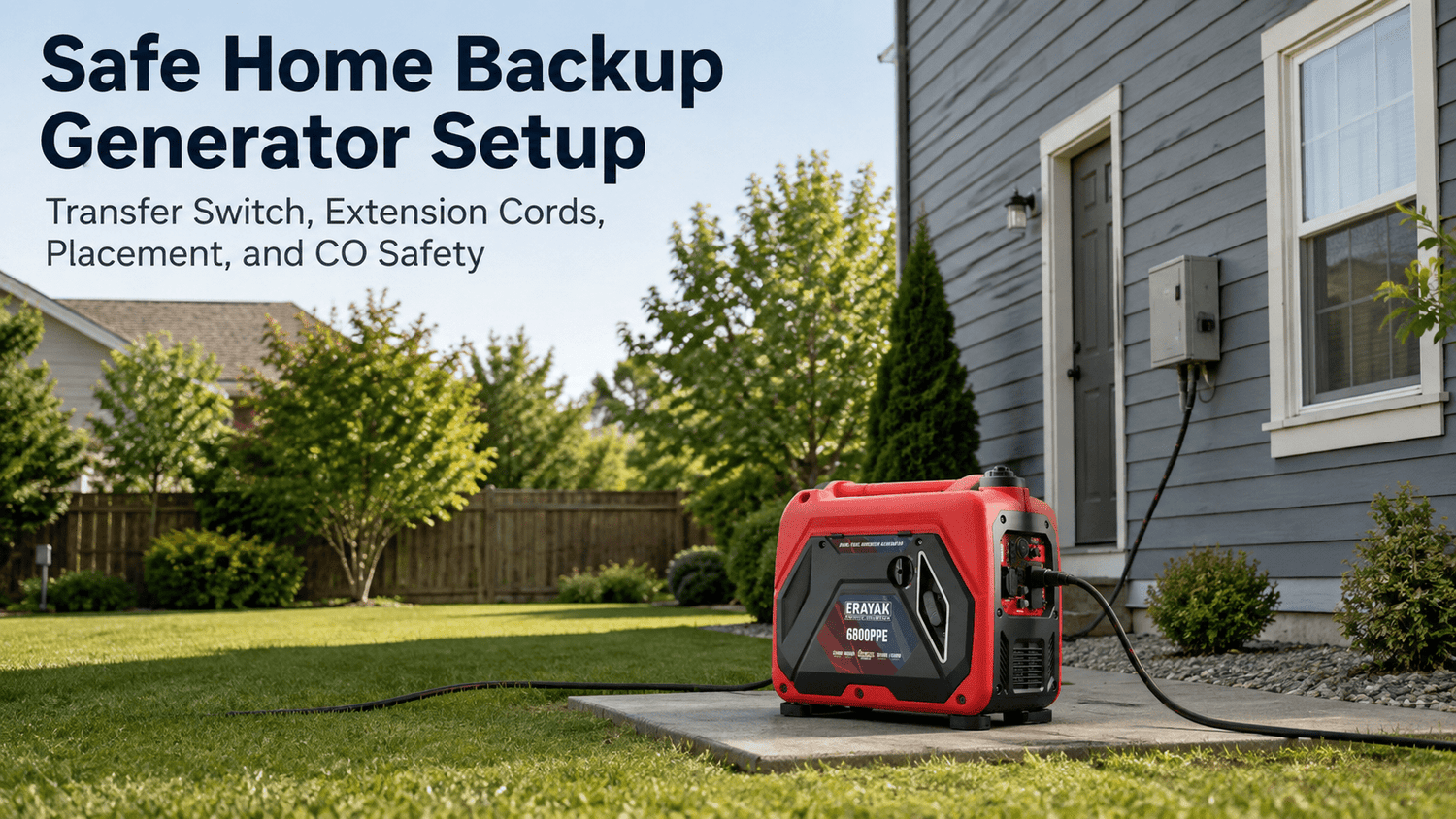
Safe Home Backup Generator Setup: Transfer Switch, Extension Cords, Placement, and CO Safety
A portable generator can keep essential loads running during an outage, but the setup has to prevent backfeeding, electrical shock, fire, and carbon-monoxide exposure. Use this guide to choose a safe connection method and prepare the operating area before the power goes out.
Quick Answer
For a safe home backup generator setup, operate the generator outdoors at least 20 feet from homes and buildings, with the exhaust pointing away from every window, door, vent, and occupied area. NIST now recommends a 25-foot distance from the home, so use the larger buffer when your site and cord plan allow. Connect home wiring only through transfer equipment installed by a qualified electrician. Otherwise, power individual cord-connected appliances with intact, grounded, outdoor-rated cords sized for the load. Keep the generator dry, install working CO alarms on every level and outside sleeping areas, and never use a garage, shed, porch, wall outlet, or male-to-male cord as a shortcut.
Choose One Safe Connection Method Before the Outage
The first decision is not where to plug in the generator. It is whether you need to energize selected home circuits or only a few individual appliances. Those are different systems with different hardware.
| Connection path | What it powers | Required hardware | Best fit |
|---|---|---|---|
| Transfer equipment plus outdoor inlet | Selected branch circuits, including compatible hardwired loads | Transfer switch or locally permitted listed interlock, inlet box, compatible generator cord, breakers, and wiring | Planned multi-circuit backup with an electrician-designed load list |
| Direct appliance extension cords | Individual cord-and-plug appliances only | Grounded, intact, outdoor-rated cords sized for each load and run length | Temporary support for a few essential 120V loads when the appliance manufacturer permits it |
| Wall-outlet backfeed | Uncontrolled home wiring and potentially utility lines | Often a male-to-male cord or improvised adapter | Never acceptable |
Transfer Switch and Power Inlet: The Planned Home-Circuit Option
A transfer switch changes selected circuits from utility power to generator power while preventing the two sources from being connected at the same time. A properly designed system normally includes an outdoor power inlet and a generator cord that matches the generator receptacle, inlet rating, voltage, and amperage.
What the electrician should confirm
- The generator output, inlet, cord, breaker, transfer equipment, and home panel are electrically compatible.
- The transfer equipment is listed for the application and acceptable to the local authority having jurisdiction.
- The system handles neutral and grounding requirements correctly for the specific generator.
- The selected circuits fit within the generator's running and starting capacity.
- The inlet location supports safe outdoor generator placement without routing a cord through a window or door.
- Required permits, inspection, labeling, and operating instructions are completed before use.
Transfer switch versus panel interlock
A manual transfer switch commonly feeds a defined set of circuits. Some jurisdictions also allow a listed, panel-specific interlock that mechanically prevents the utility main and generator breaker from being on together. An interlock is not a universal part and is not a DIY workaround. A qualified electrician and the local inspector should determine whether it is permitted and appropriate for your panel.
Extension Cords: A Direct-to-Appliance Setup Only
If you do not have transfer equipment, the safe electrical path is from the generator's built-in receptacle to an individual cord-and-plug appliance. This does not energize household circuits, wall outlets, or hardwired equipment.
Match the rating to the load
Use a grounded three-prong cord whose amp or watt rating meets the appliance load. Longer runs may require heavier conductors. Follow the generator manual, appliance instructions, and cord manufacturer's rating instead of relying on color or appearance.
Use outdoor-rated equipment
The portion outdoors must be rated for outdoor use and suitable for the conditions. Inspect plugs, blades, jackets, and strain relief before every outage. Replace any cord that is cut, crushed, abraded, loose, or hot in use.
Protect the cord path
Keep cords out of standing water and walkways. Do not pinch them in windows or doors, run them under rugs, cover them with combustible material, or route them where vehicles can cross them.
Avoid adapters and chains
Do not daisy-chain cords, defeat the grounding pin, or use a household power strip as a substitute for properly distributed generator outlets. Use GFCI protection where required, especially in damp locations, and follow the generator's grounding instructions.
CDC recommends an extension cord longer than 20 feet so the generator can remain at a safe distance. If you follow NIST's more conservative 25-foot recommendation, size the cord for that longer run. Do not move the generator closer to compensate for a short cord.
Generator Placement: Distance, Exhaust, Airflow, and Rain
Placement is a life-safety decision. Carbon monoxide is colorless and odorless, and open doors or windows do not make a garage or other enclosure safe.
Use at least 20 feet, and consider 25 feet
CPSC's May 2026 hurricane-season guidance and CDC guidance say to operate a portable generator outdoors at least 20 feet from homes and buildings, with exhaust directed away from windows, doors, and vents. NIST updated its public guidance in May 2026 to recommend 25 feet from the home. A practical safety plan is to treat 20 feet as the minimum baseline and use 25 feet when the property layout and properly rated cord allow.
Never use these locations
- Inside a house, basement, garage, crawlspace, shed, or other enclosure
- In a garage with the overhead door open
- On a porch, balcony, deck alcove, under an overhang that traps exhaust, or beside an open window
- Near doors, windows, vents, soffit openings, or outdoor-air intakes
- In a location where exhaust can enter a neighbor's building
Keep it dry without enclosing it
Do not operate or handle the generator in rain, flooding, or while standing in water. Use only weather protection that is designed or approved for the generator and preserves open airflow. Never drape a tarp over a running unit or place it inside a makeshift box. OSHA advises keeping three to four feet of clear space on all sides and above the generator for ventilation; also follow any greater clearances in the owner's manual.
Prepare the ground and operating zone
Choose a firm, level, dry surface away from combustible material. Keep children and pets out of the operating area. Arrange the generator so hot exhaust and muffler surfaces cannot contact dry vegetation, fencing, fuel containers, cords, or stored materials.
CO Alarms Are Backup Protection, Not Permission to Place the Generator Closer
CPSC recommends battery-operated CO alarms or alarms with battery backup on every level of the home and outside sleeping areas. Interconnected alarms are best because one alarm can alert the entire household. Install and replace alarms according to the manufacturer's instructions, test them monthly, and never cover them with furniture or drapes.
If an alarm sounds
Get everyone outside to fresh air immediately. Call 911 from outside. Do not re-enter until emergency personnel say the building is safe.
Know possible symptoms
Headache, dizziness, weakness, nausea, vomiting, chest pain, tiredness, and confusion can indicate CO exposure. Sleeping people may not notice symptoms.
Do not trust a shutoff alone
A generator's CO shutoff feature is an extra layer, not a substitute for outdoor placement, distance, exhaust direction, and working household alarms.
A Safe Outage Operating Sequence
Exact controls and connection order vary by generator and transfer equipment. Keep both manuals with the unit and follow them. The sequence below is a planning framework, not a replacement for those instructions.
Confirm the site is safe
Check for flooding, rain exposure, blocked ventilation, damaged cords, nearby openings, wind direction, and people or pets in the operating zone.
Place the generator before connecting loads
Move it outdoors to the preplanned 20- to 25-foot location, point the exhaust away from buildings and openings, and maintain the required clear space.
Use only the approved connection path
Connect the compatible generator cord to the installed inlet and transfer equipment, or connect individual appliances with properly rated extension cords. Never connect to a wall outlet.
Start with loads disconnected or off
Start the generator according to its manual. Let it stabilize as directed before adding electrical load.
Add essential loads gradually
Energize only the planned circuits or appliances, one at a time. Watch the generator's load indicators and allow for motor starting watts.
Monitor the entire time
Check for alarms, overheating cords, changing wind, water, unusual sound, fuel leaks, or exhaust entering an occupied area. Do not leave an unsafe setup running.
Remove loads before shutdown and refueling
Follow the equipment's shutdown sequence. Turn the generator off and let it cool before refueling. Store fuel in approved containers outside living areas and away from ignition sources.
Match the Generator to the Connection Plan, Not Just a Wattage Number
A home-backup generator needs compatible voltage, receptacles, cord and inlet ratings, starting capacity, and enough continuous output for the circuits you actually plan to use. Have the electrician review the generator manual and receptacle configuration before selecting transfer equipment.
ERAYAK 6800PD / 6800PT Series
The 6800 series provides a 120V/240V L14-30R connection path for electrician-designed home backup, along with 6800W peak and 5000W rated output on gasoline. Choose 6800PD for dual-fuel capability or 6800PT for tri-fuel capability. Confirm the exact model, fuel output, inlet, cord, and transfer equipment as one system.
ERAYAK Inverter Generator Collection
If your plan is limited to selected 120V appliances, a smaller model may be the better match. Compare generator output, fuel choice, receptacles, and portability only after you have defined the safe connection method and essential-load list.
Six Dangerous Generator Setup Mistakes
Backfeeding a receptacle
Plugging a generator into a wall outlet can energize home wiring and utility lines without approved isolation.
Running in a garage
An open garage door does not prevent lethal CO buildup or exhaust migration into the home.
Using an undersized cord
An underrated or damaged cord can overheat, cause voltage drop, and create shock or fire hazards.
Enclosing it from rain
A tarp, shed, box, or improvised shelter can trap heat and CO. Use only approved open-air weather protection.
Refueling while hot
Fuel spilled on hot engine or exhaust parts can ignite. Shut down and allow the generator to cool first.
Ignoring alarms or symptoms
If a CO alarm sounds or anyone feels ill, evacuate to fresh air and call 911 from outside.
Pre-Outage Home Backup Generator Checklist
- Read the generator manual and keep it with the unit.
- Choose the transfer-equipment path or the direct-appliance path. Never mix in an improvised wall connection.
- Have transfer equipment, inlet, and labeling installed and inspected as required.
- Mark an outdoor operating area at least 20 feet away; use 25 feet when practical.
- Confirm exhaust points away from every opening, occupied area, and neighboring building.
- Prepare approved weather protection that maintains open airflow.
- Inspect and label generator cords and appliance extension cords by intended load.
- Make a starting-watt and running-watt load list. Prioritize only essential circuits.
- Install battery-operated or battery-backup CO alarms on every level and outside sleeping areas.
- Test CO and smoke alarms monthly and replace them at the manufacturer's end-of-life date.
- Store approved fuel containers outside living areas and away from heat and ignition sources.
- Practice the connection, load, shutdown, and cooldown sequence in dry daylight conditions.
- Post emergency instructions: evacuate for a CO alarm or symptoms, then call 911 from outside.
Frequently Asked Questions
Do I need a transfer switch for a portable generator?
You need properly installed transfer equipment if the generator will supply home wiring or branch circuits. If you are powering only individual cord-and-plug appliances, you can use properly rated direct extension cords without energizing home wiring. Never connect a generator through a wall outlet.
Can I use a generator interlock instead of a transfer switch?
A listed, panel-specific interlock may be permitted in some jurisdictions when it is installed with the correct inlet, breaker, wiring, and labeling. It is not universal. Ask a qualified electrician and your local authority having jurisdiction whether it is approved for your panel and use.
How far should a portable generator be from the house?
Use at least 20 feet from homes and buildings, with exhaust directed away from windows, doors, vents, and occupied areas. NIST recommends 25 feet from the home, so use that more conservative distance when practical. Always follow any greater distance required by the manufacturer or local rules.
Can I run a generator in an open garage?
No. Never run a portable fuel-burning generator in a garage, even with the overhead door fully open. Garages can trap carbon monoxide and allow it to enter the home.
What gauge extension cord should I use with a generator?
There is no one gauge for every load and distance. Use a grounded, outdoor-rated cord whose amp or watt rating meets the connected appliance and whose conductor size is appropriate for the full run length. Longer or higher-load runs generally require heavier conductors. Follow the generator, appliance, and cord manufacturer instructions.
Can I use an extension cord for a refrigerator during an outage?
Only if the refrigerator manufacturer permits it and the temporary cord is grounded, outdoor-rated where exposed outdoors, intact, and sized for the refrigerator's running and starting load. Use a dedicated cord, keep connections dry, and do not run it under rugs or through pinched openings. A properly installed transfer setup is the cleaner option for repeated home backup.
Do I still need household CO alarms if the generator has CO shutoff?
Yes. A generator-mounted CO shutoff is an additional safeguard, not a replacement for safe outdoor placement or household alarms. CPSC recommends working CO alarms with battery power or battery backup on every level and outside sleeping areas.
Authoritative Safety Sources
- U.S. Consumer Product Safety Commission: 2026 hurricane-season generator and CO guidance
- Centers for Disease Control and Prevention: power-outage and generator safety
- National Institute of Standards and Technology: 25-foot generator placement guidance
- Occupational Safety and Health Administration: using portable generators safely
- U.S. Consumer Product Safety Commission: carbon-monoxide alarm guidance
Important: This article provides general safety planning, not site-specific electrical or code advice. Follow the generator and connected-equipment manuals, local codes, inspection requirements, and instructions from a qualified electrician.
Build the connection and placement plan as one system
Define the essential loads, safe outdoor operating zone, inlet or cord path, fuel plan, and CO-alarm coverage before choosing generator capacity. That preparation is what turns backup power into a repeatable household procedure.
