

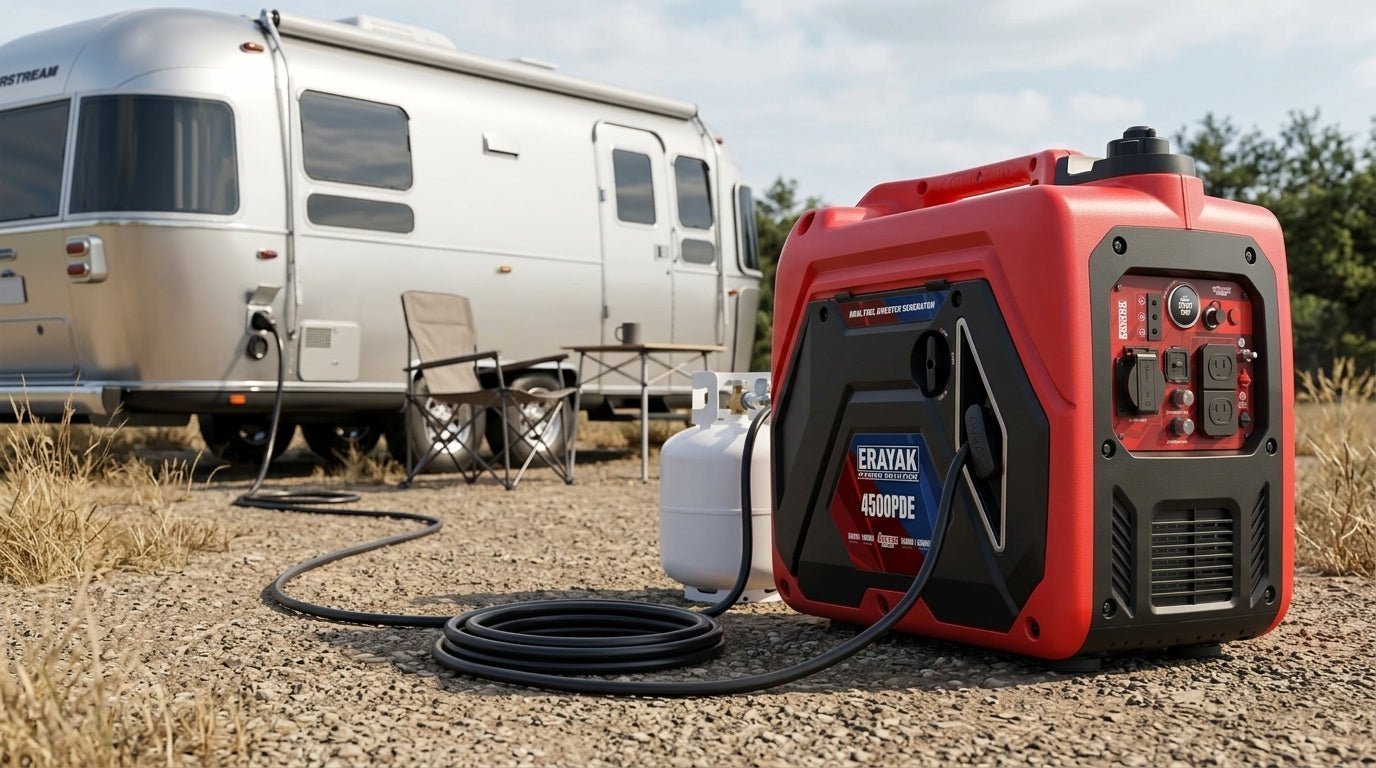
What Will a 4500 Watt Generator Run? Home, RV & AC Load Chart
A 4500 watt generator will run a strong set of essentials, including a refrigerator, freezer, lights, Wi-Fi router, TV, chargers, many portable AC units, and many RV loads. The catch is that “4500 watts” is often peak power, so you still need to plan around running watts, amps, and startup surge.
What Can a 4500 Watt Generator Run? Quick Answer
A 4500 watt generator can usually run a refrigerator or freezer, lights, router, TV, phone chargers, small kitchen appliances used one at a time, many portable AC units, and many RV essentials. It is not a whole-house generator, and it should not be expected to run an RV AC, microwave, coffee maker, electric heater, and water heater all at once.
At 120 volts, 4500 watts equals about 37.5 amps of peak power. If the generator is rated around 3500 running watts, the practical continuous load is closer to 29 amps. Always use the running-watt rating for planning, then leave headroom for compressor startup surge.

4500 Watts Usually Means Peak Power, Not Continuous Power
Before deciding what a 4500 watt generator can run, check whether the product label is using starting watts, peak watts, or running watts. Many portable generators are named by their peak output. The continuous output is usually lower.
For startup surge
Peak watts help start motors and compressors, such as refrigerators, freezers, RV AC units, sump pumps, and portable air conditioners.
For steady use
Running watts tell you what the generator can support continuously after appliances are already running. Use this number for load planning.
For fewer trips
Aim to stay below the maximum running rating instead of running the generator at the limit for long periods, especially in hot weather or at altitude.
Example: the Erayak 4500P is a gas-only 4500W peak / 3500W running inverter generator. That makes it a strong fit for selected RV, camping, and home-essential loads, not for powering every appliance in a house at once.

4500 Watt Generator Load Chart
Use this chart as a planning guide. Actual wattage varies by brand, age, temperature, altitude, compressor design, and startup conditions. Check the appliance nameplate whenever possible.
| Appliance or Load | Typical Running Watts | Typical Starting Watts | 4500W Fit |
|---|---|---|---|
| Refrigerator | 150-700W | 800-2200W | Yes Usually easy with load management. |
| Chest freezer | 100-500W | 600-1800W | Yes Avoid starting fridge and freezer at the same moment. |
| Lights, router, TV, laptop, phone chargers | 50-600W combined | Low surge | Yes Good use of a 4500W-class generator. |
| Portable AC, 8000-10000 BTU | 700-1200W | 1400-3000W | Usually Start AC first, then add small loads. |
| Portable AC, 12000-14000 BTU | 1100-1800W | 2200-4000W+ | Check Model and startup surge matter. |
| RV air conditioner, 13500 BTU | 1200-1800W | 2500-4000W+ | Check Often possible, but not with many other big loads. |
| Microwave | 1000-1600W | 1000-2000W | Use one at a time Avoid pairing with AC startup. |
| Coffee maker | 800-1500W | Low surge | Use one at a time Heating loads add up fast. |
| Space heater or electric kettle | 1200-1800W | Low surge | Use caution High steady draw leaves little margin. |
| Electric water heater | 1200-4500W | Low surge | Usually avoid Can consume most or all available output. |
| Central AC or whole-house HVAC | 3000W+ | 6000W+ | No A 4500W portable generator is not the right size. |
The best 4500W use case is not “run everything.” It is “run the right essentials with smart sequencing.”
What Can a 4500 Watt Generator Run at the Same Time?
A 4500W-class generator can run multiple appliances if the total running watts stay within the continuous rating and only one major compressor starts at a time.
| Load Combination | Likely Result | Why |
|---|---|---|
| Refrigerator + freezer + lights + router + phones | Good fit | Low steady load, with manageable compressor surge if appliances do not start at exactly the same time. |
| Portable AC + refrigerator + lights + router | Usually works | Start the AC first, let it stabilize, then add the refrigerator and small loads. |
| RV AC + RV refrigerator + lights + TV | Often possible | Depends on AC startup surge, converter load, altitude, temperature, and whether the refrigerator is on electric mode. |
| RV AC + microwave + coffee maker | Avoid | Two or three high-watt loads can exceed running capacity or cause voltage drop. |
| Portable AC + space heater | Avoid | Heating loads consume a lot of steady watts and leave little room for compressor surge. |
| Entire house | No | Use a 4500W generator for selected circuits or extension-cord loads, not whole-home power. |
Simple load formula: largest starting watts + running watts of everything else = estimated peak demand.
Example: portable AC startup 2400W + refrigerator running 500W + lights/router/chargers 250W = about 3150W peak demand. That is a realistic 4500W-class use case if your generator's running rating and surge rating support it.
Home, RV, and AC Examples
Selected home essentials
A 4500W generator can usually run a refrigerator, freezer, lights, router, TV, laptop, phone chargers, and a few small appliances with careful sequencing.
- Good for food storage and communication.
- Use one cooking or heating appliance at a time.
- Not enough for central AC or whole-home backup.
30A-style RV load planning
A 4500W inverter generator is a practical RV size for many campers because it gives enough headroom for RV AC plus smaller comfort loads when managed properly.
- RV AC may work depending on startup surge.
- Microwave and coffee maker should be used separately.
- Watch converter charging load when batteries are low.
Portable AC plus essentials
Many 8000-10000 BTU portable AC units are comfortable on a 4500W-class generator. Larger units need closer checking, especially if you also want a refrigerator running.
- Start the AC before adding other loads.
- Use nameplate volts and amps as a conservative VA check when exact running watts are unavailable.
- Reduce extra loads during compressor startup.

4500 Watts to Amps: How Many Amps Is a 4500 Watt Generator?
4500 watts equals 37.5 amps at 120 volts or 18.75 amps at 240 volts. However, many generators sold as 4500W models use 4500W as the short-term peak rating. A common 3500W running rating equals about 29.2 amps at 120V.
| Power | At 120V | At 240V | How to Use This Number |
|---|---|---|---|
| 4500 watts | 37.5 amps | 18.75 amps | Peak or starting output on many 4500W-class generators; confirm that the generator actually supports 240V. |
| 3500 watts | 29.2 amps | 14.6 amps | A common running-watt class for 4500W peak inverter generators. |
| 3000 watts | 25 amps | 12.5 amps | A more comfortable planning target when you want operating headroom. |
Conversion formula: watts / volts = amps. For example, 3500 watts / 120 volts = about 29.2 amps.
The ERAYAK 4500P and 4500PD are 120V generators. The 240V column answers the mathematical search question; it does not mean every 4500W generator supplies 240V. Also, volts multiplied by nameplate amps gives apparent power in VA for an AC load, not always exact real watts unless power factor is known.
What Should You Not Run on a 4500 Watt Generator?
A 4500W generator is useful, but it has limits. The quickest way to overload it is stacking several heat-producing or compressor loads at the same time.
Avoid stacking high-heat appliances
Space heaters, electric kettles, coffee makers, toaster ovens, hair dryers, and electric water heaters can each use a large amount of steady power. Use them one at a time, if at all.
Avoid starting two compressors together
Refrigerators, freezers, RV AC units, portable AC units, and pumps can all surge at startup. Starting two at once can exceed the generator's surge capacity.
Do not treat it as a whole-house generator
A 4500W portable generator is for selected essentials. It is not sized for central AC, electric ranges, large electric water heaters, or an entire breaker panel.
Do not ignore extension cord limits
Undersized cords and long adapter chains create voltage drop and heat. Use properly rated cords, RV connectors, and transfer equipment where appropriate.
Watch Two ERAYAK 4500W Generator Reviews
The load chart above is the right starting point for sizing. These two video walkthroughs add a closer look at operation, portability, noise, and the difference between a straightforward 4500W setup and a dual-fuel model. Treat each video as practical context, then verify your own appliance nameplates before connecting a load.
ERAYAK 4500W review: noise, portability, and operation
Use this review to see the generator format and operating experience before comparing the measured needs of your RV, portable AC, refrigerator, or backup essentials.
ERAYAK 4500W dual-fuel review
This walkthrough is the more relevant companion when gasoline and propane flexibility is part of the decision. Output and runtime can differ by fuel, so compare specifications using the same fuel and load conditions.
Which Erayak Generator Fits This Load?
Use this page as a routing guide. If the goal is ordinary 4500W-class power, the 4500P or 4500PD are the closest matches. If your load plan is bigger than this chart, move up instead of forcing a 4500W generator to do too much.

Erayak 4500P
The 4500P is the simple gas-only 4500W peak / 3500W running inverter generator choice for RV weekends, camping, tailgating, and home essentials backup.
- Gasoline only.
- Manual recoil start.
- 55 lb class, 2.25 gal fuel tank.
- Up to 8 hours runtime, 60.5 dB, THD under 1.2%.

Erayak 4500PD
The 4500PD is the stronger recommendation when the same 4500W-class use case also needs propane flexibility for RV camping, portable AC backup, and emergency readiness.
- 4500W surge / 3500W rated output at 120V.
- 29.1 rated amps at 120V.
- 2.25-gallon gasoline tank with 8 hours at 50% load on gasoline.
- Dual fuel: gasoline or propane.

ERAYAK 6800PT
Choose the 6800PT when 4500W-class power is not enough and you need a larger selected-load backup plan, 120V/240V output, or tri-fuel flexibility.
- 6800W peak and 5000W gasoline rated output at 100% output.
- 30A L5-30R and 30A 120V/240V L14-30R outlet planning.
- TT-30R adapter accessory can support RV connection planning.
- Tri-fuel model; do not confuse it with the dual-fuel 6800PD.
For most 4500W searchers, start with the 4500PD if propane matters
If you are asking what a 4500 watt generator can run because you want RV, camping, portable AC, or storm-backup flexibility, the Erayak 4500PD is usually the best product fit. If you only want gas power and simpler operation, choose the 4500P.
Do not oversell the wattage
A 4500W-class generator is a strong essentials generator, not a whole-house generator. The right buying decision depends on the loads you actually need at the same time.
Important Generator Safety for Home, RV, and AC Loads
A generator can protect food, comfort, and communication during an outage, but it must be used correctly. Review the ESFI portable-generator safety guidance before an emergency.
Never run a fuel generator indoors
Operate a fuel generator outdoors only, at least 20 feet from the home, RV, doors, windows, and vents, with exhaust directed away from people and structures. Never use one inside a home, RV, garage, shed, enclosed porch, or other enclosed or partly enclosed space. Use working carbon-monoxide alarms.
Use proper connection equipment
For home circuits, use code-compliant transfer equipment installed by a qualified electrician. Do not backfeed a home through a dryer outlet or improvised cord.
Manage large loads
Start large compressor loads one at a time. Avoid stacking RV AC, microwave, coffee maker, electric heater, and water heater loads together.
Protect cords and connectors
Use properly rated cords, keep connections dry, and replace damaged adapters or overheated plugs before using the generator again. Shut the generator down and allow it to cool before refueling.
FAQ: 4500 Watt Generator Loads
What will 4500 watts run?
A 4500 watt generator will usually run selected essentials such as a refrigerator or freezer, lights, router, TV, chargers, many portable AC units, and many RV loads. It will not run every large appliance at once, so manage startup surge and use high-draw appliances one at a time.
Can a 4500 watt generator run a house?
A 4500 watt generator can run selected home essentials, not an entire house. It can usually support a refrigerator, freezer, lights, router, TV, chargers, and some small appliances with load management.
Can a 4500 watt generator run an RV air conditioner?
Often, yes, especially for many 13500 BTU RV AC units, but it depends on the AC startup surge, temperature, altitude, soft-start equipment, and other connected RV loads. Avoid running the microwave or coffee maker during AC startup.
Can a 4500 watt generator run a refrigerator and freezer?
Usually yes. A refrigerator and freezer are realistic 4500W-class loads if you manage startup surge and avoid starting both compressors at exactly the same time.
Can a 4500 watt generator run a portable AC?
Many portable AC units can run on a 4500 watt generator. Smaller 8000-10000 BTU units are usually easier. Larger 12000-14000 BTU units need closer checking because startup surge can be much higher.
How many amps is 4500 watts?
4500 watts equals 37.5 amps at 120 volts or 18.75 amps at 240 volts. Many 4500W-class portable generators, including the ERAYAK 4500P and 4500PD, supply 120V only, so the 240V figure is a mathematical conversion rather than an available output.
How long will a 4500 watt generator run?
Runtime depends on tank size, fuel, and load. The ERAYAK 4500P lists up to 8 hours depending on operating conditions, while the 4500PD lists 8 hours at 50% load on gasoline. Do not assume every 4500W generator has the same runtime.
What should I avoid running on a 4500 watt generator?
Avoid stacking several high-wattage loads at once, such as RV AC, microwave, coffee maker, electric heater, electric kettle, and water heater. Also avoid central AC and whole-house loads that require a larger generator system.
Is a 4500 watt inverter generator good for camping?
Yes. A 4500W inverter generator is a practical camping and RV size because it can support many comfort loads while staying more portable than larger backup generators. For propane flexibility, the Erayak 4500PD is the stronger camping and emergency-prep fit.
Can I use a 4500 watt generator indoors?
No. Never use a fuel-powered generator indoors, in a garage, inside an RV, or near open windows, doors, or vents. Always operate outdoors with proper ventilation.
