

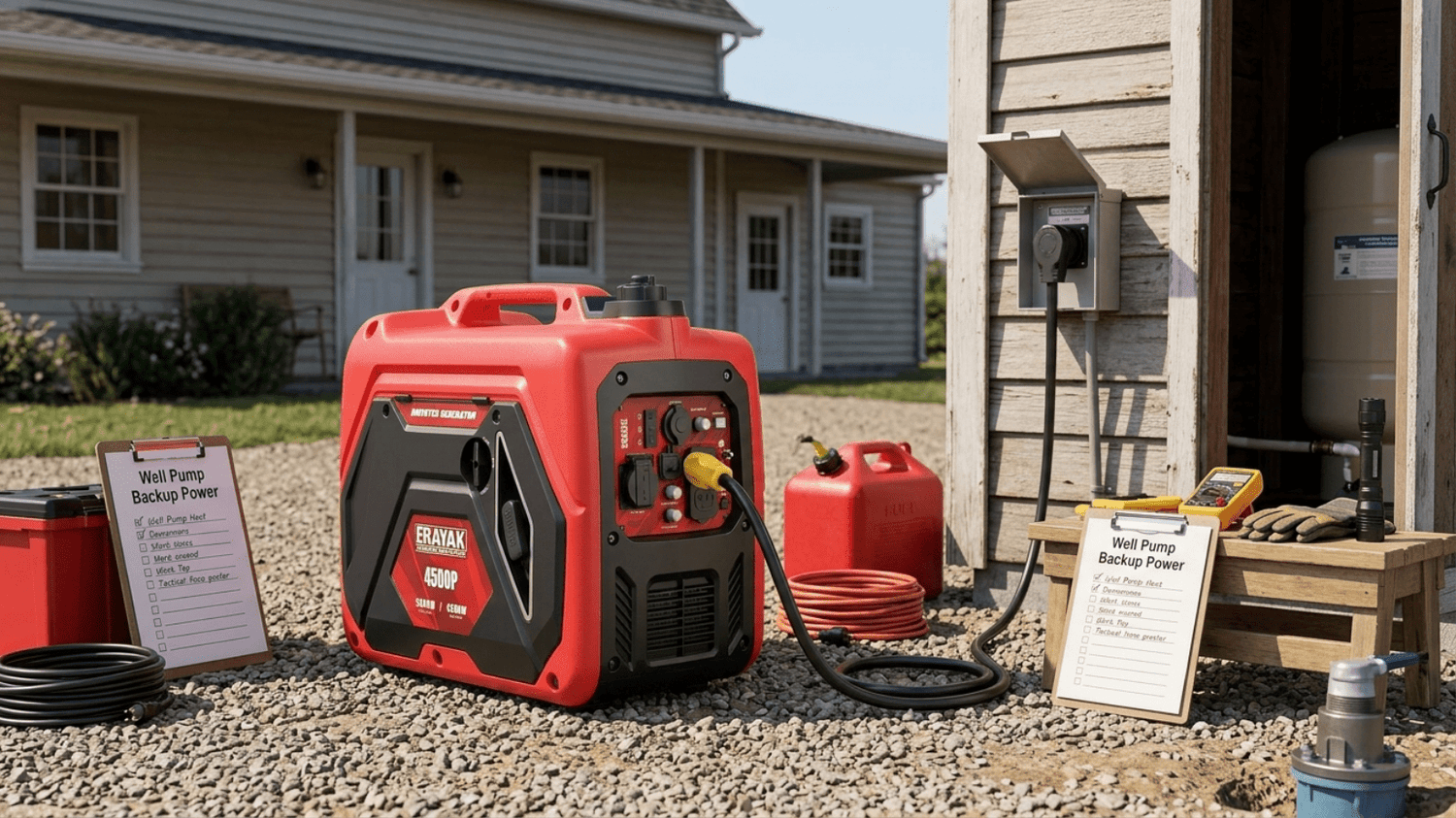
Well Pump Backup Power: Generator Sizing Basics for Rural Homes
For rural homes, losing power often means losing more than lights and Wi-Fi. If your well pump stops, you may lose running water for toilets, sinks, showers, livestock, garden irrigation, and basic household routines. A portable generator can support well pump backup power, but sizing must be done carefully because well pumps have high starting demand and may require 120V or 240V service depending on the system.
Quick Answer
To size a generator for well pump backup power, identify your pump voltage, horsepower, running watts, starting watts, circuit amperage, and whether the pump is 120V or 240V. Deep well pumps and submersible pumps often need more starting surge than their running wattage suggests. For 240V well pumps, choose a generator with proper 120V/240V output and use a professionally installed transfer switch or approved connection method.
The Erayak 6800PD / 6800PT is the best Erayak starting point for rural well pump planning because it offers 6800W peak power, 5000W rated power on gasoline, and 30A 120V/240V L14-30R output. Smaller Erayak models can support 120V appliances, lights, fans, routers, refrigerators, and selected 120V pump setups only when the pump voltage and starting demand are compatible.
Why Well Pump Backup Power Matters
Municipal water systems may keep pressure during some outages, but rural homes with private wells usually depend on electricity to move water from the well to the pressure tank and plumbing system. When the power goes out, water pressure may continue briefly from the pressure tank, then stop once the tank draws down.
Household Water Access
A powered well pump can help restore water for sinks, toilets, basic washing, showers, and daily household needs.
Farm and Property Needs
Rural properties may need water for animals, gardens, outdoor cleaning, and essential property maintenance.
Better Emergency Planning
Knowing your well pump load helps you avoid buying a generator that cannot start the pump when it matters.
Common Well Pump Types
Different pumps have different voltage needs, starting demands, and backup power requirements. Before choosing a generator, identify what type of well pump your home uses.
| Pump Type | Common Use | Backup Power Consideration |
|---|---|---|
| Shallow well jet pump | Shallower wells and some small rural homes | May be 120V or 240V; check nameplate before sizing |
| Deep well jet pump | Deeper wells with pump equipment above ground | Can have higher starting demand and may require 240V |
| Submersible well pump | Common deep well setup with pump inside the well | Often 240V; starting surge and horsepower matter |
| Booster pump | Increases water pressure in some systems | May need separate sizing from the main well pump |
| Pressure tank system | Stores pressurized water for home use | Can reduce pump cycling, but does not eliminate generator sizing needs |
Running Watts vs Starting Watts
Well pumps are motor loads. That means the generator must support both the normal running power and the short startup surge when the motor first turns on. The starting demand can be much higher than the running demand.
| Power Term | Meaning | Why It Matters for Well Pumps |
|---|---|---|
| Running watts | Power needed after the pump is already running | Determines steady generator load while water is being pumped |
| Starting watts | Short surge needed to start the pump motor | Often the main reason a generator fails to start a pump |
| Horsepower | Motor size rating such as 1/2 HP, 3/4 HP, or 1 HP | Higher horsepower usually means more starting demand |
| Voltage | 120V or 240V requirement | The generator must provide the correct voltage output |
| Amperage | Current draw listed on the pump nameplate or circuit | Helps estimate wattage and choose proper wiring equipment |
120V vs 240V Well Pumps
Voltage is one of the most important details in well pump backup power. Many small portable inverter generators provide 120V only, which is useful for refrigerators, lights, routers, fans, and small appliances, but it will not directly power a 240V well pump.
| Pump Voltage | Generator Requirement | Planning Note |
|---|---|---|
| 120V well pump | Generator must provide enough 120V running and starting watts | Still check starting surge and cord/connection rating |
| 240V well pump | Generator must provide 120V/240V output | Requires proper transfer switch, inlet, or approved connection planning |
| Unknown voltage | Do not guess | Check pump nameplate, breaker, control box, or ask a qualified electrician or well professional |
Generator Sizing Basics for Well Pumps
Generator sizing for a well pump should start with the pump itself, then add only the rural home loads you truly need during the pump cycle. The safest approach is to start and run the well pump separately from other heavy loads.
| Sizing Step | What to Find | Why It Matters |
|---|---|---|
| Step 1 | Pump voltage: 120V or 240V | The generator must match the pump’s voltage requirement |
| Step 2 | Pump horsepower and amperage | Helps estimate running and starting demand |
| Step 3 | Starting watts or locked-rotor data if available | Determines whether the generator can start the motor |
| Step 4 | Pressure tank behavior | Shows how often the pump may cycle during household water use |
| Step 5 | Other critical loads | Refrigerator, freezer, lights, router, furnace blower, and chargers add demand |
| Step 6 | Connection method | Well pumps are usually hardwired and need safe transfer equipment |
How to Connect a Generator to a Well Pump Safely
A well pump is not like a phone charger or lamp. Many well pumps are hardwired into the home’s electrical system, especially 240V submersible pumps. That means safe connection planning is just as important as generator wattage.
| Connection Method | Use Case | Safety Note |
|---|---|---|
| Manual transfer switch | Selected circuit backup, including well pump circuits where appropriate | Should be installed by a qualified electrician |
| Generator inlet box | Cleaner outdoor connection to selected home circuits | Must match generator output, cord, breaker, and transfer equipment |
| Interlock kit | Panel-based generator connection where permitted | Requires correct installation and code compliance |
| Direct cord to 120V pump | Only for compatible plug-in 120V pump setups | Use properly rated, grounded cords and follow pump instructions |
| Wall outlet backfeed | Unsafe shortcut | Do not do this; it can endanger utility workers and damage equipment |
Rural Home Load Plan During an Outage
When a well pump starts, reduce other high-demand loads. This gives the pump more starting headroom and helps keep your generator from tripping, surging, or stalling.
| Load Type | Examples | Best Strategy |
|---|---|---|
| Priority load | Well pump | Start and run the pump with other heavy loads off |
| Cold storage | Refrigerator, freezer | Run in rotation after pump cycle if generator headroom is limited |
| Communication | Router, modem, phone chargers, laptop | Usually low-load and easier to keep powered |
| Comfort loads | Fans, lights, small electronics | Add gradually after generator stabilizes |
| High-demand appliances | Microwave, coffee maker, kettle, heater, pump, power tools | Run separately from the well pump whenever possible |
| Heating equipment | Furnace blower, boiler circulator, heat tape | Plan carefully because winter loads may overlap with water needs |
Well Pump Generator Checklist
Use this checklist before storm season, winter outage season, or any rural home backup power planning project.
| Checklist Item | Why It Matters | Action |
|---|---|---|
| Pump voltage confirmed | Determines 120V vs 240V generator requirement | Check nameplate, breaker, or installer paperwork |
| Pump horsepower and amps recorded | Helps estimate running and starting demand | Write values on your emergency load sheet |
| Starting watts estimated | Prevents undersizing the generator | Ask pump manufacturer, installer, or electrician if unclear |
| Transfer equipment planned | Hardwired pumps need safe connection method | Use a qualified electrician |
| Generator output verified | Confirms 120V/240V and outlet compatibility | Match generator, cord, inlet, breaker, and transfer switch |
| Load rotation plan printed | Reduces overload during pump startup | Mark well pump as priority load |
| Fuel plan prepared | Well pump backup may require multiple run cycles | Use fresh fuel, approved cans, and safe storage |
| Test run completed | Confirms the system works before an outage | Test safely with electrician guidance where needed |
Recommended Erayak Setup by Rural Home Need
Erayak 2400P: Compact Essentials, Not Most 240V Well Pumps
Choose the Erayak 2400P for compact rural home essentials such as phones, LED lights, router, laptop, fans, small electronics, and selected light backup needs. It is not the right match for most 240V deep well pumps.
- Good for compact emergency essentials
- Useful for charging, lights, fans, router, laptop, and small electronics
- Do not assume compatibility with a hardwired 240V well pump
Erayak 4500P: Managed Home Loads and Selected 120V Pump Planning
Choose the Erayak 4500P for managed rural home backup loads such as refrigerator, freezer timing, lights, fans, WiFi, phone charging, laptop, coffee maker timing, and selected compatible 120V pump scenarios after checking pump starting demand.
- Gas-only portable inverter generator
- Manual recoil start
- 55 lb lightweight design
- 2.25 gal fuel tank
- Up to 8 hours runtime
- THD < 1.2% for sensitive electronics
- 60.5 dB noise level
- Not intended for most 240V well pump setups
Erayak 4500PD: Fuel Flexibility for Rural Outages
Choose the Erayak 4500PD when your rural home backup plan benefits from gasoline and propane flexibility for lights, refrigerator, freezer timing, fans, charging, WiFi, small electronics, and managed household loads. Confirm pump compatibility before using it for any pump application.
- Gasoline and propane flexibility
- Useful for longer outage planning and flexible fuel storage
- Good for managed rural home loads, not a default solution for 240V well pumps
Erayak 6800PD / 6800PT: Best Fit for 120V/240V Rural Home Planning
Choose the Erayak 6800 series when your rural home backup plan includes larger loads, 30A outlets, selected 120V/240V planning, compatible well pump circuits, RV adapter support, refrigerator/freezer rotation, and broader emergency power needs.
- 6800W peak power
- 5000W rated power on gasoline at 100% output
- 30A L5-30R outlet
- 30A 120V/240V L14-30R outlet
- Dual 120V household outlets
- TT-30R RV adapter accessory included
- Best Erayak option for properly planned 240V well pump backup scenarios
Well Pump Generator Safety Checklist
Well pump backup power involves motor starting loads, hardwired circuits, water systems, and possibly 240V electrical equipment. Plan the connection correctly before an outage.
- Run the generator outdoors only, away from doors, windows, vents, garages, crawlspaces, basements, sheds, and enclosed spaces.
- Never run a generator indoors or in a garage, even with doors or windows open.
- Keep generator exhaust away from people, pets, neighbors, and occupied spaces.
- Use working carbon monoxide alarms inside the home.
- Confirm whether your well pump is 120V or 240V before choosing a generator.
- Do not power a hardwired well pump with improvised wiring.
- Do not backfeed your home through a wall outlet.
- Use a properly installed transfer switch, inlet, interlock, or approved connection method designed for the pump circuit.
- Have a qualified electrician verify wiring, grounding, breaker size, transfer equipment, and generator compatibility.
- Use properly rated cords and connectors for generator inlet connections.
- Inspect cords for cuts, fraying, crushed insulation, loose plugs, heat damage, or missing ground pins.
- Never use damaged, frayed, wet, crushed, or loose cords.
- Keep plug connections dry, elevated, and away from puddles, rain runoff, snow, wet grass, and mud.
- Disconnect loads before starting the generator.
- Add the well pump only after the generator stabilizes.
- Run high-demand loads such as microwave, coffee maker, heater, power tools, and additional pumps separately from the well pump whenever possible.
- Let the generator cool before refueling or maintenance.
- Store fuel in approved containers away from flame, heat, living areas, children, and ignition sources.
Build a Safer Well Pump Backup Plan
A rural home backup plan should start with the well pump nameplate, not guesswork. Confirm voltage, horsepower, starting demand, wiring method, and transfer equipment before choosing a generator. Choose Erayak 6800 series for larger 120V/240V rural home planning, and use smaller Erayak models for managed essentials when the well pump is not part of the load.
FAQ: Well Pump Backup Power
Can a portable generator power a well pump?
Yes, if the generator provides the correct voltage, enough starting watts, enough running watts, and a safe connection method. Many well pumps are hardwired and may require a transfer switch, inlet, interlock, or other approved connection installed by a qualified electrician.
What size generator do I need for a well pump?
The required size depends on the pump voltage, horsepower, amperage, starting watts, running watts, pressure tank behavior, and other loads running at the same time. Do not size from running watts alone because motor startup demand can be much higher.
Do I need a 240V generator for a well pump?
You need a 240V-capable generator if your well pump requires 240V. Many deep well and submersible pumps are 240V, but you should confirm from the pump nameplate, breaker, control box, or installer paperwork.
Can I plug a well pump directly into a generator?
Only if the pump is designed as a plug-in load and the generator output, cord, and pump requirements match. Many well pumps are hardwired, so direct plug-in use is not appropriate. Use professional transfer equipment for hardwired pump circuits.
Why does my generator stall when the well pump starts?
The pump may have a starting surge higher than the generator can handle, or other appliances may be running at the same time. Turn off heavy loads, confirm pump starting watts, and make sure the generator is correctly sized.
Can I run a refrigerator and well pump on the same generator?
Possibly, but it depends on generator capacity and starting surges. A safer strategy is to let the well pump start and refill the pressure tank, then rotate refrigerator, freezer, lights, and charging loads after the pump cycle.
Which Erayak generator is best for well pump backup power?
The Erayak 6800 series is the best Erayak option for larger rural home planning because it provides 120V/240V output through a 30A L14-30R outlet. Confirm your well pump requirements and use proper transfer equipment before connecting.
