

Sump Pump and Refrigerator Backup: What Size Generator Do You Need?
During a power outage, two household loads often become urgent at the same time: the sump pump that protects your basement from flooding and the refrigerator that keeps food safe. Choosing the right portable generator for sump pump and refrigerator backup means understanding running watts, starting watts, load priority, cord safety, and how to avoid overloading your emergency setup.
Quick Answer
For most homes, a portable generator in the 3000W to 4500W class is a practical starting point for running a sump pump and refrigerator together, as long as both appliances are within the generator’s running and starting watt limits. A sump pump and refrigerator both use motors, which means they may need extra starting watts for a few seconds when the compressor or pump motor starts.
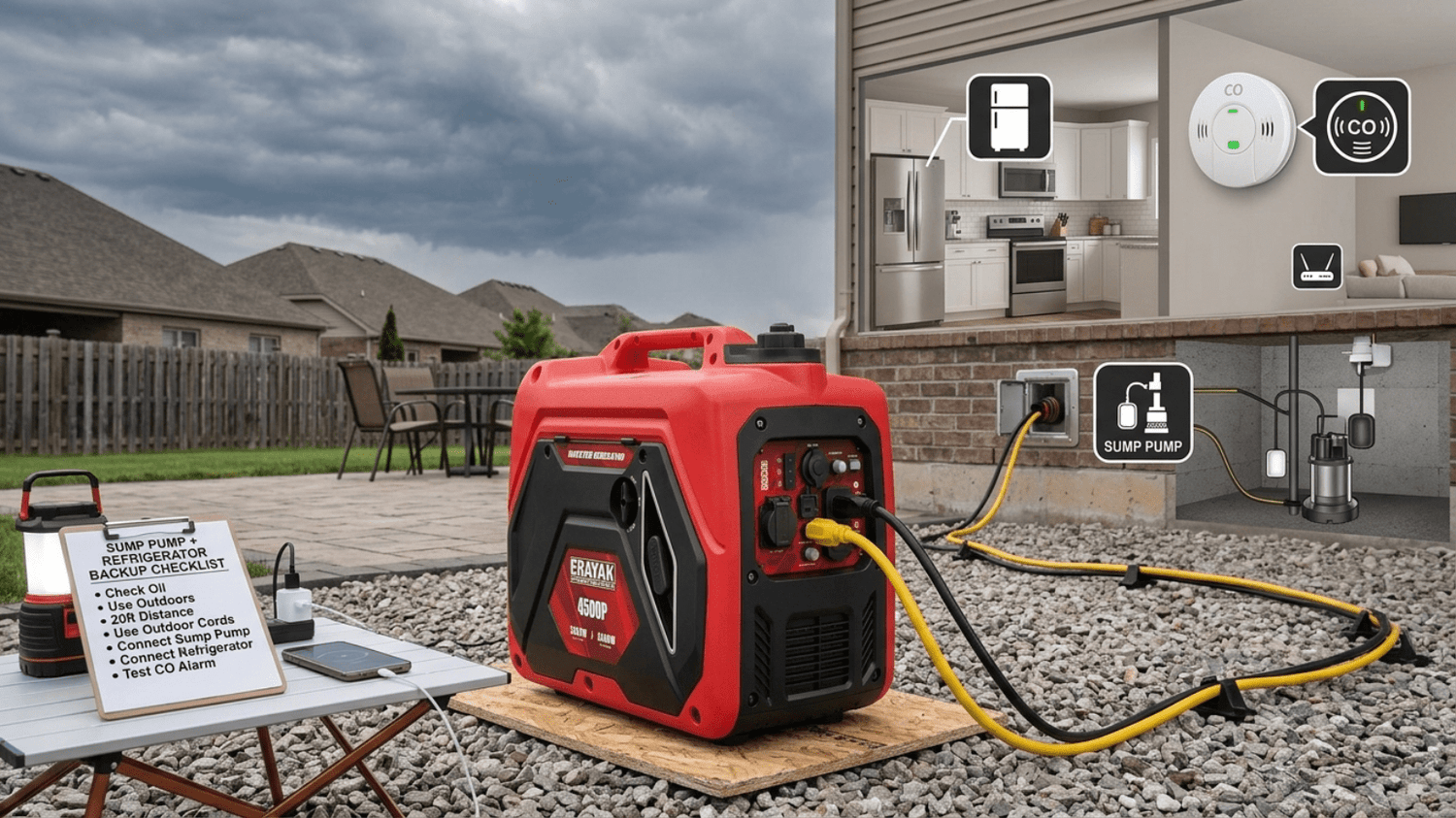
The Erayak 4500P is a strong home-backup option for managed loads such as a refrigerator, sump pump, lights, WiFi router, phone charging, fans, and coffee maker timing. For larger homes, frequent sump pump cycling, additional freezer loads, or 120V/240V planning, the Erayak 6800 series provides more headroom and 30A output options.
Why Sump Pump and Refrigerator Backup Matters
A power outage during heavy rain can create two problems at once. Your sump pump may stop removing water from the sump pit, while your refrigerator and freezer begin warming up. If the outage lasts long enough, you may face basement flooding, spoiled food, wet carpets, damaged storage items, and expensive cleanup.
Sump Pump Priority
In heavy rain, a sump pump can become the most important load in the house. If it stops, water can rise quickly.
Refrigerator Backup
Keeping the refrigerator and freezer cold helps protect groceries, frozen meals, medication storage, and household essentials.
Motor Loads Need Headroom
Both sump pumps and refrigerators may require extra startup power, so generator sizing should not rely on running watts alone.
Running Watts vs Starting Watts
When sizing a generator for a sump pump and refrigerator, the most important concept is the difference between running watts and starting watts.
| Term | Meaning | Why It Matters |
|---|---|---|
| Running watts | The power an appliance uses after it is already operating | Your generator must support the combined running watts of active loads |
| Starting watts | The extra short burst needed when a motor or compressor starts | Sump pumps and refrigerators can briefly demand more power at startup |
| Surge headroom | Extra generator capacity above normal running load | Helps prevent stalls, overload trips, and unstable operation |
| Load rotation | Running high-demand appliances one at a time | Helps a smaller generator handle essential backup tasks |
How Much Power Does a Sump Pump Need?
Sump pump power depends on horsepower, motor design, pump condition, lift height, pipe layout, and how often the pump cycles during a storm. Always check the pump label or manual for actual wattage or amperage.
| Sump Pump Size | Typical Use Case | Generator Planning Notes |
|---|---|---|
| 1/4 HP sump pump | Light-duty basement water removal | Usually easier to start, but still needs motor-starting headroom |
| 1/3 HP sump pump | Common residential sump pump size | Plan for both running power and startup surge |
| 1/2 HP sump pump | Higher water volume or deeper lift | Needs more generator headroom, especially during frequent cycling |
| Backup sump pump system | Battery or secondary pump support | Check charger and pump specifications separately |
| Older or heavily loaded pump | Worn pump, long discharge run, or high lift | May draw more power than expected and should be inspected before storm season |
How Much Power Does a Refrigerator Need?
A refrigerator is also a motor load. The compressor cycles on and off to maintain temperature. During startup, it may require more power than it uses once running. A full-size refrigerator, deep freezer, or second garage fridge should be counted separately.
| Refrigeration Load | Backup Priority | Generator Planning Notes |
|---|---|---|
| Main refrigerator | High | Keep food cold, but avoid opening doors frequently |
| Freezer section | High | Maintains frozen food if the refrigerator/freezer combo stays powered |
| Standalone deep freezer | Medium to high | Add only if generator has enough headroom after sump pump and main fridge |
| Garage refrigerator | Optional | May be a lower priority than sump pump, main fridge, lights, and communications |
| Mini fridge or medication fridge | Case-dependent | Check label and prioritize medical storage when needed |
What Size Generator Do You Need for a Sump Pump and Refrigerator?
The safest answer is: check your actual appliance labels and size from there. But for many homes, a generator in the 3000W to 4500W class provides a practical balance for one sump pump, one refrigerator, and several small essentials when loads are managed carefully.
| Backup Scenario | Typical Loads | Recommended Generator Planning |
|---|---|---|
| Basic emergency backup | Sump pump + refrigerator + phone charging | Size for motor starting surge and keep other loads minimal |
| Comfort backup | Sump pump + refrigerator + WiFi router + lights + fans | 3000W to 4500W class is often a practical starting point with load management |
| Food protection setup | Sump pump + refrigerator + deep freezer | Use more headroom or rotate freezer runtime if pump is cycling often |
| Storm-heavy basement protection | Sump pump cycling frequently + essential lights and communication | Prioritize the sump pump and avoid high-watt kitchen loads |
| Larger home backup | Sump pump + fridge + freezer + lights + WiFi + selected appliances | Consider a higher-output generator with 30A planning and clear load priority |
Load Management Plan for Outages
You do not need to run every appliance at the same time. A smart load plan lets your generator protect the basement, keep food cold, maintain communication, and support basic comfort without unnecessary overload.
| Priority Level | Loads | How to Manage Them |
|---|---|---|
| Priority 1 | Sump pump | Keep available headroom when rain is heavy or the pump is cycling frequently |
| Priority 2 | Main refrigerator / freezer combo | Run in cooling windows and keep doors closed |
| Priority 3 | WiFi router, phone charging, LED lights, battery radio | Low-load items that help with communication and safety |
| Priority 4 | Fans, laptop, small electronics | Add only after pump and refrigerator are stable |
| Rotate only | Coffee maker, microwave, kettle, toaster, space heater, power tools | Run separately and avoid using during sump pump startup or heavy cycling |
Safe Generator Setup for Sump Pump and Refrigerator Backup
Sump pump backup can be tricky because the pump is usually in a basement, while the generator must stay outdoors. The safest setup uses properly rated cords, dry elevated connections, and a clear route that avoids puddles, doors, sharp edges, and walking paths.
| Setup Area | Best Practice | What to Avoid |
|---|---|---|
| Generator placement | Outdoors, away from doors, windows, vents, garages, and enclosed spaces | Garage, basement, shed, covered porch, or near open windows |
| Cord route | Use rated cords and keep connections dry and elevated | Cords through puddles, wet grass, crushed door gaps, or damaged insulation |
| Sump pump connection | Use a properly rated cord that matches the pump load | Thin indoor cords or overloaded power strips |
| Refrigerator connection | Use a grounded cord rated for the appliance and distance | Frayed cords, loose plugs, or daisy-chained adapters |
| Home circuits | Use a properly installed transfer switch if powering circuits | Backfeeding through a wall outlet |
| Load startup | Add loads one at a time after the generator stabilizes | Starting pump, fridge, freezer, microwave, and coffee maker all at once |
Recommended Erayak Setup by Home Backup Need
Erayak 2400P: Compact Essential Backup
Choose the Erayak 2400P for compact emergency essentials such as phones, power banks, LED lights, WiFi router, laptop, small fans, and small electronics. For sump pump plus refrigerator backup, confirm your exact appliance wattage carefully before relying on this size class.
- Best for compact emergency electronics and light backup tasks
- Useful for lights, phones, router, laptop, and small fans
- Requires careful load management if used with motor loads
Erayak 4500P: Strong Starting Point for Sump Pump and Refrigerator Backup
Choose the Erayak 4500P when your home backup plan includes a sump pump, refrigerator, lights, WiFi router, phone charging, fans, laptop, and small appliance timing with managed loads.
- Gas-only portable inverter generator
- Manual recoil start
- 55 lb lightweight design
- 2.25 gal fuel tank
- Up to 8 hours runtime
- THD < 1.2% for sensitive electronics
- 60.5 dB noise level
Erayak 4500PD: Fuel Flexibility for Longer Outages
Choose the Erayak 4500PD when you want gasoline and propane flexibility for storm outages, basement flood protection, food backup, and mixed home emergency use.
- Gasoline and propane flexibility
- Useful for longer outage planning and flexible fuel storage
- Good fit for refrigerator, sump pump planning, lights, fans, charging, WiFi, and managed emergency loads
Erayak 6800PD / 6800PT: Larger Home Backup, 30A, and 120V/240V Planning
Choose the Erayak 6800 series when your backup plan needs more headroom for sump pump, refrigerator, freezer, lights, WiFi, selected appliance rotation, RV overlap, 30A outputs, and selected 120V/240V planning.
- 6800W peak power
- 5000W rated power on gasoline at 100% output
- 30A L5-30R outlet
- 30A 120V/240V L14-30R outlet
- Dual 120V household outlets
- TT-30R RV adapter accessory included
Generator Safety Checklist
Sump pump and refrigerator backup often happens during storms, rain, wet ground, basement flooding risk, and night outages. Keep the setup simple, dry, and safe.
- Run the generator outdoors only, away from doors, windows, vents, garages, crawlspaces, basements, sheds, and enclosed spaces.
- Never run a generator indoors or in a garage, even with doors or windows open.
- Keep generator exhaust pointed away from the home, neighboring homes, people, pets, and occupied areas.
- Use working carbon monoxide alarms inside the home.
- Use grounded, properly rated, outdoor extension cords.
- Inspect cords for fraying, cuts, crushed insulation, exposed wire, loose plugs, or missing ground pins.
- Do not use frayed, damaged, wet, crushed, loose, or overheated cords.
- Keep plug connections dry, elevated, and away from puddles, wet grass, rain runoff, sump water, and storm debris.
- Do not backfeed your home through a wall outlet.
- Use a properly installed transfer switch if powering selected home circuits.
- Disconnect loads before starting the generator.
- Add the sump pump and refrigerator one at a time after the generator stabilizes.
- Rotate high-demand appliances such as coffee makers, microwaves, kettles, heaters, and power tools.
- Let the generator cool before refueling or maintenance.
- Store fuel in approved containers away from flame, heat, stoves, grills, living areas, children, and ignition sources.
Protect Your Basement and Your Food During the Next Outage
A sump pump and refrigerator are two of the most important home backup loads. Choose a generator with enough starting watt headroom, use properly rated cords, prioritize the sump pump during heavy rain, rotate high-demand appliances, and keep the generator safely outdoors. For many homeowners, the Erayak 4500P is a strong starting point for managed sump pump and refrigerator backup, while the 6800 series adds more headroom for larger emergency plans.
FAQ: Sump Pump and Refrigerator Backup Generator Size
What size generator do I need to run a sump pump and refrigerator?
For many homes, a 3000W to 4500W class portable generator is a practical starting point for one sump pump, one refrigerator, and small essentials, but you must confirm your exact appliance running watts and starting watts before choosing.
Can a 4500W generator run a sump pump and refrigerator?
In many managed home backup setups, yes. A 4500W class generator can often support a sump pump, refrigerator, lights, WiFi router, phone charging, and small fans when loads are added gradually and high-demand appliances are rotated.
Can I run a sump pump and fridge at the same time?
Yes, if the generator has enough running watt capacity and enough starting watt headroom for motor startup. Since both are motor loads, avoid starting additional high-demand appliances while the pump or refrigerator is cycling.
Should the sump pump or refrigerator get priority?
During heavy rain, the sump pump should usually be the top priority because basement flooding can happen quickly. The refrigerator can often be managed in cooling windows while keeping the doors closed as much as possible.
Can I plug a sump pump directly into a generator?
You may power a sump pump with a properly rated outdoor extension cord if the pump and generator ratings are compatible. Keep connections dry and elevated, and never run the generator indoors, in a garage, or in the basement.
Can I power my whole house with a portable generator?
A portable generator should not be connected to home wiring through a wall outlet. If you want to power selected circuits, use a properly installed transfer switch or inlet setup designed by a qualified electrician.
What Erayak generator is best for sump pump and refrigerator backup?
The Erayak 4500P is a strong starting point for managed sump pump and refrigerator backup. The 4500PD adds fuel flexibility, while the 6800 series provides more headroom, 30A outputs, and selected 120V/240V planning for larger backup setups.
