

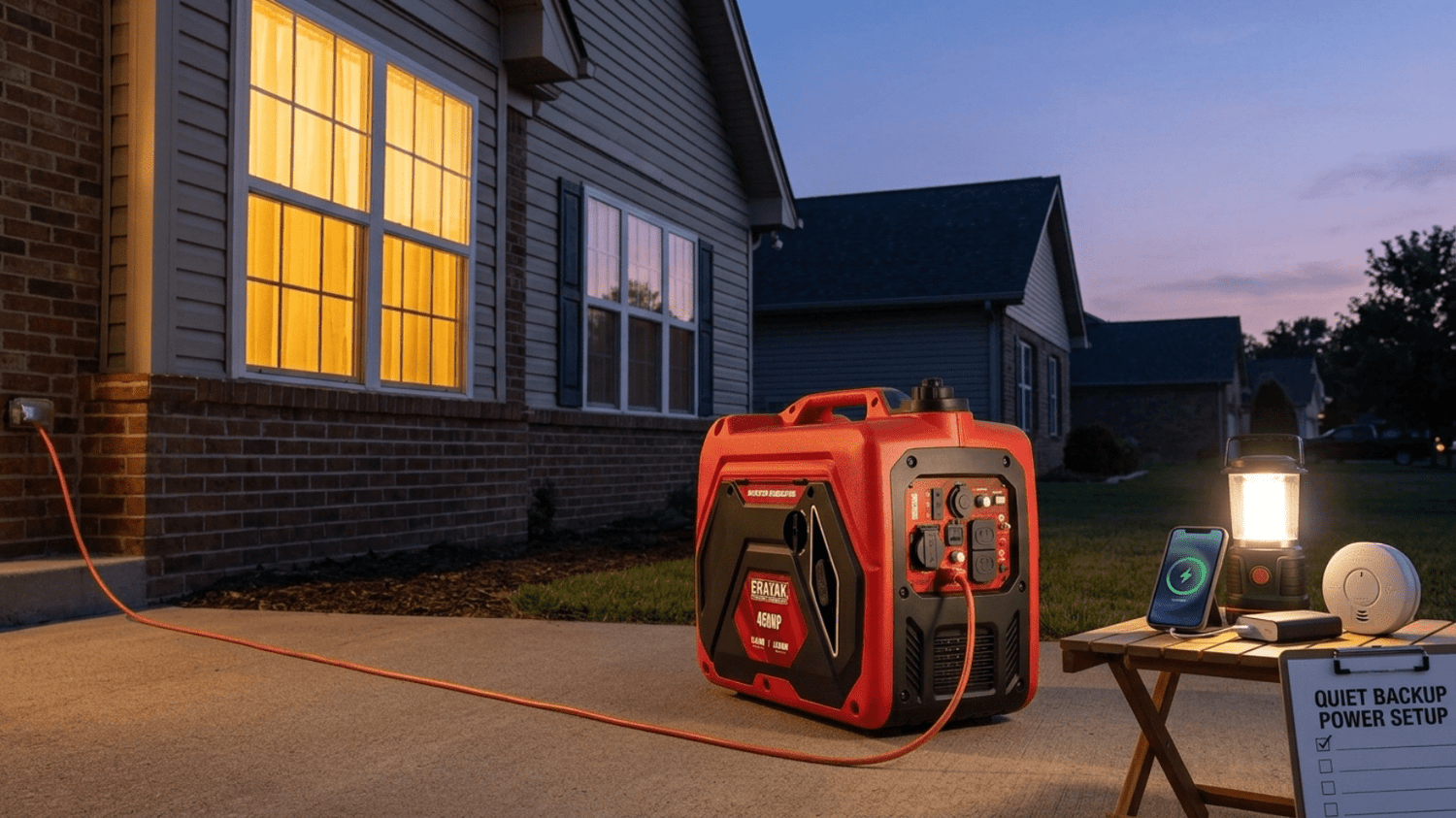
Quiet Backup Power for Home: How to Reduce Generator Noise During an Outage
During a power outage, a portable generator can keep your refrigerator, lights, Wi-Fi, fans, phone chargers, sump pump, and essential devices running. But generator noise can quickly become stressful for your family and your neighbors, especially at night. The good news: quieter backup power is possible when you choose the right generator, place it correctly, manage loads, and avoid unsafe noise-reduction mistakes.
Quick Answer
To reduce generator noise during a home outage, choose an inverter generator when possible, place the generator outdoors on a stable surface, point the exhaust away from people and neighboring homes, avoid hard echo surfaces, use longer properly rated cords when safe, reduce unnecessary loads, run heavy appliances in planned windows, and never put the generator inside a garage, shed, box, basement, crawlspace, or enclosed space.
For quiet backup power, the Erayak 4500P is a strong starting point for managed home outage loads. It is a gas-only portable inverter generator with manual recoil start, 55 lb lightweight design, 2.25 gal fuel tank, up to 8 hours runtime, THD < 1.2%, and 60.5 dB noise level.
Why Generator Noise Matters During an Outage
In an outage, generator noise is more noticeable because the neighborhood is quieter than usual. Streetlights may be off, appliances are silent, and people may be trying to sleep with windows closed and limited ventilation. A loud generator can create stress, neighbor complaints, poor sleep, and pressure to make unsafe placement decisions.
Better Sleep and Less Stress
Lower noise helps your family rest, communicate, and stay calm during a long blackout.
More Considerate Backup Power
A quieter setup reduces noise spillover toward nearby homes, fences, windows, and outdoor spaces.
Less Temptation to Place It Unsafely
When noise is planned properly, you are less likely to move the generator into a garage, shed, porch, or enclosed area.
Where Generator Noise Comes From
Generator noise is not just one sound. It comes from engine combustion, exhaust flow, cooling fans, vibration, surface reflection, and changing load demand. Understanding the source helps you reduce noise without creating a safety hazard.
| Noise Source | What You Hear | How to Reduce It |
|---|---|---|
| Engine speed | Higher pitch or louder running under load | Use an inverter generator and reduce unnecessary loads |
| Exhaust direction | Sharp noise aimed toward a house or neighbor | Point exhaust away from people, windows, and neighboring homes |
| Vibration | Rattling or humming through hard surfaces | Place generator on stable level ground, not loose boards or metal surfaces |
| Reflected sound | Echo from walls, fences, garages, or corners | Avoid placing the generator in hard-surface corners |
| Overloaded operation | Straining, surging, or unstable sound | Rotate high-demand appliances and stay within generator capacity |
| Poor maintenance | Rough running, popping, surging, or uneven idle | Use fresh fuel, clean air filter, proper oil, and maintained carburetor |
Choose a Quieter Generator Type
The easiest way to get quieter backup power is to start with a quieter generator design. Inverter generators are often preferred for home backup comfort because they can adjust engine speed based on demand and typically produce cleaner power for sensitive electronics.
| Generator Type | Noise Behavior | Best Use |
|---|---|---|
| Traditional open-frame generator | Often louder, especially under steady load | Jobsites, high-output use, situations where noise is less important |
| Portable inverter generator | Usually quieter and smoother for home emergency loads | Refrigerator, lights, router, fans, phones, laptops, selected appliances |
| Dual-fuel inverter generator | Noise depends on model and load, with flexible fuel planning | Longer outages, propane/gasoline flexibility, storm preparation |
| Larger generator running light load | Can be quieter than when heavily loaded, but may still be physically larger | More headroom for managed home loads, RV, pump, or 30A planning |
Generator Placement Tips to Reduce Noise
Placement can make a big difference. You want the generator far enough from occupied spaces to reduce noise and carbon monoxide risk, but still connected with properly rated cords. Never choose noise reduction over safe exhaust placement.
| Placement Tip | Why It Helps Noise | Safety Reminder |
|---|---|---|
| Move it farther from living areas | Distance reduces perceived noise | Use only properly rated outdoor cords and keep connections dry |
| Point exhaust away from people | Directs sharper exhaust sound away from occupied areas | Also helps keep exhaust away from doors, windows, and vents |
| Avoid hard corners | Walls and fences can reflect and amplify sound | Never place inside a garage, shed, porch, or enclosure |
| Use stable ground | Reduces rattling and vibration | Keep the generator level, dry, and clear of debris |
| Use natural barriers carefully | Fences or landscaping can reduce direct sound | Do not block airflow or trap exhaust |
| Keep cords organized | Lets you place the generator safely without shortcuts | Never use damaged, undersized, wet, or frayed cords |
How Load Management Reduces Generator Noise
A generator usually gets louder as demand increases. Running every appliance at once can make the engine work harder, increase fuel use, raise noise, and create overload risk. A simple load plan can make backup power quieter and more reliable.
| Load Type | Examples | Quiet Backup Strategy |
|---|---|---|
| Priority continuous loads | Refrigerator, freezer, Wi-Fi router, phone charging, LED lights | Keep these planned and avoid unnecessary extras |
| Comfort loads | Fans, laptop, TV, small electronics | Use only what your family needs during quiet hours |
| Short high-demand loads | Coffee maker, microwave, kettle, toaster | Run one at a time, then return to quiet baseline loads |
| Motor loads | Sump pump, furnace blower, well pump, garage door opener | Allow startup headroom and avoid stacking other heavy loads |
| Nonessential loads | Decorative lights, large entertainment systems, extra chargers | Turn off during overnight or low-noise periods |
Quiet Backup Power Tips for Night Use
Overnight outages are where generator noise matters most. The goal is to reduce demand, avoid unnecessary cycling, and keep the generator operating safely outdoors without disturbing the household more than necessary.
Run Fewer Loads Overnight
Keep only essentials connected. Avoid microwave, coffee maker, kettle, toaster, electric heater, or unnecessary lighting while people sleep.
Charge Devices Before Bed
Charge phones, power banks, radios, and laptops earlier in the evening so the generator can run lighter overnight.
Plan Refrigerator Runtime
Keep refrigerator and freezer doors closed, then run cooling loads in planned windows instead of constantly adding extra loads.
Noise-Reduction Mistakes to Avoid
Some common noise-reduction ideas are dangerous. Never trade safety for a quieter sound. A generator that is quiet because it is enclosed, overheated, or too close to the home is not a safe backup power solution.
| Mistake | Why It Is Dangerous | Better Option |
|---|---|---|
| Putting generator in garage | Carbon monoxide can enter the home even with doors open | Run outdoors away from openings |
| Building a sealed sound box | Can trap heat and exhaust | Use safe placement, distance, and rated cords |
| Covering a running generator | Can cause overheating and fire risk | Use covers only for storage after cooling |
| Using undersized long cords | Can overheat and cause voltage drop | Use outdoor-rated cords sized for load and distance |
| Placing near a fence corner | Sound can reflect and exhaust can become trapped | Keep open airflow and point exhaust safely away |
| Ignoring rough running | Surging may increase noise and indicate fuel or maintenance problems | Check fuel, oil, air filter, spark plug, and carburetor |
Recommended Erayak Setup for Quiet Home Backup
Erayak 2400P: Compact Quiet Essentials
Choose the Erayak 2400P when your quiet backup plan focuses on phones, LED lights, router, laptop, small fans, power banks, battery radio, and light home emergency essentials.
- Good fit for compact home backup and low-load outage support
- Useful for charging, lights, fans, Wi-Fi, laptop, and small electronics
- Best for families that want a lighter essential-load plan
Erayak 4500P: Quiet Home Backup Starting Point
Choose the Erayak 4500P when your home outage plan includes managed loads such as refrigerator, lights, fans, Wi-Fi router, phones, laptop, coffee maker timing, and selected household essentials.
- Gas-only portable inverter generator
- Manual recoil start
- 55 lb lightweight design
- 2.25 gal fuel tank
- Up to 8 hours runtime
- THD < 1.2% for sensitive electronics
- 60.5 dB noise level
Erayak 4500PD: Fuel Flexibility for Longer Quiet Outages
Choose the Erayak 4500PD when you want gasoline and propane flexibility for storm season, hurricane prep, winter outages, longer blackouts, and mixed home and outdoor backup use.
- Gasoline and propane flexibility
- Useful for longer outage planning and flexible fuel storage
- Good fit for refrigerator, lights, fans, charging, Wi-Fi, and managed appliance timing
Erayak 6800PD / 6800PT: More Headroom for Managed Home Loads
Choose the Erayak 6800 series when your backup plan needs more headroom, 30A outlets, selected 120V/240V planning, pump planning, RV/home overlap, and multiple power zones.
- 6800W peak power
- 5000W rated power on gasoline at 100% output
- 30A L5-30R outlet
- 30A 120V/240V L14-30R outlet
- Dual 120V household outlets
- TT-30R RV adapter accessory included
Quiet Generator Safety Checklist
Quiet backup power should never come from unsafe placement. The safest noise-reduction plan starts with outdoor operation, open airflow, dry rated cords, and smart load management.
- Run the generator outdoors only, away from doors, windows, vents, garages, crawlspaces, basements, sheds, and enclosed spaces.
- Never run a generator indoors or in a garage, even with doors or windows open.
- Do not place a generator in a shed, box, enclosed porch, basement, crawlspace, RV compartment, or DIY sound enclosure while running.
- Keep the generator away from people, pets, children, windows, vents, doors, and sleeping areas.
- Point exhaust away from the home, neighboring homes, tents, RVs, and occupied areas.
- Use working carbon monoxide alarms inside the home.
- Use grounded, properly rated, outdoor extension cords.
- Inspect cords for fraying, cuts, crushed insulation, exposed wire, loose plugs, or missing ground pins.
- Do not use frayed, damaged, wet, crushed, undersized, or loose cords.
- Keep plug connections dry, elevated, and away from puddles, snow, wet grass, and rain runoff.
- Do not backfeed your home through a wall outlet.
- Use a properly installed transfer switch if powering selected home circuits.
- Disconnect loads before starting the generator.
- Add loads gradually after the generator stabilizes.
- Rotate high-demand appliances such as coffee makers, microwaves, kettles, pumps, heaters, and cooking appliances.
- Let the generator cool before refueling, covering, storing, or maintenance.
Build Quieter Backup Power Before the Next Outage
A quieter outage setup starts with the right generator, the right placement, and the right load plan. Choose a portable inverter generator, place it safely outdoors, point exhaust away from occupied spaces, use properly rated cords, and run only the loads your family truly needs. For many home backup users, Erayak 4500P offers a strong balance of power, portability, runtime, low THD, and quieter inverter performance.
FAQ: Quiet Backup Power for Home
How can I reduce generator noise during a power outage?
Choose a quieter inverter generator, place it outdoors away from living areas, point exhaust away from people and neighboring homes, avoid echo-prone hard corners, use properly rated outdoor cords, and reduce unnecessary loads.
Can I put a generator in a box to make it quieter?
No. A sealed or poorly ventilated box can trap heat and carbon monoxide. Never enclose a running generator. Use safe outdoor placement, distance, load management, and a quieter generator design instead.
Can I run a generator in the garage if the door is open?
No. Never run a portable generator in a garage, basement, crawlspace, shed, enclosed porch, or indoor space, even with doors or windows open. Run it outdoors away from openings.
Are inverter generators quieter for home backup?
Inverter generators are often a better choice for quiet home backup because they can adjust engine speed based on load and are commonly designed for lower-noise portable power.
Does reducing load make a generator quieter?
Often, yes. A generator usually runs harder and louder under heavier load. Turning off nonessential devices and rotating high-demand appliances can reduce noise, fuel use, and overload risk.
Where should I place a generator to reduce noise safely?
Place it outdoors on dry stable ground, away from doors, windows, vents, garages, and occupied areas. Avoid hard echo corners and point exhaust away from your home and neighboring homes.
What Erayak generator is best for quiet home backup?
Choose the Erayak 2400P for compact essentials, the Erayak 4500P for managed home backup loads with quieter inverter performance, the 4500PD for fuel flexibility, and the 6800 series for larger home, RV, 30A, and 120V/240V planning.
