

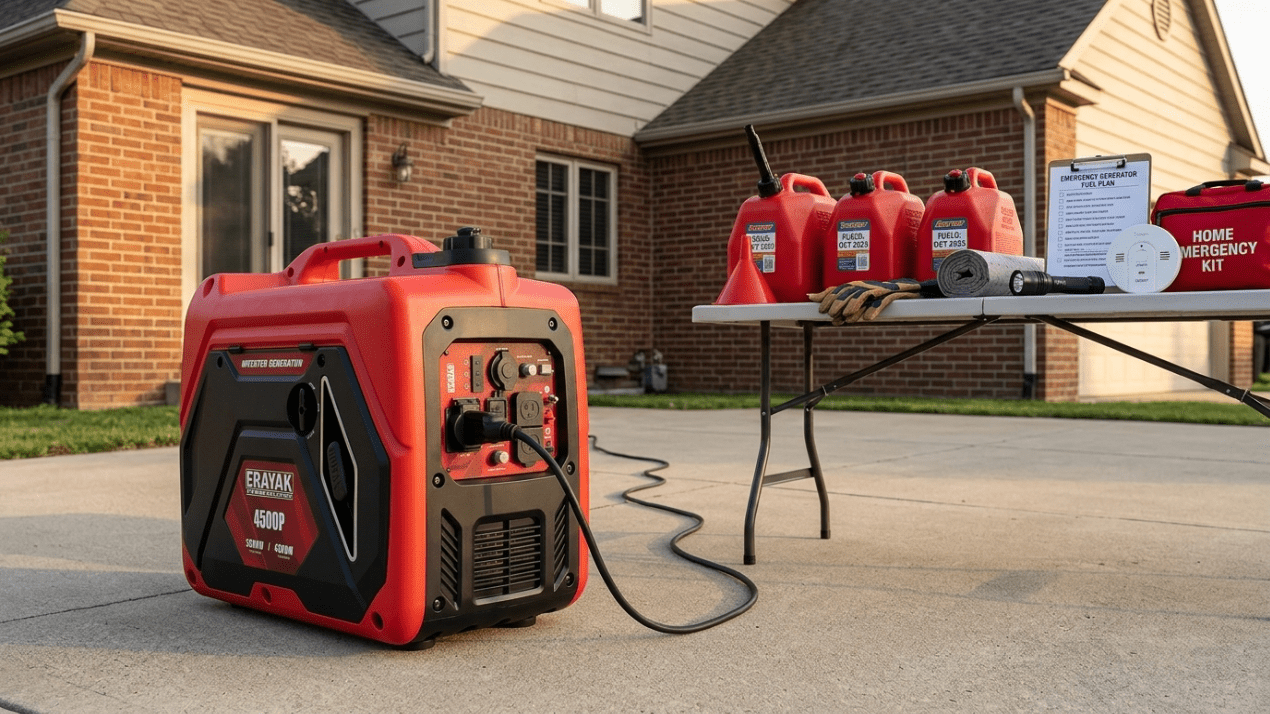
How to Store Gasoline for Emergency Generator Use: Safety, Shelf Life and Backup Power Tips
A portable generator is only useful during an outage if you also have a safe, realistic fuel plan. Learning how to store gasoline for emergency generator use helps you prepare for storms, blackouts, hurricane season, winter outages, and home backup situations without creating unnecessary fire, spill, or stale-fuel problems.
Quick Answer
To store gasoline for emergency generator use, keep fuel in approved gasoline containers, label each container with the purchase date, store it in a cool and well-ventilated location away from living areas, flames, sparks, heaters, direct sunlight, and generator exhaust, and rotate fuel before it becomes stale. Plan your fuel supply around realistic generator runtime, not guesswork.
Never refuel a hot generator. Shut the generator down, let it cool, keep fuel away from ignition sources, and wipe up spills before restarting. For home backup, combine safe gasoline storage with a generator load plan, outdoor-rated cords, transfer switch planning where applicable, carbon monoxide safety, and routine generator maintenance.
Why Gasoline Storage Matters for Emergency Generator Use
Many homeowners think about generator watts first: refrigerator, lights, sump pump, furnace blower, freezer, router, phones, and medical chargers. But during a real outage, fuel becomes the limiting factor. If your gasoline is stale, stored in the wrong container, placed near ignition sources, or not enough for the loads you plan to run, your backup power plan can fail quickly.
Stale Fuel
Old gasoline can make starting harder and may cause rough running, clogged carburetor issues, or unreliable emergency performance.
Unsafe Storage
Gasoline should not be treated like ordinary household storage. Heat, flame, sparks, pilot lights, and poor ventilation can create serious hazards.
Underplanned Runtime
A generator running heavy loads burns more fuel. A fuel plan should match your essential-load strategy, not every appliance in the house.
Use Approved Gasoline Containers
Do not store emergency generator gasoline in random bottles, jugs, buckets, glass containers, open containers, or unmarked containers. Use approved gasoline containers designed for fuel storage and transport.
| Container Rule | Why It Matters | Best Practice |
|---|---|---|
| Use approved gasoline cans | Gasoline containers are designed for fuel, vapor control, and pouring | Use containers marked for gasoline, not general-purpose jugs |
| Keep caps closed | Reduces spill and vapor release risk | Close caps tightly after filling, pouring, and transport |
| Label purchase date | Helps rotation and prevents stale fuel surprises | Write month/year on each container |
| Do not overfill | Fuel can expand with temperature changes | Follow the container fill line and instructions |
| Inspect before storage | Damaged cans can leak or vent improperly | Replace cracked, leaking, swollen, rusty, or damaged containers |
| Use a controlled pour spout | Reduces spills around the generator | Pour slowly and use a funnel or spout designed for fuel |
Where to Store Gasoline Safely
The best gasoline storage location is cool, dry, well ventilated, protected from direct sunlight, and away from anything that can ignite vapors. It should also be separated from living spaces and easy for adults to access during an outage.
| Storage Location Factor | Good Choice | Avoid |
|---|---|---|
| Ventilation | Detached, ventilated storage area where allowed | Bedrooms, closets, basements, living rooms, laundry rooms, or enclosed indoor spaces |
| Heat exposure | Cool shaded area | Direct sunlight, hot sheds, heaters, furnaces, water heaters, dryers, and stoves |
| Ignition sources | Separate from flame, sparks, pilot lights, switches, and tools | Near grills, fire pits, welding areas, electrical panels, chargers, or smoking areas |
| Children and pets | Locked or controlled access | Open shelves, reachable corners, play areas, patios, and walkways |
| Generator distance | Fuel stored away from generator exhaust and hot surfaces | Next to a running generator, on the generator, or near the muffler |
| Local rules | Follow local fire code and storage quantity limits | Large unapproved fuel stockpiles or storage that violates local rules |
How Much Gasoline Should You Store for a Generator?
The right amount depends on the generator model, tank size, load level, outage risk, storage rules, and how often you can safely refuel. Instead of trying to power the entire house continuously, build a priority-load plan.
| Backup Goal | Typical Priority Loads | Fuel Planning Strategy |
|---|---|---|
| Short evening outage | Lights, phones, router, small electronics | Run only when needed and recharge devices in batches |
| Food protection | Refrigerator, freezer, phones, lights | Cycle fridge and freezer instead of running every appliance continuously |
| Storm overnight plan | Refrigerator, sump pump, furnace blower planning, lights, phone charging | Rotate heavy loads and avoid running nonessential appliances |
| Hurricane preparation | Fridge, freezer, fans, router, phones, lights, small medical chargers | Plan for multiple fuel windows and local refueling delays |
| Winter outage | Furnace blower, lights, phones, router, selected refrigerator cycles | Prioritize heat-related loads and avoid unnecessary high-watt appliances |
| Family emergency kit | Phones, lights, radio, power banks, fridge cycles, essential comfort loads | Use generator runtime windows rather than running all day |
Fuel Shelf Life and Rotation Plan
Emergency generator gasoline should not sit forgotten for years. A simple rotation system helps keep your backup plan ready without wasting fuel.
| Rotation Step | What to Do | Why It Helps |
|---|---|---|
| Date every container | Write the purchase date on the fuel can | Prevents guessing during storm season |
| Use first-in, first-out | Use the oldest fuel first | Reduces stale-fuel risk |
| Schedule inspection | Check cans, caps, smell, leaks, swelling, rust, and storage area | Catches problems before an emergency |
| Refresh before storm season | Rotate old fuel into approved equipment or vehicle use where appropriate | Keeps emergency fuel supply current |
| Use stabilizer if appropriate | Follow fuel stabilizer label and generator manual guidance | Can help extend storage life when used correctly |
| Test the generator | Run maintenance checks before storm season | Confirms the generator starts before you need it |
Safe Refueling During a Power Outage
Refueling is one of the most important fuel-safety moments. A generator can remain hot after shutdown, and gasoline spilled on hot engine parts can ignite. Treat refueling as a controlled step, not a quick top-off.
| Refueling Step | Do This | Do Not Do This |
|---|---|---|
| Before refueling | Turn off connected loads, shut down the generator, and let it cool | Never refuel while the generator is running or hot |
| Fuel handling | Use an approved fuel container and controlled pour spout | Do not pour from unapproved containers |
| Spill control | Wipe spills and move fuel away before restarting | Do not restart with spilled gasoline nearby |
| Ignition control | Keep fuel away from flame, sparks, cigarettes, grills, and fire pits | Do not smoke while fueling or storing gasoline |
| After refueling | Close the fuel cap, move container away, then restart safely | Do not leave cans open near the generator |
| Night outage | Use a flashlight or battery lantern | Do not use candles, lighters, or open flame near gasoline |
Emergency Generator Gasoline Storage Checklist
Use this checklist before hurricane season, winter storm season, wildfire outage season, or any period when grid power may be unreliable.
| Checklist Item | Purpose | Best Practice |
|---|---|---|
| Approved gasoline containers | Safe fuel storage and transport | Use only containers designed and marked for gasoline |
| Date labels | Fuel rotation | Mark purchase date and planned rotation date |
| Fuel stabilizer | Longer storage support | Use only according to label and generator manual guidance |
| Cool storage area | Reduces heat exposure | Keep away from sunlight, heaters, furnaces, dryers, and hot generator parts |
| Ventilated storage area | Reduces vapor buildup risk | Do not store gasoline in living areas |
| Spill supplies | Cleanup readiness | Keep absorbent material, gloves, and waste bag available |
| Flashlight or battery lantern | Night refueling support | Use battery light, not candles or flame |
| Printed load plan | Fuel efficiency | Prioritize refrigerator, freezer, sump pump, furnace blower, lights, phones, router, and essential chargers |
| Generator maintenance kit | Readiness | Keep oil, funnel, rag, spark plug, air filter, and manual accessible |
| CO alarms | Life safety | Install and test carbon monoxide alarms near sleeping areas and occupied spaces |
Recommended Erayak Setup by Outage Fuel Plan
Erayak 2400P: Compact Emergency Essentials
Choose the Erayak 2400P when your gasoline storage plan is focused on compact emergency essentials such as phones, power banks, lights, router, battery radio, laptop charging, small electronics, and low-load backup windows.
- Good fit for low-load home emergency kits
- Useful for charging, lights, radio, router, laptop, and small electronics
- Best when refrigerator, pump, furnace blower, microwave, kettle, and heavy loads are not the main focus
Erayak 4500P: Practical Gasoline Backup for Managed Home Loads
Choose the Erayak 4500P when your emergency gasoline plan includes managed home loads such as refrigerator, freezer, phones, lights, router, selected furnace blower planning, sump pump planning, fans, and sensitive electronics.
- Gas-only portable inverter generator
- Manual recoil start
- 55 lb lightweight design
- 2.25 gal fuel tank
- Up to 8 hours runtime
- THD < 1.2% for sensitive electronics
- 60.5 dB noise level
Erayak 4500PD: Gasoline and Propane Flexibility
Choose the Erayak 4500PD when your emergency fuel plan includes both gasoline and propane flexibility. This can help families plan longer outages with more fuel options and better storage flexibility.
- Gasoline and propane flexibility
- Useful for longer emergency windows and flexible fuel planning
- Good fit for refrigerator, freezer, lights, fans, router, charging, and managed home backup loads
Erayak 6800PD / 6800PT: Larger Emergency Backup and 120V/240V Planning
Choose the Erayak 6800 series when your outage plan includes bigger headroom, selected 120V/240V planning, 30A output needs, RV adapter support, larger home backup windows, pump planning, food preservation, and multi-zone emergency power.
- 6800W peak power
- 5000W rated power on gasoline at 100% output
- 30A L5-30R outlet
- 30A 120V/240V L14-30R outlet
- Dual 120V household outlets
- TT-30R RV adapter accessory included
Generator Fuel Safety Checklist
Gasoline storage and generator use must be treated as part of the same emergency plan. Safe fuel storage will not help if the generator is operated indoors, refueled hot, overloaded, backfed, or connected with damaged cords.
- Store gasoline only in approved gasoline containers.
- Label every container with purchase date and rotation date.
- Store gasoline in a cool, ventilated location away from living areas, flame, sparks, pilot lights, heaters, stoves, grills, fire pits, direct sun, and hot generator parts.
- Keep gasoline away from children, pets, vehicles, walkways, and food preparation areas.
- Do not store gasoline in basements, living rooms, bedrooms, closets, laundry rooms, or near appliances with ignition sources.
- Follow local fire code, residential fuel storage limits, and manufacturer instructions.
- Run the generator outdoors only, away from doors, windows, vents, garages, enclosed spaces, and occupied areas.
- Never run a generator inside a home, garage, basement, crawlspace, shed, tent, RV, vehicle, or enclosed shelter.
- Point exhaust away from people, doors, windows, vents, neighboring homes, and sleeping areas.
- Install and test carbon monoxide alarms near sleeping areas and occupied indoor spaces.
- Use properly rated, grounded, outdoor extension cords.
- Inspect cords for cuts, fraying, crushed insulation, heat damage, loose plugs, or missing ground pins.
- Never use damaged, frayed, cut, crushed, or loose extension cords.
- Disconnect loads before starting or stopping the generator.
- Add appliances gradually after the generator stabilizes.
- Do not backfeed a home through a wall outlet. Use a properly installed transfer switch where applicable.
- Shut the generator down and let it cool before refueling or maintenance.
- Wipe up spills and move fuel containers away before restarting.
- Never smoke or use candles, lighters, grills, stoves, or open flame near gasoline storage or refueling.
Build a Safer Emergency Generator Fuel Plan
Start with approved gasoline containers, date labels, a fuel rotation schedule, a safe storage location, and a realistic load plan. Then match your generator to essential outage needs such as refrigeration, sump pump planning, furnace blower planning, lights, phones, router, fans, and sensitive electronics. Choose Erayak 2400P for compact emergency essentials, 4500P for managed gasoline backup, 4500PD for fuel flexibility, and the 6800 series for larger home backup and 120V/240V planning.
FAQ: How to Store Gasoline for Emergency Generator Use
How should I store gasoline for emergency generator use?
Store gasoline in approved gasoline containers, label each container with the purchase date, keep it in a cool and ventilated location away from living areas and ignition sources, and rotate it regularly before it becomes stale.
Can I store gasoline in my garage for a generator?
Local rules vary. In general, gasoline should be stored away from living areas, flame, sparks, pilot lights, heaters, dryers, stoves, and other ignition sources. Follow local fire code, storage quantity limits, and container requirements.
How much gasoline should I store for a portable generator?
The right amount depends on your generator, expected outage length, essential loads, fuel consumption, local storage limits, and your ability to rotate fuel safely. Store only what you can safely manage and legally keep.
Does gasoline go bad in storage?
Yes. Gasoline can degrade over time, especially when stored poorly. Use date labels, rotate fuel regularly, inspect containers, and consider fuel stabilizer when appropriate according to the stabilizer label and generator manual.
Can I refuel a generator while it is running?
No. Shut the generator down and let it cool before refueling. Gasoline spilled on hot generator parts can ignite and cause fire or burn hazards.
Where should gasoline be kept during a power outage?
Keep gasoline in approved containers away from the running generator, exhaust, hot surfaces, doors, windows, vents, living areas, children, pets, fire pits, grills, smoking areas, and electrical sparks.
What Erayak generator is best for emergency gasoline backup?
Choose the Erayak 2400P for compact emergency essentials, the Erayak 4500P for managed gasoline backup loads, the Erayak 4500PD for gasoline and propane flexibility, and the Erayak 6800 series for larger home backup, 30A output needs, and selected 120V/240V planning.
