

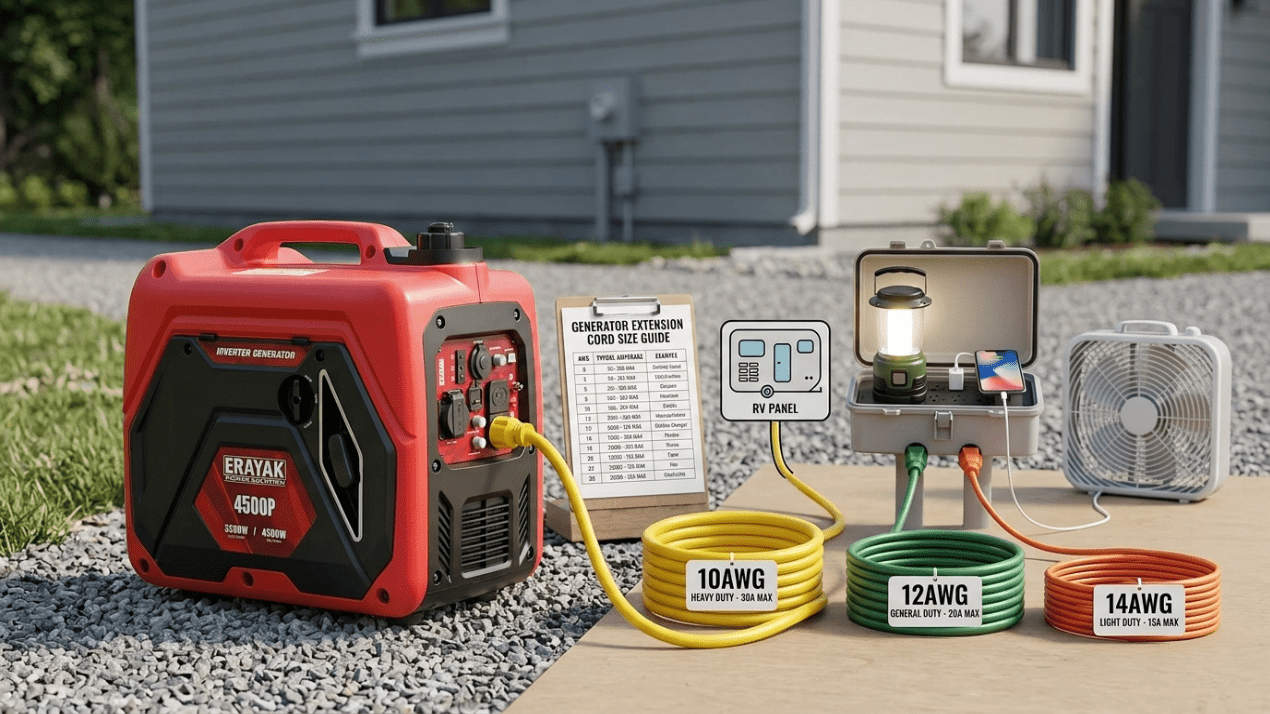
Generator Extension Cord Size Guide: 10AWG vs 12AWG vs 14AWG
Choosing the right generator extension cord size is just as important as choosing the right portable generator. A cord that is too thin, too long, damaged, or underrated can create voltage drop, poor appliance performance, overheating, and safety risks. This guide explains how to compare 10AWG, 12AWG, and 14AWG extension cords for home backup, RV camping, outdoor events, jobsite power, and family emergency setups.
Quick Answer
For generator use, a lower AWG number means a thicker cord. 10AWG is the heaviest of the three and is usually the better choice for longer runs, higher loads, RV adapters, larger appliances, and 30A-style planning when the cord is properly rated. 12AWG is a strong middle option for many household loads, camping loads, tools, fans, refrigerators, and moderate generator use. 14AWG should generally be reserved for shorter, lighter loads such as LED lights, phone chargers, small electronics, and low-power accessories.
Always check the cord label, generator outlet rating, appliance wattage, plug type, cord length, and outdoor rating before use. Do not use damaged, frayed, crushed, cut, or underrated extension cords with a generator.
What Does AWG Mean?
AWG stands for American Wire Gauge. It describes wire thickness. With extension cords, the important rule is simple: the lower the AWG number, the thicker the wire. A 10AWG cord is thicker than a 12AWG cord, and a 12AWG cord is thicker than a 14AWG cord.
Thickest of the Three
Better for heavier loads, longer runs, RV-style connections, higher current planning, and larger generator setups when the cord is properly rated.
Heavy-Duty Middle Ground
A practical choice for many generator users who need more headroom than 14AWG but do not need a full 10AWG setup.
Light-Duty Planning
Best for shorter, lighter loads such as lights, phone charging, small fans, radios, routers, and small electronics.
10AWG vs 12AWG vs 14AWG Generator Cord Comparison
The table below is a practical planning guide. Always follow the rating printed on the cord itself. Two cords with the same gauge may have different ratings depending on construction, jacket type, length, plug type, and manufacturer.
| Cord Gauge | Best For | Typical Generator Use | Use With Caution |
|---|---|---|---|
| 10AWG | Heavier loads, longer cord runs, larger appliances, RV-style use, 30A-style planning when properly rated | RV adapter setups, larger refrigerators, sump pumps, jobsite tools, multiple managed loads, 6800W-class generator planning | Still must match plug type, outlet rating, voltage, length, and cord label |
| 12AWG | Moderate to heavy household and outdoor loads | Refrigerator, freezer, fans, lights, router, coffee maker timing, small tools, camping power, home essentials | Do not overload with multiple heating or motor loads at once |
| 14AWG | Shorter, lighter-load use | LED lights, phones, power banks, battery chargers, radios, small fans, light electronics | Not ideal for long runs, heavy appliances, large tools, pumps, heaters, or high-watt kitchen loads |
Why Cord Length Matters
Cord length matters because longer cords create more voltage drop. Voltage drop can make motors work harder, reduce appliance performance, trip protection, and increase heat in the cord. That is why a cord that works for a short light-duty setup may be the wrong choice for a longer generator run.
| Cord Length Situation | Risk | Better Strategy |
|---|---|---|
| Short run with low loads | Usually easier to manage | Use a properly rated outdoor cord; 14AWG may be acceptable for light loads |
| Medium run with mixed loads | More voltage drop and more heat potential | Consider 12AWG for better headroom |
| Long run with heavier loads | Higher voltage drop risk | Consider 10AWG or a generator cord designed for the outlet and load |
| Long run with motor loads | Startup demand can make voltage drop worse | Use a thicker cord and start one motor load at a time |
| Long run with heating loads | Continuous high current can overheat underrated cords | Use a properly rated heavy-duty cord and rotate loads |
| Multiple cords connected together | More connections, more resistance, more failure points | Use one correctly sized cord of the proper length instead |
Matching Cord Size to Generator Loads
The right extension cord depends on what you are powering. Lights and phones are not the same as refrigerators, pumps, power tools, coffee makers, microwaves, griddles, or RV loads. The more current the load needs, the more important cord gauge becomes.
| Load Type | Examples | Suggested Cord Planning |
|---|---|---|
| Light electronics | Phones, power banks, LED lights, radios, small chargers | 14AWG may work for short light-duty runs; 12AWG adds margin |
| Moderate household loads | Router, laptop, fans, small TV, battery chargers | 12AWG is a practical general-use choice |
| Compressor loads | Refrigerator, freezer, mini fridge, portable cooler | 12AWG or 10AWG depending on length, startup demand, and cord rating |
| Pump loads | Sump pump, well pump support, RV water pump, small utility pump | Often better with 10AWG or a dedicated heavy-duty generator cord |
| Heating appliances | Coffee maker, kettle, microwave, toaster, griddle, heater | Use heavy-duty properly rated cords and run one high-watt load at a time |
| RV or 30A-style loads | RV adapter, TT-30R adapter use, larger managed loads | Use cord and adapter rated for the outlet, voltage, amperage, and RV load plan |
Home Backup Cord Planning
For home backup, the generator often needs to power essentials such as a refrigerator, freezer, router, lights, phone chargers, fan, sump pump, or furnace controls. Cord sizing becomes more important because loads may run for hours, and some appliances have startup demand.
Lights, Phones, Router
Low-load devices are easier to manage, but the cord still needs to be outdoor-rated, grounded, intact, and properly labeled.
Refrigerator and Freezer
Compressor startup requires headroom. Avoid long, thin cords and avoid starting multiple compressor loads at once.
Pumps and Tools
Motor loads can draw more power at startup. Use heavier properly rated cords and start loads one at a time.
Camping and RV Cord Planning
Camping and RV setups often combine lights, phones, fans, coffee makers, electric coolers, RV battery chargers, microwaves, and small appliances. This is where cord planning matters: outdoor cords must be rated for the load, kept dry, and routed away from wet ground, foot traffic, fire pits, grills, and tent entrances.
| Camping / RV Load | Cord Planning Tip | Best Practice |
|---|---|---|
| Phones, lanterns, power banks | Light-load setup | Use a dry charging table and avoid cord clutter |
| Portable cooler or mini fridge | Compressor startup may need headroom | Start cooler first, then add light loads |
| Coffee maker, kettle, microwave | High-watt short-use loads | Run one at a time with a properly rated cord |
| RV battery charging | May run for longer periods | Use cord and adapter rated for the RV connection |
| RV adapter use | Plug type and amperage matter | Do not force mismatched adapters or underrated cords |
| Outdoor event lighting | Long runs can add voltage drop | Use thicker wire for longer distances and inspect cords before setup |
Jobsite and Outdoor Work Cord Planning
Jobsite tools can pull heavy startup current. Saws, compressors, grinders, pumps, chargers, and pressure washer accessories may need thicker cords than light campsite electronics. When in doubt, choose a properly rated heavier-gauge cord and keep the run as short as practical.
| Work Load | Why Gauge Matters | Suggested Planning |
|---|---|---|
| Battery chargers | May run for long periods | Use outdoor-rated cords and avoid overheating |
| Power tools | Motor startup and load spikes | 12AWG or 10AWG depending on length and tool rating |
| Air compressor | High startup demand | 10AWG is often the better planning direction for longer runs |
| Work lights | Lower load, often extended runtime | 14AWG may work for light setups; inspect and avoid damage |
| Outdoor pumps | Motor load plus wet environment | Use GFCI protection where appropriate and keep plugs dry |
| Multiple tools | Stacking loads can overload cord or generator | Run one high-demand tool at a time |
Common Generator Extension Cord Mistakes
Many generator problems come from cord mistakes rather than generator problems. Avoid these issues before every outage, campsite setup, RV weekend, or jobsite day.
- Using an indoor cord outdoors.
- Using a cord with no visible rating label.
- Using a cord that is too thin for the load or distance.
- Using damaged, frayed, crushed, cut, or loose cords.
- Running a cord through a doorway or window where it can be pinched.
- Leaving plug connections on wet ground.
- Connecting multiple extension cords together instead of using one properly sized cord.
- Running heating appliances, motor loads, and compressor loads at the same time without checking total watts.
- Using adapters that do not match the generator outlet, cord rating, voltage, or load plan.
- Assuming 14AWG is fine for every generator load because the plug fits.
Recommended Erayak Generator Setup
Erayak 2400P: Compact Cord Planning for Light Essentials
Choose the Erayak 2400P for compact generator setups focused on phones, LED lights, power banks, small fans, laptop charging, radios, WiFi/router support, small electronics, and light camping power.
- Best paired with properly rated outdoor cords for low-load essentials
- Good for compact camping, small emergency charging, and basic outdoor power
- Use heavier cords when running longer distances or small appliances
Erayak 4500P: Strong Starting Point for Home, Camping, and Managed Loads
Choose the Erayak 4500P when you need more headroom for home essentials, camping appliances, refrigerator support, lights, fans, phones, routers, coffee maker timing, and general managed loads.
- Gas-only portable inverter generator
- Manual recoil start
- 55 lb lightweight design
- 2.25 gal fuel tank
- Up to 8 hours runtime
- THD < 1.2% for sensitive electronics
- 60.5 dB noise level
Erayak 4500PD: Fuel Flexibility for Longer Backup and Outdoor Use
Choose the Erayak 4500PD when you want gasoline and propane flexibility for home backup, camping, RV weekends, outdoor events, storm prep, and longer generator runtime planning.
- Gasoline and propane flexibility
- Good fit for managed household, camping, and outdoor event loads
- Pair with properly rated outdoor cords and avoid stacking high-demand appliances
Erayak 6800PD / 6800PT: Larger Cord Planning for 30A Outputs and Multi-Zone Power
Choose the Erayak 6800 series for larger home backup, RV, cabin, food truck, jobsite, and multi-zone generator planning. This is where plug type, cord gauge, adapter rating, and outlet rating become especially important.
- 6800W peak power
- 5000W rated power on gasoline at 100% output
- 30A L5-30R outlet
- 30A 120V/240V L14-30R outlet
- Dual 120V household outlets
- TT-30R RV adapter accessory included
Generator Extension Cord Safety Checklist
A generator extension cord must do more than reach the appliance. It must be rated for the load, suitable for outdoor use, grounded when needed, intact, dry, and routed safely.
- Run the generator outdoors only.
- Keep the generator away from doors, windows, vents, garages, tents, RV openings, cabins, sheds, and enclosed spaces.
- Never operate a generator indoors, in a garage, in a basement, in a crawlspace, in a tent, in a vehicle, or under an enclosed canopy.
- Use extension cords that are rated for outdoor use.
- Use cords rated for the intended watts or amps.
- Use grounded 3-prong cords when the equipment requires grounding.
- Inspect the entire cord before use.
- Do not use cords with cuts, fraying, crushed insulation, missing ground pins, loose plugs, heat damage, or exposed conductors.
- Keep plug connections dry and elevated.
- Do not place plug connections in puddles, wet grass, mud, snow, cooler condensation, or drink spills.
- Do not pinch cords through doors, windows, tailgates, or heavy equipment.
- Do not run cords under rugs, blankets, tarps, heavy furniture, or vehicle tires.
- Do not connect multiple extension cords together for long generator runs.
- Use one properly rated cord of the correct length whenever possible.
- Keep cords away from fire pits, grills, stoves, heaters, exhaust, fuel containers, and hot generator surfaces.
- Disconnect loads before starting the generator.
- Add loads gradually after the generator stabilizes.
- Run high-demand appliances one at a time when possible.
- Let the generator cool before refueling or maintenance.
- Do not backfeed a home by plugging the generator into a wall outlet.
- Use a properly installed transfer switch for home wiring connections where applicable.
Choose the Right Generator and Cord Setup
Start with your appliance wattage, generator outlet rating, cord length, plug type, and outdoor conditions. Use 14AWG only for short light loads, 12AWG for many general-use generator setups, and 10AWG for heavier loads, longer runs, RV-style planning, and larger managed setups when the cord is properly rated.
FAQ: Generator Extension Cord Size
What size extension cord do I need for a generator?
The right size depends on the load watts or amps, cord length, generator outlet rating, plug type, voltage, and outdoor conditions. For light short runs, 14AWG may be enough. For general generator use, 12AWG is often a stronger choice. For heavier loads, longer runs, RV-style use, or 30A-style planning, 10AWG is usually the better direction when properly rated.
Is 10AWG better than 12AWG for a generator?
10AWG is thicker than 12AWG and usually provides better headroom for longer runs and heavier loads. However, it must still match the generator outlet, plug type, voltage, amperage, and cord label rating.
Can I use a 14AWG extension cord with a generator?
Yes, but only for properly rated light-duty use. A 14AWG cord is generally better for shorter runs with small loads such as LED lights, phones, chargers, radios, and small fans. It is not ideal for heavy appliances, long runs, pumps, heaters, or high-watt kitchen loads.
Is 12AWG enough for a portable generator?
12AWG is a practical middle-ground cord for many portable generator loads, especially moderate home, camping, and outdoor uses. For longer runs, higher loads, compressor startup, pumps, or RV-style planning, 10AWG may be a better choice.
Can I connect two generator extension cords together?
It is better to avoid daisy-chaining extension cords. Multiple cords add more connections, more resistance, more voltage drop, and more failure points. Use one properly rated outdoor cord of the correct length whenever possible.
Can an undersized generator cord damage appliances?
An undersized cord can cause voltage drop, poor appliance performance, overheating, tripped protection, and possible equipment stress. Motor loads such as refrigerators, freezers, pumps, compressors, and power tools are especially sensitive to poor cord sizing.
What is the safest extension cord for a generator?
The safest generator extension cord is outdoor-rated, grounded when required, properly labeled, rated for the intended watts or amps, short enough to reduce voltage drop, thick enough for the load, and free from damage. It must also match the generator outlet and appliance plug.
