

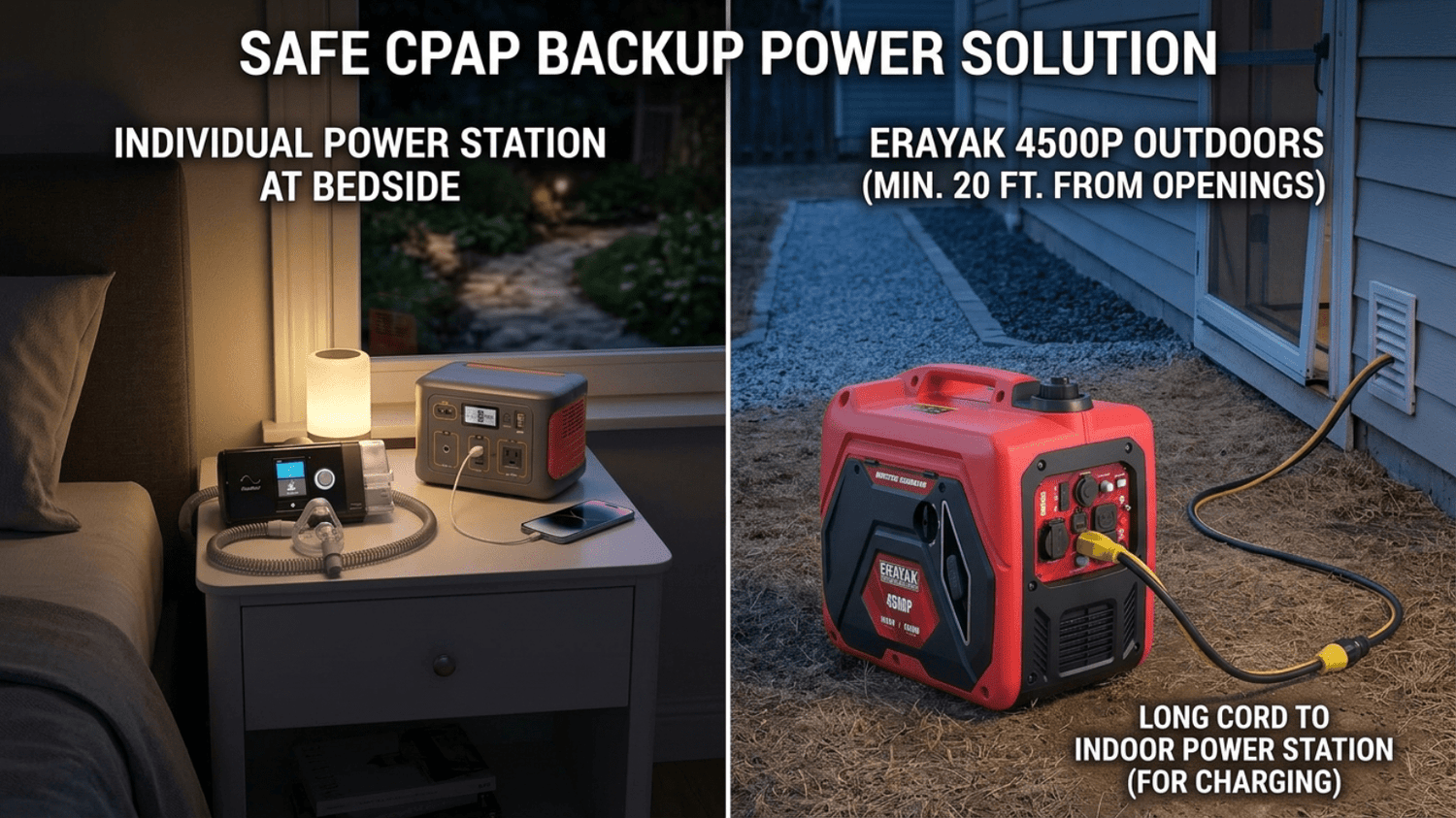
CPAP Backup Power at Home: Generator and Battery Options for Overnight Outages
A nighttime power outage can be stressful for anyone who relies on a CPAP machine. The best backup plan is not simply “buy a generator” or “buy a battery.” A safer home setup combines the right overnight battery backup, a properly placed outdoor generator, load planning, charging strategy, and a clear routine before storm season begins.
Quick Answer
For CPAP backup power at home, use a dedicated CPAP battery or portable power station for overnight operation, then use a portable generator during daytime or planned windows to recharge the battery, power lights, run a router, charge phones, and support other emergency essentials. Do not run a generator indoors, in a garage, near a bedroom window, or close to air vents.
For Erayak owners, the 2400P is a compact option for charging CPAP batteries, phones, lights, WiFi routers, laptops, fans, and small electronics. The 4500P adds more headroom for broader home emergency loads, while the 4500PD adds gasoline and propane flexibility for longer outages.
Why CPAP Backup Power Needs a Plan
CPAP machines are usually used while people are sleeping, which makes backup power different from daytime appliances. You need quiet nighttime power near the bed, safe generator operation outdoors, and enough runtime to last through the night without waking up to switch cables or refuel equipment.
Power Must Last While You Sleep
A CPAP backup plan should be ready before bedtime, not assembled during a storm or blackout.
Batteries Work Best at Bedside
A CPAP battery or power station can run indoors quietly, while a generator should remain outdoors only.
Generators Help Extend Outages
A generator can recharge CPAP batteries during the day and support other emergency loads.
Battery vs Generator for CPAP Overnight Use
Batteries and generators solve different parts of the outage problem. A battery is usually the better bedside overnight solution. A generator is better for recharging, longer outages, and supporting additional home loads.
| Backup Option | Best Use | Key Consideration |
|---|---|---|
| Dedicated CPAP battery | Quiet overnight CPAP runtime | Check compatibility with your CPAP model, pressure settings, humidifier use, and DC adapter needs |
| Portable power station | CPAP plus phones, small lights, and small electronics | Use watt-hour capacity and real load testing to estimate runtime |
| UPS backup | Short transition power and brief outages | Many UPS units are not designed for all-night CPAP runtime |
| Portable generator | Daytime recharging and broader outage loads | Must run outdoors only and away from doors, windows, vents, garages, and bedrooms |
| Generator + battery | Best practical system for longer overnight outages | Run CPAP from battery at night, recharge battery from generator during the day |
How to Estimate CPAP Power Needs
CPAP power use depends on the machine, pressure setting, humidifier, heated tubing, mask leak, room temperature, and whether the device runs from AC or DC power. The most reliable approach is to check the CPAP label or manual, then test your backup system before an outage.
| Planning Step | What to Check | Why It Matters |
|---|---|---|
| Find CPAP power rating | Look at the label, power supply, or manual | Gives a starting point for generator or battery planning |
| Check AC vs DC input | Some CPAP machines may run more efficiently from compatible DC adapters | Can affect battery runtime |
| Check humidifier use | Heated humidifiers often increase power use | May reduce overnight battery runtime |
| Check heated tubing | Heated tubing adds another heating load | May shorten battery runtime |
| Test a full night | Run your CPAP from the backup system before storm season | Confirms real runtime instead of guessing |
| Plan recharge time | Measure how long your battery takes to recharge | Helps schedule daytime generator use |
Humidifier, Heated Tubing, and Runtime
The heated humidifier and heated tube are often the biggest difference between a short backup runtime and a full-night runtime. Some users plan separate modes: normal comfort mode when grid power is available, and a pre-approved outage mode that reduces power use.
| CPAP Feature | Power Impact | Backup Planning Tip |
|---|---|---|
| CPAP blower only | Usually lower power demand | Often easier for overnight battery backup |
| Heated humidifier | Can significantly increase power use | Check manufacturer guidance before changing humidifier settings |
| Heated tubing | Adds heating demand | Test runtime with tubing on and off if allowed by your care plan |
| Mask leak | May increase workload | Maintain mask fit and replace worn supplies as needed |
| Pressure setting | Can affect power demand | Do not change prescribed pressure settings without medical guidance |
Recommended Overnight CPAP Backup Setup
For most home users, the cleanest overnight system is a bedside battery for the CPAP and an outdoor generator reserved for daytime charging and other emergency loads.
| Setup Layer | Recommended Use | Why It Works |
|---|---|---|
| Layer 1: CPAP battery | Run CPAP overnight beside the bed | Quiet, indoor-friendly, and does not require nighttime generator operation |
| Layer 2: Portable power station | Backup option for CPAP, phone, small light, and radio | Adds flexibility if the outage lasts longer than one night |
| Layer 3: Portable generator | Recharge batteries during the day and support home essentials | Extends outage readiness beyond one battery cycle |
| Layer 4: Load schedule | Charge CPAP battery before bedtime, then power other essentials | Prevents wasting generator runtime and fuel |
| Layer 5: Safety plan | CO alarms, outdoor generator placement, dry cords, and fuel management | Protects the household while keeping backup power usable |
Where a Generator Fits in the Plan
A portable generator is not the best device to place beside a bed, but it is extremely useful for maintaining the full backup system during a longer outage. Use the generator during planned daytime windows to recharge CPAP batteries, phones, power banks, and power stations. You can also support lights, WiFi, fans, refrigerator timing, and other managed essentials.
Recharge CPAP Batteries
Use generator runtime to bring the CPAP battery or power station back to full before bedtime.
Power Household Essentials
During the day, the generator can support phones, router, lights, fans, laptop, and selected appliances.
Manage Loads Carefully
Avoid stacking CPAP charging, refrigerator startup, microwave, coffee maker, pump, heater, and other high-demand loads at once.
CPAP Outage Power Checklist
Use this checklist before hurricane season, winter storm season, wildfire shutoffs, or any period when overnight outages are possible.
| Checklist Item | Purpose | Before the Outage |
|---|---|---|
| CPAP manual and power specs | Confirms power input and adapter requirements | Store manual or photo of power label with emergency kit |
| Compatible CPAP battery | Provides quiet overnight power | Test a full-night runtime before storm season |
| Portable power station | Adds charging and backup flexibility | Keep charged and test with your CPAP setup |
| Portable generator | Recharges batteries and supports broader home loads | Maintain fuel, oil, cords, and safe placement plan |
| Outdoor-rated extension cords | Connects generator to charging area safely | Use grounded, rated, intact cords only |
| CO alarms | Supports household safety during generator use | Install working alarms near sleeping areas and living spaces |
| Battery recharge schedule | Prevents bedtime surprises | Recharge CPAP battery before evening |
| Medical contact plan | Supports users with higher medical risk | Ask your provider about outage planning and backup options |
Recommended Erayak Setup by Outage Scenario
Erayak 2400P: Compact CPAP Battery Recharging and Essentials
Choose the Erayak 2400P when your outage plan focuses on recharging a CPAP battery or portable power station, phones, LED lights, WiFi router, laptop, small fans, radio, and compact emergency electronics.
- Good fit for compact CPAP backup power support
- Useful for battery recharging, phones, lights, router, fans, and small electronics
- Best paired with a dedicated CPAP battery for overnight indoor use
Erayak 4500P: Broader Home Backup with CPAP Battery Charging
Choose the Erayak 4500P when your emergency setup includes CPAP battery charging plus managed home loads such as refrigerator timing, lights, fans, WiFi, phone charging, laptop, and coffee maker timing.
- Gas-only portable inverter generator
- Manual recoil start
- 55 lb lightweight design
- 2.25 gal fuel tank
- Up to 8 hours runtime
- THD < 1.2% for sensitive electronics
- 60.5 dB noise level
Erayak 4500PD: Fuel Flexibility for Longer Overnight Outages
Choose the Erayak 4500PD when you want gasoline and propane flexibility during longer outages, storm prep, winter weather, hurricane season, or mixed home and outdoor use.
- Gasoline and propane flexibility
- Useful for longer outage planning and flexible fuel storage
- Good fit for CPAP battery recharging, lights, fans, WiFi, phones, refrigerator timing, and managed home essentials
Erayak 6800PD / 6800PT: Larger Home Backup and Multi-Zone Planning
Choose the Erayak 6800 series when your emergency plan needs more headroom, 30A outlets, selected 120V/240V planning, refrigerator and freezer timing, pump planning, RV overlap, and multiple home power zones.
- 6800W peak power
- 5000W rated power on gasoline at 100% output
- 30A L5-30R outlet
- 30A 120V/240V L14-30R outlet
- Dual 120V household outlets
- TT-30R RV adapter accessory included
CPAP Generator Safety Checklist
CPAP backup power should make an outage safer, not create new risks. A generator can help recharge batteries and support emergency loads, but it must be used correctly.
- Run the generator outdoors only, away from doors, windows, vents, garages, crawlspaces, basements, sheds, and enclosed spaces.
- Never run a generator indoors, in a garage, in a bedroom, near a sleeping area, under a porch, or near an open window.
- Do not run a generator while people are sleeping unless it is safely placed outdoors, monitored as appropriate, and all manufacturer and local safety guidance is followed.
- Use a CPAP battery or power station for quiet indoor overnight CPAP operation when possible.
- Use working carbon monoxide alarms inside the home, especially near sleeping areas.
- Use grounded, properly rated, outdoor extension cords.
- Inspect cords for fraying, cuts, crushed insulation, exposed wire, loose plugs, or missing ground pins.
- Do not use frayed, damaged, wet, crushed, or loose cords.
- Keep plug connections dry, elevated, and away from puddles, snow, wet grass, and rain runoff.
- Do not backfeed your home through a wall outlet.
- Use a properly installed transfer switch if powering selected home circuits.
- Disconnect loads before starting the generator.
- Add loads gradually after the generator stabilizes.
- Recharge CPAP batteries while you are awake whenever possible.
- Let the generator cool before refueling or maintenance.
- Store fuel in approved containers away from flame, heat, stoves, grills, living areas, children, and ignition sources.
- Ask your CPAP provider or clinician about backup power planning if your therapy is medically critical.
Build a Safer CPAP Backup Power Plan Before the Next Outage
A good CPAP outage plan starts with a tested overnight battery, then uses a portable generator to recharge that battery and support daytime emergency loads. Choose Erayak 2400P for compact CPAP battery charging and essentials, 4500P or 4500PD for broader home backup, and the 6800 series for larger multi-zone emergency power planning.
FAQ: CPAP Backup Power at Home
Can a portable generator power a CPAP machine?
Yes, a portable generator can support CPAP backup power, especially for recharging a CPAP battery or power station. For overnight use, a dedicated CPAP battery or power station is often a safer and quieter bedside option, while the generator stays outdoors.
Should I run my CPAP directly from a generator overnight?
For most home outage plans, it is better to run the CPAP from a tested battery overnight and use the generator during daytime or planned windows to recharge the battery. Never run a generator indoors, in a garage, or near a bedroom window.
How long will a battery run a CPAP machine?
Runtime depends on the CPAP model, pressure setting, humidifier use, heated tubing, battery capacity, and whether the device uses AC or DC power. Test your exact setup before relying on it during an outage.
Does a CPAP humidifier reduce battery runtime?
Yes, heated humidifiers and heated tubing can significantly increase power use and reduce runtime. Check your CPAP manual and clinician guidance before changing humidifier or therapy settings.
What generator size is best for CPAP backup power?
A compact inverter generator can be enough for recharging CPAP batteries, phones, lights, router, and small electronics. A larger generator is useful when you also need refrigerator timing, fans, laptops, or broader home backup loads.
Can I use a UPS for CPAP backup?
A UPS may help with short outages or transition time, but many UPS units are not designed for full-night CPAP runtime. Test the exact UPS and CPAP setup before relying on it overnight.
What Erayak generator is best for CPAP backup power?
Choose the Erayak 2400P for compact CPAP battery recharging and essentials, the Erayak 4500P or 4500PD for broader home backup with managed loads, and the Erayak 6800 series for larger home, RV, 30A, 120V/240V, and multi-zone emergency planning.
