

🔋 2026 EV Mobility Report: The Zero-Range Defense
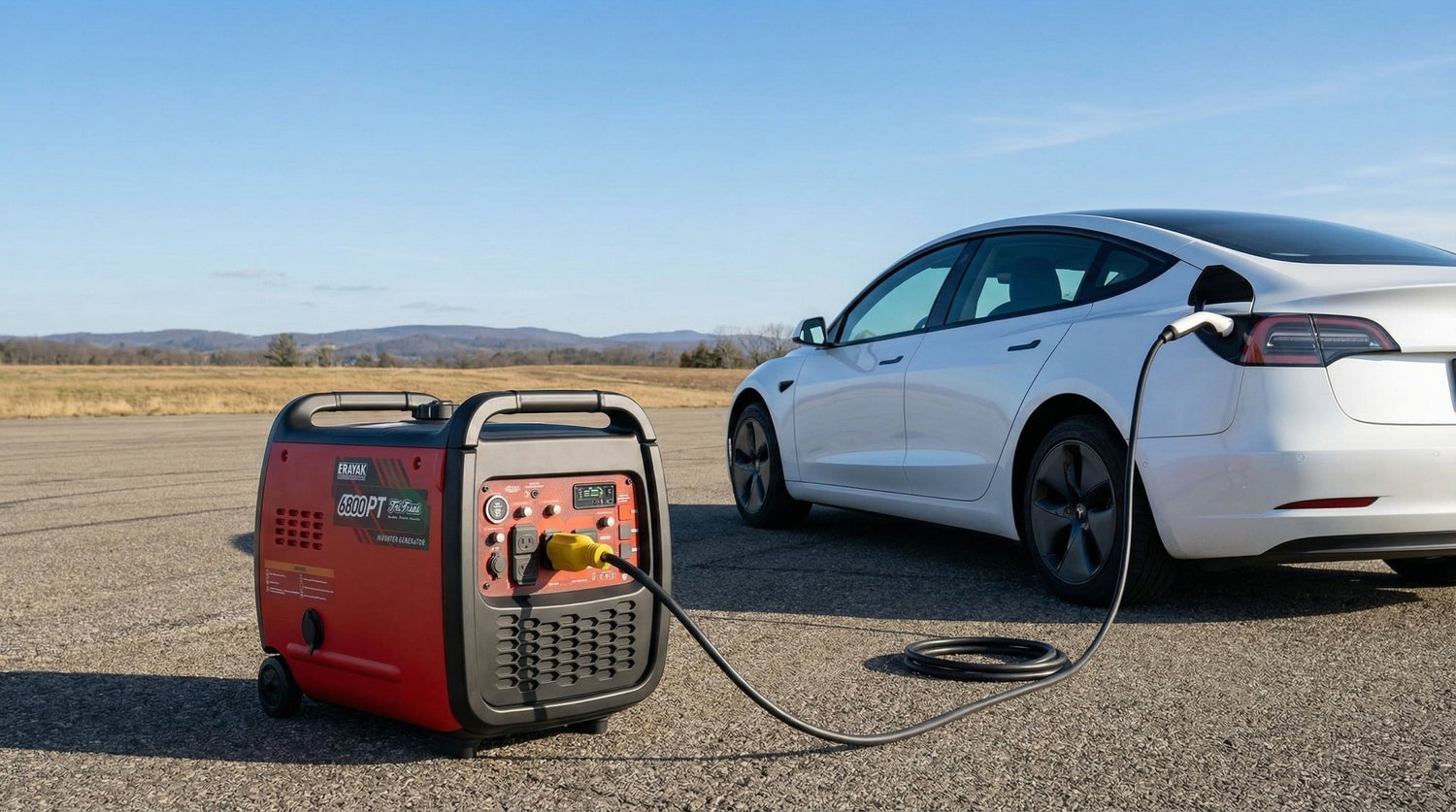
Don't let a grid failure turn your $60,000 EV into a driveway weight. The ERAYAK 6800PT Tri-Fuel Inverter is the industry's premier Level 2 emergency charging solution. EV OWNER SPECIAL: Use code "Erayak2026" for 7% OFF your total order today!
As electric vehicle (EV) adoption hits record highs in 2026, a new question is dominating community forums: "Can I charge my Tesla with a portable generator during a blackout?" The short answer is yes—but the long answer involves a critical warning. Modern EVs are highly sophisticated computers on wheels. If you feed them "Dirty Power" from a standard contractor-grade generator, they will instantly lock out the charge to protect their lithium-ion battery packs.
1. The "Dirty Power" Fear: Why EV s Reject Standard Generators
Most portable generators utilize mechanical governors that produce Total Harmonic Distortion (THD) levels of 15% to 25%. To a Tesla or Ford Lightning, this jagged electricity looks like a system fault. EV onboard chargers require a Pure Sine Wave (<3% THD) that mimics the stability of the public utility grid.
⚠️ Warning: The Grounding Lockout
EVs perform a safety check for a proper ground connection. Because most portable generators use a Floating Neutral standard, the car will sense a "Missing Ground" and refuse to charge. To fix this, you must use a specialized Neutral-Ground Bonding Plug to establish the safety reference your car expects.
2. Sizing Guide: Level 1 vs. Level 2 Emergency Charging
Charging speed depends on the wattage and voltage your generator can provide. For 2026, here is the breakdown of what to expect when charging off-grid:
| Charging Method | Watts Required | Generator Match | Est. Miles Per Hour |
|---|---|---|---|
| Level 1 (120V) | ~1,440W | ERAYAK 2400P / 4500PD | 3 - 5 Miles |
| Level 2 (240V) | ~5,760W+ | ERAYAK 6800PT (Tri-Fuel) | 15 - 25 Miles |
For standard overnight emergency range, Level 1 is sufficient. However, for a true "Standby Alternative" that can add 50+ miles of range in a few hours, a 240V unit like the ERAYAK 6800PT is mandatory.
3. The Ultimate EV Companion: ERAYAK 6800PT

ERAYAK 6800PT | The Whole-Home & EV Powerhouse
- Native 240V L14-30R Port: Directly supports Level 2 EVSE charging cables for faster recovery.
- Medical Grade Power: < 1.5% THD Pure Sine Wave ensures your car's computer stays safe.
- Tri-Fuel Ready: Run on Gasoline, Propane (LPG), or Natural Gas (NG) for unlimited runtime.
- Wireless Key Fob: Monitor and control your charge from inside your home.
4. CMO Strategy: Three Rules for Safe EV Backup
To safely charge your EV with an ERAYAK generator, our engineering team recommends these protocols:
- Use a Bonding Plug: Insert our N-G Bonding Plug into any unused 15A outlet on the panel to clear the "Open Ground" error code.
- Dial Down the Amps: If charging via 120V (Level 1), go into your EV's touchscreen settings and limit the draw to 12A or 10A to prevent the generator from overloading.
- Outdoor Operation ONLY: Carbon Monoxide is a silent killer. Always position the generator at least 20 feet from your home and garage.
Conclusion: Deciding Your Off-Grid Independence
In 2026, the best portable generator for an EV owner is one that respects the car's sensitive electronics. By choosing ERAYAK’s Pure Sine Wave technology, you are investing in a system that protects your vehicle, your home, and your peace of mind.
Ready to secure your mobility? Browse our Inverter Generator Collection or consult our Generator Resource Center for technical deep dives. Use discount code "Erayak2026" for 7% OFF today!
Frequently Asked Questions
Q1: Can I charge my Tesla while driving with a generator?
No. Almost all modern EVs (including Teslas) disable the drive motor the moment a cable is detected in the charge port.
Q2: Will a generator damage my lithium battery?
No, provided you use an Inverter Generator. The onboard charger in the car converts AC to DC safely; as long as the AC is stable (Pure Sine Wave), the battery is protected.
Q3: What happens if I use a non-inverter generator?
The car will likely detect the unstable voltage and throw a "Charging Fault" or "High THD" error, refusing to charge until a cleaner power source is provided.
