

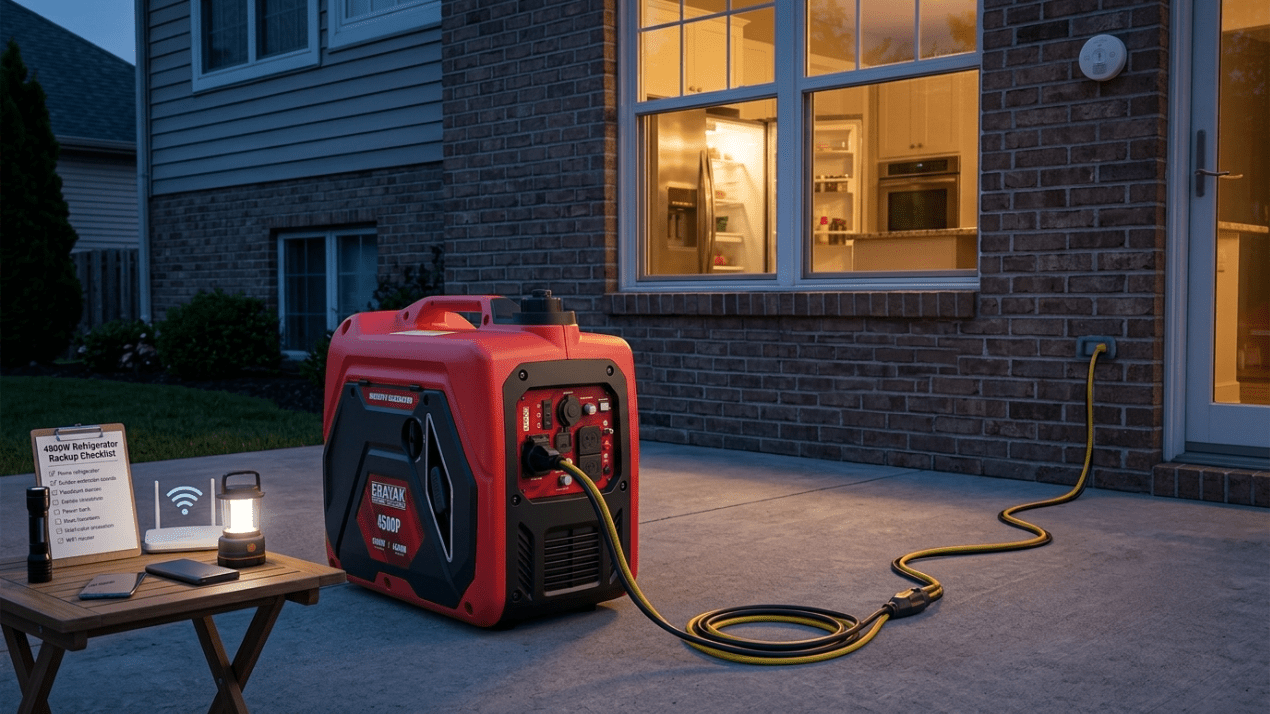
Can a 4500W Generator Run a Refrigerator During a Power Outage?
Yes, in most home backup situations, a 4500W portable generator can run a refrigerator during a power outage when the refrigerator’s running watts, starting watts, cord rating, and other connected loads are managed correctly. The key is not only the refrigerator’s normal running power. You also need to allow room for compressor startup, avoid stacking high-demand appliances, and keep the generator outdoors with safe cord routing.
Quick Answer
A 4500W generator can usually run a refrigerator during a power outage, as long as the refrigerator’s startup surge and your other connected loads stay within the generator’s available capacity. For best results, connect the refrigerator first, let the compressor start and stabilize, then add lower-demand items such as LED lights, phones, WiFi router, laptop, fan, and power banks.
Avoid starting a refrigerator at the same time as a microwave, coffee maker, electric kettle, toaster, sump pump, freezer, space heater, or other high-demand appliance. If you want a portable inverter generator for refrigerator backup plus basic household essentials, the Erayak 4500P is a practical gas-only option with 55 lb lightweight design, 2.25 gal fuel tank, up to 8 hours runtime, THD < 1.2%, and 60.5 dB noise level.
Can a 4500W Generator Run a Refrigerator?
In most cases, yes. A 4500W generator has enough output headroom for a typical household refrigerator plus several lower-demand essentials, provided the refrigerator is connected correctly and other loads are added gradually.
The most important question is not simply “Can it run?” The better question is:
Refrigerators are compressor appliances. When the compressor starts, the refrigerator may briefly need more power than it uses while running normally. A 4500W generator gives you room for that startup event, but you should still avoid connecting multiple surge or heating loads at the same time.
Refrigerator + Low Loads
Refrigerator, LED lights, phone chargers, WiFi router, laptop, power banks, and small fans are usually easier to manage.
Refrigerator + Motors
Freezer, sump pump, furnace blower, well pump, or garage door opener can create additional startup demand.
Refrigerator + Heat Appliances
Microwave, coffee maker, toaster, kettle, griddle, and space heater should usually be run separately.
Why Refrigerator Starting Watts Matter
A refrigerator has two important power numbers: running watts and starting watts. Running watts are what the refrigerator uses after the compressor is already operating. Starting watts are the short surge needed when the compressor turns on.
| Power Term | What It Means | Why It Matters During an Outage |
|---|---|---|
| Running watts | The power needed while the refrigerator is operating normally | This affects how much remaining capacity you have for lights, chargers, fans, and router |
| Starting watts | The brief surge needed when the compressor starts | This is why you should start the refrigerator before adding other loads |
| Compressor cycling | The refrigerator turns on and off to maintain temperature | Other appliances may be running when the compressor cycles back on |
| Temperature setting | How cold the refrigerator is set | Colder settings may increase compressor activity |
| Door openings | How often warm air enters the refrigerator | Frequent opening can make the refrigerator work harder |
| Other connected loads | Everything else plugged into the generator | High-demand appliances can reduce available startup headroom |
What Else Can You Run with a Refrigerator?
A 4500W generator can often support more than a refrigerator, but the safest plan is to separate loads into low-demand essentials, motor loads, and high-watt heating loads.
| Load Type | Examples | Best Strategy with a Refrigerator |
|---|---|---|
| Low-demand essentials | LED lights, phones, power banks, WiFi router, laptop, radio | Add after the refrigerator starts and stabilizes |
| Comfort loads | Small fan, CPAP, small TV, modem, computer monitor | Check labels and add gradually |
| Other compressor loads | Freezer, mini fridge, portable cooler | Avoid starting multiple compressor appliances at the same time |
| Motor loads | Sump pump, furnace blower, well pump, garage door opener | Start separately and keep extra headroom |
| Heating loads | Microwave, coffee maker, kettle, toaster, griddle, space heater | Rotate separately from refrigerator startup |
| Whole-home wiring | Home circuits, breaker panel, hardwired appliances | Use only with a properly installed transfer switch where applicable |
Simple Outage Load Plan for a 4500W Generator
During a power outage, a clean sequence matters. Do not plug everything in at once. Start with your priority appliance, then add smaller loads.
| Step | What to Do | Why It Helps |
|---|---|---|
| Step 1 | Move the generator outdoors to a safe location | Keeps exhaust away from doors, windows, vents, garage, and living spaces |
| Step 2 | Start the generator with loads disconnected | Lets the generator stabilize before appliance startup |
| Step 3 | Connect the refrigerator first | Gives the compressor the best chance to start cleanly |
| Step 4 | Wait for the refrigerator to stabilize | Reduces overlap between compressor startup and other devices |
| Step 5 | Add low-demand essentials | LED lights, phones, router, laptop, and radio are easier to manage |
| Step 6 | Rotate high-demand appliances | Microwave, coffee maker, kettle, toaster, pumps, and heaters should not all run together |
Extension Cord and Placement Setup
A refrigerator backup setup depends heavily on cord safety. Use only a properly rated outdoor extension cord, keep it dry, and inspect it before use. The cord should be long enough to keep the generator outdoors away from openings, but not so long or undersized that it creates unnecessary voltage drop or overheating risk.
| Setup Item | What to Check | Why It Matters |
|---|---|---|
| Generator location | Outdoors, away from doors, windows, vents, garage, and enclosed spaces | Reduces carbon monoxide risk |
| Extension cord rating | Outdoor-rated, grounded, and sized for the appliance load and distance | Helps reduce overheating and cord failure |
| Cord condition | No cuts, fraying, crushed insulation, loose plugs, or missing ground pin | Damaged cords should not be used |
| Connection point | Dry, elevated, and protected from rain, puddles, and foot traffic | Helps protect the plug connection |
| Refrigerator path | Route cord where it will not be pinched by doors or walked on | Reduces trip hazards and cord damage |
| Load sequence | Start refrigerator first, then add smaller loads | Protects generator headroom for compressor startup |
Common Mistakes to Avoid
A 4500W generator can be a strong refrigerator backup option, but many outage problems come from setup mistakes rather than generator size alone.
Plugging in Everything at Once
Start with the refrigerator first. Add low-demand loads later. Rotate heating and motor appliances separately.
Using the Wrong Cord
Light-duty, damaged, or undersized cords can create problems. Use a grounded outdoor-rated cord that matches the load.
Running the Generator Too Close
Never run the generator indoors, in a garage, or near doors, windows, vents, or enclosed areas.
Why Erayak 4500P Fits Refrigerator Backup
The Erayak 4500P is a practical option for homeowners who want a portable inverter generator for refrigerator backup, lights, charging, router, fan, laptop, and other managed essentials during an outage.
Erayak 4500P: Refrigerator + Essential Home Backup
Choose the Erayak 4500P when your power outage setup focuses on a household refrigerator, low-demand essentials, and carefully rotated appliances.
- Gas-only portable inverter generator
- Manual recoil start
- 55 lb lightweight design
- 2.25 gal fuel tank
- Up to 8 hours runtime
- THD < 1.2% for sensitive electronics
- 60.5 dB noise level
- Good fit for refrigerator backup, lights, phone charging, router, laptop, fan, and managed household essentials
Need More Fuel Flexibility?
If you want gasoline and propane flexibility for longer outages, the Erayak 4500PD may be a better fit for refrigerator backup and essential home loads.
- Gasoline and propane flexibility
- Useful for longer outage planning
- Good fit for refrigerator backup, lights, charging, fan, router, and managed appliances
Need More Headroom for Larger Home Loads?
If your outage plan includes refrigerator, freezer, pump planning, 30A output needs, RV adapter support, or selected 120V/240V planning, consider the Erayak 6800 series.
- 6800W peak power
- 5000W rated power on gasoline at 100% output
- 30A L5-30R outlet
- 30A 120V/240V L14-30R outlet
- Dual 120V household outlets
- TT-30R RV adapter accessory included
Generator Safety Checklist for Refrigerator Backup
Refrigerator backup often happens during stressful outages, storms, heat waves, or nighttime power failures. Set up the generator safely before connecting the refrigerator.
- Run the generator outdoors only.
- Keep it away from doors, windows, vents, garages, basements, crawlspaces, sheds, enclosed spaces, and attached structures.
- Never run a generator indoors, in a garage, in a basement, in a shed, in a vehicle, under a porch, or in any enclosed or semi-enclosed space.
- Point exhaust away from your home, people, pets, neighboring homes, doors, windows, and vents.
- Use working carbon monoxide alarms inside the home.
- Use properly rated outdoor extension cords.
- Use grounded cords that are rated for the refrigerator load and cord distance.
- Inspect cords for cuts, fraying, crushed insulation, heat damage, loose plugs, or missing ground pins.
- Never use damaged, frayed, cut, crushed, or loose extension cords.
- Keep plugs, adapters, and cord connections dry and elevated.
- Disconnect loads before starting the generator.
- Connect the refrigerator first, then add lower-demand devices gradually.
- Run microwaves, coffee makers, electric kettles, toasters, heaters, pumps, freezers, and other high-demand appliances separately when possible.
- Let the generator cool before refueling or maintenance.
- Store fuel in approved containers away from flame, heat, living areas, doors, windows, vents, vehicles, and appliances.
- Do not backfeed your home by plugging the generator into a wall outlet.
- Use a properly installed transfer switch or approved interlock system if connecting a generator to home wiring.
Keep Your Refrigerator Running During an Outage
A 4500W generator can usually run a refrigerator during a power outage when you allow for compressor startup, use the right extension cord, and rotate high-demand appliances. Choose Erayak 4500P for refrigerator backup and managed essentials, 4500PD for fuel flexibility, or the 6800 series for larger home backup and multi-zone power planning.
FAQ: Can a 4500W Generator Run a Refrigerator?
Can a 4500W generator run a refrigerator during a power outage?
Yes. A 4500W generator can usually run a refrigerator during a power outage if the refrigerator’s starting watts and other connected loads stay within the generator’s available capacity. Start the refrigerator first, let it stabilize, then add low-demand devices gradually.
Can a 4500W generator run a refrigerator and freezer?
Possibly, but you should avoid starting both compressor appliances at the same time. Start one first, let it stabilize, then start the other. Check both appliance labels and leave extra headroom for compressor startup.
Can a 4500W generator run a refrigerator and microwave?
It may be possible, but it is better to rotate them. Let the refrigerator run normally, then use the microwave only when other high-demand loads are off. Avoid microwave use during refrigerator compressor startup.
Can a 4500W generator run a refrigerator and coffee maker?
Possibly, but coffee makers can be high-demand heating appliances. Run the coffee maker separately from refrigerator startup and avoid using it with other high-demand loads such as kettle, toaster, microwave, pump, or space heater.
What should I plug in first: the refrigerator or other devices?
Start the generator with loads disconnected, then connect the refrigerator first. After the compressor starts and stabilizes, add lower-demand items such as LED lights, phones, router, laptop, radio, and small fan.
Can I plug my refrigerator directly into a generator?
You can connect a refrigerator to a generator using a properly rated, grounded outdoor extension cord when the generator is safely outdoors and the cord is in good condition. Do not use damaged cords or undersized cords.
Where should I place a generator when running a refrigerator?
Place the generator outdoors on dry stable ground, away from doors, windows, vents, garages, basements, crawlspaces, sheds, people, pets, and enclosed or semi-enclosed spaces. Point exhaust away from occupied areas.
Is the Erayak 4500P good for refrigerator backup?
Yes. The Erayak 4500P is a practical gas-only portable inverter generator for refrigerator backup, lights, phone charging, router, laptop, fan, and managed household essentials. It has manual recoil start, 55 lb lightweight design, 2.25 gal fuel tank, up to 8 hours runtime, THD < 1.2%, and 60.5 dB noise level.
