

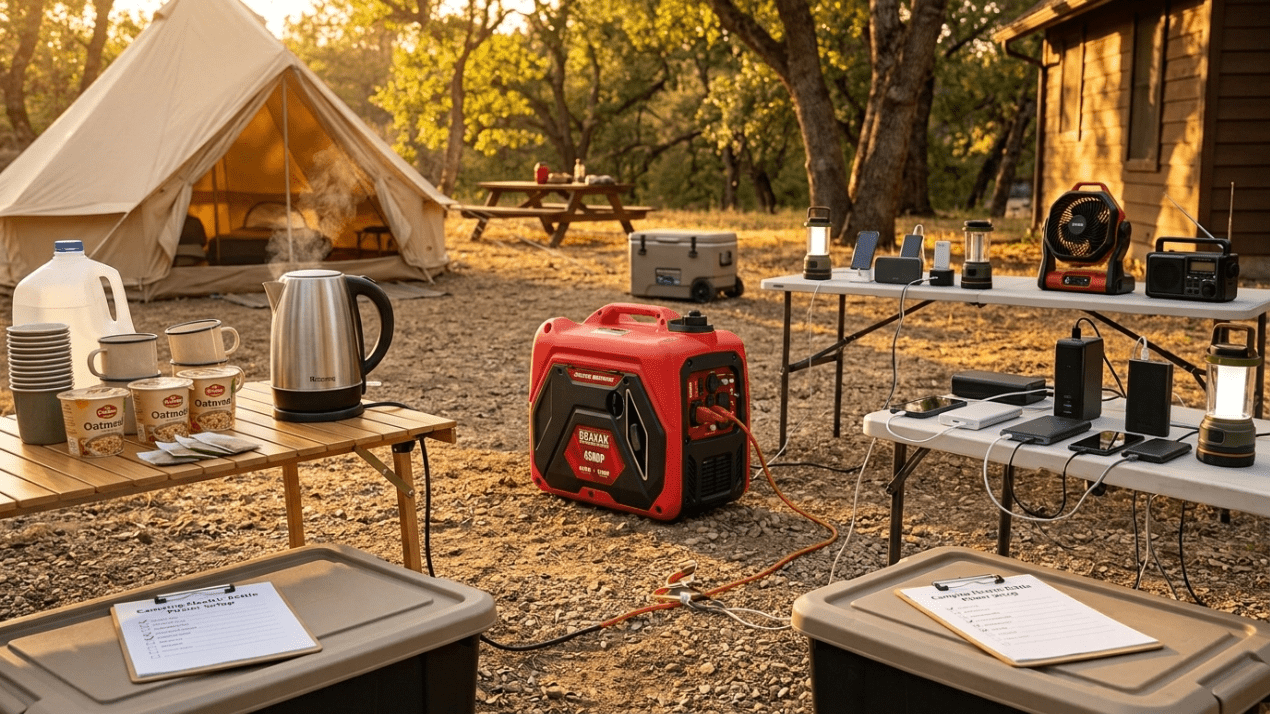
Camping Electric Kettle Power Setup: Generator Guide for Hot Water Outdoors
A camping electric kettle power setup can make outdoor mornings easier when your family wants hot water for coffee, tea, instant oatmeal, soup, baby bottles, dish rinsing, or cold-weather comfort. But an electric kettle is a high-watt heating appliance, so it should be treated as a short-use planned load, not something to run casually with a microwave, coffee maker, cooler startup, pump, or food warmer at the same time.
Quick Answer
For a practical camping electric kettle power setup, check the kettle label for input watts, use an outdoor-rated cord with the correct rating, place the kettle on a stable dry table, and run it as a short heating window. After boiling water, return to lower-load devices such as phones, power banks, LED lights, radio, small fans, and cooler support.
The Erayak 2400P fits light campsite electronics and selected small-appliance planning only after checking wattage carefully. The Erayak 4500P is a stronger starting point for family camp kitchen power with kettle timing, cooler support, lights, phones, fans, and multiple devices. The 4500PD adds gasoline and propane flexibility, while the 6800 series fits larger camp kitchens, RV-friendly setups, cabin weekends, pump planning, and multi-zone outdoor power.
How Camping Electric Kettles Use Power
Electric kettles are simple to use, but they can draw a lot of power while heating. Many kettles are designed for household outlets, so the actual input wattage must be checked before connecting one to a portable generator at camp.
Input Watts
The input wattage tells you what the generator must supply while the kettle is heating.
Short Heating Load
A kettle may run for only a few minutes, but during that time it can use much more power than lights or chargers.
Load Rotation
The best campsite strategy is to boil water first, then switch back to charging, lights, fans, and cooler support.
Basic Camping Electric Kettle Power Setup
A safe kettle setup starts with a dry table, stable appliance placement, a clean cord route, and no competing high-watt appliances. Keep water, heat, plugs, and foot traffic separated.
| Setup Step | What to Do | Why It Matters |
|---|---|---|
| Step 1 | Place the generator outdoors on dry stable ground | Keeps exhaust away from tents, RVs, cabins, doors, windows, and vents |
| Step 2 | Place the kettle on a stable dry table | Reduces tipping, splash, spill, and plug-contact risks |
| Step 3 | Use a properly rated outdoor extension cord | Helps reduce overheating, voltage drop, and cord failure risk |
| Step 4 | Keep plug connections dry and elevated | Important near water jugs, drink tables, dew, rain, and wash basins |
| Step 5 | Run the kettle as a planned short-use load | Prevents stacking high-demand appliances for long periods |
| Step 6 | Return to lower loads after boiling water | Phones, lights, power banks, radio, and fans are easier to manage |
Hot Water Use Cases at Camp
A kettle can be useful for more than tea. It can support the morning coffee table, quick meals, family comfort, and cold-weather routines when used in a controlled load window.
| Hot Water Use | Why It Helps | Power Setup Tip |
|---|---|---|
| Coffee and tea | Fast morning routine without a full kitchen | Boil water first, then return to charging and lights |
| Instant oatmeal or soup | Quick breakfast or simple camp meal | Keep food prep separate from plug connections |
| Baby bottle water | Family convenience during travel | Follow safe feeding and temperature guidelines for the bottle |
| Cold-weather comfort | Warm drinks during fall or winter camping | Do not move the generator near tents or cabins for warmth |
| Dish rinse water | Helps with light cleanup | Keep wash basins away from cords and outlets |
| Outdoor drink station | Supports cocoa, instant coffee, tea, or warm cider | Keep water spills away from chargers and plug connections |
What Can Run with a Camping Electric Kettle?
A kettle should usually be treated as a priority heating load. Run it briefly, then switch back to low-load devices. This keeps your camp kitchen more predictable and reduces overload risk.
| Load Category | Examples | Best Strategy |
|---|---|---|
| Usually easy after kettle use | Phones, power banks, LED lanterns, battery radio, USB chargers | Use after water heating is finished |
| Comfort loads | Small fans, laptop, camera battery chargers, Bluetooth speaker | Use during low-load windows and avoid cord clutter |
| Cooling loads | Portable cooler, mini fridge, compact freezer | Avoid kettle use during compressor startup or heavy cycling |
| Other high-watt loads | Coffee maker, microwave, food warmer, griddle, induction cooktop | Run separately from the kettle |
| Motor loads | Small pump, blender, tool charger | Check wattage and avoid stacking with kettle use |
| Priority loads | Radio, phone charging, small medical chargers | Keep priority above nonessential hot-water appliances |
Kettle Power Zones and Cord Routing
A kettle setup involves hot water, steam, food prep, kids, pets, and walking paths. Keep the generator outside the kitchen zone, keep plug connections away from water, and keep the kettle table stable and dry.
| Power Zone | What Goes There | What to Avoid |
|---|---|---|
| Generator zone | Generator outdoors on dry stable ground with clear airflow | Tents, RV openings, cabin doors, windows, vents, enclosed canopies, food tables, kitchen canopies, and crowds |
| Kettle zone | Electric kettle, stable table, mugs, hot water area | Wet ground, unstable tables, overloaded power strips, and loose cords |
| Dry charging zone | Phones, power banks, laptop, radio, USB hub | Water spills, wash basins, cooler condensation, drink station water, unstable tables |
| Cooler zone | Portable cooler, mini fridge, food storage | Starting compressor loads while kettle is heating |
| Cooking zone | Stove, grill, utensils, food prep, hot cookware | Any cord, plug, adapter, fuel can, or generator exhaust |
| No-cord zone | Fire pit, grill, stove, water station, walking paths | Any plug, adapter, cord, generator, fuel can, or charging table |
Camping Kettle Generator Checklist
Use this checklist before a family camping trip, RV stop, lake weekend, cabin stay, backyard cookout, beach morning, or outdoor coffee station.
| Checklist Item | Purpose | Kettle Power Tip |
|---|---|---|
| Kettle input wattage label | Confirms actual electrical demand | Use input watts for generator planning |
| Outdoor-rated extension cord | Connects generator to kettle zone | Use a cord rated for the appliance and distance |
| Dry elevated plug connection | Protects connection from water, dew, rain, and drink spills | Keep connections off grass, sand, mud, and drink tables |
| Stable hot-water table | Supports kettle weight and safe pouring | Keep level, dry, ventilated, and away from kids’ walking paths |
| Separate charging table | Organizes phones and power banks | Do not mix electronics with hot water, steam, or spills |
| CO alarm | Supports safety near occupied cabins or RVs | Use inside cabins or RVs when people sleep there |
| Fuel can and funnel | Supports planned runtime | Store away from tents, cabins, vehicles, grills, stoves, and kitchen areas |
| Printed load list | Prevents overload | Mark kettle, microwave, coffee maker, cooler, pump, warmer, and griddle as rotation loads |
Recommended Erayak Setup by Kettle Use Case
Erayak 2400P: Compact Camping Essentials and Light Hot-Water Planning
Choose the Erayak 2400P for compact campsite support focused on low-load essentials such as phones, power banks, LED lanterns, radio, small fans, laptop charging, and selected small-appliance planning only after checking wattage carefully.
- Good fit for compact camping electronics and light camp kitchen support
- Useful for charging, lights, small fans, speaker, laptop, and small electronics
- Best when kettle, microwave, coffee maker, warmer, pump, and high-watt loads are limited or run separately
Erayak 4500P: Best Starting Point for Family Camping Kettle Power
Choose the Erayak 4500P when your outdoor setup includes kettle timing, portable cooler support, lights, phones, fans, power banks, radio, laptop, coffee station planning, and multiple family devices.
- Gas-only portable inverter generator
- Manual recoil start
- 55 lb lightweight design
- 2.25 gal fuel tank
- Up to 8 hours runtime
- THD < 1.2% for sensitive electronics
- 60.5 dB noise level
Erayak 4500PD: Fuel Flexibility for Longer Camp Kitchen Weekends
Choose the Erayak 4500PD when you want gasoline and propane flexibility for longer camping weekends, lake trips, cabin stays, RV stops, outdoor kitchens, coffee stations, and flexible fuel planning.
- Gasoline and propane flexibility
- Useful for longer outdoor days and flexible fuel planning
- Good fit for kettle timing, cooler support, lights, fans, charging, coffee station planning, and managed campsite loads
Erayak 6800PD / 6800PT: Larger Camp Kitchen, RV, Cabin, and Multi-Zone Power
Choose the Erayak 6800 series for larger outdoor kitchens, RV adapter support, selected 120V/240V planning, cabin use, small pump support, compact freezer planning, multiple family power zones, and broader backup overlap.
- 6800W peak power
- 5000W rated power on gasoline at 100% output
- 30A L5-30R outlet
- 30A 120V/240V L14-30R outlet
- Dual 120V household outlets
- TT-30R RV adapter accessory included
Camping Electric Kettle Generator Safety Checklist
Camping kettle generator use can involve hot water, steam, food prep, water jugs, children, pets, tents, RVs, cabins, and short high-demand runtime windows. Keep generator placement and electrical connections simple, dry, visible, and safely separated.
- Run the generator outdoors only.
- Keep it away from tents, RV openings, cabin doors, windows, vents, enclosed canopies, food tables, kitchen canopies, coolers, kids, pets, and sleeping areas.
- Never run a generator inside a tent, RV, cabin, shed, garage, enclosed shelter, basement, crawlspace, vehicle, or under an enclosed canopy.
- Point exhaust away from people, tents, RVs, cabins, neighboring campsites, food prep areas, and sleeping areas.
- Use working carbon monoxide alarms inside nearby cabins or RVs when people sleep there.
- Use properly rated outdoor extension cords.
- Inspect cords for cuts, fraying, crushed insulation, heat damage, loose plugs, or missing ground pins.
- Never use frayed, cut, damaged, crushed, or loose extension cords.
- Keep plugs, adapters, and cord connections dry and elevated.
- Keep cords away from wet ground, hot water, steam, food spills, drink spills, wash basins, coolers, grills, fire pits, stoves, fuel containers, and walking paths.
- Disconnect loads before starting the generator.
- Run the kettle only after the generator stabilizes and other high-demand loads are off.
- Run coffee makers, microwaves, warmers, pumps, compact freezers, heaters, griddles, induction cooktops, and cooking appliances separately when possible.
- Let the generator cool before refueling.
- Store fuel in approved containers away from flame, heat, stoves, fire pits, tents, cabins, vehicles, and kitchen areas.
- Do not plug a generator into a wall outlet to power cabin, home, or RV wiring without a properly installed transfer switch where applicable.
- Follow campground, park, cabin, RV site, beach, tailgate, event, and local generator rules.
Build a Cleaner Camping Electric Kettle Power Setup
Start with the kettle as a short-use planned load, then return to phones, power banks, LED lights, radio, fans, and cooler support after boiling water. Rotate microwaves, coffee makers, pumps, warmers, griddles, coolers, freezers, and high-demand appliances separately. Choose Erayak 2400P for compact camp essentials, 4500P or 4500PD for broader family kettle and camp kitchen power, and the 6800 series for RV, cabin, pump, freezer, event, and multi-zone power.
FAQ: Camping Electric Kettle Power Setup
Can a portable generator power a camping electric kettle?
Yes, if the generator is sized for the kettle’s actual input wattage. Check the kettle label or manual, run it as a short-use load, and avoid stacking it with other high-demand appliances.
What size generator do I need for a camping electric kettle?
The required size depends on the kettle’s input watts, cord rating, cord length, and other connected loads. A smaller kettle may be easier to support, while family camp kitchens with coolers, coffee makers, microwaves, and multiple appliances need more headroom.
Can I run lights and phone chargers with a camping kettle?
Low-load items such as LED lights, phones, power banks, radios, and USB chargers are usually easier to manage after kettle use. Avoid stacking the kettle with other high-demand appliances.
Can I run a cooler and electric kettle at the same time?
Possibly, but cooler startup and kettle use can overlap poorly. Avoid kettle use while a portable cooler, mini fridge, or compact freezer is starting or cycling heavily unless your generator and cord rating clearly support the combined demand.
Can I run a coffee maker with a camping electric kettle?
Usually they should be run separately. Coffee makers and kettles can both be high-demand heating loads, so rotate them instead of using both at the same time.
Where should I place a generator when powering a camping kettle?
Place the generator outdoors on dry stable ground, away from tents, RV openings, cabins, doors, windows, vents, enclosed canopies, food tables, people, pets, and sleeping areas. Point exhaust away from occupied areas.
What Erayak generator is best for camping electric kettle power?
Choose the Erayak 2400P for compact campsite electronics and carefully managed small appliance planning, the Erayak 4500P or 4500PD for broader family camp kitchen power with kettle timing, lights, charging, fans, and cooler support, and the Erayak 6800 series for larger RV, cabin, pump, freezer, event, and multi-zone setups.
