

Why Your RV Generator Can't Power the AC: Hidden Loads Explained
If your RV generator overloads when the air conditioner starts, the generator may not be the only problem. Hidden loads like the converter charger, battery charging, refrigerator, microwave, and water heater can use hundreds or even thousands of watts before the AC compressor tries to start.
Quick Answer: Why the Generator Overloads When the RV AC Starts
Your RV generator may fail to start the AC because the air conditioner needs a short starting surge, while hidden background loads are already using part of the generator's capacity. The most common hidden load is the RV converter charger, which can draw several hundred watts while charging the battery bank.
Converter charger or inverter/charger working in the background after you plug in.
Rooftop AC compressor startup, especially without a soft-start module.
Turn off battery charging and other large loads, then start the AC by itself.
What Is an RV Converter Charger?
An RV converter charger takes 120V AC power from shore power or a generator and converts it to 12V DC power for your battery bank and low-voltage RV systems. If the batteries are low, the charger can draw a meaningful amount of power as soon as the generator is connected.
Example: If your generator can supply 4,500 peak watts but the converter charger is already using 600 watts, you have less headroom available when the AC compressor tries to start. Add a refrigerator cycle or microwave and the generator may overload.
This is why an RV AC test should be done with other loads turned off. If the AC starts when the converter charger is disabled or the battery is already charged, the issue is load management rather than a defective generator.
Why RV Air Conditioners Are So Demanding
A rooftop RV air conditioner has two different power needs: running watts after it is already operating, and starting watts for the compressor startup. That starting surge is the hard part for a portable generator.
Often around 1,300-1,500 running watts, with much higher startup demand.
Often around 1,500-1,800 running watts, with a larger startup surge.
Can reduce compressor startup surge, but it does not remove the need to manage other loads.
RV Power Consumption Chart: What Else Is Running?
| RV Load | Typical Running Watts | Startup / Surge Concern | AC Startup Advice |
|---|---|---|---|
| Converter charger | 300-1,500W | No compressor surge, but heavy charging can be continuous | Reduce charge rate or temporarily disable if your RV allows it. |
| 13,500 BTU rooftop AC | 1,300-1,500W | High compressor startup surge | Start by itself; consider a soft-start module. |
| 15,000 BTU rooftop AC | 1,500-1,800W | Higher compressor startup surge | Use careful load management and confirm generator capacity. |
| Microwave | 1,000-1,500W | Moderate startup demand | Do not run during AC startup on a smaller generator. |
| Electric water heater | 1,000-1,500W | Usually steady resistance load | Turn off before testing AC. |
| Refrigerator on electric | 150-600W | May cycle unexpectedly | Switch to propane mode if appropriate and safe for your appliance. |
Step-by-Step: How to Test Why the Generator Won't Run the RV AC
Use a controlled test instead of guessing. The goal is to isolate the AC from hidden loads, then add loads back one at a time.
Switch off the microwave, water heater electric mode, coffee maker, space heater, and unnecessary outlets.
If your RV allows it, reduce charger output or temporarily disable the converter charger for the AC startup test.
Start the generator, let it stabilize, and use the correct mode recommended by the generator manual for large startup loads.
Set the thermostat so the fan and compressor start in a controlled way. Watch for overload, voltage drop, or breaker trips.
Once the AC is running, add refrigerator, charging, or small loads one at a time while monitoring generator behavior.
If the AC only fails at compressor startup, a properly installed soft-start module may reduce surge demand.
What Size Generator Helps With RV AC Hidden Loads?
For many 30 amp RVs with one rooftop air conditioner, a 4,000W-4,500W inverter generator is the practical class to consider. A smaller 2,000W-2,500W generator may be excellent for battery charging and electronics, but it is often not the right tool for rooftop AC plus hidden loads.
| Generator Class | Best For | AC Reality |
|---|---|---|
| 2,000W-2,500W inverter | Battery charging, refrigerator support, lights, laptops, small camping loads | Usually not enough for standard rooftop AC without very specific conditions. |
| 4,000W-4,500W inverter | 30 amp RV, one AC, managed essentials, quieter campground use | Best practical target for many one-AC RV setups when hidden loads are managed. |
| 6,800W-class inverter | Larger RV or home backup planning, selected 120V/240V loads | More headroom, but still requires safe connection and load planning. |
Best Erayak Fits for RV AC Load Management
Choose based on the job. A generator that is perfect for battery charging may be the wrong size for AC startup.
 Erayak 4500P: Gas-Only 30A RV Fit
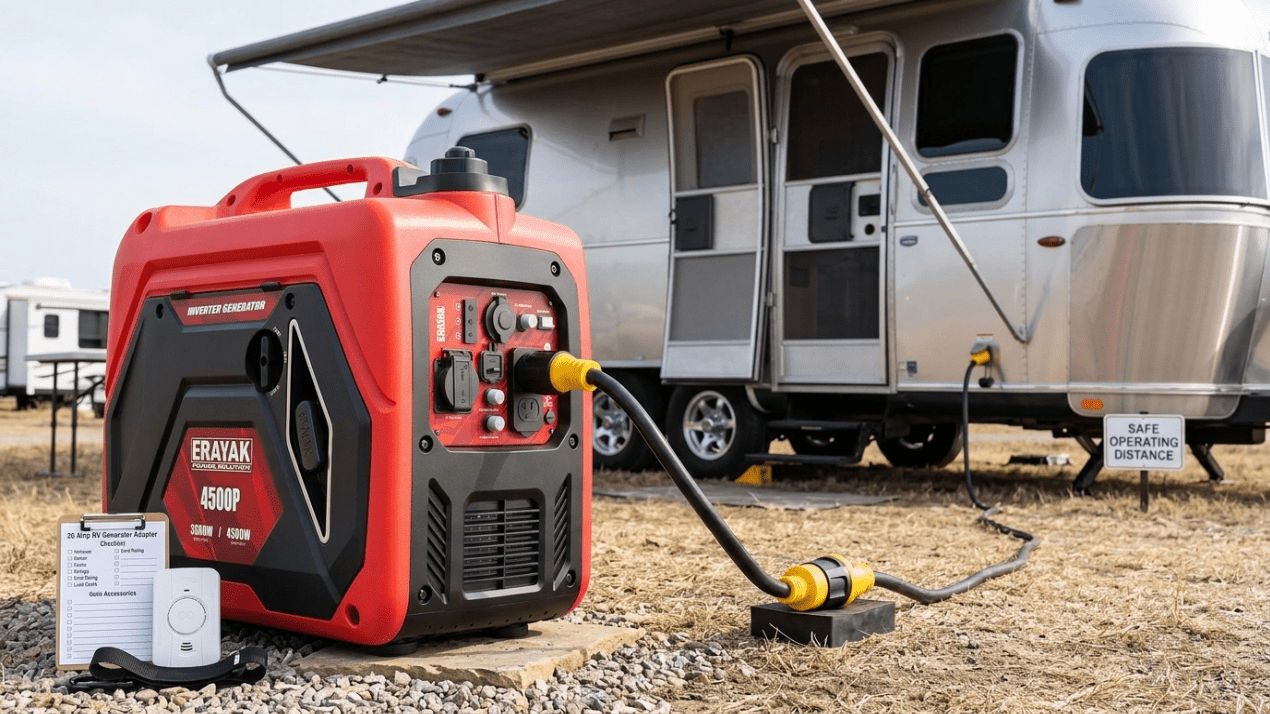
The 4500P is the gas-only 4,500W-class fit for many 30 amp RV owners managing one AC and essential loads. It is manual recoil start, 55 lb class, with a 2.25 gal tank, up to 8 hours runtime, 60.5 dB, and THD below 1.2%.
Compare the Erayak 4500PFAQ Support
 Erayak 4500PD: Dual-Fuel RV Flexibility
The 4500PD is the better fit when RV AC planning overlaps with propane flexibility, refrigerator support, storm backup, and longer trip fuel options.
Compare the Erayak 4500PD
 Erayak 2400P: Light RV Loads
Use the 2400P for charging, lights, routers, phones, fans, and small RV loads. Do not treat it as the default pick for standard rooftop AC startup.
Compare the Erayak 2400PGenerator Safety Notice
Never run a fuel generator indoors, inside an RV, in a tent, in a garage, under an awning, in a storage compartment, or near open windows, doors, or vents. Operate outdoors only with open airflow, exhaust pointed away from people, and working carbon monoxide alarms inside the RV.
Use properly rated RV cords and adapters. Do not backfeed outlets, bypass breakers, or use improvised wiring to force an AC load to run. For RV electrical changes, soft-start installation, transfer equipment, or home backup wiring, follow the manuals and use a qualified professional when needed.
FAQ: RV Generator and Air Conditioner Problems
Why won't my RV generator run my air conditioner?
The most common reasons are AC startup surge, hidden loads such as the converter charger, low battery charging draw, refrigerator or water heater load, undersized generator output, or an AC that needs a soft-start solution.
Can a converter charger stop my generator from starting the RV AC?
Yes. If the converter charger is drawing several hundred watts to charge the battery bank, it reduces the generator headroom available for the AC compressor startup.
Will a 3500 watt generator run an RV air conditioner?
Sometimes, but it depends on AC size, starting watts, altitude, temperature, fuel type, hidden loads, and whether a soft start is installed. Many RV owners have better results in the 4,000W-4,500W inverter class for one AC plus managed essentials.
Do I need to turn off the battery charger before starting the RV AC?
For troubleshooting, it can help to reduce or disable charging if your RV system allows it. Once the AC is running, you can add charging back carefully and watch for overload.
Will a soft start fix every RV AC generator problem?
No. A soft start can reduce compressor startup surge, but it will not fix undersized generator capacity, heavy background loads, unsafe wiring, bad cords, or a malfunctioning AC.
What size generator is best for a 30 amp RV with one AC?
For many 30 amp RVs with one rooftop AC, a 4,000W-4,500W inverter generator is the practical target, assuming you manage the microwave, water heater, converter charger, and other large loads.
Fix the Load Stack Before Blaming the Generator
If your RV generator cannot power the AC, first remove hidden loads, check converter charging, start the AC by itself, and then add appliances back slowly. If the generator still struggles, the next step is usually a soft-start module, a better load plan, or a correctly sized 4,000W-4,500W inverter generator for one-AC 30 amp RV use.


