By: KC
Your Generator Has Enough Watts — But Is It Damaging Your Devices?
You checked the wattage. You matched it to your load. But wattage alone does not protect your laptop, CPAP machine, or smart home hub from waveform damage. The spec most buyers overlook is Total Harmonic Distortion (THD), and it determines whether your generator delivers safe, clean electricity or a choppy signal that slowly degrades your gear.
Here is the quick breakdown: modified sine wave generators typically produce 20–30% THD. Standard pure sine wave units come in under 3%. Premium inverter generators push below 1.2%. That gap matters more than most people realize.
This article explains exactly what THD is, why the 1.2% threshold specifically matters, and which devices are most at risk. If you power a CPAP at a campsite, charge a MacBook on a jobsite, or keep a smart home running during an outage, this is the spec you need to understand before your next purchase.
What Is THD and Why Does Waveform Shape Matter?
Total Harmonic Distortion measures how much a power waveform deviates from a clean, smooth sine wave. Think of utility grid electricity: it delivers a near-perfect sine wave, and every sensitive electronic device you own is designed to expect exactly that shape. THD is expressed as a percentage. The lower the number, the closer the waveform is to what your devices were built to receive.
There are three main waveform tiers. Square wave inverters sit at the bottom, producing roughly 48% THD. Modified sine wave inverters improve on that but still deliver a stepped, blocky waveform with THD around 23.8% in measured studies. Pure sine wave inverters bring THD under 3%, and premium inverter generators achieve below 1.2% under load.
One common misconception: a surge protector will fix the problem. It will not. As covered in our own generator THD guide, surge protectors address voltage spikes only. They do nothing about waveform distortion.
The IEEE 519 standard recommends THD not exceed 8% at the point of common coupling for low-voltage systems. That is the floor for general safety. Real-world tolerances for ultrabooks, medical devices, and IoT controllers demand tighter margins. Most competitors stop at "under 3%." The sub-1.2% benchmark exists because devices like CPAP machines and modern laptops perform measurably better, and last measurably longer, when THD stays well below that 3% ceiling.
CPAP Machines: When Power Quality Becomes a Health Issue
Over 30 million Americans are estimated to have sleep apnea, according to the American Medical Association. Roughly 8 million CPAP machines are sold in the U.S. each year. That is a massive population of users who depend on clean, reliable power every single night.
Multiple CPAP manufacturers explicitly warn that modified sine wave power can damage their machines and void warranties. The heated humidifier component is the most vulnerable. It relies on precise waveform timing to regulate temperature, and the stepped waveform of a modified sine wave inverter disrupts that timing directly.
Oxygen concentrators face the same risk. For these devices, pure sine wave power is a medical necessity, not a preference. LVYUAN's 2026 electronics guide confirms that both CPAPs and oxygen concentrators cannot safely operate on modified sine wave inverters.
CPAP therapy has an 80% success rate in improving sleep and reducing health risks when used consistently. Interrupting that therapy because your generator damaged the machine or voided the warranty is a preventable problem. For RV travelers and campers who rely on CPAP at night, generator waveform quality is a health-critical decision.
The same waveform distortion that threatens CPAP machines also silently degrades the laptop sitting next to it.
Laptops and the Battery Management System Problem
Modern laptops, especially MacBooks and ultrabooks, use sophisticated Battery Management Systems (BMS) calibrated for grid-quality power. The BMS firmware expects a smooth sine wave. When it receives a distorted one, problems compound quickly.
Distorted waveforms cause laptop power adapters to run 25–30% hotter than they would on clean power. That excess heat accelerates wear on the adapter itself and on internal laptop components, shortening the lifespan of both.
Motors and adapters on modified sine wave also operate 15–20% less efficiently. That reduced efficiency translates to faster component degradation and a shorter useful life for expensive hardware.
There is also a concrete financial risk. Running a laptop on a generator with high THD can void the manufacturer's warranty. Conventional (non-inverter) generators can produce 9–25%+ THD depending on load, making them unsuitable for daily laptop use.
Premium inverter generators at sub-1.2% THD closely replicate grid power, which is exactly what laptop BMS firmware is calibrated for. If you are working remotely from an RV or a jobsite, this spec is the difference between protecting your investment and slowly degrading your power adapter.
Smart Home Devices: The Zero-Crossing Detection Risk
Smart thermostats, Zigbee and Z-Wave hubs, smart locks, and mesh Wi-Fi routers all rely on a technique called zero-crossing detection. They use the precise points where the AC waveform crosses zero volts to synchronize timing and control functions. Modified sine wave power has an extended "zero state" that throws this detection off. The result: clocks run slow, smart plugs misfire, and control boards malfunction.
The scale of this risk is growing fast. The global number of active IoT devices was estimated at 16.7 billion in 2023 and is projected to reach 29 billion by 2027. Every one of those devices is a potential casualty of dirty power during an outage.
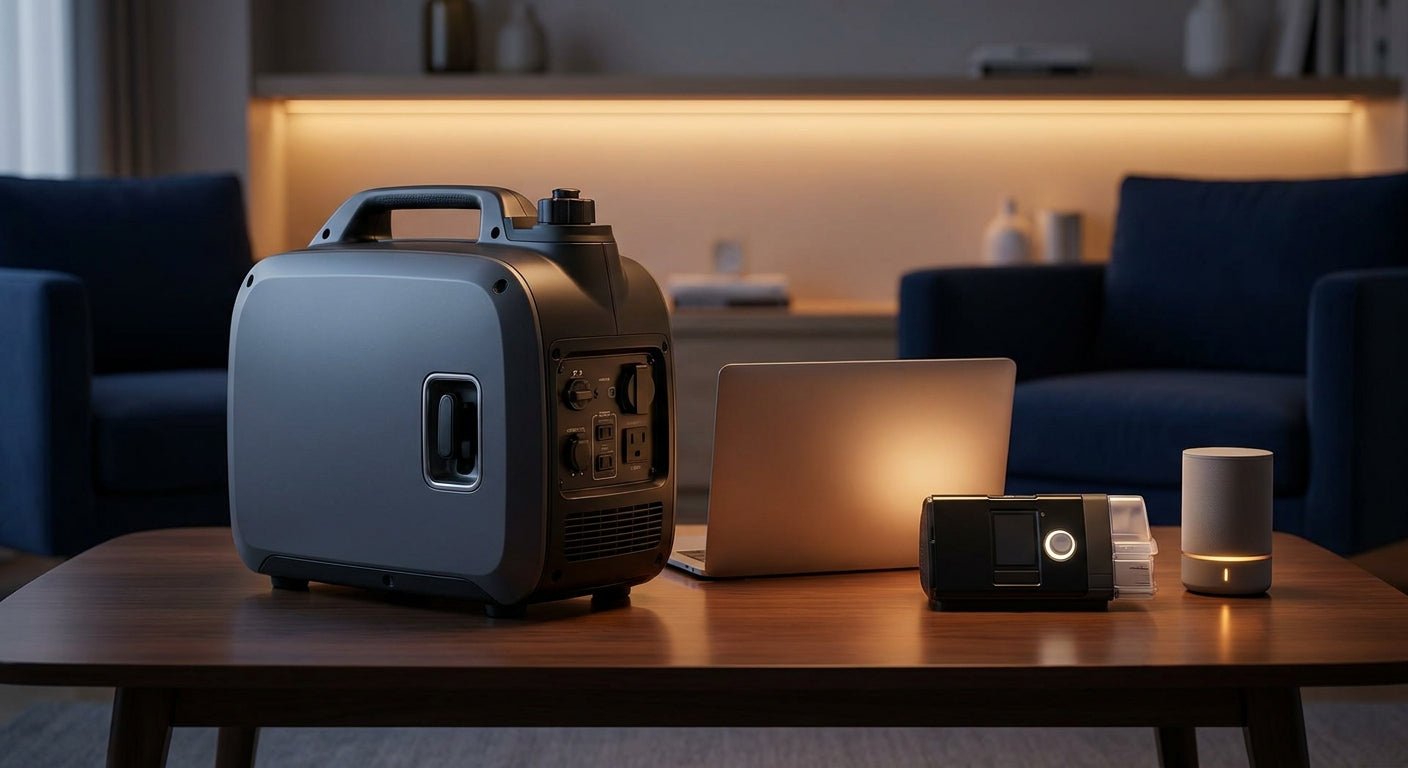
The risk compounds when you run a CPAP, laptop, and smart home hub simultaneously on one generator. Mixed loads increase THD stress. Sub-1.2% THD generators maintain waveform integrity even under demanding, mixed-load conditions. For homeowners who rely on smart home ecosystems, waveform quality determines whether the whole system survives an outage intact.
Device Compatibility Quick-Reference: Minimum THD Requirements
- CPAP with heated humidifier: Pure sine wave required. Under 3% THD minimum; sub-1.2% recommended.
- MacBook / ultrabook laptop: Sub-1.2% THD strongly recommended for BMS protection.
- Zigbee / Z-Wave smart hub: Pure sine wave required for zero-crossing reliability.
- Smart TV: Pure sine wave recommended.
- Mesh Wi-Fi router: Pure sine wave recommended.
- Oxygen concentrator: Pure sine wave required.
- Standard power tools: Modified sine wave tolerable.
This checklist reflects manufacturer guidance and industry testing data. It is especially relevant for RV travelers running multiple devices simultaneously from a single generator.
The Hidden Cost of Cheap Power: ROI for Pure Sine Wave
The pure vs. modified sine wave decision is a total cost of ownership question, not just an upfront price comparison. A modified sine wave generator may cost less at checkout, but the downstream costs add up: shortened device lifespans, voided warranties on laptops and CPAP machines, and the potential for medical device failure.
Motors on modified sine wave consume approximately 20% more power than on pure sine wave. That is a measurable efficiency loss on every tank of fuel. Pure sine wave inverters operate at 90–95% efficiency, compared to 70–80% for modified sine wave units, meaning more fuel is wasted per watt delivered every time you run the generator.
When you factor in device protection, warranty preservation, and fuel savings over the life of the generator, the upfront premium for a sub-1.2% THD pure sine wave inverter generator pays for itself. At Erayak, our pure sine wave output with THD below 1.2% is a deliberate engineering choice. It is a verified benchmark, not a marketing label, designed for exactly these use cases.
Choosing the Right Generator: What to Look for Beyond Wattage
When shopping for a generator, confirm the actual THD spec. Look for sub-1.2%, not just the generic "pure sine wave" label. Verify that the unit uses true inverter technology. For extended outages, check fuel flexibility: gasoline, dual-fuel, or tri-fuel options give you more runtime versatility.
Wattage is necessary but not sufficient. A high-wattage generator with poor THD can still damage every sensitive device connected to it. Quiet operation is another benefit of inverter generators, with some models running as low as 52 dB, making them practical for RV parks, campsites, and residential neighborhoods.
For anyone powering medical devices like CPAPs, U.S.-based technical support and warranty guidance provide real peace of mind. You want a team that understands the equipment and can help you get it right.
You now have the spec knowledge to make an informed decision. THD below 1.2% is the benchmark that separates safe power from risky power. Your devices, your warranties, and in some cases your health depend on it.
Sources
- SolarTech Online — Modified Vs Pure Sine Wave Inverter Guide
- Erayak Power — What Is THD in Generators?
- Electrical Trader — Harmonic Distortion Limits by Voltage Level (IEEE 519)
- CPAP.com — Sleep Apnea Statistics
- Sleep Advisor — Sleep Apnea Statistics for 2026
- PowerInverter.com — Power Inverter for CPAP Machine
- LVYUAN — Can Modified Sine Wave Inverter Damage Electronics? (2026)
- EasyLonger — Sleep Apnea Key Facts and Statistics
- WattBuild — Pure vs Modified Sine Wave Inverters
- GeneratorBible — What Is THD?
- arXiv — IoT-Enabled Smart Grid Systems
- PowerStationInfo — Pure Sine Wave vs Modified Sine Wave Inverters

